A Contract Signed Before a Turkish Company Is Registered: Who Must Pay?
Short answer: A Turkish joint-stock or limited company obtains legal personality through registration in the trade registry. People who act or undertake commitments in its name before registration are personally liable on a joint and several basis under Turkish Commercial Code Articles 355 and 588. The company alone becomes liable through the statutory adoption route when the future-company capacity was expressly disclosed and the company accepts the commitments within three months after registration. Registration by itself does not establish that every earlier contract was adopted.
Have a general question about this article? Ask anonymously
Quick summary
| Legal issue | A Contract Signed Before a Turkish Company Is Registered: Who Must Pay? |
|---|---|
| Short answer | A Turkish joint-stock or limited company obtains legal personality through registration in the trade registry. People who act or undertake commitments in its name before registration are personally liable on a joint and several basis under Turkish Commercial Code Articles 355 and 588. The company alone becomes liable through the statutory adoption route when the future-company capacity was expressly disclosed and the company accepts the commitments within three months after registration. Registration by itself does not establish that every earlier contract was adopted. |
| Key legislation | Turkish Commercial Code No. 6102; Turkish Code of Obligations No. 6098 |
Find the actual registration date
The legal starting point is registration, not the first commercial announcement. Turkish Commercial Code Article 355(1) gives a joint-stock company legal personality when it is registered in the trade registry. Article 588(1) states the same rule for a limited company. The relevant registry record should be obtained before deciding whether the contracting entity already existed when the commitment was made.
Articles 335 and 585 describe formation through the founders’ declarations in the required articles and expressly preserve the respective registration provisions. Signing the formation documents is therefore not interchangeable with acquiring legal personality. A reserved trade name, draft articles, tax identification step or pending registry application does not prove that the registration event had occurred. The file must identify the completed legal event and its date.
Compare the contract date with that verified date. Where the agreement was negotiated earlier but signed later, preserve both stages instead of assigning the entire relationship to the first email. A preliminary commitment and the final contract may require separate analysis. The rule applies to the actual act or undertaking, so the chronology must identify when the disputed obligation was established.
Identify who undertook the commitment
The pre-registration liability provisions focus on those who acted or undertook commitments in the company’s name. Identify the signer, the capacity asserted and any other participant who actually made the relevant undertaking. A future shareholder’s name on an investment plan does not, by itself, establish that the shareholder entered every pre-registration transaction. The evidence must connect the person to the particular legal act.
The contract should be read with order confirmations, instructions, correspondence and any authority documents. Distinguish a person signing for an existing foreign parent from someone purporting to sign for a future Turkish subsidiary. Those are different capacities and can point to different obligors. A shared brand or email domain cannot resolve the distinction without the actual contractual record.
Liability among the persons within these statutory provisions is joint and several; it is not merely a duty to use reasonable efforts to register the company. The claimant must still establish the underlying commitment, amount and applicable conditions of performance. Identifying a potentially liable actor does not prove that every amount in the claimant’s invoice is contractually due.
The joint-stock company rule
For an anonim şirket, Article 355(2) states that people who act and undertake commitments in the company’s name before registration are personally liable on a joint and several basis. The same paragraph contains the statutory route by which only the company becomes liable. The act or commitment must have been expressly identified as being undertaken for the company to be formed, and the registered company must accept it within the specified three-month period.
Both conditions require examination. A later registration certificate proves the creation of the company, but it does not prove the earlier disclosure or subsequent acceptance. The company name in the heading should be considered together with wording explaining its future status and the signing capacity. The adoption evidence then needs to be connected to the commitment that was actually made.
The company’s subsequent existence should not lead the supplier or founder to discard the earlier contract. Those original documents establish who initially undertook the obligation and whether Article 355’s exception is available. The later acceptance record should supplement that history rather than replace it with a newly dated version pretending the company existed before registration.
The limited-company rule
For a limited şirket, Article 588(3) establishes personal, joint and several liability for those acting in the company’s name before registration. Paragraph 4 contains the corresponding adoption conditions: express disclosure that the commitments were made for the future company and company acceptance within three months following registration. The relevant paragraphs differ in numbering from the joint-stock provision, but the distinction between initial actor liability and statutory adoption remains essential.
The company’s limited-liability form therefore does not itself protect someone who personally entered a pre-registration commitment within Article 588. The corporate liability rules for an existing company cannot simply be applied backwards. Equally, an overseas investor should not be told that every person planning to hold a share is automatically liable for all earlier dealings. The rule requires identification of the persons who acted in the company’s name.
Record the chosen company form accurately. A draft transaction referring to an intended limited company, followed by registration of a differently structured entity, requires particular attention to the identity of the party and the adoption record. The analysis must establish which commitment was made for which proposed company rather than infer identity solely from similar trading names.
Express disclosure of the future company
The express-disclosure condition makes the original contracting record important to both sides. The counterparty must have been clearly informed that the transaction or undertaking was made in the name of a company to be formed. An internal founder discussion is not evidence of what the counterparty was told. Preserve the agreement and communications containing that disclosure, including any annex explaining the proposed entity and signing capacity.
A commercial name printed on an unsigned draft does not answer the question alone. The review should identify the operative agreement and the disclosed legal status at that time. A later assertion that everyone understood incorporation was pending must be assessed against the actual evidence. The statutory wording requires express disclosure; it should not be reduced to an assumption drawn only from the parties’ commercial expectations.
The disclosure also helps delimit the commitment. Identify the goods or services, payment obligation, deposits, continuing duties and any conditions linked to registration. A clause delaying performance until registration is a contractual term whose effect must be examined. It is not automatically the same as an effective statutory adoption after registration or a release of the persons who originally acted.
Acceptance within three months
The adoption period runs from trade-registry registration. It does not run from the earlier signature, the first invoice, commencement of trading or receipt of a tax notice. The operative registration date and the company’s acceptance date must be established precisely. The statute gives a three-month period, not an open-ended opportunity to treat all pre-registration expenditure as automatically belonging to the new company.
Acceptance must be attributable to the company through its legally competent decision-making and representation arrangements. Identify the relevant decision, authorised signatories and communication. A founder’s personal promise after registration is not necessarily a company act merely because that person is now a shareholder. The company records should show what was accepted and when, with the representation position checked against the actual corporate structure.
The provisions do not prescribe one universal acceptance document for every transaction. A recorded corporate decision and clear communication can provide strong evidence, while the effect of other conduct requires examination under the applicable rules and facts. A ledger entry or isolated payment should not automatically be treated as proof that every obligation in a broader agreement was accepted within the statutory period.
What exactly did the company accept?
The acceptance record should identify the original agreement, date, counterparty and commitments. A business relationship can contain several orders, variations and payment arrangements. Evidence that the company accepted one identified commitment does not remove the need to examine the others. Prepare an adoption schedule that connects each earlier obligation to the corresponding company act, rather than relying on a general statement that all startup matters were transferred.
Where the statutory conditions are satisfied, Articles 355 and 588 state that only the company is liable for the accepted commitments under that route. This consequence must be tied to the particular obligations and relevant persons. Separate guarantees, misconduct claims or independent contractual undertakings require their own assessment; an adoption entry should not be described as a universal release of every person from every related legal relationship.
Changes made after registration also need accurate characterisation. A new order concluded by the registered company is not necessarily adoption of an older order. A revised payment schedule can address an existing debt without explaining who originally owed it. The documentation should state the intended legal operation so that the counterparty’s records, company accounts and founders’ account do not describe three different transactions.
Formation expenses have a separate rule
Article 355(3) for joint-stock companies and Article 588(2) for limited companies address formation expenses. If the company does not accept them, the founders bear those expenses and have no recourse against shareholders under the stated rule. This is separate from simply identifying whoever signed an ordinary commercial contract before registration. The character of the expense and the basis of company acceptance must be established.
Keep a formation-expense account with invoices, payment evidence, the person who incurred or paid each cost and any acceptance decision. Do not classify every early operational purchase as a formation expense merely because it occurred near incorporation. The statutory category requires examination of what the expenditure concerned. Likewise, a founder’s reimbursement request should not be merged without explanation into the supplier’s original claim.
The distinction matters when the founders and eventual shareholders are not identical. The expense rule specifically addresses recourse against shareholders. A later change in ownership does not justify issuing an unexplained equal-share invoice to all current holders. The relevant corporate and contractual records must establish the obligation actually relied upon.
When the adoption conditions are missing
Failure to establish timely statutory adoption does not allow the parties to rewrite the registration chronology. The initial liability must be examined under Articles 355 or 588. A later arrangement involving the company may require a separate legal mechanism, with its own conditions. It should not be labelled timely statutory adoption simply because the parties prefer the company to appear as sole debtor.
Code of Obligations Articles 195 and 196 distinguish an internal promise to release a debtor from the external assumption of debt through an agreement with the creditor. The site’s debt-assumption guide explains that different route. An agreement between founder and company alone should not automatically be described as releasing the original obligor toward the supplier.
Any later settlement should identify the remaining debtor, the company’s undertaking, the creditor’s agreement and the scope of release. Performance already made and security already given must also be reconciled. A document addressing future payment should not conceal whether the creditor has actually agreed to substitute its debtor or merely accepted an additional source of payment.
Foreign investors and parent companies
Foreign ownership does not alter the registration trigger in these Turkish company-law provisions. The site’s guide to full foreign ownership of a Turkish company addresses the separate investment framework. Ownership, authority to sign and liability for a pre-registration transaction remain distinct questions. The review should identify the actual foreign individual or legal entity involved, not refer only to headquarters.
Where a foreign parent participated, preserve its authority documents and the capacity in which its representative acted. The law governing the underlying contract and any foreign representation issue may also require analysis. A Turkish incorporation plan does not, by itself, make the parent the contracting party, and the later subsidiary’s existence does not automatically erase a commitment the parent actually undertook.
Build the contract and payment chronology
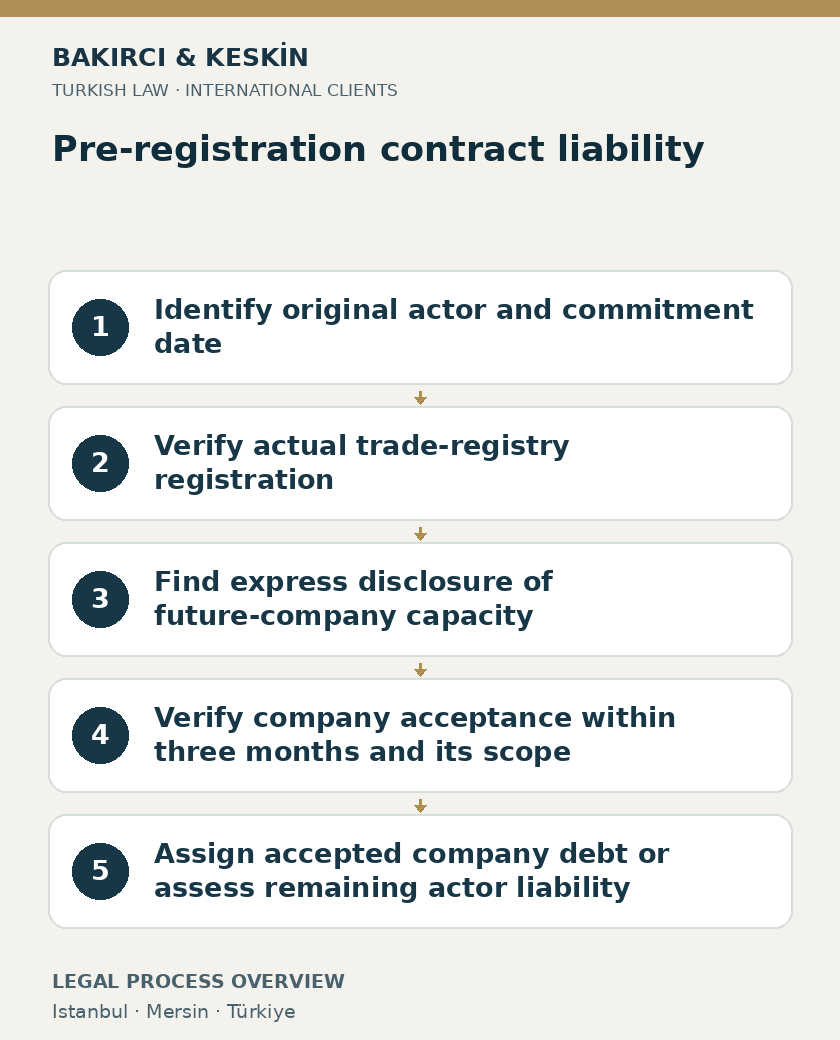
A useful chronology places the original commitment, express disclosure, trade-registry registration, company acceptance and actual performance in order. Attach the source for each date. Separate signature dates from delivery, receipt and payment dates. The adoption analysis should be reproducible from those documents rather than depend on a retrospective summary written by an interested participant.
The account should show deposits, later transfers, goods or services received and the outstanding balance. Identify who made each payment and for which obligation. A payment by a founder or group treasury entity may concern another person’s debt; its legal effect must be established from the instruction and underlying arrangement. The payer’s name alone should not be used to rewrite the entire debtor history.
Complete the post-registration handover
After registration, the responsible company officers should review the existing commitment list while the statutory adoption period is still relevant. The review should identify accepted commitments, disputed items and expenses requiring a separate decision. Record the actual decisions and communicate them accurately to counterparties. A complete handover aligns the company’s legal, operational and accounting records.
For a supplier pursuing payment, the immediate task is to establish the original obligor and any valid subsequent change. For founders, it is to document disclosure and company acceptance accurately. Both sides benefit from preserving the original transaction rather than relying on the appearance of the new corporate name on later invoices.
Frequently asked questions
1. When does a Turkish limited or joint-stock company obtain legal personality?
Upon registration in the trade registry under Articles 588(1) and 355(1), respectively. Signing formation documents is not the same legal event.
2. Who is liable for a contract signed in the company’s name before registration?
The provisions impose personal, joint and several liability on the persons who acted or undertook the relevant commitment, subject to the statutory adoption exception.
3. Are all future shareholders automatically liable?
No such conclusion follows merely from future share ownership. Identify who actually acted in the company’s name and examine the separate formation-expense rule where relevant.
4. Does registration automatically transfer every earlier contract?
No. The statutory route requires express disclosure of the future-company capacity and acceptance by the company within three months following registration.
5. When does the three-month period start?
It starts with the company’s trade-registry registration, not the original signature, first invoice or commencement of trading.
6. Is a founder’s later promise always company acceptance?
No. Acceptance must be attributable to the company under its competent corporate and representation arrangements. Share ownership alone does not establish that authority.
7. What is the effect of valid statutory adoption?
Articles 355 and 588 state that only the company is liable for the accepted commitments when the specified conditions are met. Other independent obligations require separate assessment.
8. Who bears formation expenses the company does not accept?
Articles 355(3) and 588(2) place them on the founders and exclude their recourse against shareholders under that rule. The expenditure must first be correctly classified.
9. Can a later debt assumption still require creditor agreement?
Yes. The separate external debt-assumption route under Article 196 involves an agreement with the creditor. An internal founder-company arrangement is not automatically equivalent to it.
10. Which documents should an overseas investor provide?
Provide the original contract, future-company disclosure, registry certificate, authority documents, company acceptance record, formation-expense account and payment chronology.
Official legal sources
- Turkish Commercial Code No. 6102 — Articles 335, 355(1)–(3), 585, 588(1)–(4), 629
- Turkish Code of Obligations No. 6098 — Articles 195, 196
Legal sources reviewed on 28 October 2026. The official Turkish legislation controls; individual facts and later amendments must be checked before action.
Contact information
Do not include confidential documents or identity numbers in an initial message. An enquiry does not establish representation or suspend any legal deadline.
Istanbul and Mersin contact details
Bakırcı & Keskin Law Office is Mersin-based. Turkish matters are handled under the applicable jurisdiction and agreed mandate. The competent court and the scope of representation are assessed for each matter.
Istanbul — Polaris Plaza
Maslak Ahi Evran Caddesi, Polaris Plaza No:21, Floor 9, 34475 Sarıyer/İstanbul, Türkiye.Mersin — Profit İş Merkezi
İhsaniye Mahallesi, 4903. Sokak, Profit İş Merkezi No:23, Floor 3, Office 14, 33070 Akdeniz/Mersin, Türkiye.+90 552 224 43 66 · Contact details in English. An enquiry does not establish representation or suspend a legal deadline.
Istanbul Office – Polaris Plaza, Maslak / Sarıyer
Bakırcı & Keskin Hukuk Bürosu
Maslak Ahi Evran Caddesi, Polaris Plaza No:21, Kat:9, 34475 Sarıyer/İstanbul
Our physical offices in Istanbul and Mersin coordinate matters throughout Turkey, subject to jurisdiction and the local steps required for each case. Please specify your preferred office when arranging an in-person appointment.
Open the Istanbul office on Google Maps · Contact and appointments
Contact regarding a legal matter
In your first message, you may briefly state the subject, your country or city, and any relevant notification or recent procedural date. Please do not send identity numbers, medical data, or personal documents. Messaging alone does not constitute legal advice or create a lawyer–client relationship.
Discover more from Bakırcı & Keskin Hukuk Bürosu
Subscribe to get the latest posts sent to your email.