Taking Over a Debt in Turkey: Creditor Consent, Release and TCO Articles 195–201
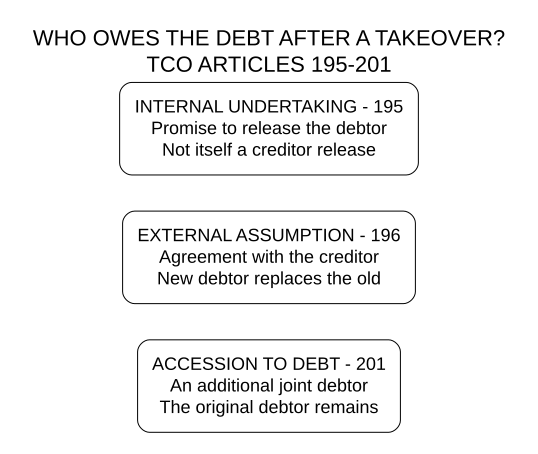
A promise to take over somebody’s Turkish debt does not, by itself, release the original debtor from the creditor’s claim. Article 195 of the Turkish Code of Obligations regulates the internal undertaking between the existing debtor and the person promising to relieve it. Article 196 requires an agreement with the creditor for an external substitution that releases the former debtor. Article 201 describes a different arrangement: an additional person joins the debt and becomes jointly and severally liable alongside the original debtor. Identifying which arrangement was actually made is essential before declaring a borrower, seller or group company free of the obligation.
Have a general question about this article? Ask anonymously
Start with the creditor, the existing debtor and the proposed new obligor
Write down the legal identity of each person and the obligation involved. A debt assumption changes the debtor side of a relationship. An assignment of a receivable changes the creditor. Transferring a whole contract is another transaction with its own requirements. An agreement called a transfer should be classified by its operative terms rather than its commercial heading.
Identify the agreement, invoice, facility or judgment giving rise to the debt, the amount outstanding, its currency, maturity and any security. A purchaser’s promise to handle all obligations connected with a transaction needs a sufficiently identifiable scope. The source of a debt and a schedule of amounts are both important: an amount alone does not establish which legal obligation is being assumed.
Our assignment-of-receivables guide addresses the creditor-side transfer. This article deals primarily with Law No. 6098, Articles 195–201. Business transfers, inheritance partition, mortgaged property and transfers of contractual positions can engage special provisions and should not be reduced to a generic debt-takeover clause.
Article 195: the internal undertaking is a promise to relieve the debtor
A person entering an internal assumption agreement with the debtor undertakes to release that debtor by paying the obligation itself or by assuming the debt with the creditor’s consent. The creditor is not automatically a party to the internal contract. The legal duty created between the two contracting persons must therefore be distinguished from the creditor’s continuing claim against its existing debtor.
Read how relief is to occur. A promise to pay the creditor by a stated date, a promise to obtain a substitution and an indemnity against a later demand do not use identical mechanisms. The document should identify the promised result and any condition or reciprocal performance. Do not assume that using the word indemnity means the creditor already accepted a new debtor.
Article 195 also states that the original debtor cannot demand performance from the assuming party before performing its own obligations under the internal agreement. The record should therefore show whether the original debtor delivered the agreed consideration, documents or other required performance. A breach claim under the internal contract cannot ignore a reciprocal obligation that the same provision makes material.
If the debtor has not been released, it can demand security from the other party under Article 195. That is a distinct protection against continued exposure. It does not mean the creditor must stop pursuing the original obligation. Keep the internal security request separate from any defence to the creditor’s claim.
Article 196: substitution requires agreement with the creditor
Replacing the debtor and releasing the original debtor occurs through an agreement between the person assuming the debt and the creditor. Article 196 places the creditor at the centre of that external assumption. A private purchase agreement between two other persons cannot be presented as the creditor’s agreement merely because the creditor later received a copy.
Notification of the internal assumption agreement by the assuming person, or by the debtor with that person’s permission, amounts to an offer to conclude the external assumption agreement. Notification and acceptance are different steps. Preserve who made the communication, the permission relied on and the terms submitted. A notice saying a business has been sold does not necessarily contain an offer to replace a debtor on every contract.
The creditor can accept expressly or by implication. Under Article 196, acceptance is deemed to occur where the creditor accepts the assuming person’s performance without reservation or consents to another act performed by that person in the capacity of debtor. The underlying assumption context and capacity are important. The mere existence of money sent by a third party should not be isolated from those statutory facts.
Written confirmation of the agreed substitution provides a clearer record of the debt, effective date, release and continuing terms. The confirmation should identify any reservation rather than leave the original debtor to infer its discharge from a changed account name. Although proof and form are distinct questions, a vague administrative update is poor evidence of the precise release claimed.
Article 197 regulates the offer and the consequence of silence
The creditor can accept an offer to assume the debt at any time under Article 197, but the assuming person or former debtor can set a period for acceptance. If the creditor remains silent until that period ends, the offer is treated as rejected. The statute does not turn silence at the end of the stated period into consent.
Record the offer’s complete terms, the acceptance period and proof of delivery. A response accepting a different amount or adding continuing liability for the former debtor needs its own contractual analysis. It should not silently be recorded as unconditional acceptance of the original proposal. The release actually agreed can differ from the commercial result first requested.
The article also addresses a second internal assumption agreement and a new offer made to the creditor before the first offer is accepted. In that situation, the first offeror ceases to be bound by its offer. Keep the successive documents and timing together. A closing file containing several proposed replacements cannot be understood from only the latest signature page.
Article 198 protects accessory rights but requires written consent from sureties and third-party pledgors
Article 198 preserves the creditor’s accessory rights despite a change of debtor, except rights personal to the former debtor. It then provides a specific protection for a third person who supplied a pledge and for a surety: their responsibility continues only if they give written consent to the assumption of the debt. Their consent is separate from the creditor’s acceptance of the new debtor.
This distinction is central to a secured restructuring. List each personal security and third-party pledge, identify its provider and obtain the relevant written consent before describing it as continuing against the new debtor. A creditor’s signature on the substitution agreement is not the surety’s consent. Nor does a debtor’s group relationship with the surety establish the required written declaration.
The scope of any consent must be matched to the actual transaction. Identify the debt, new debtor and intended continuing security. A generic acknowledgment that documents were received is not necessarily consent to continuing responsibility. Where a new personal undertaking or increased exposure is created, its own form and capacity rules also require examination.
Our suretyship form and spousal-consent guide addresses those additional requirements. Article 198 should not be described as dispensing with every other mandatory safeguard. The security provider’s written consent to debtor substitution and validity of the underlying security are different questions.
Article 199 separates debt-related defences from personal and internal defences
The new debtor acquires the right to assert defences relating to the assumed debt. The creditor does not obtain an uncontestable claim merely because another person took it over. Preserve the original agreement, performance history, payments and correspondence establishing any objection to the existence, amount or enforceability of the particular obligation.
Unless the external assumption agreement indicates otherwise, the new debtor cannot assert the former debtor’s personal defences against the creditor. That rule requires classification of the defence instead of treating every objection belonging to the former debtor as automatically transferable. Read any provision in the external agreement expressly preserving an additional defence.
The new debtor also cannot raise defences arising from the internal assumption contract against the creditor. A dispute over consideration between old and new debtors is therefore not automatically an answer to the external payment claim. Those internal remedies must be pursued on their own legal basis. Keep the two agreements and their separate performance records distinct.
A useful defence schedule identifies the objection, the contract or event from which it arises and the party against whom it is available. This prevents an internal purchase-price complaint from being confused with an objection inherent in the assumed debt. It also reveals when the external agreement itself changes the position allowed by Article 199.
Article 200: invalidity of the external assumption can restore the old position
If the external assumption agreement becomes invalid, Article 200 states that the original debt continues with its accessory obligations, preserving the rights of third persons in good faith. A failed substitution is not a basis for declaring that nobody owes the debt. The status of the original obligation and protected third-party rights must be examined together.
The creditor can also seek compensation from the assuming person for loss of previously available security or other damage unless that person proves absence of fault both in the invalidity and in the creditor’s loss. This creates a separate damage enquiry. The existence of an invalid document does not by itself establish every amount claimed as compensation.
Preserve the legal basis for invalidity, the security that was released or lost, the creditor’s actions and the resulting financial effect. Do not assume that a registry can simply be rewritten without considering intervening rights. The statute’s protection of third persons in good faith makes the chronology particularly important.
Article 201 adds a debtor instead of replacing the old one
Accession to a debt is an agreement between the joining person and the creditor under which that person becomes responsible alongside the existing debtor. Article 201 makes the joining person and original debtor jointly and severally liable to the creditor. The former debtor is not released merely because the creditor has gained another person to pursue.
Read whether the instrument says replacement, release, joint responsibility or an additional undertaking. Those words must be interpreted in the context of the complete agreement. A lender can seek additional support without agreeing to a debtor substitution. The original debtor needs evidence of actual release rather than evidence that somebody else also signed.
Accession must also be distinguished from suretyship and other personal-security arrangements. The substance of the obligation matters, particularly where an individual supplies security under a different label. Article 603 extends specified suretyship safeguards to other individual personal-security contracts. Renaming the paper debt accession does not remove the need for the correct legal classification.
Business and property transfers can engage special rules
Article 202 separately addresses taking over assets or a business with its assets and liabilities. It regulates notification or announcement, responsibility to creditors and a two-year period of joint liability for the former debtor. For already due debts the period runs from notification or announcement; for debts due later it runs from maturity. It does not begin while the transferee has failed to perform the notification or announcement duty described in the article.
That provision should not be mechanically applied to every share purchase. Buying shares, acquiring business assets and replacing a debtor are different legal events. Corporate, registry and transaction-specific provisions must be checked. A clause allocating liabilities between buyer and seller does not necessarily reproduce their position toward creditors under the applicable statute.
Article 204 expressly preserves special provisions for assumption connected with inheritance partition and transfer of pledged immovable property. Article 205 separately addresses transfer of the entire contractual position. Identify the actual transaction before deciding which rule releases which person. This article does not replace the specialised statutory review required for those transfers.
Confirm release through a complete closing and response record
The closing file should contain the debt schedule, internal agreement, external offer and acceptance, evidence of authority, consent from affected security providers and an account of payments. State separately the original debtor’s release, the new debtor’s obligation and the security that continues. A release should not be inferred solely from deletion of a name in an accounting system.
Where a demand is served after the transfer, preserve its service record and compare the claimed debt with the transaction schedule. An internal indemnity can support a separate claim without being a complete defence to the creditor. Our Turkish enforcement guide explains why the actual procedure and response deadline must be identified. Negotiations about a replacement debtor do not automatically suspend a pending proceeding.
Frequently asked questions
Does somebody’s promise to pay my debt release me?
Not by itself. Article 195 creates an internal obligation to relieve the debtor. External replacement and release require the creditor agreement described in Article 196, unless a different applicable statutory route governs the transaction.
Can the creditor accept a replacement debtor by conduct?
Article 196 recognises express and implied acceptance. It specifies acceptance of the assuming person’s performance without reservation or consent to another act performed in the capacity of debtor. Establish the assumption context and conduct rather than relying on an unexplained transfer.
Does the creditor’s silence mean acceptance?
Under Article 197, where an acceptance period has been set and the creditor remains silent until it ends, the offer is treated as rejected. Silence is not converted by that rule into consent.
What can the old debtor demand if the internal promise is not fulfilled?
Article 195 permits a demand for security if the debtor has not been released. It also makes performance of the debtor’s own internal obligations relevant to demanding performance from the assuming party.
Does a surety remain bound when the borrower changes?
Article 198 requires the surety’s written consent for its responsibility to continue following debt assumption. The creditor’s acceptance is not that consent. Other applicable validity requirements must also be examined.
Can the new debtor assert objections to the original debt?
Article 199 transfers debt-related defences. Personal defences of the former debtor require the separate rule stated there, and internal-assumption defences cannot be used against the creditor.
What happens if the external assumption is invalid?
Article 200 preserves the original debt and accessory obligations, subject to rights of third persons in good faith. It also regulates compensation against the assuming person unless the statutory absence of fault is proved.
Is accession to a debt the same as substitution?
No. Article 201 adds a jointly and severally liable person alongside the existing debtor. It does not release the original debtor merely because another person joins.
Does selling shares automatically transfer the company’s debts to the buyer personally?
A share purchase, a business transfer and personal debt assumption are different transactions. Identify the statutory route and signed undertakings. A change of ownership alone does not establish a personal replacement obligation.
Which documents should an overseas party prepare?
Prepare the debt schedule, internal agreement, creditor acceptance, authority documents, security consents and payment history. Identify any served deadline and agree a confidential channel before transmitting financial or identity records.
Official legal sources
Turkish Code of Obligations No. 6098, Articles 195–205 and 603; official Ministry text of the debt-assumption provisions. This is an English explanation rather than an official translation. The Turkish text and applicable special legislation govern.
Istanbul and Mersin offices
For an English-language debt-assumption review, identify whether you are the creditor, existing debtor, proposed replacement or security provider. State the transaction date and any response deadline through the English contact section, then agree a confidential channel for the documents. Our Mersin-based practice has offices in Mersin and Istanbul and coordinates matters throughout Türkiye.
Istanbul — Polaris Plaza
Maslak Ahi Evran Caddesi, Polaris Plaza No:21, Floor 9, 34475 Sarıyer/İstanbul. Istanbul office information.
Mersin — Profit İş Merkezi
İhsaniye Mahallesi, 4903. Sokak, Profit İş Merkezi No:23, Floor 3, Office 14, 33070 Akdeniz/Mersin.
Call +90 552 224 43 66. General legal information; an enquiry does not establish representation or suspend a deadline.
Contact regarding a legal matter
In your first message, you may briefly state the subject, your country or city, and any relevant notification or recent procedural date. Please do not send identity numbers, medical data, or personal documents. Messaging alone does not constitute legal advice or create a lawyer–client relationship.
Discover more from Bakırcı & Keskin Hukuk Bürosu
Subscribe to get the latest posts sent to your email.