A New Turkish Company Buys or Leases Major Assets: TCC Article 356, Valuation and Shareholder Approval
A newly registered Turkish joint-stock company cannot treat every large asset purchase or lease as an ordinary board-approved contract. Article 356 of Turkish Commercial Code No. 6102 imposes a special process on qualifying acquisitions and leases during the first two years after registration. Where its conditions are met, shareholder approval and trade-register registration are requirements for validity, and premature performance, including payments, is expressly affected.
Have a general question about this article? Ask anonymously
Foreign investors encounter this question when a new Turkish A.Ş. purchases an operating business, takes over equipment or enters a substantial asset lease. The relevant legal question is not simply whether the directors can sign. It is whether the particular contract falls within Article 356, whether a statutory exception applies and whether the required valuation, approval and registration have occurred before the company performs it.
Short and clear answer
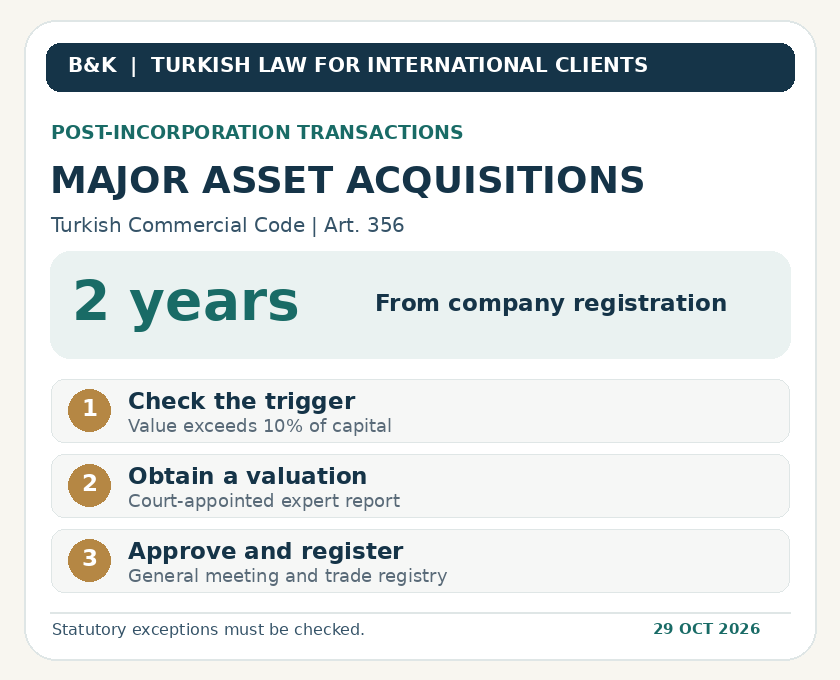
Article 356(1) covers contracts made within two years after the company’s registration for acquiring or leasing an enterprise or asset for consideration exceeding one tenth of its capital. Such contracts are not valid until approved by the general meeting and registered in the trade registry. The provision also declares invalid dispositions made to perform them before approval and registration, expressly including payments.
Before the shareholders decide, a court-appointed expert values the relevant enterprise or asset on the board’s application. Article 356 refers to Article 421(3) and (4) for the meeting and decision thresholds. The contract and approval resolution are registered and announced together. Article 356(5) excludes enterprises and assets constituting the company’s business activity and those acquired through compulsory enforcement; the scope of those exceptions must be assessed, not assumed.
| Question | Article 356 rule |
|---|---|
| Relevant period | First two years after company registration |
| Consideration threshold | More than one tenth of capital |
| Covered arrangements | Qualifying acquisition or lease of an enterprise or asset |
| Valuation | Court-appointed expert before the general-meeting decision |
| Approval threshold | Article 421(3)–(4): at least 75% of capital; no automatic reduction at later meetings |
| Validity and publicity | Approval and registration; contract and resolution also announced |
Confirm the company form and registration date
Article 356 sits within the joint-stock company provisions. A review should first establish that the buyer or lessee is the relevant A.Ş., rather than an overseas parent, a Turkish limited company or a branch described loosely as a company. The same commercial group can contain all of those structures. A contract addressed to the wrong entity can make both the statutory analysis and the proposed approval documents unreliable.
The two-year period begins with the company’s registration. It is not measured from the first sale, the first invoice, the opening of a bank account or the date the business becomes profitable. Obtain the actual registration record and connect it to the contractual chronology. A commercial launch date used in a management presentation should not replace the legal registration date in the Article 356 assessment.
Identify the acquisition or lease that is being assessed
The provision expressly addresses both acquisition and leasing. Reviewing only outright purchase agreements leaves a material gap. Identify the enterprise or asset, the legal nature of the arrangement and the entire relevant contractual package. A lease, purchase option, side agreement and payment undertaking may describe different obligations; the analysis should establish what the company has actually committed to rather than rely on a short procurement description.
The statute does not limit its wording to contracts with founders. A transaction should not be dismissed from review merely because the seller or lessor is an independent foreign supplier. Equally, the existence of a parent-company counterparty is not the sole legal trigger. Timing, subject matter, consideration, capital and the statutory exceptions must be examined for the actual contract.
More than ten percent: use the right comparison
Article 356 refers to consideration exceeding one tenth of capital. That is different from saying at least ten percent. It also is not a comparison with annual turnover, the purchase budget, enterprise valuation or cash currently held in the company’s bank account. Preserve the capital information relevant to the transaction and the contractual consideration used for the comparison, together with the reasons for any calculation choices.
Complex pricing should not be reduced to an unexplained headline number. Instalments, variable consideration, related undertakings and foreign-currency amounts require a documented assessment of the particular bargain. For a lease, do not assume that one month’s payment necessarily represents the consideration for the whole arrangement. This guide does not invent a universal exchange-rate or lease-capitalisation formula; those questions must be resolved from the applicable rules and the actual terms.
Dividing a commercial arrangement into several documents does not answer whether the statutory rule applies. The transaction review should examine how the documents relate to one another, the assets concerned and the obligations undertaken. A procurement team should not be instructed to split an invoice simply to produce a lower apparent comparison. The legal assessment needs the substance and full documentation of the proposed transaction.
The business-activity and compulsory-enforcement exceptions
Article 356(5) excludes the enterprises and assets constituting the company’s business activity and those acquired through compulsory enforcement. The statutory expression about the business activity should not be casually rewritten as everything the company finds useful. A company can need an asset for its operations without that observation alone resolving the exact exception. Examine its actual business, the articles and the character of the specific acquisition.
Likewise, a commercially negotiated purchase from a distressed seller is not automatically an acquisition through compulsory enforcement. Preserve the documents establishing the legal route used. The exception must follow from the transaction’s actual character, not from a description such as urgent sale or liquidation price. Where the parties rely on an exception, the decision record should state which exception and the supporting facts instead of silently omitting the approval process.
The court-appointed expert comes before the shareholder decision
Under Article 356(2), before the general meeting decides, an expert appointed by the commercial court of first instance where the company is located values the enterprise or assets to be acquired or leased. The board initiates that application. The resulting report has official character. A private seller’s valuation, internal financial model or lender’s appraisal may supply useful information, but it is not automatically the court-appointed report specified by the statute.
The application and valuation materials should identify the asset accurately and provide the information needed to assess it. For an enterprise, the review should distinguish what is included from liabilities or rights dealt with separately. For equipment or another identified asset, specifications, ownership records and relevant contractual conditions matter. An incomplete asset schedule can create a mismatch between what the expert valued and what the shareholders are asked to approve.
The report should be read alongside the final proposed contract. If material terms or the asset package change, the team must assess whether the existing valuation still addresses the transaction being put to the meeting. It is not enough to keep any expert report in the folder simply because its date precedes the resolution. The sequence required by Article 356 must be supported by a coherent description of the same transaction throughout.
The seventy-five-percent approval requirement
Article 356(3) refers to Article 421(3) and (4). The relevant decision threshold is affirmative votes representing at least seventy-five percent of the company’s capital. It is not merely a majority of the persons who attend a sparsely attended meeting. If the required threshold is not reached at the first meeting, the referenced rule requires the same threshold at later meetings rather than permitting an automatic reduction.
The meeting arrangements should also comply with the applicable general-meeting rules and the company’s articles. Overseas ownership does not remove those requirements. Confirm the shareholder list, representation documents and authority of anyone acting for a foreign corporate shareholder. A board resolution authorising the chair to sign the purchase contract is not itself the shareholder approval that Article 356 requires.
A single-shareholder A.Ş. still needs the legally required corporate decision and registration process. Unanimous economic ownership does not turn the statute into an optional formality. The written record should identify the contract, the valuation material considered and the decision actually taken. Avoid a generic resolution approving all future acquisitions where the legal task is approval of a particular transaction under Article 356.
Registration and announcement of the contract and resolution
Article 356(4) requires the contract to be registered and announced together with the general meeting’s approval resolution. The legal sequence therefore does not end when shareholders vote. The parties need to track the registry submission, registration and announcement, preserving the relevant records. A courier receipt showing that documents reached an adviser is not proof of registration, and a draft Gazette text is not proof of publication.
The validity wording in Article 356(1) specifically refers to approval and registration, while paragraph four also imposes announcement. Those requirements should be described accurately rather than merged into an imprecise statement that filing is enough. The contract, resolution and valuation should refer consistently to the same company, counterparty and asset. Differences in translation or corporate names should be resolved before the registry package is submitted.
Why an advance payment is not a harmless shortcut
The statute expressly includes payments within the dispositions made for performance before approval and registration. A purchaser should therefore not assume that a deposit is outside the concern merely because full ownership transfer will occur later. Identify what the payment accomplishes, the obligation it performs and the contractual conditions attached to it. A clause promising that the company will obtain approval later does not itself supply the missing statutory step.
A completion plan can separate negotiation and preparation from performance, but the actual legal effect of each step must be examined. Do not simply relabel a payment as refundable or provisional and declare Article 356 irrelevant. Where money has already moved, preserve the bank records, payment instruction and agreement. The consequences, including any restitution or corrective steps, require analysis of the existing transaction rather than an invented account that nothing was performed.
Corporate approval does not replace other transaction requirements
Satisfying Article 356 does not prove that the seller owns the asset, that a mortgage has been discharged or that every regulatory permission exists. Property-transfer formalities, licensing, tax, customs and other relevant transaction rules remain separate. The company’s authority to sign, the special early-acquisition process and the requirements for transferring the particular asset should each have their own place in the closing checklist.
The provision also should not be confused with capital contributions in kind at formation or with a purchaser buying shares from an existing shareholder. Those structures involve different legal questions. The economic description investment in Turkey is too broad to decide which rules apply. Identify whether the company receives an asset under a contract, receives capital or is itself the issuer of shares being transferred between others. The Article 380 financial-assistance guide addresses a separate share-acquisition financing issue.
What a foreign seller or lessor should request
A foreign counterparty should establish the Turkish company’s registration date and legal form before treating an authorised signature as the end of corporate due diligence. Where Article 356 applies, obtain the relevant valuation, approval and registry evidence and reconcile them with the final contract. The foreign seller’s own jurisdiction may impose additional approval requirements, but its compliance does not replace the Turkish company’s statutory process.
Contract drafting should identify which party is responsible for each preparation step, which conditions must be satisfied before performance and how the parties will document completion. That drafting does not waive mandatory law; it reduces avoidable uncertainty about the intended sequence. Do not promise that a choice of foreign contract law automatically removes a Turkish corporate validity issue. The applicable laws and the nature of each obligation require separate review.
A practical document package for review
Collect the registration extract, current articles and capital records; the proposed acquisition or lease agreement and side documents; a precise asset schedule; price and payment terms; the proposed exception analysis, if any; the court valuation file; shareholder representation documents; and the approval and registry records. Keep the dates visible so the first-two-years question and the performance sequence can be checked without reconstructing them from scattered messages.
The useful outcome is a decision about the actual transaction: whether Article 356 applies, which statutory steps remain outstanding and what must happen before performance. It is not a general certificate that every large acquisition by the company is permissible. For overseas investors, a coordinated review of the legal and accounting material before the first transfer of money is more effective than trying to reconstruct the statutory sequence after a disagreement.
Related reading: foreign directors’ responsibilities and documenting shareholder loans. These are separate from the Article 356 validity process.
Frequently asked questions
When does the two-year period begin?
It begins with the company’s registration, not its first invoice, bank-account opening or commercial launch.
Does Article 356 cover leases as well as purchases?
Yes. The provision expressly addresses qualifying acquisitions and leases of enterprises or assets within the relevant period and consideration threshold.
Is the threshold at least ten percent of capital?
The statutory wording is consideration exceeding one tenth of capital. It should not be replaced with a different mathematical comparison.
Does the rule apply only when the seller is a founder?
The provision does not restrict its wording to founder counterparties. Assess the actual transaction and statutory conditions.
Can a private valuation replace the court-appointed expert?
A private report is not automatically the report specified by Article 356(2), which requires a court-appointed expert before the shareholder decision.
What shareholder approval threshold applies?
Article 356 refers to Article 421(3)–(4): affirmative votes representing at least seventy-five percent of capital, with the same threshold at subsequent meetings.
Is a board signature enough to validate the contract?
Not where Article 356 applies. The provision requires general-meeting approval and registration, in addition to the applicable publicity obligations.
Can the company pay an advance before approval?
Article 356 expressly includes payments among premature performance dispositions affected by invalidity before approval and registration. The actual payment arrangement requires review.
Are there statutory exceptions?
Article 356(5) excludes enterprises and assets constituting the company’s business activity and those acquired through compulsory enforcement. The facts supporting an exception must be established.
Does Article 356 approval replace property or regulatory requirements?
No. Asset-transfer formalities, title checks, licences and other applicable requirements remain separate from the corporate approval process.
Nationwide transaction support
Av. Halil Bakırcı · Mersin Bar Association registration 3472 · Bakırcı & Keskin Hukuk Bürosu. Overseas clients can arrange a document review for Turkish corporate and asset transactions. Istanbul and Mersin meetings are by appointment.
Request review of an asset purchase or lease
This information does not establish that a specific transaction is exempt or valid without examination of its records.
Istanbul Office – Polaris Plaza, Maslak / Sarıyer
Bakırcı & Keskin Hukuk Bürosu
Maslak Ahi Evran Caddesi, Polaris Plaza No:21, Kat:9, 34475 Sarıyer/İstanbul
Our physical offices in Istanbul and Mersin coordinate matters throughout Turkey, subject to jurisdiction and the local steps required for each case. Please specify your preferred office when arranging an in-person appointment.
Open the Istanbul office on Google Maps · Contact and appointments
Contact regarding a legal matter
In your first message, you may briefly state the subject, your country or city, and any relevant notification or recent procedural date. Please do not send identity numbers, medical data, or personal documents. Messaging alone does not constitute legal advice or create a lawyer–client relationship.
Discover more from Bakırcı & Keskin Hukuk Bürosu
Subscribe to get the latest posts sent to your email.