Cross-Shareholdings in Turkey: The 25% Threshold, Frozen Rights and Meeting Quorums
Cross-shareholdings in Turkey require two separate legal checks: whether the companies are in a reciprocal participation relationship, and which shareholder rights remain exercisable. Article 197 of Turkish Commercial Code No. 6102 defines reciprocal participation by reference to capital companies holding at least one quarter of each other’s shares. Article 201 then restricts a capital company that knowingly enters that relationship through a share acquisition. The registered ownership percentage is therefore not necessarily the percentage of rights that the company can exercise.
Have a general question about this article? Ask anonymously
This guide addresses foreign corporate investors, Turkish joint-venture partners, company secretaries and meeting chairs. Its subject is reciprocal participation, not an ordinary minority investment in which the investee owns no corresponding stake in the investor. It also distinguishes Article 201 from the separate consequences of unfulfilled shareholding notifications and from a subsidiary holding shares in its parent. Combining those different rules into one general voting percentage produces an unreliable meeting file.
Short and clear answer
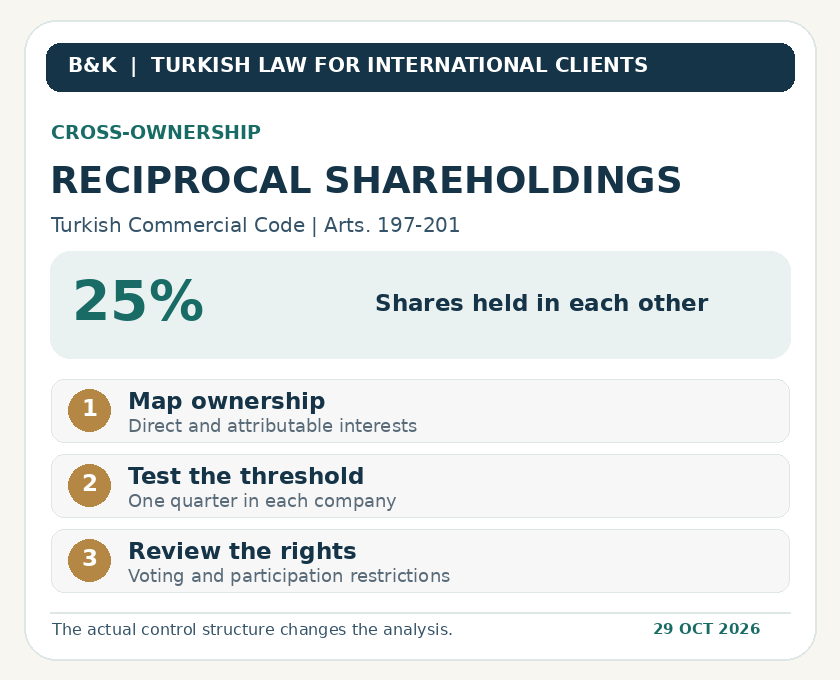
Article 197 requires reciprocal holdings of at least 25%, assessed under Article 196. Where Article 201(1) applies, the capital company that knowingly enters the reciprocal relationship can exercise only one quarter of the total votes and other shareholder rights arising from the participation. The remaining rights are frozen, with the statutory exception for acquiring bonus shares. Article 201 also addresses the exclusion of the relevant shares from meeting and decision quorum calculations.
The rule has an express boundary. Under Article 201(2), its first-paragraph restriction does not apply where a subsidiary acquires its parent’s shares or where both companies control each other. That does not create unrestricted voting rights: Article 201 expressly preserves Articles 389 and 612. The applicable parent-share and own-share provisions must be examined before recording any shares as freely exercisable.
| Question | Statutory starting point |
|---|---|
| What creates reciprocal participation? | Each capital company holds at least one quarter of the other’s shares: Article 197. |
| How are percentages calculated? | Article 196, including its own-share adjustments and attributed holdings. |
| Who faces the Article 201 restriction? | The capital company acquiring shares and knowingly entering the reciprocal relationship. |
| How much can it exercise? | One quarter of the relevant votes and other shareholder rights, subject to the statutory exceptions. |
| What is expressly preserved? | Bonus-share acquisition and the separate rules in Articles 389 and 612. |
The 25% threshold applies in both directions
Article 197 is not triggered merely because one investor holds a quarter of a company. It concerns capital companies holding at least a quarter of each other’s shares. The ownership review must therefore run in both directions. A chart showing only the Turkish company’s shareholders leaves unanswered whether the Turkish company itself holds a relevant stake in the corporate investor. That reverse ownership can be decisive for the legal classification.
The provision also connects reciprocal participation with control. Where one of the companies controls the other, the latter is additionally a subsidiary. Where each controls the other, both are treated as controlling and subsidiary companies. Those classifications matter because Article 201(2) changes the route of analysis. A file should not stop after finding reciprocal percentages; it must separately examine control through voting, appointment powers, agreements and other circumstances covered by Article 195.
Article 196 prevents a simple but incorrect denominator
Article 197 refers to Article 196 for calculating the participation percentages. Article 196 compares the nominal value of the participation with the relevant company’s capital and requires adjustment for that company’s own shares, including shares acquired for its account and held through another person. The statutory denominator is therefore not always the unadjusted amount copied from a headline capital table. Keep both the original figures and the adjustments used.
Article 196 separately deals with usable voting rights and with holdings attributed through subsidiaries or persons holding for the company’s account. Capital participation, voting power and economic exposure are related but distinct questions. The review should record the class of shares, their nominal values, relevant voting rights and the basis for attributing an indirect holding. A group consolidation percentage is useful background, but it is not automatically the calculation required by these company-law provisions.
The requirement of knowingly entering reciprocal participation
Article 201(1) expressly refers to a company acquiring shares and knowingly entering the reciprocal position. Knowledge and the sequence of acquisitions therefore matter. Do not assume that the same restriction applies to both companies merely because a later ownership chart shows reciprocal stakes. Identify which acquisition created the relevant relationship and what the acquiring company knew about the corresponding holding when it acted.
The evidence review should include transaction documents, due-diligence materials, board papers, notifications, registers and correspondence concerning the existing ownership structure. A later statement that management did not appreciate the legal consequence is not the same question as whether the company knew the underlying reciprocal holding existed. Conversely, the conclusion should not be based solely on the fact that two companies use the same accounting adviser or have overlapping commercial activities.
One quarter of the relevant rights is not 25 percentage points
The operative fraction in Article 201 is one quarter of the total votes and other shareholder rights arising from the participation. It is not a grant of twenty-five percentage points of the entire company’s voting power. The relevant starting figure is the rights attached to the participation under examination. Those rights must first be identified correctly, including any separate voting restrictions, before the Article 201 limitation is applied.
The provision is also broader than a rule about how many ballot papers are issued. It refers to other shareholder rights and freezes the remainder, subject to its express exception. Meeting administration should not record a voting adjustment while treating every other right as automatically unaffected. Equally, the rule should not be described as transferring ownership of the restricted shares to someone else. Holding the shares and exercising rights attached to them are different legal positions.
Bonus shares are expressly excepted
Article 201 preserves the acquisition of bonus shares while describing the freezing of other rights. That exception must be recorded accurately. It should not be expanded into a statement that every distribution, subscription opportunity or economic benefit remains fully available. The legal character of the corporate action matters. A distribution described informally as free or additional should be checked against the actual resolution and the rights it creates.
For administration, retain a separate record of the corporate action, the shares or benefits allocated and the basis for treating it under the statutory exception. The purpose is to prevent a voting restriction from being applied mechanically to an expressly protected bonus-share acquisition, while also preventing the bonus-share language from being used to disregard restrictions on unrelated rights. The statutory exception supplies the legal boundary; the company’s records establish which side of it the action falls on.
Why the attendance list needs its own legal calculation
Article 201 expressly states that the relevant shares are not taken into account in calculating meeting and decision quorums. A company must therefore examine quorum treatment as well as the number of votes actually cast. Copying the entire registered shareholding into an attendance list and reducing only the ballots is not a complete application of the provision. The record should identify the restricted participation and the statutory basis for the adjustment.
Keep the registered capital table, the rights-exercise calculation and the meeting-specific quorum schedule as distinct documents. Identify the relevant legal form and the particular decision being taken, because other provisions determine the required quorum. This guide does not replace those decision-specific rules with a universal percentage. The practical objective is a calculation that can be checked from the share records through to the attendance list and the recorded result.
Article 201(2) is not a route to unrestricted parent-company votes
The first-paragraph limitation does not apply where a subsidiary acquires the parent’s shares or both companies control each other. Read that exception together with the express reservation of Articles 389 and 612. In particular, Article 389 addresses a joint-stock company’s own shares and parent-company shares acquired by its subsidiary. It excludes the specified shares from the parent’s meeting quorum and freezes voting and associated rights attached to parent shares held by the subsidiary.
That is why the control assessment cannot be skipped. A transaction outside Article 201(1) may still be subject to a stricter or differently structured own-share rule. For a limited company, Article 612 requires its own examination. The correct conclusion is not that the first restriction disappears and all rights revive. It is that the relevant special provisions, corporate form and ownership relationship determine the rights that can actually be exercised.
Article 198 creates an independent reporting question
A reciprocal investment can also cross one of the shareholding thresholds listed in Article 198. That provision requires the specified notices and registry publicity and has its own rights-freezing consequence while the requirements remain unfulfilled. Compliance with Article 198 does not remove an applicable Article 201 restriction. Conversely, analysing reciprocal participation does not establish that the notification obligations were completed.
The transaction file should therefore have separate lines for the participation calculation, the knowledge and control analysis, the Article 198 notice, registration and announcement, and the Article 201 rights treatment. The firm’s shareholding notification guide explains the ten-day reporting rule. It is a related compliance step, not an alternative way of obtaining unrestricted voting rights in a reciprocal participation arrangement.
What an overseas acquisition team should check before closing
Obtain the ownership records for both companies, not just the investment target. Request the articles, share classes, relevant control agreements, own-share information and details of holdings through subsidiaries or nominees. Reconcile those records with the transaction’s proposed completion steps. A staged acquisition can change the legal position during the transaction, so the final intended structure should not be substituted for the structure existing at each completed step.
The investment agreement should distinguish ownership representations from assumptions about usable votes. A purchaser valuing a stake on the basis of unrestricted meeting power needs the legal rights position tested before committing funds. The review should also identify whether the transaction involves the target funding acquisition of its own shares, a separate issue discussed in the Article 380 financial-assistance guide. Different restrictions can arise from the same document set.
Preparing an evidence-based general meeting file
Before the meeting, reconcile the current register with the last verified ownership chart and any intervening transfers. Record the date to which the rights assessment relates. Obtain the documents establishing control and any relevant notification compliance. Prepare a written explanation for each adjustment rather than leaving the attendance clerk to infer the legal result from a percentage written next to a shareholder’s name.
Preserve the final attendance list, proxies, objections, voting records and minutes. A foreign corporate shareholder’s representative needs authority to act for that entity, but a valid proxy does not increase the substantive rights the entity is entitled to exercise. The representative’s authority and the shareholding restriction are separate checks. Where the rights position is disputed, the contemporaneous objection and the actual calculation are more informative than an unparticularised allegation made after the result is known.
A disputed resolution requires more than a general complaint about cross-holdings
Identify the specific decision, the shares whose treatment is challenged and the way the alleged error affected the meeting or vote. Do not describe every reciprocal investment as automatically invalidating all corporate resolutions. The legal classification of the alleged defect, standing, applicable challenge route and statutory periods must be assessed for the actual company and decision. The merits of the ownership restriction and the procedural route for contesting a resolution are distinct questions.
For document preparation, collect the versions of the articles and ownership records in force at the relevant date, the acquisition sequence, evidence of knowledge, control documents and the meeting file. Keep facts that support the restriction separate from facts that support an exception. Related minority shareholder rights should be assessed without assuming that every numerical minority threshold uses the same denominator or answers the same question as Articles 197 and 201.
Nationwide corporate review and Mersin coordination
Bakırcı & Keskin Hukuk Bürosu assists with Turkish corporate matters involving overseas investors and companies across Turkey. A useful initial enquiry identifies the two companies, their reciprocal holdings, the intended transaction or meeting and any imminent date. Detailed ownership records should be supplied through an agreed document-transfer method after the scope of review and any conflict check are addressed. The firm’s contact page provides current appointment and office arrangements.
Frequently asked questions
Does one company owning 25% of another automatically create reciprocal participation?
No. Article 197 requires the capital companies to hold at least one quarter of each other’s shares. The ownership review must run in both directions.
Which provision governs the percentage calculation?
Article 197 refers to Article 196, including its own-share adjustments and rules for attributed holdings. Capital participation and usable votes should be distinguished.
Does Article 201 automatically restrict both companies in the same way?
The provision refers to the acquiring capital company that knowingly enters reciprocal participation. The acquisition sequence, knowledge and control relationships must be established for each company.
Does the one-quarter rule mean 25% of the entire company’s votes?
No. It concerns one quarter of the relevant votes and shareholder rights arising from the participation, not twenty-five percentage points of the whole company.
Are bonus-share acquisitions expressly protected?
Yes. Article 201 expressly excepts acquisition of bonus shares from the freezing of other rights. That exception should not be expanded to unrelated distributions or rights.
Must meeting quorums also be reviewed?
Yes. Article 201 contains a specific quorum-exclusion rule. Reducing ballots while leaving the registered holding wholly unadjusted is not a complete analysis.
Does a subsidiary holding parent shares escape all restrictions?
No. Article 201(2) must be read with the preserved special provisions, particularly Article 389 for a joint-stock company’s parent-share and own-share position.
Does filing an Article 198 notice remove the reciprocal-participation restriction?
No. Article 198 reporting and Article 201 rights restrictions are separate. Completion of one does not establish compliance with or exemption from the other.
Can a proxy exercise rights that are frozen for the shareholder?
A proxy’s authority does not enlarge the shareholder’s substantive rights. Representation and the underlying rights restriction must be checked separately.
What should a foreign investor send for review?
Ownership records for both companies, the acquisition sequence, articles, control documents, own-share information, notification evidence and any relevant meeting records.
Professional information
Av. Halil Bakırcı · Mersin Bar Association registration 3472 · Bakırcı & Keskin Hukuk Bürosu. This guide explains the statutory framework; a company-specific rights calculation requires its actual corporate records.
Istanbul Office – Polaris Plaza, Maslak / Sarıyer
Bakırcı & Keskin Hukuk Bürosu
Maslak Ahi Evran Caddesi, Polaris Plaza No:21, Kat:9, 34475 Sarıyer/İstanbul
Our physical offices in Istanbul and Mersin coordinate matters throughout Turkey, subject to jurisdiction and the local steps required for each case. Please specify your preferred office when arranging an in-person appointment.
Open the Istanbul office on Google Maps · Contact and appointments
Contact regarding a legal matter
In your first message, you may briefly state the subject, your country or city, and any relevant notification or recent procedural date. Please do not send identity numbers, medical data, or personal documents. Messaging alone does not constitute legal advice or create a lawyer–client relationship.
Discover more from Bakırcı & Keskin Hukuk Bürosu
Subscribe to get the latest posts sent to your email.
