A Turkish Promissory Note Was Endorsed After Maturity: When TCC 690 Gives Only Assignment Effects
A Turkish promissory note does not lose the ordinary effects of endorsement merely because its maturity date has passed. The decisive statutory distinction is more specific: endorsement after non-payment protest, or after expiry of the period for drawing that protest, has only the effects of an assignment of the claim. An overseas buyer of overdue receivables and a Turkish debtor responding to a new claimant therefore need the complete chronology, not simply the date printed in the maturity box.
Have a general question about this article? Ask anonymously
Direct answer
TCC Article 690(1) preserves ordinary endorsement effects after maturity, but gives only assignment effects to endorsement after non-payment protest or expiry of its statutory period. Article 778(1)(a) applies this rule to promissory notes. Under Article 690(2), an undated endorsement is presumed to precede expiry of the protest period until the contrary is proved. Where assignment rules apply, TCO Article 188 becomes important for the debtor’s available defences.
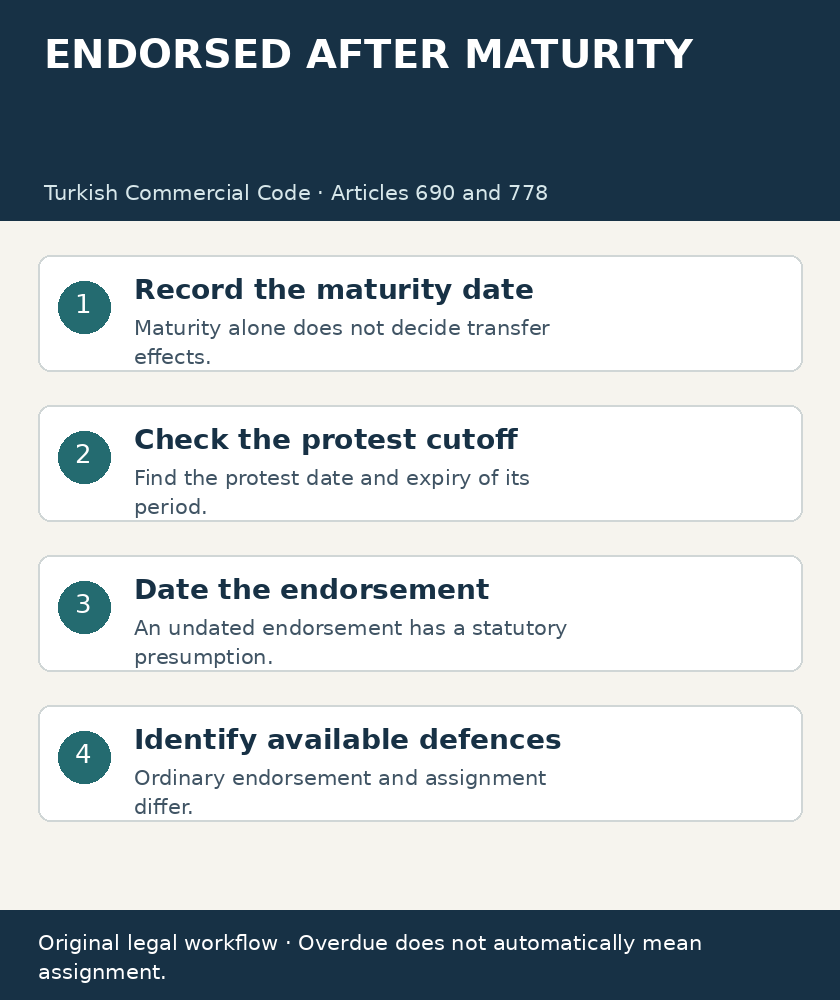
Quick summary
| Transfer position | Article 690 consequence |
|---|---|
| After maturity, before the relevant protest cutoff | Maturity alone does not remove ordinary endorsement effects. |
| After an actual non-payment protest | Only assignment effects. |
| After expiry of the period for that protest | Only assignment effects, even without an actual protest. |
| Endorsement has no date | Statutory presumption that it preceded expiry of the protest period, unless disproved. |
| Assignment effects apply | Assess the debtor’s defences under the applicable assignment rules, including TCO 188. |
| The note was transferred late | Do not automatically treat the note as formally invalid or restart its limitation period. |
1. Separate maturity, protest and transfer
Begin with the maturity fixed by the instrument and the applicable statutory rules. Then establish whether a non-payment protest was drawn and, independently, when the period for drawing it expired. Finally, reconstruct the endorsement and delivery of the note. These are different events, and the Article 690 classification depends on their relationship.
A chronology should identify the source of each date: the original note, a notarial protest, an endorsement on the reverse or allonge, a delivery receipt, the acquisition agreement and contemporaneous correspondence. A later accounting entry is not automatically the date when the instrument was endorsed or possession transferred. The evidence must address the actual transaction rather than merely the purchaser’s internal bookkeeping.
Keep both sides of the note and every attachment together. A front-page scan can establish the stated maturity while omitting the very endorsement being examined. Conversely, the reverse page alone can conceal a maturity clause or another feature relevant to the validity and timing analysis. The legal review requires the complete instrument.
2. Understand why an overdue note can still carry ordinary endorsement effects
Article 690 opens with a clear rule: endorsement after maturity produces the effects of endorsement before maturity. The exception concerns the subsequent protest-related cutoff. A creditor therefore cannot be denied ordinary endorsement effects solely because the paper was already due when transferred, and a purchaser cannot determine the legal position solely from the label overdue.
Articles 681–684 provide the broader endorsement framework, including transfer by endorsement and delivery, the form of the endorsement and the transfer of rights. Article 686 concerns the holder’s entitlement through the chain of endorsements. These requirements remain relevant; Article 690 does not make possession of an arbitrary photocopy equivalent to a completed transfer of the original instrument.
Also distinguish an endorsement for collection or pledge from an outright transfer. The wording on the instrument can limit the role in which the recipient acts. An entity presenting the note for payment may be collecting for another person rather than having purchased the claim. Its legal position should be established from the endorsement and supporting documents, not from a description used in a collection email.
3. Establish the actual protest and the protest period
Article 690 refers both to non-payment protest and to expiry of the period prescribed for drawing it. An actual protest can therefore be relevant before the entire statutory period has elapsed. Where no protest was drawn, expiry of the prescribed period remains an independent cutoff. Absence of a protest document does not mean that ordinary endorsement effects continue indefinitely.
For instruments payable on a fixed day, a period after issue or a period after sight, Article 714(3) requires non-payment protest within the two business days following the payment day. Sight instruments have the different reference specified by the same provision. The type of maturity must therefore be identified before calculating the applicable period. Articles 752 and 753 also contain the relevant holiday and calculation rules.
Article 715 requires the protest to be drawn by a notary in the prescribed form. An ordinary demand email or an internal bank note is not automatically that statutory protest. Obtain the actual instrument and protest record where a party relies on the protest date. A clause dispensing with protest under Article 722 must also be read carefully: it does not dispense with timely presentation and the required notices, and it should not be treated as rewriting Article 690’s transfer rules.
4. Apply the undated-endorsement presumption accurately
Article 690(2) provides that an undated endorsement is presumed to have been made before expiry of the period for drawing the protest, until the contrary is proved. The presumption addresses the absence of a date; it is not a finding that every undated endorsement is genuine or that every person possessing the paper is entitled to it.
A party disputing the presumed timing should identify evidence of the actual endorsement and transfer chronology. Relevant materials include the acquisition agreement, delivery record, payment for the acquisition and contemporaneous correspondence identifying the original note. The date a scanned copy first appeared in a litigation file may be relevant context but is not necessarily the date of the earlier physical transfer.
Read the presumption according to its wording. It refers to expiry of the protest period. An actual earlier protest and other evidence in the file must still be considered under paragraph (1). A submission should not silently replace the statutory wording with a broader presumption that every undated endorsement necessarily preceded every relevant event.
5. Identify what assignment effects change
After the statutory cutoff, Article 690 gives the endorsement only the effects of assignment of the claim. This affects the relationship between the acquirer, the transferor and the debtor. It is not a rule that the instrument’s original formal elements disappear simply because a later transfer occurred. The validity of the note and the effects of transferring it are separate questions.
Article 687(2) expressly preserves the provisions concerning transfers by assignment. The debtor’s defence position must therefore be examined through the applicable assignment framework rather than automatically applying the ordinary protection of an endorsed instrument against personal defences arising from earlier relationships.
The transferor’s obligations also require separate attention. The ordinary endorsement guarantee and the contractual or statutory obligations of an assignor are not interchangeable labels. In an acquisition agreement, identify the right being transferred, the documents delivered, the disclosed objections and any warranties or recourse arrangements. Do not infer a particular warranty merely from the purchaser having paid money for an overdue note.
6. Organise the debtor’s defences under TCO 188
TCO Article 188 permits the debtor to raise against the assignee the defences the debtor had against the assignor when learning of the assignment. Identify both the defence and its relevant factual basis. Payment, release, an agreed adjustment and a disputed obligation are not established simply by asserting that the note was transferred late.
The second paragraph addresses set-off involving a counterclaim not yet due when the debtor learned of the assignment: the counterclaim must become due before, or at the same time as, the assigned claim. This is a defined condition, not a general permission to deduct every future or disputed claim against the former creditor. The relevant due dates and the date of learning of the assignment must be documented.
Prepare separate evidence for each defence. Bank transfers should be linked to the specific debt; settlement documents should identify what was released; account records should explain any partial payment. Our guide to receipts and return of notes explains why clear payment documentation matters even where the original commercial relationship is no longer disputed.
7. Distinguish transfer from notification to the debtor
The date of acquisition and the date on which the debtor learned of the assignment serve different legal functions. Article 690 classifies the transfer by reference to the endorsement and protest chronology. Article 188 uses the debtor’s learning of the assignment for the stated defence rules. One timestamp should not be substituted for both without examining the evidence.
TCO Article 186 protects the debtor’s good-faith payment to the former creditor where the assignment was not notified by the assignor or assignee, subject to the provision’s conditions. Once a competing entitlement is known, an informal preference for the former business contact is not a sufficient payment strategy. Verify the claimant and the legal effect of the notification.
Where ownership of the claim is genuinely disputed, Article 187 provides rules on withholding performance and deposit at the place determined by the judge. It is not a licence to disregard every demand indefinitely. The dispute, maturity and appropriate deposit procedure must be addressed. Our guide to judicial deposit where two parties claim the same payment examines that distinct remedy.
8. Check the acquisition file before paying for an overdue note
The buyer should obtain the original instrument, the entire endorsement chain, protest records, the underlying account documentation and a record of payments already credited. TCO Article 190 requires the assignor to deliver the claim document and other proof in its possession and to provide information needed to assert the claim. A purchase price should not be treated as a substitute for that documentary review.
Read any warranties against the actual statutory and contractual framework. Article 191 regulates guarantees in assignments made for consideration and distinguishes gratuitous or legally occurring transfers. The contract can raise further questions about scope and allocation of risk. Our guide to remedies against the assignor of an uncollectible receivable addresses the separate recovery relationship between buyer and seller.
Check the identity and authority of the person transferring the note, particularly where a company signs. The buyer’s assumption that an instrument is authentic does not establish the representative’s authority. The company-note authority guide explains the distinction. A missing original also calls for a separate analysis rather than treating an acquisition contract as possession of the paper.
9. Do not restart limitation or miss an enforcement deadline
Articles 749–751, applied through Article 778, distinguish the relevant instrument claims and the acts that interrupt limitation. The transfer date is not a new maturity date merely because a different creditor has acquired the note. Identify the obligated person’s role and the claim being pursued before selecting the limitation period.
The ordinary three-year claim against the promissory-note maker is linked to the maker’s position under Article 779 and the applicable Article 749 rule. Claims involving endorsers have their own conditions and periods. A later transfer cannot simply be used to rewrite those statutory positions. The purchaser should require a reliable procedural and limitation history rather than relying solely on the current balance.
Where a payment order has already been served, the enforcement objection period is a separate and immediate issue. Article 168 of the Enforcement and Bankruptcy Law contains the specified five-day routes for special bill enforcement. Late-transfer arguments must be presented through the appropriate procedure and evidence; an email explaining the commercial disagreement does not preserve a statutory objection by itself.
10. Review the cross-border connections and the precise remedy
A foreign purchaser does not automatically change the law governing every signature or the protest procedure. The conflicts provisions referred to by TCC Article 778 include rules concerning the place of signature, the place of the relevant protective act and the payment place. Record those connections before assuming that the Turkish domestic timing rule resolves an instrument issued or payable abroad.
Foreign-language acquisition documents relied upon in Turkish civil proceedings require the appropriate translations under HMK Article 223; foreign official documents raise Article 224 and treaty questions. The practical file should preserve originals, complete attachments and proof of delivery. The language in which the purchase contract was negotiated does not establish that every legal issue is governed by that country’s law.
Finally, separate the requested relief: collection from the maker, a defence to an assignee, recovery against the transferor or a dispute over the original paper. Each has its own parties and evidence. Our debt-collection guide for clients abroad provides the wider procedural context without replacing the specific Article 690 classification.
Frequently asked questions
Does every endorsement after maturity have only assignment effects?
No. Article 690 preserves ordinary endorsement effects after maturity until the relevant non-payment-protest cutoff is reached.
What are the two protest-related cutoffs?
An actual non-payment protest, or expiry of the statutory period for drawing it. Endorsement after either relevant event has only assignment effects.
What if no protest was ever drawn?
Expiry of the prescribed protest period remains relevant under Article 690. Ordinary effects do not continue indefinitely merely because there is no protest document.
What is presumed when an endorsement has no date?
Article 690(2) presumes that it preceded expiry of the protest period, until the contrary is proved.
Is the late-transferred note automatically invalid?
No. The transfer’s legal effect and the instrument’s formal validity are separate questions.
Which assignment provision protects the debtor’s defences?
TCO Article 188 addresses defences held against the assignor when the debtor learned of the assignment and the specified set-off conditions.
Is notification to the debtor the same date as endorsement?
Not necessarily. Transfer, physical delivery and learning of the assignment are separate events that must be proved for their respective legal purposes.
Does transfer give the buyer a fresh limitation period?
No new period should be assumed merely from transfer. The applicable claim, statutory starting point and interruption history must be examined.
Is a demand email automatically a statutory protest?
No. Articles 714 and 715 prescribe the protest framework and notarial form.
Can a foreign investor assess an overdue Turkish note remotely?
Initial document review can be conducted remotely, but the original instrument, authority records and formal representation requirements must still be addressed.
Türkiye-wide case management and Mersin practice
Bakırcı & Keskin Law Office reviews Turkish commercial claims for clients abroad from its Mersin office. For a late-transfer dispute, provide the complete note, endorsement and delivery records, protest documents, acquisition agreement, notifications and payment history. The review identifies the actual transfer regime and the correct claim or defence instead of relying on the single description overdue note.
Updated: 29 October 2026. The statutory classification must be applied to the actual chronology and the note’s domestic or international legal connections.
Istanbul Office – Polaris Plaza, Maslak / Sarıyer
Bakırcı & Keskin Hukuk Bürosu
Maslak Ahi Evran Caddesi, Polaris Plaza No:21, Kat:9, 34475 Sarıyer/İstanbul
Our physical offices in Istanbul and Mersin coordinate matters throughout Turkey, subject to jurisdiction and the local steps required for each case. Please specify your preferred office when arranging an in-person appointment.
Open the Istanbul office on Google Maps · Contact and appointments
Contact regarding a legal matter
In your first message, you may briefly state the subject, your country or city, and any relevant notification or recent procedural date. Please do not send identity numbers, medical data, or personal documents. Messaging alone does not constitute legal advice or create a lawyer–client relationship.
Discover more from Bakırcı & Keskin Hukuk Bürosu
Subscribe to get the latest posts sent to your email.
