Unpaid Construction Work in Turkey: Statutory Mortgage, Three-Month Registration and Overseas Owner Defences
Short and direct answer: Turkish Civil Code Article 893(3) permits qualifying construction creditors, including specified subcontractors and craftsmen, to request a statutory mortgage over the property on which they performed the relevant work. Article 895 requires registration within three months after that work is completed, and requires recognition of the debt by the owner or its determination by a court. The owner can prevent registration by furnishing sufficient security. An unpaid invoice does not automatically constitute a registered mortgage, and the ranking rules in Articles 896–897 are qualified rather than giving every contractor unconditional priority.
Have a general question about this article? Ask anonymously
For an overseas owner, the immediate task is to identify the qualifying work, completion date, claimed debt, present title record and any timely application or provisional entry. The same facts matter to contractors and lenders. This article addresses construction-related property security, not the separate seller’s mortgage under Article 894.
Quick summary
| Principal law | Turkish Civil Code No. 4721 Articles 893(3), 895–897 and 1011 |
|---|---|
| Three-month period | Registration within three months after completion of the undertaken work, Article 895 |
| Debt condition | Accepted by owner or determined by court |
| Substitute security | Sufficient security may prevent registration, Article 895 |
| Ranking | Equal rank among construction creditors; conditional priority against earlier creditors |
| Buyer risk | Verify actual land-register status, not merely the developer’s correspondence |
What exactly does the construction-creditor mortgage protect?
Turkish Civil Code Article 893(3) permits a statutory mortgage request for defined construction creditors whose labor, with or without supplied materials, contributes to building or other work on immovable property. The provision expressly addresses subcontractors and craftsmen who are owed the value of materials and labor by the owner or contractor. The right concerns real-property security; it is not created automatically over every asset of the party that ordered the work. Identify the particular registered parcel and the work carried out on that parcel before making a demand.
A foreign buyer can discover the dispute after paying the developer, because an unpaid contractor or subcontractor may assert a construction claim relating to work performed on the buyer’s property. The fact that the buyer settled with the main contractor does not independently answer every statutory mortgage question. Conversely, an invoice issued to a contractor does not prove that the statutory conditions for registration against the owner’s land are satisfied. Establish the claimant’s role, the contract chain, the work, and the correct property title.
Article 893’s final sentence says that an advance waiver of the statutory mortgage right by qualifying creditors is invalid. This should be distinguished from a later, fact-specific settlement, discharge or sufficiently secured arrangement. A generic clause inserted into a tender document before work begins should not be treated as an unqualified way of abolishing the protection provided by the Civil Code. The proper course is to identify the relevant obligation and the actual legal act relied on.
Check whether the alleged creditor actually qualifies
Start with the underlying works. A subcontractor who installed equipment or supplied labor for a building may be in a different position from a merchant who merely sold unrelated goods to the owner. Article 893(3) focuses on labor and materials linked to construction or other work on the immovable. The file should contain the accepted contract, work orders, dated site reports, delivery documentation and evidence establishing what value the claimant contributed to the property.
Corporate identity and contractual capacity matter. The owner of the land, the main contractor, the subcontractor and a supplier can be separate companies. The claimant must explain why it belongs to the protected class and what claim arises from the qualifying work. The legal test should not be replaced by a list of invoices without an explanation of the project or by the statement that every unpaid business debt creates a property charge.
A creditor seeking registration should map each claimed amount to the relevant building work and its date. Ordinary finance charges, unrelated product deliveries and damages from another contract cannot silently be included as qualifying labor and material value. The owner should test the same account without assuming that any debt between other companies is automatically invalid. The debt and the statutory right to security are distinct issues requiring separate examination.
Article 895: the registration clock starts at completion of the undertaken work
Article 895 allows registration from the time the creditor undertakes the relevant work or supply of materials, and it requires registration within three months after completion of the undertaken work. This is not a universal three-month period from the date an unpaid invoice was sent. A contractor’s final invoice may be issued much later than the practical completion date, while another subcontractor’s work may have its own completion record. The legal chronology must identify whose work is relevant and when it was completed.
Completion is a factual point that should be established by site records, acceptance certificates, dated correspondence and the nature of remaining tasks. A minor later inspection or an administrative delay should not automatically be treated as proof that substantial work remained unfinished. Equally, an owner cannot choose an earlier date merely to defeat registration. A precise chronology is essential, because the statutory wording expressly requires timely registration of the construction-creditor mortgage.
Sending a payment reminder or requesting negotiation is not the act of registering the mortgage in the land register. A creditor approaching the end of the statutory period must consider the correct registration or protective procedure under applicable law rather than assume informal communications will preserve the real right. An overseas owner should obtain the current registry excerpt and the application record before asserting that no timely registration occurred.
The debt must be accepted by the owner or determined by a court
Article 895 requires the amount to have been recognized by the property owner or decided by a court as a condition for registration. The mere existence of the contractor’s invoice is therefore not equivalent to an established registrable amount. Where the owner signed an acknowledgment, obtain the actual document and identify what it admits. Where the debt is disputed, identify the proceeding in which the claim is to be established.
The factual dispute may concern whether the work was completed, whether it was defective, what payments were made and whether the claimed creditor actually performed qualifying work. A mortgage registration issue should not be confused with a complete construction defects trial, but those issues can bear on the existence and amount of the claim. The owner should not sign an open-ended acknowledgment without understanding what property security it may support.
Do not assume that a judgment against a different contractual debtor necessarily proves every requirement against the landowner. The identity of the parties, the actual ruling and the statutory condition must be considered. A foreign owner can authorize legal representation to inspect the relevant file and respond through lawful procedures; living abroad does not remove the importance of the underlying evidence or the specific entry sought.
A disputed claim may justify examination of provisional entry under Article 1011
Civil Code Article 1011 permits provisional registration annotations in defined circumstances to protect asserted real rights while their basis is being determined, according to the applicable conditions and a relevant judicial decision or agreement. Where the construction debt remains contested and the Article 895 period is running, the creditor should not simply wait indefinitely for a final judgment without assessing the protective route. The procedural requirements must be satisfied; a claim letter cannot itself make the provisional annotation.
A provisional annotation is not a final judicial finding that the entire invoice is correct. Its scope, period and legal effect follow the specific decision and the Civil Code. The landowner should request the registry record, court order and notices to understand what is protected and whether the procedural conditions were met. An allegation that the entry is provisional does not justify ignoring it, but neither should it be presented as the same thing as a final mortgage establishing all claimed sums.
The documents should distinguish the debt action, request for provisional protection, actual annotation date and ultimate registration. Keeping these dates separate is essential when several purchasers, mortgage lenders or subcontractors are affected. The correct remedy depends on the existing land record and the order, not a blanket statement that every disputed mortgage may be deleted immediately.
Article 895 allows the landowner to provide sufficient substitute security
The last sentence of Article 895 states that registration cannot be demanded if the owner provides sufficient security. This is a direct statutory protection for the landowner, but it does not say that any unsupported promise to pay qualifies. The security must be examined for adequacy, enforceability, beneficiary, currency, scope and the amount of the qualifying claim. The relevant dispute may concern whether the offered instrument genuinely secures the required amount.
An overseas owner facing a transaction or planned refinancing may prefer an appropriately structured guarantee rather than an encumbrance affecting title. That practical preference does not settle the legal test. The owner and creditor should identify which claims the security covers, its duration and conditions for enforcement or release. Legal counsel should ensure that the document does not inadvertently concede disputed personal liability unrelated to the property.
The creditor should assess a proposed instrument on its legal merits rather than reject every substitute as a matter of course. Conversely, the owner should not declare the mortgage claim defeated merely because a family member offered to sign a private letter. The Article 895 analysis asks whether sufficient security actually exists for the protected construction claim.
Earlier bank mortgages and construction creditors have qualified priority rules
Civil Code Article 896 provides that qualifying construction creditors have the same rank among themselves for purposes of the statutory mortgage even when their rights were registered at different dates. That does not mean every construction creditor automatically jumps ahead of every earlier mortgage. The priority rules must also be examined under Article 897, including the statutory conditions relating to the increase in land value and the earlier secured creditors’ knowledge or ability to know of prejudice.
A buyer or lender should obtain the historical and current land-register information and the chronology of construction. The analysis needs the secured amounts, registration dates, relevant land value and any evidence bearing on the Article 897 conditions. A slogan that construction creditors ‘always come first’ would overstate the statutory position. Equally, the existence of an older bank mortgage is not, by itself, a complete answer to an eligible construction creditor’s rights.
Article 897 also addresses the entry concerning the commencement of work in the land-register statements column and the restrictions operating until the registration period expires. That provision should be examined in the actual sequence rather than described as a general prohibition on every land-registry transaction. The present and prior entries, their dates and any pending court orders are critical evidence.
Why this is different from a seller’s statutory mortgage under Article 894
Article 893 lists different categories of statutory mortgage beneficiaries. A seller with an unpaid purchase price may rely on the seller’s category, while subcontractors and craftsmen rely on construction work under paragraph 3. Article 894 sets a separate three-month period from transfer of ownership for the seller, heirs and other joint ownership partners. Article 895 instead measures the construction-creditor registration period from completion of the undertaken work.
These are not interchangeable three-month clocks. An overseas purchaser who sees an entry in the registry should identify which legal category was invoked and the exact event from which the relevant period runs. A buyer’s own unpaid purchase obligation does not automatically create the same legal chronology as an unrelated subcontractor’s work. Combining the two into a generic ‘three months from deed transfer’ guide creates legal error.
A complete title review should therefore identify the claimed category, the underlying transaction, payment records, work completion or title-transfer date, and the actual request for registration. A party seeking to discharge a right should use the documents for that category, rather than argue from a superficially similar provision that governs a different creditor.
Overseas owners should preserve a complete title and building file
The landowner should request the current and historical registry extracts, the construction contracts, subcontractor documentation, work acceptance records, written acknowledgments and evidence of all payments. If a particular company is demanding a statutory mortgage, match its legal name and claimed work to the contractual and site documents. Do not send identity numbers or confidential bank credentials through public enquiry forms while gathering evidence.
For property acquired after construction, record the timing of the purchase and the condition of the register at completion. If a registration, annotation or application appeared later, obtain its source and the competent proceeding. The legal effects of the purchaser’s position require property-law analysis; they cannot be resolved simply by citing the absence of a direct contract with the subcontractor.
The buyer should also distinguish the construction-creditor claim from contractual remedies against the developer. An unpaid contractor, an alleged defective apartment and delayed transfer can arise from the same development but trigger different rights, deadlines and defendants. The legal file should be organized by each cause of action, with a common chronology that prevents contradictory factual assertions.
The court and interim-relief route depend on the actual case
The court competent for a claim concerning an immovable right and the procedural steps for registration should be determined under the applicable Civil Procedure Code rules and the documents. Article 12 of Law No. 6100 is relevant to suits concerning real rights in immovable property. Articles 389 and following set out the general interim-injunction framework, but a requested provisional registry annotation and an injunction are not identical procedural measures.
A creditor should formulate the exact relief needed and the statutory basis rather than ask generically for the court to ‘freeze everything’. A landowner can address the claimed right and any requested protection with issue-specific evidence about work, debt, timely registration and substitute security. The legal consequences depend on what the court has actually ordered, and an online article should not predict a ruling without the record.
Foreign participants may handle parts of their dispute through duly authorized representation and remote correspondence, but procedural service and deadline control remain essential. Any matter involving an existing entry or an impending transaction needs the real registry and court documents rather than an assumption derived from a marketing brochure.
Buying, selling or refinancing while a claim is disputed
A pending construction-creditor mortgage issue can affect sale negotiations, financing and due diligence. Parties should identify whether a right has already been registered, whether there is a provisional annotation, or whether the creditor is only threatening future action. These are different legal states. A contractual promise by the seller to ‘clear the title later’ must be assessed against the recorded encumbrances and the buyer’s transaction documents.
If the creditor accepts substitute security or the matter is resolved by a binding settlement, any release and registry steps should be documented. Do not assume an email from the contractor has automatically erased an existing registered mortgage. The title file should confirm the effective record after the legal transaction. Equally, an unregistered demand should not be presented as if it already had the legal effects of a completed mortgage.
Foreign buyers and lenders benefit from a clear record of the parties, claimed debt, actual work and title status. The protective measures should be proportionate to the legal risk and documented in the transaction schedule. A reliable property transaction cannot be reduced to checking only whether the newest bank statement displays the agreed purchase price.
A precise checklist for a construction creditor or property owner
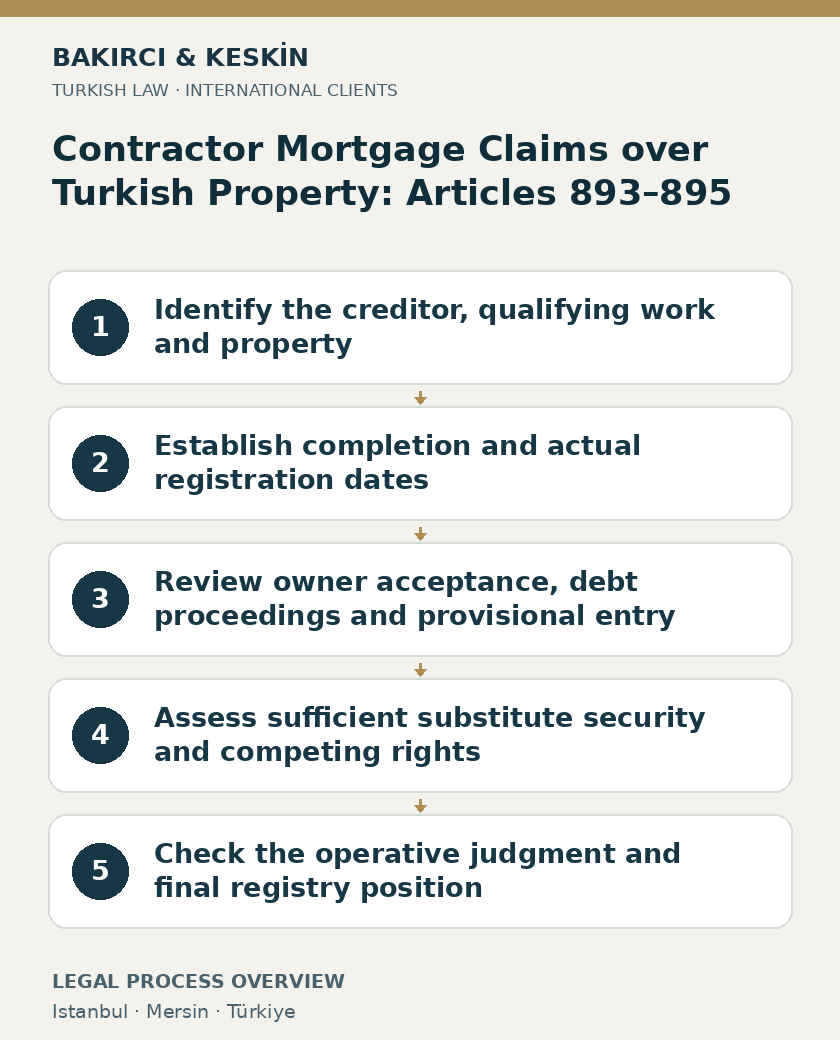
Identify the statutory beneficiary under Article 893(3), the immovable, the actual work, relevant contract and unpaid amount. Document completion and calculate the Article 895 period from that event. Establish whether the owner accepted the receivable or a court determined it, and examine any necessary provisional measure under Article 1011. For the owner, gather the same records and examine whether sufficient security under Article 895 can address the claim.
Reconcile the registry sequence and competing rights under Articles 896–897. The final claim should identify what is sought: debt recovery, security registration, provisional protection or a response to an existing entry. These are different remedies. Preserve service evidence and seek the correct court relief instead of relying on a template letter that omits the property and statutory dates.
This publication explains the law in general terms for foreign property owners, lenders and contractors. It does not decide that any particular creditor qualifies, that every unpaid invoice deserves a mortgage or that every previously registered bank right is subordinated. The outcome depends on the work, debt proof, registry record, lawful security and the actual procedural history.
Frequently asked questions
Can a subcontractor claim security without contracting directly with the landowner?
Article 893(3) includes qualifying subcontractors and craftsmen whose labor and materials relate to the property. The creditor must prove the statutory class, work and relevant receivable; direct contractual privity is not the only consideration.
Does an unpaid construction invoice create a mortgage automatically?
No. Article 895 sets requirements for land-register registration, including the three-month period and acceptance of the debt by the owner or a court determination.
When does the three-month registration period begin?
Article 895 measures it from completion of the undertaken work, not merely the invoice or deed transfer date.
Can a construction creditor waive this protection before work begins?
The final sentence of Article 893 says an advance waiver of the statutory mortgage right by the qualifying creditor is invalid.
Does a demand letter preserve the right automatically?
A demand letter is not the same as timely registration. Where the debt is disputed, the appropriate protective registry and procedural route must be assessed.
Can the owner prevent registration by furnishing security?
Article 895 provides that sufficient substitute security prevents the registration request, but actual adequacy and enforceability have to be established.
Do all construction liens outrank earlier bank mortgages?
No. Article 896 concerns equal rank among qualifying construction creditors, while Article 897 provides conditional priority rules involving earlier creditors.
What if the owner disputes the work or amount?
The receivable must be accepted by the owner or decided by a court under Article 895; provisional entry under Article 1011 may need separate examination.
Is this the same as the unpaid seller’s statutory mortgage?
No. Article 894 uses a different clock for sellers and certain joint owners; construction work is governed by Article 895.
Can the landowner be abroad during the procedure?
Residence abroad does not itself determine entitlement. The owner should obtain registry records, relevant papers and properly authorized representation.
Does provisional entry conclusively establish the debt?
No. A provisional annotation serves a protective purpose under its legal conditions and court order; it does not itself constitute a final determination of every debt claim.
What should be reviewed before a sale or mortgage loan?
Obtain current and historical land records, the underlying building and contract file, completion dates, payment evidence, pending court orders and any valid substitute security.
Related English legal guides
- Buying mortgaged Turkish property: title and payment protections
- Construction and developer disputes for overseas owners
- Foreign legal representation and power of attorney
- Lawyer Halil Bakırcı — Istanbul and Mersin
Office and contact
Mersin office: İhsaniye Mahallesi, 4903. Sokak, Profit İş Merkezi No:23, Floor 3, Office 14, Akdeniz/Mersin. Istanbul appointment inquiries can also be arranged through the firm’s contact channels; confirm the venue before visiting. Phone: +90 552 224 43 66.
Istanbul Office – Polaris Plaza, Maslak / Sarıyer
Bakırcı & Keskin Hukuk Bürosu
Maslak Ahi Evran Caddesi, Polaris Plaza No:21, Kat:9, 34475 Sarıyer/İstanbul
Our physical offices in Istanbul and Mersin coordinate matters throughout Turkey, subject to jurisdiction and the local steps required for each case. Please specify your preferred office when arranging an in-person appointment.
Open the Istanbul office on Google Maps · Contact and appointments
Contact regarding a legal matter
In your first message, you may briefly state the subject, your country or city, and any relevant notification or recent procedural date. Please do not send identity numbers, medical data, or personal documents. Messaging alone does not constitute legal advice or create a lawyer–client relationship.
Discover more from Bakırcı & Keskin Hukuk Bürosu
Subscribe to get the latest posts sent to your email.