Turkish Apartment Neighbour Refuses Repair Access: Condominium Article 23, Mediation and Compensation
Short and direct answer: Article 23 of Turkish Condominium Law No. 634 obliges the owner or occupant of a neighbouring independent unit to allow entry and tolerate work necessary to repair the specified damage or defect or carry out relevant reconstruction. Owners of the units benefiting from the entry must immediately compensate damage caused by the permitted access. The right is not unlimited permission to enter forcibly or undertake unrelated alterations. Law No. 6325 Article 18/B makes mediation a pre-action condition for ordinary Condominium Law disputes, and Article 33 provides a judicial-intervention route.
Have a general question about this article? Ask anonymously
For owners living abroad, the practical file should demonstrate technical necessity, precise proposed work, communications with the actual occupant, damage prevention and the correct legal process. This guide concerns an Article 23 dispute, distinct from a landlord’s ordinary inspection rights under a residential tenancy.
Quick summary
| Governing provision | Condominium Law No. 634, Article 23 — necessary access and immediate compensation |
|---|---|
| Affected persons | Owner and people occupying the other unit in a different legal capacity |
| Work covered | Defined repairs, defects, relevant reconstruction and access necessary for the works |
| Pre-action step | Mediation under Law No. 6325 Article 18/B(1)(c) |
| Judicial option | Condominium Law Article 33 intervention by the competent local magistrates’ court |
| Not authorized | Unrelated renovation or unilateral forced entry |
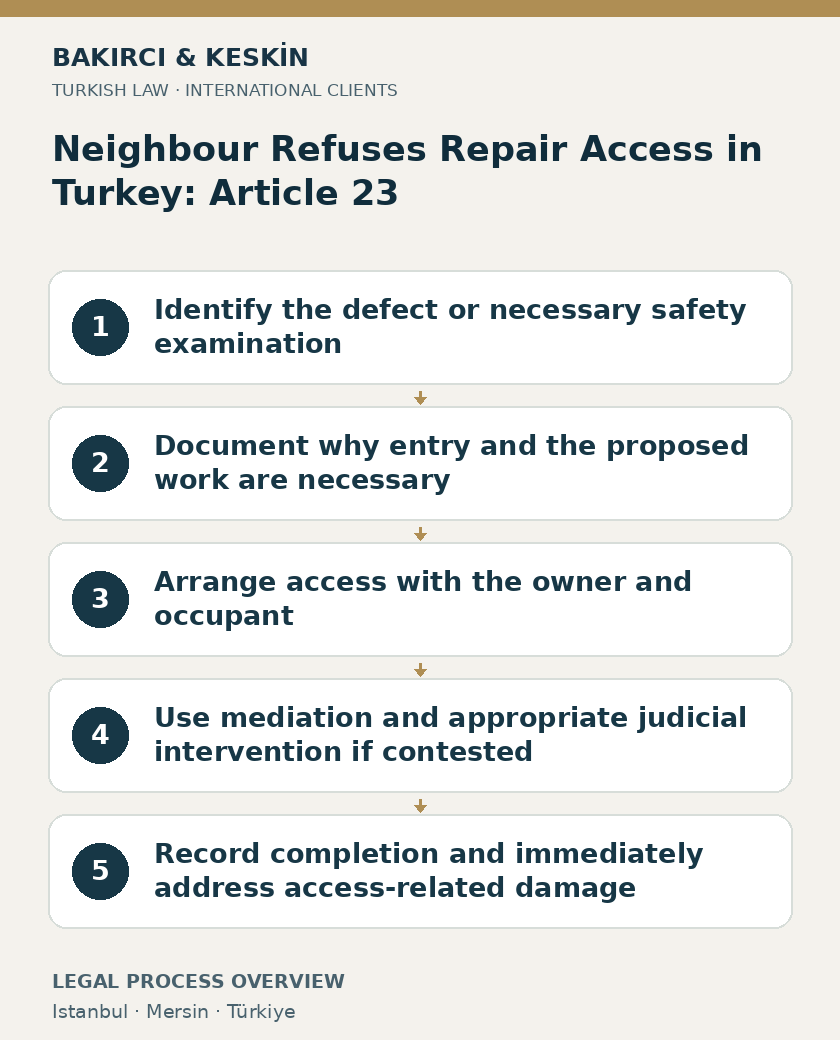
Article 23 creates a duty to permit necessary access
Condominium Law No. 634 Article 23 deals with a concrete situation: repair, removal of a defect or reconstruction of installations in one independently owned unit requires entry into another unit. The owner or occupant of the other unit must permit entry and tolerate the necessary work. This is a statutory duty related to the identified repair, not a general right for one neighbour or a building manager to enter any apartment at any chosen time.
An overseas owner who discovers a water leak or shared-service fault should obtain a technical explanation of why access through another unit is necessary. The file should distinguish a defect in the claimant’s unit, a defect in common installations and a larger reconstruction after partial destruction of the main property. All may raise different management or project approvals even though physical access is regulated by Article 23.
The actual request must be proportionate to the necessary repair. A claimant should identify the work, the part of the neighbour’s apartment affected, the expected duration and how any damage will be documented. A broad demand for unrestricted access without explaining technical necessity is not made legally complete merely by quoting Article 23. The law ties the duty to real work of the kind it describes.
The duty applies to owners and people occupying the unit under another title
Article 23 expressly refers not only to the registered owner of the unit through which entry is needed, but also to a person occupying that unit in another capacity. A tenant or other lawful occupant should therefore not assume the provision is irrelevant simply because their name is absent from the title deed. The arrangement may require dealing with both the actual occupant and the registered owner for planning, communication and access.
The property management file should record the correct apartment numbers, the title or management information and the identity of the person in possession. A residential tenant’s practical availability is an important fact when scheduling works. Informing the wrong individual can produce avoidable disputes, and the right to enter is not a licence to bypass ordinary communication where there is time to arrange access.
An overseas owner whose unit is occupied by someone else should coordinate an authorized local contact, contractor and written appointment. The law concerns the necessary work rather than the physical presence of the owner in Türkiye. A carefully documented arrangement can prevent disputes about whether the correct unit was entered, whether consent was actually given and who was responsible for the condition of the premises.
Technical necessity should be established before a disputed entry request
Take dated photographs and obtain reliable information about the defect, including source and consequences of water leakage, cracked service pipes, structural damage or access to a component that cannot be reached from the affected unit. A qualified technical report can explain why entry is needed and which work is contemplated. A private allegation that the neighbour is obstructive does not itself establish the statutory necessity.
If several repair methods exist, identify which are viable and why the proposed access is necessary. Article 23 does not require the beneficiary to select an imaginary alternative merely to avoid disturbing another unit, but it also does not give the contractor unbounded discretion. The technical record should identify the points of access and the least disruptive practicable method within the actual situation.
The work schedule should distinguish investigation, temporary protection and permanent repair. A claimant who needs access to locate a leak may not automatically have the same authority to rebuild unrelated parts of the apartment. The application or agreement should state the relevant stages so that the occupant knows what must be tolerated and the beneficiary can later establish that the necessary scope was respected.
Entry for repair is not authorization for every structural alteration
Article 19 of the Condominium Law separately addresses maintenance, protection of the building’s structure and appearance, and specified common-area changes. The statutory consent rules for certain alterations still matter. Article 23’s access obligation should not be read as overriding every other legal permission needed for the work itself. The physical route into a neighbour’s unit and the underlying authorization for construction are different questions.
A contractor should not use an agreed visit for pipe repairs to alter a structural wall, add new equipment or change the façade without checking the applicable rules. The management plan, technical design and any required owners’ decision may remain relevant. A foreign apartment owner should therefore ask the manager for project and approval documents, not simply rely on the contractor’s statement that entry is urgent.
Some urgent repairs or strengthening measures are addressed by specific exceptions and judicial mechanisms under Article 19. The circumstances and technical findings must be established before relying on an exception. A general online guide cannot declare every planned upgrade urgent or treat a disputed meeting decision as irrelevant. The legal file should separate immediate protective measures from broader reconstruction requiring its own authorization.
Article 23 also covers access after part of the main property is destroyed
The second paragraph addresses the need to use surviving independent units to reconstruct destroyed independent units, annexes, common spaces or installations. This can be important after a fire, severe structural failure or other incident affecting only part of a condominium building. The statute identifies a duty on the owners and occupants of surviving units where their property must be used for the necessary reconstruction.
That duty does not settle how reconstruction is approved, who funds the entire project or the rights of insurers and other owners. Those questions require the applicable condominium, property, construction and insurance rules. A claimant should show the actual destruction and why the surviving unit is needed. A broad redevelopment proposal should not be disguised as the repair of a defect merely to invoke the access duty.
For international co-owners, the case file should include the building’s title and management documents, technical damage report, reconstruction proposal and any owner meeting resolutions. The unit through which access is needed and the units benefiting from reconstruction must be identified. This is important both for enforcing necessary access and for determining the separate compensation owed for harm caused by that access.
Damage caused by the permitted access must be compensated immediately
Article 23’s final paragraph requires the owners of the independent units benefiting from the permission to compensate immediately the damage suffered by another owner or occupant because of granting access. That provision protects the person required to tolerate construction activity. The right to enter and the duty to pay access-related damage therefore operate together; a beneficiary should not present the first while ignoring the second.
Before work, record photographs of floors, walls, fittings and movable items likely to be affected. Agree how the area will be protected, how completion will be documented and what repairs will follow. Where damage occurs, preserve receipts, surveys and dated evidence. An occupant should not have to guess which new damage resulted from the operation, and the beneficiary should not accept unrelated pre-existing defects as caused by its contractor without checking the evidence.
The statutory immediate compensation rule concerns harm from the permission and the necessary work. It does not automatically allocate the entire original building-repair cost, the price of common-area reconstruction or every unrelated inconvenience to the owner seeking access. Those separate claims must be analyzed under the applicable provisions. A precise before-and-after inspection can help distinguish legitimate access damage from the underlying defect that made work necessary.
A properly drafted access request should be capable of implementation
The request should identify the property, apartment numbers, defect, technical reason for entry, scope of work, proposed dates, the workers involved and a plan to prevent and compensate damage. The communication should reach the actual occupant and the registered owner where relevant. A message simply stating ‘open your door under Article 23’ is less likely to resolve a disagreement than a technically documented and workable arrangement.
A foreign owner can authorize a local professional or representative to coordinate appointments, but should not circulate unnecessary identity documents or confidential keys. Retain records of the proposed schedule, replies and reasons for refusal. If access is rejected because the dates are impracticable, that factual issue is different from a categorical refusal to permit statutorily necessary works. A revised appointment offer may be a practical step without surrendering a legal entitlement.
If an agreement is reached, record the permitted scope and contact persons. The agreement should specify that it does not authorize unrelated alterations and that damage attributable to permitted work will be assessed and paid according to the law. A clear access protocol helps the neighbouring occupant understand what they must tolerate while preserving the beneficiary’s ability to complete genuine repairs.
Law No. 6325 Article 18/B makes mediation a pre-action condition
Article 18/B(1)(c) of Law No. 6325 requires an application to mediation before filing actions arising from the Condominium Law. A repair-access dispute under Article 23 generally falls within that defined category. A claimant should not simply file a conventional case while ignoring the statutory pre-action condition. The procedure and its exceptions, if any, must be examined against the actual action and relief sought.
The parties should preserve the mediation application, identification of the condominium and disputed entry, invitations, communications and final record. If mediation produces an agreement involving immovable property, Article 18/B imposes specific requirements. For agreements within its scope, the enforceability certificate under Article 18/B(3) is mandatory; the appropriate court and examination depend on whether the agreement concerns immovable property.
Pre-action mediation does not mean neighbours must passively allow continuing damage or that urgent protective judicial measures are always unavailable. The specific interim remedy and its legal basis require separate assessment. Do not assume that an informal telephone conversation with the building manager is equivalent to the statutory mediation process, or that a pending mediation has automatically resolved every immediate safety issue.
Article 33 supplies a judicial-intervention route when duties are not performed
Article 33 of the Condominium Law permits a harmed apartment owner or owners to seek intervention by the competent magistrates’ court (sulh hukuk mahkemesi) in the location of the main property when another owner or qualifying occupant fails to perform their duties. The court considers the law, management plan and, where appropriate, general provisions and equity. The actual requested order should describe the necessary entry and work rather than demand an undefined permanent right of access.
The case file should show the technical necessity, attempted arrangements, actual refusal and completion of any relevant pre-action mediation requirement. The order should be workable: identify the unit, scope, timing or implementation conditions suitable to the dispute. The court procedure is not a substitute for proving the defect or determining what the proposed contractors genuinely need to do.
Article 33 also contains rules concerning compliance with a judicial decision and consequences of ignoring it. These should be read from the applicable current text, not translated into a vague threat of immediate criminal punishment. A foreign owner should obtain the operative order and proof of service before drawing conclusions about enforcement or penalties. The parties’ legal obligations depend on what has actually been ordered.
The right of access is not a general permission to enter by force
Article 23 imposes a legal duty to allow necessary access. It does not on its own authorize a private person to break a lock, enter a dwelling against the occupant’s will or disregard separate legal protections for possession and privacy. Where the occupant refuses, the correct route is to assess the statutory mediation and judicial mechanisms and any genuine urgent protective remedy that the facts support.
Owners, managers and contractors should avoid creating a second dispute by destroying property, threatening occupants or performing unauthorized work. Documented technical necessity and a lawful decision are more reliable than unilateral self-help. The occupant should likewise avoid assuming that every request is voluntary when the statutory conditions are met; the duty and the compensation obligation must both be acknowledged.
A building may face an immediate safety risk requiring action by competent authorities or lawful emergency measures. Those circumstances need their own statutory and factual basis. A generic article cannot authorize a particular forced entry. The professional response should be limited to the legal measures available for the actual defect, the occupants and the applicable procedural conditions.
Managing the dispute from abroad without losing evidence
An apartment owner living overseas can arrange a technical inspection, gather building records and appoint an appropriately authorized representative in Türkiye. The file should identify the registered apartment owner, occupant, property manager and qualified contractor. Remote communication is useful for scheduling but does not replace the statutory steps where mediation, a court order or specific documentation is required.
Preserve original photos, site reports, service invoices, communications and any management decisions. A bilingual chronology can identify the first discovery of the defect, its progression, proposed repair and responses from the neighbouring unit. The objective is not to collect the largest possible pile of messages but to show technical necessity, the required access and the efforts taken to arrange it lawfully.
If the work proceeds, document condition before and after, invoices for access damage and the steps taken to restore the area. This protects the beneficiary and occupant alike. An overseas owner should avoid signing a blank undertaking that absorbs unrelated building costs simply to secure an entry appointment. The relevant entitlement and compensation should be described separately.
Keep the proposed relief narrow and evidence-based
A claimant should begin by stating the defect, why entry into the other unit is indispensable, the precise work and the requested cooperation. The application should rely on Article 23 for necessary access, Article 18/B for the pre-action mediation process, and Article 33 where judicial intervention is appropriate. A demand should not include unrelated construction, blanket future inspections or financial claims that are unsupported by the actual records.
An occupant defending the request should identify whether the proposed work falls within Article 23, whether technical necessity is proved, whether the timing and scope can be made workable, and how damage will be prevented and compensated. A categorical refusal without engaging with legitimate repair needs can raise legal consequences, while an occupant is entitled to insist that the work does not exceed the statutory necessity.
An agreement or ruling should permit real implementation and keep a record of the resulting condition. The overall principle is reciprocal: necessary access must be tolerated, and access-related damage must promptly be compensated. Those two duties, together with the procedural safeguards, are the proper legal basis for resolving a repair dispute between Turkish condominium owners and occupants.
Frequently asked questions
When does Article 23 require entry to another apartment?
When the specified repair or rebuilding work affecting a unit or installations requires entry through another independent unit, its owner or qualifying occupant must tolerate necessary access.
Can a tenant refuse because only the landlord owns the property?
Article 23 expressly includes persons occupying the unit in another capacity, not only registered owners. Practical arrangements should address both the owner and actual occupant.
Does Article 23 permit every alteration proposed by a contractor?
No. It concerns entry and work necessary for the described repair; separate approvals under Article 19 and other laws may still be required.
Who pays harm caused by access through the neighbouring apartment?
The final paragraph of Article 23 makes the owners of benefiting units responsible for immediately compensating damage caused by the permitted access.
Does the beneficiary automatically pay the whole original repair cost?
Not merely by virtue of the Article 23 damage rule. Liability for original repair work and common-property costs requires separate assessment.
Can an apartment owner demand entry while living abroad?
Living overseas does not itself extinguish the statutory rights. Necessary facts, affected units and authorized representation must be documented.
Is mediation required before an ordinary Article 23 lawsuit?
Article 18/B(1)(c) of Law No. 6325 establishes pre-action mediation for Condominium Law disputes, subject to the applicable procedural rules.
Which court may intervene when a neighbouring owner fails to perform the duty?
Article 33 identifies the magistrates’ court at the location of the main immovable property for the specified intervention.
Can the claimant simply break the neighbour’s lock?
Article 23 is not a blanket authorization for private forced entry. Refusal requires lawful procedural or genuinely applicable emergency measures.
Is access required after part of a condominium building is destroyed?
Article 23’s second paragraph addresses necessary use of surviving units for reconstruction under its stated conditions.
Must compensation wait until the entire building renovation ends?
The statute states that harm caused by permitting access must be compensated immediately by the owners benefiting from the permission.
How should an overseas owner document the claim?
Keep property records, technical necessity reports, communications, mediation documents, any court order, and photographs and invoices documenting access-related damage.
Related English legal guides
- Unauthorized apartment alterations in Turkey
- Condominium management plans for overseas owners
- Rental property defects and repair remedies
- Lawyer Halil Bakırcı — Istanbul and Mersin
Office and client contact
Mersin office: İhsaniye Mahallesi, 4903. Sokak, Profit İş Merkezi No:23, Floor 3, Office 14, Akdeniz/Mersin. Istanbul meeting arrangements should be verified in advance through the firm’s contact channels. Phone: +90 552 224 43 66.
Istanbul Office – Polaris Plaza, Maslak / Sarıyer
Bakırcı & Keskin Hukuk Bürosu
Maslak Ahi Evran Caddesi, Polaris Plaza No:21, Kat:9, 34475 Sarıyer/İstanbul
Our physical offices in Istanbul and Mersin coordinate matters throughout Turkey, subject to jurisdiction and the local steps required for each case. Please specify your preferred office when arranging an in-person appointment.
Open the Istanbul office on Google Maps · Contact and appointments
Contact regarding a legal matter
In your first message, you may briefly state the subject, your country or city, and any relevant notification or recent procedural date. Please do not send identity numbers, medical data, or personal documents. Messaging alone does not constitute legal advice or create a lawyer–client relationship.
Discover more from Bakırcı & Keskin Hukuk Bürosu
Subscribe to get the latest posts sent to your email.