Cash Capital Increases in Turkey: The Notional Interest Tax Deduction
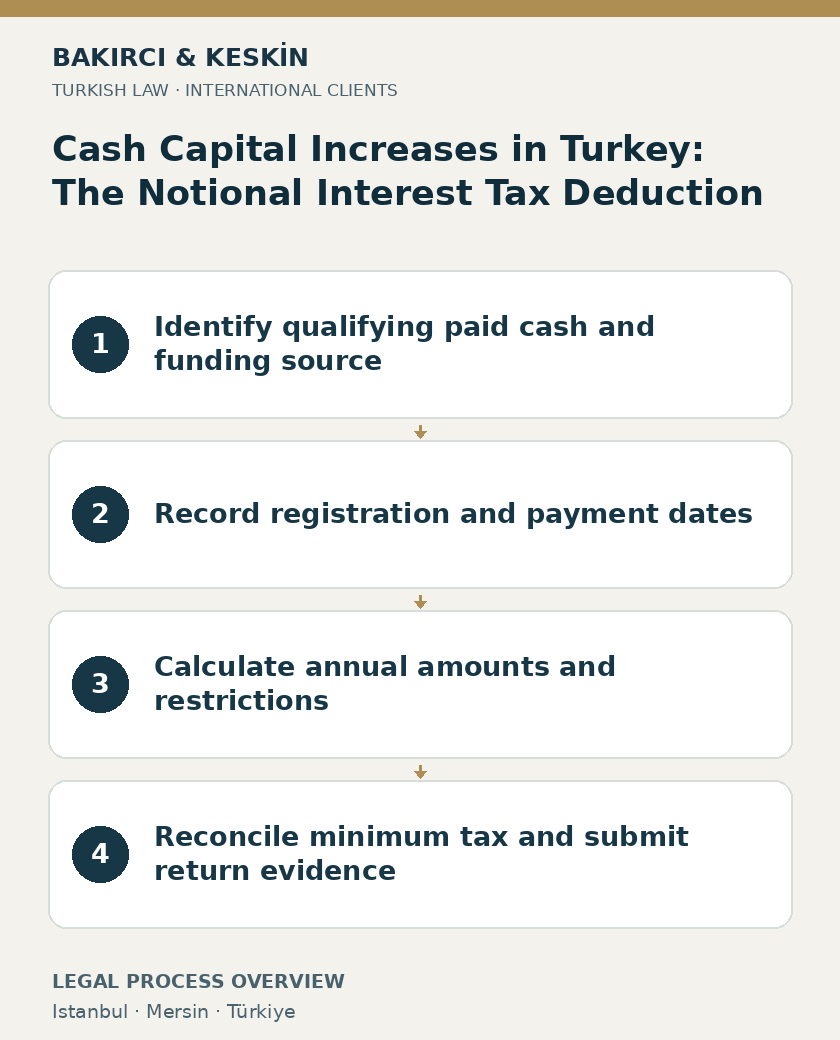
Short answer: Article 10(1)(ı) permits a qualifying deduction calculated from paid cash capital, the prescribed Central Bank interest rate, the applicable percentage and time. The foreign-cash percentage is 75%; the general percentage is 50%. Eligibility, five-period limits, carryforward and domestic minimum tax must be checked separately.
Have a general question about this article? Ask anonymously
Quick summary
| Legal issue | Cash Capital Increases in Turkey: The Notional Interest Tax Deduction |
|---|---|
| Short answer | Article 10(1)(ı) permits a qualifying deduction calculated from paid cash capital, the prescribed Central Bank interest rate, the applicable percentage and time. The foreign-cash percentage is 75%; the general percentage is 50%. Eligibility, five-period limits, carryforward and domestic minimum tax must be checked separately. |
| Key legislation | Corporate Tax Law No. 5520, Article 10(1)(ı), Article 32/C and Transitional Article 15(13); Corporate Tax General Communiqué No. 1, Section 10.6. |
A cash capital contribution can support a deduction from taxable profit
Corporate Tax Law No. 5520 Article 10(1)(ı) permits qualifying capital companies to calculate a deduction by reference to eligible cash capital, the prescribed commercial lending interest rate and the applicable deduction percentage. The amount is a deduction from corporate profit shown separately in the corporate tax return. It is not interest actually paid to the shareholder.
The general statutory percentage is 50%, with a 75% percentage for the portion of a qualifying cash increase met with cash brought from abroad. Those percentages apply to the calculated notional interest amount. They do not mean that half or three quarters of the contributed capital is repaid by the tax authority.
A foreign investor should establish eligibility, registration, payment dates, funding source and use of the money before including the deduction in a financial plan. The five-period calculation limit, carryforward rules and domestic minimum corporate tax must also be examined. A completed capital increase does not establish the final tax saving on its own.
Identify the company and the qualifying cash increase
Article 10(1)(ı) covers qualifying capital companies, excluding institutions operating in the finance, banking and insurance sectors and state economic enterprises. Section 10.6.2 of Corporate Tax General Communiqué No. 1 repeats these exclusions. Foreign ownership neither disqualifies an otherwise eligible company nor removes a sector exclusion.
The provision concerns registered cash increases in paid or issued capital and the cash-paid part of capital on formation of a new capital company. Section 10.6.1 explains the regime for qualifying registrations from 1 July 2015. Identify the registered transaction and the cash actually paid against it rather than treating every shareholder transfer as capital.
The joint-stock capital-increase guide addresses the separate corporate process. For the deduction, retain the registration record and bank evidence together. A proposed increase, unsigned subscription document or amount left unpaid does not establish a qualifying paid cash contribution under the tax rules.
Internal reserves, non-cash contributions and borrowed shareholder funds are excluded
The statute excludes increases arising from non-cash asset transfers, mergers, transfers and divisions, and capitalisation of equity accounts already appearing in the balance sheet. An increase in registered capital can therefore be valid under company law while producing no eligible cash amount for this deduction. The two conclusions address different legal questions.
It also excludes increases funded through credit or borrowing by shareholders or persons related to them within the stated Article 12 framework. The source of the subscription money must therefore be documented. A bank receipt into the company proves receipt but does not, by itself, resolve the exclusion concerning the contributor’s borrowed funding.
Section 10.6.1 additionally explains the exclusion of securities contributed instead of cash and increases implemented through offsets between balance-sheet accounts. Converting an existing account balance into capital is not automatically a new cash injection. Preserve the original financing and accounting entries rather than relying only on the final capital-account balance.
Separate the interest benchmark from the deduction percentage
The calculation uses eligible cash capital multiplied by the prescribed commercial lending interest rate, the applicable deduction percentage and the relevant time fraction. These are separate inputs. The amount calculated is then considered for deduction from corporate profit; it is not itself a credit directly subtracted from the tax payable.
The interest benchmark is the Central Bank’s last published rate for the relevant year for the defined weighted annual average Turkish-lira commercial lending series. Section 10.6.1 identifies the series excluding corporate overdraft accounts and corporate credit cards. The shareholder’s deposit rate, foreign borrowing rate or the company’s negotiated loan rate is not the prescribed substitute.
Use the publication applicable to the actual accounting period and retain its evidence with the calculation. This article does not assign a final 2026 year-end rate before that period has closed. A current financing quote or a rate from an earlier official illustration should not be presented as the rate governing the completed 2026 annual calculation.
Registration and actual payment determine the first calculation month
Sections 10.6.1 and 10.6.3.1 distinguish cash paid before registration from cash paid afterwards. For the part paid into the company’s bank account before registration, the registration date is used. For amounts actually paid after registration, the bank-payment date is used. The earlier board or shareholder decision date does not replace those rules.
The calculation counts the relevant starting month as a full month and uses the remaining months of the accounting period over twelve. Contributions paid in different months require separate timing records. Applying one starting month to the entire subscribed amount can overstate the deduction where some cash was deposited later.
The amount used is limited to cash actually deposited into the company’s bank account. The unpaid balance of a subscription is excluded until payment satisfies the relevant requirements. Delayed payment also does not create a fresh five-period registration window merely because a later instalment starts generating an eligible amount within the existing window.
A capital advance has specific accounting and same-period registration conditions
Section 10.6.3.1.1 addresses money deposited before the capital-increase decision as an advance intended to meet the future subscription. The company must record the money in the Other Capital Reserves equity account from the date of bank deposit. The capital-increase decision concerning it must be registered by the end of that same accounting period.
Where those conditions are satisfied, the relevant registration date is used for the deduction. The earlier deposit date does not itself start the calculation. Keep the original bank receipt, the account entry made from receipt and the registration record together, because each establishes a different condition in the advance rule.
The Communiqué excludes advances not capitalised within the accounting period of deposit. It also excludes amounts not recorded in the required equity account from receipt, even where a capital increase is completed within that period. A later change in the description of an ordinary shareholder loan does not establish the required original accounting treatment.
New annual deductions are calculated for five accounting periods
Under the current Article 10(1)(ı), the deduction is calculated separately for the accounting period in which the capital-increase decision, or the articles on initial formation, are registered and for the following four accounting periods. This is a total of five calculation periods, subject to continued satisfaction of the conditions.
The rule does not grant five complete years from the cash-payment anniversary. A late registration within an accounting period still uses that period as the first one, while the first-period calculation reflects the applicable months. Record both the registration-period window and the payment-based fraction; they serve different functions.
Section 10.6.3.2.1 applies this framework to increases from 5 July 2022. Maintain a separate schedule for each increase, showing its registration period and final eligible calculation period. Combining several increases into one undated total makes it difficult to identify when the right to calculate further annual amounts ends.
The transitional window for older increases runs through 2026
Provisional Article 15(13) governs companies that increased capital or were first established before the relevant 2022 amendment took effect. It applies the five-accounting-period rule starting with the 2022 accounting period. Section 10.6.3.2.2 identifies the resulting sequence through the 2026 accounting period for those earlier qualifying increases.
The transition should not be confused with restarting the window whenever a shareholder changes or an old contribution is reviewed. The underlying qualifying increase remains the reference transaction. Establish whether the increase belongs to the pre-5 July 2022 transition or the later registration-based rule before preparing the annual schedule.
The end of the period for calculating a new annual amount is also different from the use of an already calculated amount carried forward because profit was insufficient. The latter requires its own balance and supporting history. A statement that every benefit disappears after 2026 would ignore that separate carryforward rule.
Unused deductions can carry forward without indexation
Article 10(1)(ı) provides that amounts not deducted because the tax base is insufficient pass to subsequent accounting periods. Section 10.6.3.3 explains that the carried amount is used without indexation. The company must distinguish an unused amount already calculated from a request to calculate another annual amount after the permitted window.
The Communiqué preserves the use of qualifying unused amounts independently of the five-period limit on annual calculation. Keep a schedule recording the amount generated, the amount deducted in each return and the remaining balance. An unsupported total carried into a later return does not explain whether its original calculation was eligible.
Do not increase the unused balance automatically for inflation, a new Central Bank interest rate or the passage of another year. Those factors do not revalue a carried deduction under section 10.6.3.3. The later year’s applicable rate concerns a permitted new calculation, while the historic unused amount remains separately identifiable.
A later capital reduction changes the amount available for calculation
Section 10.6.3.4 provides that the part corresponding to a capital reduction ceases to support the deduction from the month following registration of the reduction decision. The calculation therefore needs the reduction’s registration date and amount. A full-year calculation based on the unreduced contribution would disregard this adjustment.
Section 10.6.3.4 also contains an adjustment for a reduction before a later cash increase. Read that text together with the amended section 10.6.3.2 and the final paragraph of section 10.6.3.4, which expressly preserve deduction for a subsequent qualifying increase within its applicable calculation window. Establish the dates, sequence and conditions of the actual increases and reductions. A company that previously reduced capital should not be described as permanently barred from claiming for every later cash increase.
The tax treatment of a capital reduction under Article 32/B is a separate question from the continued notional-interest deduction under Article 10(1)(ı). Record each analysis in the transaction file. A conclusion that a particular repayment has a stated distribution-tax treatment does not determine whether the cash-capital deduction continues unchanged.
The company’s income, assets and use of funds can produce a zero percentage
Section 10.6.4.2 sets out restrictions under Decision No. 2015/7910. It provides a zero percentage where at least 25% of income comes from the stated passive sources outside commercial, agricultural or professional activity conducted with proportionate capital, organisation and personnel. Zero also applies where at least 50% of assets comprise the specified affiliated securities, subsidiaries and participation interests. The defined activity and asset tests must be examined, not inferred from the company’s name.
It also applies zero to the relevant portion of increased cash capital contributed as capital to other companies or made available as loans. The Communiqué addresses recovery of a loaned amount separately, with renewed eligibility limited by the recovered amount and the applicable five-period framework. Maintain records of both the outgoing funding and any actual repayment.
The land-investment restriction applies to the corresponding amount, while the special investment-certificate provision must be checked on its own terms. The rules also contain a historic restriction linked to reductions between 9 March and 1 July 2015. These provisions require a review of the capital’s use and history before applying the general percentage to every lira received.
The 75% rule concerns cash brought from abroad
The second paragraph of Article 10(1)(ı) assigns 75% to the portion of a cash increase met with cash brought from abroad. The statutory criterion concerns the funding of that portion. It should not be replaced by a statement that all capital of any foreign-owned company automatically qualifies at 75%.
Keep the transfer records, contributor information, bank credit and subscription allocation together so that the foreign-funded portion can be identified. The other eligibility rules, including actual cash payment and the exclusions for borrowed shareholder funding, still require examination. An overseas origin does not by itself establish that every condition of the deduction has been met.
Section 10.6.4.1 separately describes percentage-point adjustments for qualifying listed companies and specified investment-certificate uses. Identify the exact provision supporting any adjustment rather than combining percentages without a legal basis. The calculation should explain the applicable percentage for each portion and should not describe the 75% factor as a 75% reduction in corporate tax payable.
Domestic minimum corporate tax requires a separate comparison
Article 32/C establishes the domestic minimum corporate-tax calculation, generally using 10% of the defined profit before the relevant deductions and exemptions, subject to its stated adjustments and exclusions. The cash-capital deduction in Article 10(1)(ı), with the Turkish dotless letter, is not among the deductions listed in Article 32/C(2) for subtraction in that calculation.
The company therefore needs both the ordinary corporate-tax calculation and the applicable minimum-tax comparison. A valid cash-capital deduction can reduce the ordinary base without delivering the same reduction in the final amount payable where the minimum controls. The nominal deduction amount should not be presented to the investor as a guaranteed cash tax saving.
Article 32/C(5) excludes newly commencing institutions from that provision for their first three accounting periods. Its applicability requires a separate review of the company’s position. The foreign-owned company tax guide provides the wider corporate-tax context; this deduction remains one component of the completed return rather than a replacement for that calculation.
File the annual calculation and the required bank evidence
The Revenue Administration announced that its 24 May 2026 Series No. 25 Communiqué addresses use of the cash-capital-interest deduction in the fourth provisional tax period. This affects the return-period workflow and does not replace the Article 10(1)(ı) conditions governing qualifying cash, the applicable deduction percentage or the five-accounting-period window. For a 2026 filing, reconcile the current provisional return instructions with the annual return and supporting bank and trade-registry records.
Section 10.6.5.1 explains that the new deduction is calculated for the annual accounting period because it uses the last published interest rate for the relevant year. Qualifying unused amounts from an earlier period can, however, be deducted in subsequent provisional-tax periods. The treatment of a carried balance should not be confused with prematurely calculating a new annual amount.
For a company with an approved special accounting period, section 10.6.5.2 uses the last published prescribed rate as of the month in which that period ends. The company’s actual accounting calendar therefore matters. A calendar-year rate should not be copied into a special-period computation without applying the stated rule.
Section 10.6.5.3 requires a bank-branch-approved account statement evidencing the actual cash deposit to be submitted on paper or electronically to the competent corporate-tax office within the corporate-tax return filing period. Information on the increased cash capital and deduction must also accompany the return. Preserve these submissions, the calculation schedules and the resulting carryforward balance as a single reviewable record.
Frequently asked questions
Is this a deduction of the capital contribution itself?
No. The deduction uses eligible cash capital, the prescribed interest benchmark, the applicable percentage and the time fraction. It reduces corporate profit under the stated conditions; it is not a repayment of capital or a direct tax credit.
Does foreign ownership automatically give the 75% percentage?
No. Article 10(1)(ı) applies 75% to the qualifying portion met with cash brought from abroad. The source and allocation of the funds and the remaining conditions must be established.
Can an unpaid capital subscription support the calculation?
No. The calculation is limited to the qualifying amount actually paid into the company’s bank account.
When does the first calculation month start?
For cash paid before registration, use registration; for cash paid afterwards, use the actual bank-payment date. The relevant starting month is counted as a full month.
Are ordinary shareholder loans eligible capital advances?
The advance rule requires the specified equity-account treatment from receipt and registration of the increase within the same accounting period. A loan label changed later does not establish those conditions.
How long can new annual amounts be calculated?
The current rule uses the registration accounting period and the following four periods. Earlier qualifying increases are subject to the transition running from 2022 through the 2026 accounting period.
Are unused deductions lost when the calculation window ends?
Qualifying amounts already calculated but unused because profit was insufficient can be carried forward under the separate rule, without indexation.
What happens after a capital reduction?
Section 10.6.3.4 removes the corresponding amount from the calculation starting with the month after registration of the reduction, and also addresses earlier reductions before a later increase.
Can the money be lent to another company without affecting the percentage?
Section 10.6.4.2 applies zero to the relevant portion contributed as capital or made available as loans, with specific rules for recovery of loaned amounts and the applicable period limit.
Does a qualifying deduction guarantee an equal reduction in tax payable?
No. It is a deduction from profit, and the applicable tax rate, available profit and domestic minimum-tax comparison affect the actual tax result.
Official legal sources
- Corporate Tax Law No. 5520: Article 10(1)(ı), Article 32/B, Article 32/C, Provisional Article 15(13).
- Corporate Tax General Communiqué No. 1: Sections 10.6.1–10.6.5.
Primary statutory comparison updated 1 November 2026; re-check for subsequent effective changes.
Revenue Administration: Corporate Tax General Communiqué amendment, Series No. 25 (24 May 2026) — covers the fourth provisional-tax-period treatment of the cash capital increase deduction.
Contact information
Do not include confidential documents or identity numbers in an initial message. An enquiry does not establish representation or suspend any legal deadline.
Istanbul and Mersin contact details
Bakırcı & Keskin Hukuk Bürosu has physical offices in Istanbul and Mersin. Turkish legal matters are handled under the competent jurisdiction and a properly agreed mandate. Both offices are mapped below.
Istanbul — Polaris Plaza
Maslak Ahi Evran Caddesi, Polaris Plaza No:21, Floor 9, 34475 Sarıyer/İstanbul, Türkiye.Mersin — Profit İş Merkezi
İhsaniye Mahallesi, 4903. Sokak, Profit İş Merkezi No:23, Floor 3, Office 14, 33070 Akdeniz/Mersin, Türkiye.+90 552 224 43 66 · Contact details in English. An enquiry does not establish representation or suspend a legal deadline.
Contact regarding a legal matter
In your first message, you may briefly state the subject, your country or city, and any relevant notification or recent procedural date. Please do not send identity numbers, medical data, or personal documents. Messaging alone does not constitute legal advice or create a lawyer–client relationship.
Discover more from Bakırcı & Keskin Hukuk Bürosu
Subscribe to get the latest posts sent to your email.