Tax on a Turkish Company Capital Reduction: The Five-Year Rules in Article 32/B
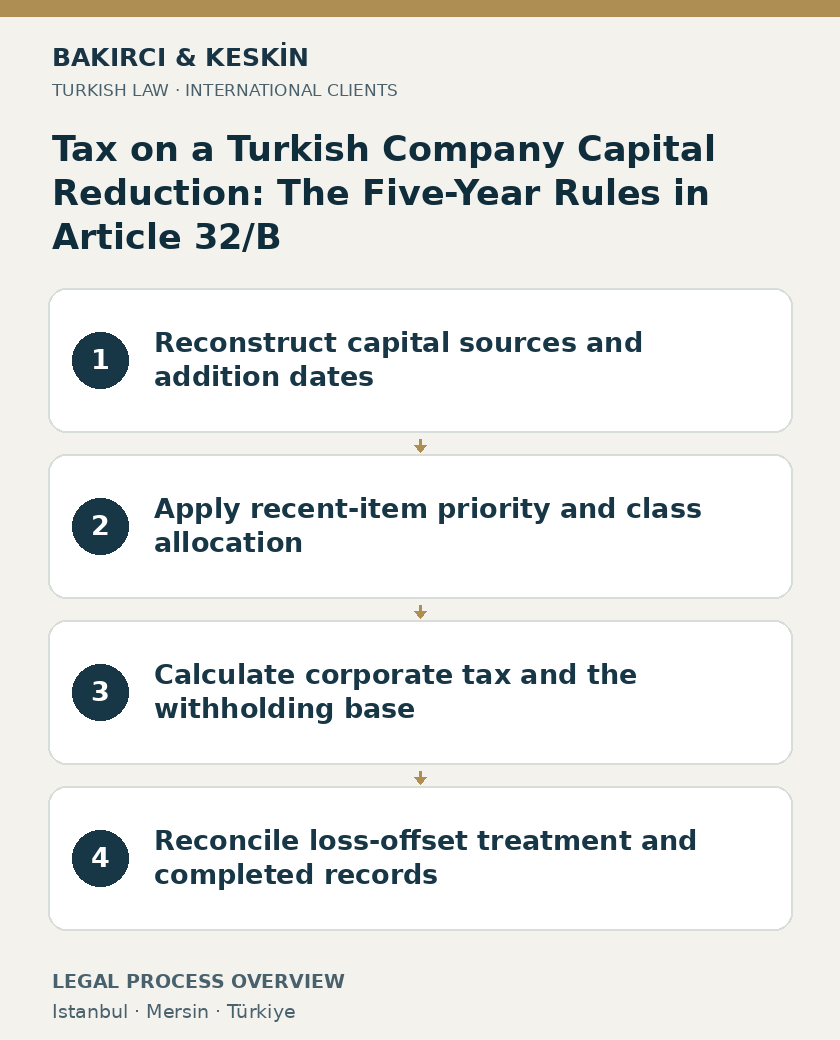
Short answer: Article 32/B allocates a capital reduction by the source and age of its components. Before five full years, the statutory taxable classes are used first; qualifying older amounts use proportions, with recent capitalised equity taking priority. Five years changes allocation, not automatically taxability. Loss-offset reductions have a separate withholding rule.
Have a general question about this article? Ask anonymously
Quick summary
| Legal issue | Tax on a Turkish Company Capital Reduction: The Five-Year Rules in Article 32/B |
|---|---|
| Short answer | Article 32/B allocates a capital reduction by the source and age of its components. Before five full years, the statutory taxable classes are used first; qualifying older amounts use proportions, with recent capitalised equity taking priority. Five years changes allocation, not automatically taxability. Loss-offset reductions have a separate withholding rule. |
| Key legislation | Corporate Tax Law No. 5520, Article 32/B; Corporate Tax General Communiqué No. 1, section 32.4; Turkish Commercial Code No. 6102, Articles 473–475. |
Capital reduction does not identify its tax treatment by its name
Corporate Tax Law No. 5520 Article 32/B determines which components of a company’s capital are treated as reduced and how those components are taxed. The registered capital figure can contain original cash, contributions in kind and amounts capitalised from other equity accounts. A resolution labelled return of capital does not itself establish that the whole amount is tax-free.
The provision uses both the source of the capital and the time elapsed since equity items were added to it. It contains an ordering rule for reductions before five full years, a proportional method after that period and a priority rule where components have different ages. The analysis must therefore reconstruct the capital account before applying a tax rate.
For a foreign investor, the company’s corporate reduction and the investor’s expected net payment are separate parts of the transaction. The amount legally reduced is not automatically the amount transferable without tax. Identify the operation, capital composition and recipient before approving a payment estimate.
Reconstruct the capital account from its actual sources
Obtain the incorporation and capital-increase records, registered resolutions, general ledger and the equity accounts from which amounts were transferred. Each capitalised amount should be traceable to its source and addition date. A current balance sheet showing a single capital total does not reveal all the information required by Article 32/B.
Separate original cash or in-kind contributions from capitalised profits, revaluation-related amounts and other equity items. The tax treatment of an equity account follows the relevant legislation governing that item. A generic accounting description such as reserves is not sufficient to place every component into one statutory class.
The joint-stock capital-increase guide explains the separate corporate process. Those historic decisions and registration records also help establish the capital’s composition for a later reduction. Preserve the supporting ledger transfers so that the tax analysis is based on the amount actually added, not a planned increase that was never completed.
Article 32/B uses three tax classes of capital components
The first class, in Article 32/B(1)(a), consists of equity items whose transfer, withdrawal or movement from capital to other accounts would trigger both corporate tax and withholding connected with profit distribution or remittance to the head office. These items cannot be treated as original untaxed contributed capital merely because they were previously moved into the capital account.
The second class, in paragraph (1)(b), consists of equity items subject only to the stated distribution or head-office-remittance withholding. The third, in paragraph (1)(c), concerns cash and in-kind capital whose transfer to another account or withdrawal would not be taxed under that classification. The classes carry different consequences.
Section 32.4.2 of Corporate Tax General Communiqué No. 1 explains the classification and the importance of identifying the component reduced. The analysis should state the legal basis for each component’s class. It should not replace the three statutory categories with an unsupported distinction between foreign-funded and domestically funded capital.
The same section distinguishes past-year profits, which carry the described distribution-withholding consequence, from certain revaluation funds and positive capital-adjustment differences carrying both charges on withdrawal. This distinction prevents the calculation from imposing corporate tax again merely because an item is a capitalised profit. Conversely, recording a taxable revaluation-related amount within capital does not convert its withdrawal into a repayment of original cash. The particular account’s governing provision remains necessary.
Original contributed capital must be distinguished from capitalised earnings
Cash paid by shareholders and amounts capitalised from earnings can appear in the same registered capital total. Article 32/B requires their sources to remain distinguishable. The existence of sufficient historic cash contributions does not, by itself, permit the company to choose those contributions as the exclusive source of every later reduction.
The statutory ordering and proportional rules determine which amounts are treated as reduced. A resolution expressing a commercial wish to repay only cash contributions must therefore be reconciled with those rules. The source schedule should show what capital is available in each class and which allocation method applies.
Contributions in kind also appear in the third statutory class where they have the described non-taxable withdrawal character. Their identification requires the contribution and valuation record, not merely a current asset list. A company asset acquired later in ordinary business is not, for that reason alone, proof of an original in-kind capital contribution.
Before five full years, the statute applies the taxable classes first
Article 32/B(2) addresses reduction before five full years have elapsed from the addition of the equity items to capital. It treats the reduction as coming first from class (a), then class (b), and then class (c). Section 32.4.4 of the Communiqué explains that same ordering.
The first allocation therefore uses the components subject to both corporate tax and withholding, followed by withholding-only components and then the relevant cash or in-kind capital. The company cannot substitute a proportional calculation merely because that would produce a lower tax amount before the statutory time condition is satisfied.
Apply the sequence to the actual reduction amount and available component balances. The worksheet should show how much of each class is exhausted and where the remaining reduction falls. An overall effective tax percentage selected without that allocation does not demonstrate compliance with Article 32/B.
After five full years, qualifying components are allocated proportionately
Article 32/B(1) provides a proportional method once five full years have passed from the addition of the relevant equity items to capital. Cash and in-kind capital and the other components are compared with total capital to identify the composition of the reduced amount. The relevant class proportions determine the allocation.
Section 32.4.3 states that the proportions use the three classes described in the Communiqué, rather than another invented grouping. The calculation should therefore reconcile each component with its class, determine the class’s share of the relevant total and apply that proportion to the reduction under the applicable framework.
Passing five years does not erase the tax character of the capitalised items. It changes the allocation method from the statutory priority sequence to the proportional method where its conditions are met. The resulting reduced amount can still include components subject to corporate tax, withholding or both.
Recent capitalised equity is treated as withdrawn first
Article 32/B(3) gives priority to capitalised equity items whose addition date has not passed the five-full-year threshold. This matters where a company has several capital increases and some components are older than others. The company’s age is not a substitute for the age of each relevant capitalised item.
Section 32.4.5 explains that the recent components are reduced first. The statutory class order applies to those components, and the remaining reduction is then assessed against the remaining capital under the applicable proportional framework. The calculation should show the separate stages rather than average all capital together at the outset.
Prepare a schedule with source, addition date, balance and age classification. Reconcile the recent amounts allocated first with the amount left to be allocated. A single average holding period or a statement that most capital is old does not establish the priority required by paragraph three.
The five-year period concerns addition to capital, not when the profit was earned
The statutory period runs from the date the equity item was added to capital. The date the company originally earned a profit, acquired an asset or opened a reserve account is not automatically that date. The actual capitalisation event must be established from the corporate and accounting records.
The Communiqué’s application uses the relevant capital-registration record in identifying the capitalisation and reduction history. Preserve the decision, registration and accounting entries together and resolve inconsistent dates before finalising the age analysis. A board proposal that precedes completion should not silently be used as if capitalisation had already occurred.
The wording is five full years, not simply appearance in five annual balance sheets. Identify the exact relevant dates and whether the statutory period has elapsed. For multiple additions, perform the analysis for each component rather than using the company’s earliest capital increase as a date for the entire current balance.
For the first class, withholding follows deduction of corporate tax
Article 32/B(4) subjects the class (a) amounts identified through the preceding allocation rules to corporate tax and withholding, and the class (b) amounts to withholding only. The classification step therefore precedes both calculations. A company should not apply withholding to an unexplained total without identifying which components it contains.
For a component subject to both taxes, the withholding base is the amount remaining after the calculated corporate tax has been deducted. The article then refers to the applicable withholding provisions in Articles 15 and 30 of the Corporate Tax Law and Article 94 of the Income Tax Law. The stages must remain visible in the calculation.
That sequencing should not be replaced by applying both taxes independently to the same gross figure. Nor should an illustrative rate from an older publication be treated as the current rate for every recipient. Establish the applicable period, corporate category and withholding position before calculating the actual liability and net amount.
A reduction to offset past-year losses excludes the stated withholding
Article 32/B(5) separately addresses capital reduction through offset of past-year losses. The components reduced are still identified under paragraphs one, two and three, but the withholding described in paragraph four is not applied to those amounts. The relief concerns the stated withholding consequence of that loss-offset operation.
Section 32.4.6 explains that the operation does not constitute a cash or book payment to shareholders for the described distribution or head-office-remittance purpose. The actual loss and the accounting reduction must therefore be established. Merely naming a shareholder repayment loss coverage does not prove that the statutory operation occurred.
The same section preserves corporate taxation where the allocated reduction includes a component that is taxable at corporate level. A reduction used to cover losses should therefore not be described as automatically exempt from every tax. The component allocation and remaining corporate-tax consequence must still be calculated.
Foreign ownership does not replace the allocation rules
Article 32/B classifies the company’s capital components rather than creating a general exemption based on a shareholder living abroad. Establish the legal recipient and the nature of the resulting amount. A foreign individual, foreign corporation and head-office remittance are not interchangeable descriptions for withholding purposes.
The paragraph-four references to the applicable withholding provisions require their own recipient and payment analysis. Any treaty claim also requires the actual agreement, recipient status and supporting evidence. This article does not assign one universal withholding percentage to every capital reduction involving an overseas investor.
The foreign-owned company tax guide explains the separation between the Turkish company and its shareholders. The company’s corporate-level charge and the tax associated with an amount attributed to the recipient should be recorded separately. Combining them into one figure without showing the statutory bases obscures the calculation.
A tax calculation does not replace the corporate reduction process
For a joint-stock company, Commercial Code Articles 473–475 govern the separate capital-reduction process, including the corporate decision and creditor-protection framework. Article 32/B answers which capital components are reduced for tax purposes. Satisfaction of one framework should not be reported as automatic completion of the other.
The corporate documents should describe the actual purpose and amount of the operation consistently with the tax worksheet. A reduction to return value and a reduction to eliminate accumulated losses have different factual records. Resolve any mismatch before the company reports a net payment or a completed restructuring to foreign shareholders.
The legal and accounting completion record should distinguish the approved reduction, registration, allocated tax components, tax declarations and any shareholder payment. Those events can have different dates and documentary proof. A resolution alone does not establish that every tax amount has been declared or that funds have actually been returned.
Prepare a component-by-component reduction calculation
A reviewable calculation begins with total capital reconciled to its underlying sources. It then records each capitalised item’s addition date and statutory class, applies the recent-component priority where relevant, and allocates the reduction through the required order or proportions. Keep each step connected to the supporting records.
Next identify the corporate-taxable portion, the withholding-only portion and the relevant non-taxable contributed-capital portion. Apply the loss-offset rule only to the operation it governs, and show the corporate-tax deduction before determining the class (a) withholding base. The final total should reconcile with the actual amount reduced.
Retain the source accounts, historic registrations, calculation, current tax provisions and completed declaration and payment records. The result should explain the tax effect of the particular reduction without asserting that five years automatically makes capital tax-free or that a shareholder’s description can override the statutory allocation.
Frequently asked questions
Is a payment described as returned capital automatically tax-free?
No. Article 32/B identifies which capital components are treated as reduced and applies the relevant tax character to those components.
Which three classes does Article 32/B use?
Components subject to corporate tax and withholding, components subject only to the stated withholding, and cash or in-kind capital with the described non-taxable withdrawal character.
What is the allocation before five full years?
Article 32/B(2) applies class (a), then class (b), then class (c), subject to the relevant component and timing analysis.
Does passing five years remove all tax?
No. It permits the proportional allocation method where its conditions are met. The tax character of the allocated components remains relevant.
What happens where capital contains both recent and older capitalised equity?
Paragraph three gives priority to the items whose addition dates have not passed the five-full-year threshold. The remaining reduction then follows the applicable remaining-capital calculation.
Does the age of the original profit determine the five-year period?
The statutory period concerns when the equity item was added to capital. The earning date and capitalisation date must not be assumed identical.
Is withholding on class (a) calculated before corporate tax?
Article 32/B(4) uses the amount remaining after calculated corporate tax has been deducted as the withholding base.
Does a loss-offset reduction always avoid corporate tax?
No. Paragraph five excludes the stated withholding, while the Communiqué preserves corporate taxation of allocated components that carry that tax character.
Can the company simply elect to reduce only cash contributions?
The allocation must follow the statutory ordering, proportional and recent-component priority rules. A commercial label or resolution does not replace them.
Does foreign ownership change the capital-component allocation?
Article 32/B does not create a general foreign-owner exemption. Recipient status, applicable withholding provisions and any treaty treatment require their separate analysis.
Official legal sources
- Corporate Tax Law No. 5520: Article 32/B.
- Corporate Tax General Communiqué No. 1: Sections 32.4.1–32.4.6.
- Turkish Commercial Code No. 6102: Articles 473–475.
Primary source comparison updated on 1 November 2026. Check any later amendments before taking legal action.
Official Gazette — Corporate Tax General Communiqué amendment (Series No. 21), 1 March 2023
Contact information
Do not include confidential documents or identity numbers in an initial message. An enquiry does not establish representation or suspend any legal deadline.
Istanbul and Mersin contact details
Bakırcı & Keskin Hukuk Bürosu operates physical offices in Istanbul and Mersin. Turkish legal matters are handled in accordance with the competent jurisdiction and the agreed mandate. Both office locations are shown below.
Istanbul — Polaris Plaza
Maslak Ahi Evran Caddesi, Polaris Plaza No:21, Floor 9, 34475 Sarıyer/İstanbul, Türkiye.Mersin — Profit İş Merkezi
İhsaniye Mahallesi, 4903. Sokak, Profit İş Merkezi No:23, Floor 3, Office 14, 33070 Akdeniz/Mersin, Türkiye.+90 552 224 43 66 · Contact details in English. An enquiry does not establish representation or suspend a legal deadline.
Contact regarding a legal matter
In your first message, you may briefly state the subject, your country or city, and any relevant notification or recent procedural date. Please do not send identity numbers, medical data, or personal documents. Messaging alone does not constitute legal advice or create a lawyer–client relationship.
Discover more from Bakırcı & Keskin Hukuk Bürosu
Subscribe to get the latest posts sent to your email.