Challenging a Paternity Acknowledgment in Turkey: Claimants, Proof and Time Limits
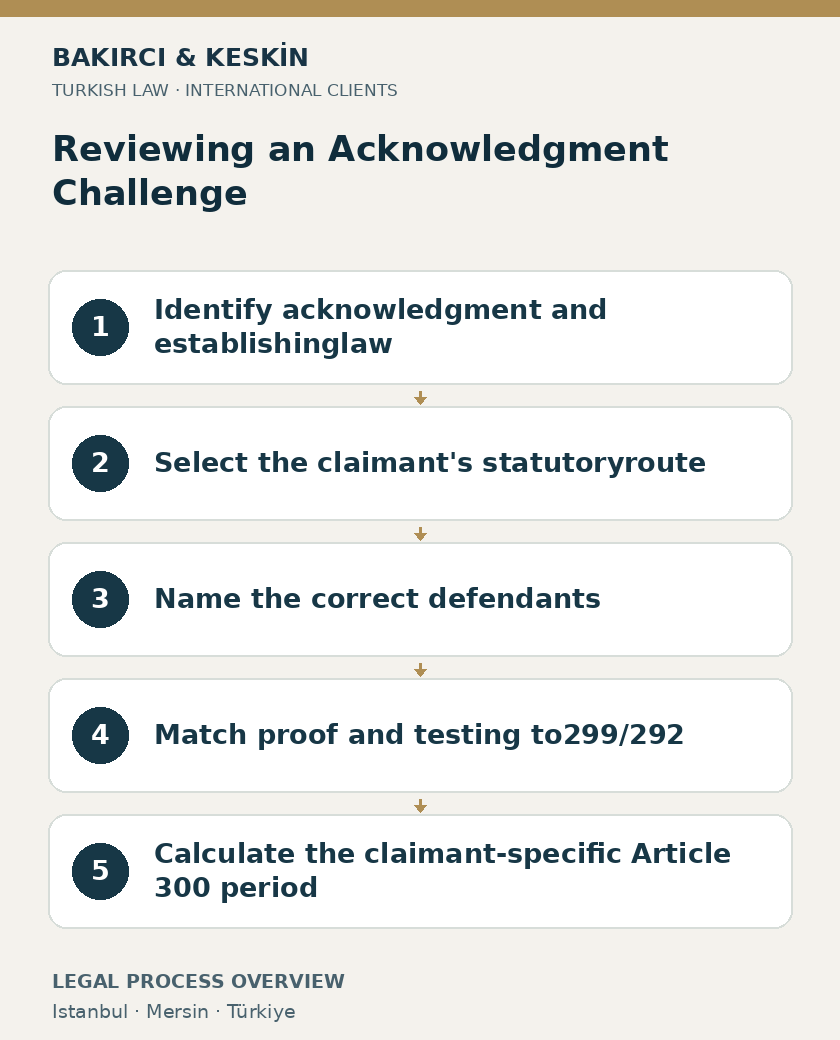
Short answer: Where Turkish law governs cancellation of an acknowledgment of paternity, Civil Code Articles 297–300 distinguish the acknowledging father’s action from an action brought by the mother, child or another entitled person. The defendants, proof and filing periods differ. Article 300 includes separate one-year and five-year rules, a special rule for the child and a one-month route where a justified reason explains delay. In an international case, first identify the law under which parentage was established under MÖHUK Article 16(2).
Have a general question about this article? Ask anonymously
Quick summary
| Legal issue | Challenging a Paternity Acknowledgment in Turkey: Claimants, Proof and Time Limits |
|---|---|
| Short answer | Where Turkish law governs cancellation of an acknowledgment of paternity, Civil Code Articles 297–300 distinguish the acknowledging father's action from an action brought by the mother, child or another entitled person. The defendants, proof and filing periods differ. Article 300 includes separate one-year and five-year rules, a special rule for the child and a one-month route where a justified reason explains delay. In an international case, first identify the law under which parentage was established under MÖHUK Article 16(2). |
| Key legislation | Turkish Civil Code No. 4721 — Articles 282, 283, 284, 295, 296, 297, 298, 299, 300; Private International and Procedural Law No. 5718 — Articles 16, 17, 40; Code of Civil Procedure No. 6100 — Articles 292 |
1. Identify how the legal parent-child relationship was established
Civil Code Article 282 identifies marriage to the mother, acknowledgment and judicial decision as ways in which the paternal relationship is established, with adoption separately addressed. Those routes do not produce one interchangeable challenge procedure. Before invoking Articles 297–300, establish that the relationship being challenged rests on an acknowledgment.
A birth certificate showing a father’s name does not necessarily explain the legal route. Obtain the underlying registration material, declaration or judgment. A relationship arising from the marital presumption requires examination of the corresponding rules, while a final judicial parentage determination presents a different procedural issue. The action should be selected from the legal source of parentage rather than the result printed in a register.
Article 295 also states that a child already linked to another man cannot be acknowledged until that relationship is invalidated. This is relevant where the records show more than one asserted paternal connection. Identify the existing legal relationship and its status before assuming that a later declaration automatically replaced it or that cancellation of the later declaration resolves everything.
2. In an international case, cancellation follows the law that established parentage
MÖHUK Article 16(2) provides that parentage is annulled under the law by which it was established. A Turkish filing does not alone make Turkish substantive cancellation rules applicable. The first task is to identify the establishing law through the relevant conflicts framework and the actual acknowledgment or other legal act.
The international parentage guide explains Article 16’s establishment sequence. For the present action, record the child and parents’ relevant nationalities, residence connections and the instrument used. Then determine whether Turkish Articles 297–300 govern the challenge or whether foreign substantive grounds and filing periods must be established.
The remainder of this article describes the Turkish-law acknowledgment challenge. It should not be applied mechanically to every foreign birth record. Jurisdiction, procedure, the legal effect of a foreign judgment and applicable substantive law remain distinct. A reliable review labels each issue so that evidence of biological relationship is not used as a substitute for selecting the governing legal rule.
3. Obtain the declaration and its notification history
Article 295 permits acknowledgment through the father’s written application to the population officer or court, or a declaration in an official instrument or will. Where the person acknowledging is a minor or under restriction, the parent or guardian’s consent is also required. Obtain the complete act, its date and any relevant consent instead of relying on a later summary.
Article 296 regulates notification to the relevant population offices and onward notification to the child, mother and, where the child is under guardianship, the guardianship authority. The notification record can help establish when persons learned of the acknowledgment. It should be retained with the declaration and current registry extract, particularly where Article 300’s knowledge dates are disputed.
Check names, dates of birth and identity numbers across the documents. If the acknowledgment was made in a will, distinguish the testamentary instrument, opening record and notification. A document’s execution date and the date the claimant learned of it can differ. Those dates perform different roles in the filing-period analysis and must not be silently substituted for one another.
4. Article 297 gives the acknowledging father a defined challenge
Under Article 297, the person who acknowledged paternity can seek cancellation for mistake, deception or intimidation. The claim must identify the alleged defect in the acknowledgment and the supporting facts. A later change of intention, disagreement about maintenance or breakdown of the relationship is not itself one of the grounds named in that provision.
The statutory action is brought against the mother and the child. Naming only a population office does not address Article 297’s defendant structure. The child’s independent procedural position must be respected, including any representation issue arising from conflicting interests. The identity of the appropriate representative requires assessment before service and substantive proceedings are planned.
Genetic evidence can be relevant, but the petition still needs to explain the Article 297 ground. Identify what the acknowledging person believed, what information was supplied or concealed and how the alleged intimidation operated. The evidence should connect those facts to the declaration, rather than assume that every later biological dispute produces the same cancellation right for every claimant.
5. Article 298 identifies additional persons entitled to challenge
Article 298 names the mother, child and, if the child has died, the child’s descendants. It also identifies the public prosecutor, Treasury and other interested persons. A person relying on the final category should explain the legally relevant interest. A family relationship or disagreement should not be treated as automatic proof of standing without connecting it to the action.
This action is directed against the acknowledging person or, if that person has died, the heirs. The defendant structure therefore differs from Article 297. Obtain the death and inheritance information where relevant so that the case is directed to the proper parties. Filing against the most accessible relative does not resolve which heirs or representatives must participate.
The claimant’s capacity also matters for deadlines and proof. Identify whether the case is brought by the mother in her own capacity, by or for the child, or by another interested person. A petition that switches between those positions without explanation can obscure the applicable statutory rule and the child-specific protection in Article 300.
6. Article 299 contains a special sequence for a mother or child
Article 299 generally places the burden of proving that the acknowledging person is not the father on the claimant. Its second paragraph provides a particular rule where the mother or child brings the action alleging non-paternity. Their burden arises after the acknowledging person presents convincing evidence of sexual relations with the mother during the conception period.
This sequence should be stated accurately. It does not make every claimant subject to an identical evidential starting position, and it does not itself establish a biological conclusion. The court must assess the relevant material within the statutory framework. Identify the claimant category and the evidence concerning the conception period before presenting a broad assertion about who must prove what.
Article 284 provides for judicial investigation of material facts in parentage cases and assessment of evidence. The parties should nevertheless provide a coherent and lawful evidence file. A court’s investigative role is not a reason to withhold available records, omit relevant dates or replace factual allegations with a request that the court discover the entire case unaided.
7. Genetic testing must be connected to the judicial process
Code of Civil Procedure Article 292 regulates taking blood or tissue to establish parentage where necessary to resolve the dispute, consistent with scientific data and without a health danger. It provides for a judicial order using force where a person fails to comply without a justified reason. The court controls that statutory process.
A privately obtained test requires assessment of identity, sample provenance, methodology and evidential usability. Its existence should not be presented as automatically changing the civil register or cancelling the acknowledgment. Provide the complete report and explain how it was obtained so that counsel can assess its role alongside the court’s evidential directions.
Where participants live in different countries, identify their locations and the practical availability of the samples requested by the court. Do not assume that an overseas laboratory appointment implements a Turkish judicial direction without coordination. Preserve the report’s identifiers and accompanying records so that the tested persons can be connected to the parties. The evidence must answer the relationship being litigated, with a reliable explanation of whose samples were examined.
The same provision prevents a third person from avoiding the obligation merely by invoking a right to refuse witness testimony. This does not eliminate the conditions concerning necessity, science and health. The requested investigation must remain tied to the legally relevant parentage dispute, with the appropriate procedural safeguards and an accurate record of the court’s order.
8. The acknowledging father’s Article 300 periods depend on the alleged ground
For the acknowledging person, Article 300 provides one year from learning the cancellation ground or from the end of the effect of intimidation, with a five-year outer period from acknowledgment. These are statutory forfeiture periods governing the right to sue. They should not be described simply as an ordinary debt limitation that the parties can ignore unless someone raises a defence.
Create a chronology of acknowledgment, the alleged mistake or deception, discovery and any relevant intimidation. Identify the evidence for each date. The date of a later medical report can be relevant without necessarily being the first date the ground was known. Earlier correspondence or information may affect the calculation and must be disclosed rather than excluded from the file.
The five-year element also requires the actual acknowledgment date, not merely the date a new registry extract was obtained. Where the record is unclear, request the underlying act promptly. The justified-delay rule in Article 300 must be considered separately; uncertainty about dates should not be converted into an assumption that the right remains available indefinitely.
9. Other claimants and the child have distinct Article 300 rules
For interested persons, Article 300 connects the one-year period to learning both of the acknowledgment and that the acknowledging person cannot be the child’s father, with a five-year outer period from acknowledgment. The two knowledge elements must be identified. A date showing awareness of the registration alone does not necessarily establish the second element.
The article separately states that the child’s right of action expires one year after becoming an adult. This special paragraph should not be obscured by mechanically applying the ordinary adult claimant’s timetable to the child’s position. Establish the legally relevant adulthood date and whether the proceeding is the child’s own claim or another person’s claim.
A parent should not assume that expiration of the parent’s period necessarily disposes of the child’s separate right. Equally, the child’s rule should not be used to extend a different claimant’s personal period without a legal basis. Maintain separate claimant-and-date entries in the case analysis, even where the same documents support more than one person’s factual position.
10. A justified reason for delay creates a specific one-month question
The final paragraph of Article 300 permits filing within one month after a reason justifying delay has ceased, even where the earlier periods have passed. The reason, its effect on delay and its ending date require evidence. The provision should not be described as an automatic extension granted whenever a claimant lives abroad or was unfamiliar with Turkish procedure.
Prepare the chronology and supporting records for the alleged impediment. Explain when the person became able to act and why the filing falls within the one-month period. The court must assess the justification under the provision. A general request for fairness without the relevant facts leaves both the reason and the statutory timing unanswered.
Do not postpone review while waiting for every evidential item to arrive. The immediate task is to identify the applicable right and dates so that counsel can determine the lawful step needed. Family negotiations or informal promises to correct the record should not be assumed to preserve a forfeiture period or replace the required judicial procedure.
11. Choose the court and representation through the correct legal framework
Article 283 provides the domestic territorial rule for parentage cases by reference to a party’s domicile at filing or birth. International jurisdiction must then be assessed through MÖHUK’s applicable provisions and treaty rules. Family Courts Family Courts Law No. 4787 supplies the family-court framework. The foreign location of one person requires analysis, rather than an assumption that no Turkish forum exists.
Where the child requires representation and a conflict exists, the representation issue must be resolved separately from the adult’s own instruction to a lawyer. A power of attorney cannot cure an underlying lack of authority to act for the child. The overseas power of attorney guide explains the preparation of authority once the proper instructing capacity is established.
12. Keep parentage, registration and related obligations distinct
The claim concerns the legal parent-child relationship created by acknowledgment. The resulting register implementation must follow the operative judgment and applicable procedure. A private agreement between adults or an informal letter to a registry should not be treated as equivalent to a final cancellation judgment resolving the legal relationship.
Maintenance, nationality, inheritance and parental-responsibility consequences require their own analysis. Article 17 separately regulates the effects of parentage in international cases, subject to other applicable rules. The action should not promise automatic reimbursement of every earlier payment or immediate resolution of every related right merely because acknowledgment is challenged.
13. Prepare a dated, claimant-specific file for counsel
Provide the acknowledgment, notification history, current civil-status record, relevant marriage records, nationality information and the evidence supporting the chosen ground. Add a chronology of discovery, adulthood and any alleged impediment. Identify each proposed claimant and defendant. This permits the different Article 297, 298, 299 and 300 rules to be applied without conflating the parties’ positions.
For foreign material, supply the complete document and information about its issuer, authentication and translation. Keep original testing and court records intact. The central task is to connect the correct cancellation law, entitled claimant, proper defendants, proof and filing period. Resolving only the biological question leaves several legally decisive parts of an acknowledgment challenge unanswered.
Frequently asked questions
Is cancellation of acknowledgment the same as denying marital paternity?
No. First identify how parentage was established. Articles 297–300 concern acknowledgment, while a marital presumption or judicial determination raises a different legal route. The registry entry alone may not identify the underlying act.
Does Turkish cancellation law always apply in a Turkish court?
No. MÖHUK Article 16(2) connects cancellation to the law under which parentage was established. Turkish filing does not by itself select Turkish substantive grounds and periods.
On what grounds can the acknowledging father sue?
Article 297 names mistake, deception and intimidation. The claim must establish the relevant ground and is directed against the mother and child. A change of intention is not itself one of the named grounds.
Who else can challenge the acknowledgment?
Article 298 names the mother, child, the child’s descendants after the child’s death, public prosecutor, Treasury and other interested persons. The action is against the acknowledging person or that person’s heirs if deceased.
Who proves that the acknowledging person is not the father?
Article 299 states the general claimant burden, with a special sequence for the mother or child. Their burden arises after convincing evidence of sexual relations during the conception period is presented by the acknowledging person.
Does a private DNA result automatically cancel the record?
No. The report requires evidential assessment and does not itself replace a legal cancellation process. HMK Article 292 governs necessary, scientifically appropriate and medically safe judicial testing and compliance.
What period applies to the acknowledging father’s claim?
Article 300 provides one year from learning the ground or the end of intimidation’s effect, and five years from acknowledgment, subject to the separate justified-delay rule. Establish the relevant dates from evidence.
Does the child have a separate period?
Yes. Article 300 separately provides one year from becoming an adult. Distinguish the child’s claim from a parent’s or another interested person’s personal action and timetable.
Can a late action still be brought?
Article 300 permits filing within one month after a reason justifying delay ends. The reason and ending date must be established; foreign residence or lack of familiarity with procedure does not automatically prove the exception.
Does cancellation automatically settle support and nationality issues?
Those consequences require separate legal and procedural assessment. Do not assume that challenging acknowledgment itself changes every register or reverses every payment. Identify the operative decision and the rules governing each related issue.
Official legal sources
- Turkish Civil Code No. 4721 — Articles 282, 283, 284, 295, 296, 297, 298, 299, 300
- Private International and Procedural Law No. 5718 — Articles 16, 17, 40
- Code of Civil Procedure No. 6100 — Articles 292
- Family Courts Law No. 4787 — Articles 2, 4
Legal sources reviewed on 28 October 2026. The official Turkish legislation controls; individual facts and later amendments must be checked before action.
Contact information
Do not include confidential documents or identity numbers in an initial message. An enquiry does not establish representation or suspend any legal deadline.
Istanbul and Mersin contact details
Bakırcı & Keskin Law Office is Mersin-based. Turkish matters are handled under the applicable jurisdiction and agreed mandate. The competent court and the scope of representation are assessed for each matter.
Istanbul — Polaris Plaza
Maslak Ahi Evran Caddesi, Polaris Plaza No:21, Floor 9, 34475 Sarıyer/İstanbul, Türkiye.Mersin — Profit İş Merkezi
İhsaniye Mahallesi, 4903. Sokak, Profit İş Merkezi No:23, Floor 3, Office 14, 33070 Akdeniz/Mersin, Türkiye.+90 552 224 43 66 · Contact details in English. An enquiry does not establish representation or suspend a legal deadline.
Istanbul Office – Polaris Plaza, Maslak / Sarıyer
Bakırcı & Keskin Hukuk Bürosu
Maslak Ahi Evran Caddesi, Polaris Plaza No:21, Kat:9, 34475 Sarıyer/İstanbul
Our physical offices in Istanbul and Mersin coordinate matters throughout Turkey, subject to jurisdiction and the local steps required for each case. Please specify your preferred office when arranging an in-person appointment.
Open the Istanbul office on Google Maps · Contact and appointments
Contact regarding a legal matter
In your first message, you may briefly state the subject, your country or city, and any relevant notification or recent procedural date. Please do not send identity numbers, medical data, or personal documents. Messaging alone does not constitute legal advice or create a lawyer–client relationship.
Discover more from Bakırcı & Keskin Hukuk Bürosu
Subscribe to get the latest posts sent to your email.