Conditional Capital Increase in Turkey: Convertible Debt, Employee Share Rights and Articles 463–472
Short and direct answer: Under Turkish Commercial Code Articles 463–472, a joint-stock company can establish conditional capital so specified creditors holding newly issued convertible debt instruments and employees acquire new shares through valid conversion or purchase rights. The aggregate nominal conditional increase cannot exceed half of the company’s capital under Article 464. Rights granted before registration of the enabling clause are void under Article 465(3). Capital increases when qualifying rights are exercised and the corresponding capital obligation is performed by payment or set-off; the board registers the resulting amendment within three months after the accounting period closes under Article 471. Article 469’s old transaction-auditor requirement was repealed in 2012 and must not be applied as current law.
Have a general question about this article? Ask anonymously
This guide addresses foreign investors using convertible finance and Turkish companies offering qualifying employee participation. It separates the registered authorization, issue of valid rights, their actual exercise, the legal moment of shareholder acquisition and the later period-end trade registry recording. It also reviews shareholder protection, dilution and the 2012 amendments that corrected several provisions still reproduced incorrectly in some older legal materials.
Quick summary
| Core law | Turkish Commercial Code Articles 463–472, as amended by Law No. 6335 |
|---|---|
| Beneficiaries | Specified bond or similar debt holders and employees under Article 463 |
| Aggregate ceiling | Nominal conditional capital not more than half of capital; Article 464 |
| Critical validity rule | Grant of rights before registration of enabling articles void; Article 465(3) |
| Legal trigger | Exercise plus payment or set-off; Article 463(2) |
| Registry timing | Three months after close of accounting period; Article 471 / Registry Regulation 77 |
First distinguish a conditional increase from ordinary cash subscriptions
Articles 463–472 of Turkish Commercial Code No. 6102 govern a special mechanism for a joint-stock company to issue new shares when holders of valid conversion or purchase rights exercise them. This is different from an immediate conventional cash capital increase under Articles 456–461 or a capitalization of company reserves under Article 462. In a conditional increase, the articles of association establish a capacity, and the registered capital changes automatically when qualifying rights are actually exercised and the related capital debt is performed as prescribed.
The transaction should be classified from the signed financing documents, not just from a presentation to overseas investors. A convertible bond, an employee share-option arrangement and an ordinary private sale of existing shares have different legal events. In the conditional mechanism, new shares are acquired through rights authorized by the corporate articles. A sale of existing shareholders’ shares is a separate transfer transaction and does not increase the company capital merely because the seller receives a large price.
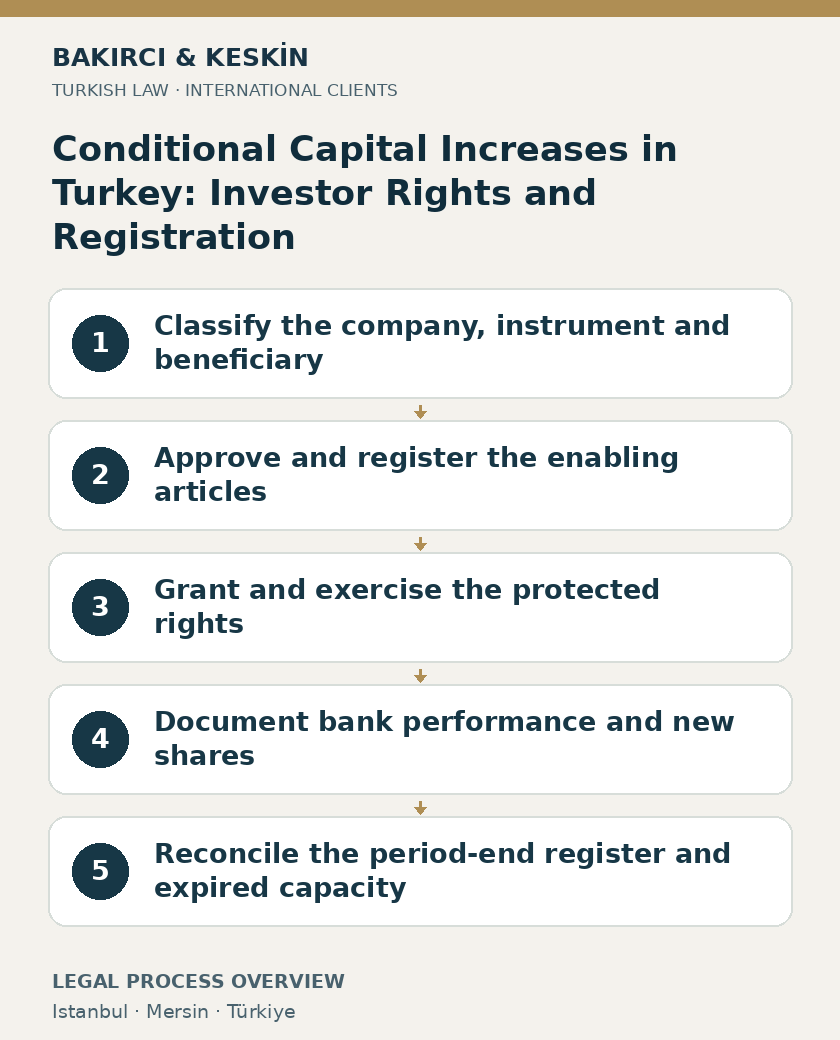
For a foreign lender, the key practical distinction is when an enforceable conversion right arises, how it is exercised, and how the company’s nominal capital and shareholders’ rights change. A funding term sheet promising a future conversion does not itself prove the statutory enabling clause was registered. The legal file must keep the agreement, corporate authorization, registration, actual exercise, payment or set-off, and period-end reconciliation in separate dated records.
Article 463 identifies the eligible beneficiaries and the corporate decision
Article 463(1) allows the general assembly to decide on conditional capital increases by providing conversion or purchase rights for persons who are creditors of the company or group companies as a result of newly issued bonds or similar debt instruments, or for employees. The applicable beneficiary class and instrument must be identified in the articles and the financing documents. An unrelated trade creditor does not automatically acquire a statutory conversion right simply because the company owes it money.
The reference to employees is commercially relevant to structured employee participation plans, but it does not turn every informal promise of shares into an established conditional increase. The company’s general assembly must adopt the necessary articles framework, and the other statutory requirements must be respected. The employee’s employment contract, plan rules and actual right of acquisition must be compared with the approved and registered articles rather than treated as substitutes for them.
Article 463(2) then describes the legally significant event: the increase occurs automatically when the conversion or purchase right is exercised and the share-capital obligation is fulfilled by payment or set-off, and only to that extent. The general assembly decision and the later exercise therefore have different legal consequences. A company should not show the entire maximum conditional authorization as capital already paid in before any rights have been validly exercised.
Article 464 caps conditional nominal capital at one half
Article 464(1) provides that the aggregate nominal value of conditionally increased capital cannot exceed half of the company’s capital. This is an aggregate ceiling, not a separate half-capital allowance for each issue of convertible securities or each group of employees. If the existing relevant company capital is TRY 20 million, the ordinary statutory ceiling illustrated by Article 464 is TRY 10 million of nominal conditional increase, subject to assessment of the actual capital and any applicable specific rules.
Article 464(2) requires consideration paid for the new shares to be at least their nominal value. An agreement describing a much lower amount or issuing shares without meeting the statutory capital payment obligation must be checked carefully. Commercial valuation premiums and debt-conversion ratios are distinct from the rule protecting nominal capital. A high company valuation does not expand the statutory half-capital ceiling.
For an investor presentation, separate authorized nominal conditional capacity, the amount of outstanding unexercised conversion rights, the actual issue price and the company’s registered or paid capital at the relevant times. A schedule that shows every available conversion as shares already issued can misstate dilution. It can also conceal whether different financing rounds together exceed the Article 464(1) maximum.
Article 465 specifies what the articles of association must say
Article 465(1) requires the enabling articles to state the nominal amount of conditional capital, the numbers, nominal values and categories of shares, eligible groups of conversion or purchase holders, the extent of removal of existing shareholders’ pre-emption rights, privileges assigned to any classes, and restrictions on transfer of new registered shares. The required details belong in the corporate constitution, not exclusively in a confidential investor side letter.
Where bonds or similar debt instruments carrying conversion or purchase rights are not first offered to shareholders, Article 465(2) additionally requires the articles to specify conditions for exercise and principles governing the issue-price calculation. This ensures the legal framework can be examined by affected shareholders and future right holders. A vague resolution that the board may issue options whenever convenient is not a substitute for all of the statutory content.
The actual registered text should be obtained from the trade registry alongside the general assembly resolution. Check that different share series, voting privileges, transfer restrictions and conversion terms match the instruments offered. A drafting inconsistency may create a dispute between the contract and company records. Do not assume that a private English financing agreement silently amends the registered Turkish articles.
Conversion rights granted before registration of the enabling clause are void
Article 465(3) states that conversion and purchase rights granted before registration of the relevant conditional-capital provision in the articles are void. The statutory term addresses validity, not merely a recommended filing order. This is an important transactional risk when financing documents are signed in one jurisdiction and the Turkish registry procedure occurs later.
Preserve the chronology of the general assembly decision, adopted articles, registration, issue or grant of the conversion or purchase instruments, and holder acceptance. A signed board presentation or investor agreement dated before registration does not prove that the rights were validly granted afterward. Counsel should identify the legally operative grant date and whether any corrective transaction was undertaken, without promising that a defective earlier grant automatically became valid through subsequent registry filing.
Parties should ensure the binding right and exercise schedule is aligned with the registered enabling clause. If a transaction was promoted or funded before completion, the actual rights of investors depend on the relevant documents and law. This analysis is different from a claim to repayment of underlying debt or damages under another valid agreement; those cannot be decided merely by quoting the capital registration rule.
Article 466 protects the existing shareholders’ opportunity
Article 466(1) requires bonds or similar debt instruments carrying conversion or purchase rights to be offered first to existing shareholders in proportion to their shareholdings. This protection concerns the opportunity to subscribe for the specified instruments and should not be conflated with the ordinary pre-emption right on a conventional capital increase. In the conditional mechanism the articles also address the removal of pre-emption rights for the new shares acquired through exercise.
Article 466(2) allows limitation or removal of the first-offer right for just cause. Paragraph 3 prohibits unjustifiable advantage or disadvantage arising from removal or restriction of the relevant pre-emption and offer rights. A company should therefore document the reason for excluding shareholders and the allocation made to creditors or employees rather than assume a simple majority preference is sufficient in every disputed structure.
An overseas minority shareholder can request the actual issue documentation, corporate resolution, offering chronology and reasons for any exclusion. A convertible-bond placement made directly to one investor needs to be considered against the specific Article 466 rule and the related articles. The existence of commercial urgency or a strategic financing partner is relevant context but not, on its own, conclusive proof that statutory protection was properly displaced.
Article 467 prevents improper impairment of rights
Article 467(1) protects creditors and employees granted rights to acquire registered shares from being prevented from exercising those rights merely because transfer of those shares is restricted, unless the reservation was included in the articles and prospectus as specified. The presence of a general transfer restriction should not be treated as automatic authority to block a previously granted conversion right. The actual registered clauses and the relevant offering material matter.
Article 467(2) also addresses damage to conversion and purchase rights caused by new capital increases, new rights or other corporate acts. It describes exceptions involving reduction of the conversion price, appropriate compensation, or a corresponding impairment of shareholder rights. These provisions make subsequent financing rounds and changes to capital structure particularly important for a company with outstanding convertible instruments.
A careful investment file should maintain a rights ledger showing holders, exercise periods, strike or conversion terms, transfer limitations, adjustments and later corporate actions. Without that record the board can inadvertently create inconsistent obligations or dilute rights in violation of the statutory framework. It is not sufficient to tell investors that a future financing will be handled fairly without identifying the legal mechanism that protects their specific rights.
Article 468 requires a written exercise declaration and bank-mediated performance
Article 468(1) requires the holder to exercise a conversion or purchase right through a written declaration referring to the conditional-capital article in the company’s constitution. Where the applicable legislation requires publication of an issue prospectus, the declaration also refers to it. This is a legally meaningful act, not merely an informal message that the holder is interested in becoming a shareholder.
Article 468(2) provides for fulfillment of the capital undertaking by payment or set-off through a deposit or participation bank. The transaction documents should show the relevant bank role and the amount credited, not merely a note in the lender’s internal account that a debt will be converted. Currency, issue price and amount of debt satisfied must be reconciled with the articles and the rights actually exercised.
Article 468(3) provides that the shareholder rights arise when the capital undertaking is fulfilled. Read this with Article 463(2), which makes the capital increase occur automatically upon valid exercise and performance to the relevant extent. This chronology is important to voting, dividend rights, the shareholder register and future transfers. The subsequent trade-register filing is a distinct step and should not be described as the only moment when the rights arise.
Do not apply repealed Article 469 or obsolete auditor-report requirements
Article 469 of the Turkish Commercial Code was repealed by Law No. 6335 of 26 June 2012, Article 43. Many archived reproductions of the original 2011 statute still show a transaction auditor’s verification step as if Article 469 remained in force. An October 2026 corporate filing should not be rejected or described as incomplete solely because it lacks an auditor report demanded by that repealed wording.
The 2012 amendments also changed Article 470 and removed its second paragraph, and deleted the auditor-verification phrase from Article 471. Article 472 was rewritten to require removal of the conditional-capital clause when the rights end, without retaining the former requirement for a transaction auditor to verify that event. Use the consolidated text and the relevant 2012 amending law, not only the original 14 February 2011 Official Gazette publication.
This does not eliminate genuine documentary requirements under Trade Registry Regulation Article 77 or special rules applicable to particular companies. The board still has duties and the registration application still needs the prescribed records. The legal distinction is between current statutory documents and a repealed auditor-validation obligation. A good closing checklist should name the current source of each document rather than mechanically reproduce the pre-2012 text.
The board declaration under Article 470 concerns capital actually created
Article 470(1), as amended in 2012, requires the board’s capital-increase declaration to identify the numbers, nominal values and categories of new shares, privileges given to certain share groups and the capital position at the end of the accounting period. The board adjusts the articles to the actual position. That accounting review should be based on real rights exercised and amounts performed, not the entire possible nominal amount in the original authorization.
The board should reconcile the exercise declarations, eligible holders, shares issued, nominal and issue amounts, funds received and any lawful set-off. This helps establish that capital changed only to the extent prescribed by Article 463(2). A creditor who merely has an outstanding unexercised right should not be treated as a shareholder with issued shares, while a holder who validly exercised and performed should be accounted for in the resulting corporate position.
The relevant registered share classes and privileges must also be respected. It is inadequate to state that a single number of new ordinary shares was issued if the approved articles authorize different classes or rights. The declaration and registry submission should correspond with the underlying instruments and actual exercise record.
Article 471 uses three months after the accounting-period close
Article 471(1) obliges the board to register the articles amendment within three months following the close of the accounting period and submit the capital-increase board declaration to the trade registry. Trade Registry Regulation Article 77 gives the associated application and documentary framework. This is not a generic three-month period beginning on each day an employee exercises an option or when the original general assembly approved the enabling clause.
An overseas investor should identify the company’s actual accounting-year end. If it closes on 31 December, the three-month rule produces a different calendar date than if it has a different valid accounting period. The company should maintain a rights-exercise and payment ledger so that the period-end reconciliation can be completed and the filing prepared accurately. The article’s language relates to actual changes, not to a new round of shareholder approval of every prior valid exercise.
Do not conflate the automatic legal increase under Article 463(2) with the later registry amendment under Article 471. The latter is a statutory recording obligation, and failure to address it can generate a distinct problem. A correct explanation should state both events and should not imply that registry recording is optional merely because capital increased through valid exercise and payment.
Remove the enabling clause after conversion and purchase rights end
Article 472, in its amended 2012 form, requires the board to remove the conditional-capital provision from the articles when conversion and purchase rights cease, and the provision is also deleted from the register. This cleanup is distinct from registration of an actual period-end capital change under Article 471. A company should not retain a defunct conditional authorization indefinitely as if unused conversion rights were still outstanding.
The board should determine which rights were validly exercised, which expired and whether the relevant conditional capacity remains legally available. An investor’s failure to exercise by a contractual deadline must be assessed against the actual instrument, registered articles and any amendments, rather than guessed from the original finance presentation. The transaction file should contain evidence of expiry and a dated board decision to make the appropriate record changes.
Article 472 no longer imposes the historical transaction-auditor verification language. Avoid using forms based solely on the initial 2011 text. The company should follow the current law and the operative trade-register process for deletion. When financing is followed by another investor round, cleaning the old clause also helps prevent the cap and dilution schedule from being overstated.
Practical transaction protections for foreign creditors and employees
Foreign participants should obtain a certified translation where needed of the current registered company articles, assembly resolution, relevant convertible instrument or employee plan and related company-book entries. The legal owner of each right must be identified accurately. A foreign parent company, Turkish subsidiary, investor vehicle and employee are not interchangeable. Company-group relationships can affect eligibility under Article 463 but do not remove the requirement to establish the relevant right and counterparty.
A closing record should keep the registration receipt, issue dates, written exercise declaration and bank evidence of payment or set-off together. Separate the maximum possible dilution from exercised rights. Financial modelling may present potential fully diluted ownership, but it should not describe hypothetical shares as issued registered capital before the statutory conditions are met. Any conflict between English-language terms and registered Turkish clauses requires legal attention.
Bakırcı & Keskin Hukuk Bürosu handles Turkish legal matters for foreign investors and businesses through its physical Mersin office and appropriate nationwide representation. This publication is general legal information; an individual investment needs review of the actual corporate and financing documents. It does not guarantee the validity of an unexamined conversion scheme, investor entry or share valuation.
Frequently asked questions
What is a conditional capital increase under Turkish Article 463?
It enables new shares through conversion or acquisition rights granted within a registered articles framework to the specified creditor or employee groups. Capital increases upon valid exercise and performance.
Is the decision taken by the general assembly or just the board?
Article 463 places creation of the conditional-capital framework with the general assembly and company articles; the board later reconciles and registers actual exercised increases.
Can the conditional amount exceed half of existing nominal capital?
Article 464(1) imposes an aggregate nominal ceiling of half the capital. Separate investor groups do not each receive their own independent half-capital allowance.
Can shares be acquired by set-off of debt instead of cash?
Article 463(2) and Article 468(2) allow the capital undertaking to be performed by payment or set-off under the specified bank-mediated procedure.
Are conversion rights granted before the enabling clause is registered valid?
No. Article 465(3) states that rights granted before registration of the conditional-capital articles provision are void.
Must convertible bonds first be offered to existing shareholders?
Article 466(1) requires the relevant instruments first be offered to shareholders proportionately, subject to legally justified restrictions under the following paragraphs.
Can a later financing dilute the protected conversion rights without compensation?
Article 467(2) restricts impairment by further increases or new rights and sets out specified adjustments or exceptions.
How must an investor exercise the conversion right?
Article 468(1) requires a written declaration referencing the enabling articles provision and, when required, the prospectus.
Does the increase occur only when the registry files the new capital?
Article 463(2) connects the increase to valid exercise and performance of the capital obligation. Article 471 separately governs subsequent registry recording.
Does Article 469 still require a transaction auditor?
No. Article 469 was repealed by Law No. 6335 in 2012; the relevant former auditor language was also amended or removed from Articles 470–472.
When is the board required to register the completed conditional increase?
Article 471 requires registration within three months after the accounting period ends, with the board declaration and applicable Trade Registry Regulation Article 77 documents.
What happens after all conversion and purchase rights have ended?
Article 472 in its amended form directs the board to remove the enabling clause from the articles and to have the provision deleted from the register.
Related English legal guides
- General capital increase in Turkish joint-stock companies
- Minority shareholder rights under the Turkish Commercial Code
- Foreign ownership of a Turkish company
- Legal representation from abroad
Office and contact
Physical office: Mersin. Istanbul meetings may be arranged by prior appointment; confirm the venue before visiting. Telephone: +90 552 224 43 66.
Istanbul Office – Polaris Plaza, Maslak / Sarıyer
Bakırcı & Keskin Hukuk Bürosu
Maslak Ahi Evran Caddesi, Polaris Plaza No:21, Kat:9, 34475 Sarıyer/İstanbul
Our physical offices in Istanbul and Mersin coordinate matters throughout Turkey, subject to jurisdiction and the local steps required for each case. Please specify your preferred office when arranging an in-person appointment.
Open the Istanbul office on Google Maps · Contact and appointments
Contact regarding a legal matter
In your first message, you may briefly state the subject, your country or city, and any relevant notification or recent procedural date. Please do not send identity numbers, medical data, or personal documents. Messaging alone does not constitute legal advice or create a lawyer–client relationship.
Discover more from Bakırcı & Keskin Hukuk Bürosu
Subscribe to get the latest posts sent to your email.