A Turkish Commercial Agent’s Noncompete After Termination: Two-Year Limit, Compensation and Article 123
Short and direct answer: Under Turkish Commercial Code Article 123, a post-termination non-compete for a statutory commercial agent requires a written agreement and delivery of a principal-signed document stating the conditions. It may operate no longer than two years after the agency ends and may cover only the agent’s allocated territory or customers and the subjects of contracts the agent mediated. The principal must pay appropriate compensation for the restriction. Before termination, the principal may waive it in writing, with the compensation obligation released six months after the waiver. After qualifying fault-based just-cause termination, either party can give a written release declaration within one month. Clauses contrary to Article 123 are invalid insofar as they prejudice the agent.
Have a general question about this article? Ask anonymously
This English legal guide is for foreign manufacturers, brands and commercial agents ending a Turkish market-representation relationship. It treats enforceability of a restrictive covenant and the compensation payable for that covenant, not the separate Article 122 customer-portfolio payment. Actual agency classification, the written documents and the applicable law must be identified before a conclusion is drawn.
Quick summary
| Applicable law | Commercial Code No. 6102, Article 123; commercial agents under Article 102 |
|---|---|
| Form | Written agreement and principal-signed document given to agent |
| Duration | Maximum two years after actual end of agency |
| Territory and subject | Assigned territory/customer group and the subjects of contracts mediated |
| Compensation | Principal owes appropriate payment for restriction |
| Waiver and release | Principal’s pre-termination written waiver: six-month rule; qualifying fault-termination written release: one month |
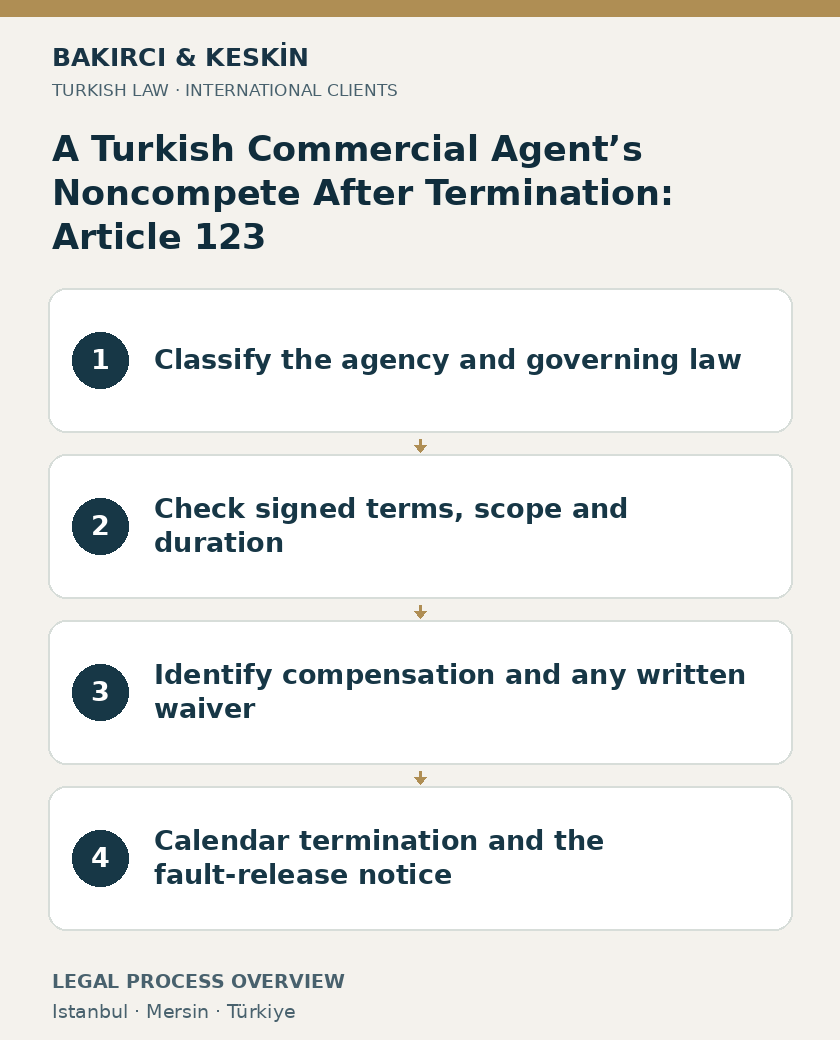
Start with a statutory commercial agent rather than an employee or reseller
Turkish Commercial Code Article 102 defines a commercial agent as an independent person who regularly intermediates or concludes contracts concerning a merchant’s business in a defined territory, without occupying the dependent position of an employee or ordinary commercial representative. Article 123 governs the particular post-termination restriction of that agent’s business activities. Calling a Turkish reseller an agent in a foreign supplier’s standard form does not conclusively determine whether the statutory agency chapter applies.
The distinction matters because an employee’s post-employment non-compete raises a different regime under the Turkish Code of Obligations, while a distributor that buys and resells products on its own account is not automatically the agent described in Article 102. Article 122 can extend certain portfolio-compensation protection to qualifying exclusive distributors, but that extension cannot be presented as a blanket incorporation of every Article 123 detail into every resale contract.
For a foreign principal, review the relationship’s structure: whether the Turkish business acts on its own account, regularly negotiates or signs contracts for the principal, carries relevant commercial risks, and receives commission. Include the original contract, correspondence and actual performance. If a dispute concerns choice of law, also examine the agreement and Private International Law No. 5718 Article 24; an English-language contract or foreign headquarters does not automatically eliminate all Turkish-law issues.
Article 123 requires a written agreement and a document signed by the principal
Article 123(1) requires the post-termination competition agreement to be in writing. It also requires that a document containing the agreed restrictions and signed by the principal be given to the agent. These are identified statutory requirements. A vague oral warning on the agent’s final working day, or a unilateral notice without the necessary contractual foundation, should not be treated as conclusive proof of an enforceable post-termination covenant.
The file should contain the complete signed wording, the persons signing, the effective agency agreement and evidence that the required signed document was provided to the agent. It should identify the territory or customer group, the relevant lines of business and dates. An employer-issued personnel handbook designed for employees is not a sufficient substitute merely because a commercial agent receives a copy.
Where the foreign principal signs a bilingual agreement abroad, ensure the Turkish counterpart received the legally relevant signed document and the parties actually agreed to the restriction. Any dispute about signature authority, translation or electronic form requires the actual instrument and applicable form rules to be examined. A term sheet promising that details will be finalized later is a different document from a completed agreement specifying the statutory scope.
The post-termination restriction cannot extend beyond two years
Article 123(1) states that the restriction may be agreed for no more than two years after the end of the agency relationship. The relevant starting event is the legally effective termination date, not the date a foreign supplier later discovers the agent’s new employer or the date the last customer order is delivered. A three-year non-compete inserted in a generic international distribution template should not be represented as fully enforceable under the Turkish Article 123 framework.
Record the contract’s fixed or indefinite term, any renewal, the termination notice and the event that legally ended the relationship. A notice sent today might produce an effective termination only after a valid notice period; an immediate for-cause notice may produce a different date. Article 121 separately regulates termination and notice. The correct Article 123 covenant period should be matched to the real termination date rather than a hypothetical last invoicing date.
Article 123’s two-year rule is an upper bound, not a requirement that every clause last the full period. Parties may agree a shorter duration consistent with the provision. An overseas principal who seeks a narrow one-year customer restriction should still check the written-document, geographic, subject-matter and compensation rules. Short duration alone does not cure the absence of the other statutory conditions.
The restriction must fit the agent’s allocated territory or customer circle
Article 123(1) confines the restriction to the territory or customer group assigned to the agent and the subjects of contracts the agent helped establish. A clause prohibiting the agent from participating in any commercial activity worldwide, including unrelated products or customer groups, exceeds the specificity of that statutory description. The actual geographic territory and customer records should therefore be obtained and preserved.
The agent may have worked for a foreign manufacturer across part of Türkiye, specific wholesale customers or a defined group of hospitals. The documents should show what was actually assigned, whether the scope changed by later agreement and which products or services formed the mediated contracts. A map of the market or an internal sales plan is evidence only to the extent it actually establishes the contractual region or customer circle.
The required subject-matter limitation is as important as geography. A restriction tied to medical device sales does not necessarily authorize excluding the agent from unrelated software or property services. Likewise, a distributor may manage several brands and product lines in different legal capacities. Avoid a covenant that treats the agent’s entire future livelihood as one undifferentiated prohibited activity. The statutory protective language limits both the area or clientele and the contract subjects.
The principal must pay appropriate compensation for the restraint
Article 123(1) expressly requires the principal to pay the agent suitable compensation for the post-contractual competition restriction. This is a substantive price for limiting the agent’s business freedom, not a discretionary goodwill payment that may be omitted while keeping the non-compete. The parties should identify what remuneration was agreed, how and when it is payable, and how the amount relates to the actual duration and scope of the restraint.
The statute does not create one universal fixed percentage of former commission or guarantee the same compensation in every commercial relationship. The required amount must be assessed in light of the concrete restriction and applicable law. Relevant information can include the prior territory, customer portfolio, agency earnings and impact of the restriction. A claimant should not invent a statutory tariff merely because compensation has to be appropriate.
The principal’s compensation obligation should be kept separate from already-earned sales commission, termination notice damages and portfolio compensation under Article 122. Those amounts protect different interests and require different statutory elements. A settlement spreadsheet should contain distinct headings with the legal basis and period for each. Paying one type of remuneration does not necessarily discharge another without a valid agreement or legal reason.
The principal may waive the restraint in writing before agency termination
Article 123(2) allows the principal to waive application of the non-compete in writing until the agency relationship ends. Under that paragraph, the principal is released from its compensation obligation once six months have elapsed from the written waiver declaration. This provision is not the same as an unrestricted ability to reject compensation immediately after termination simply because the principal later decides it no longer needs the protection.
The precise waiver date matters. For example, a written waiver communicated before effective termination must be distinguished from a message sent several months after the relationship has ended. Record the full declaration, its addressee, communication channel and date. The statute’s six-month compensation release period runs from the declaration rather than from an arbitrarily chosen payroll date or the end of the second contractual year.
A waiver should clearly identify the restriction to which it relates and whether it addresses the entire restraint or a particular part. When parties negotiate a narrower waiver, carefully preserve its terms and the legal consequences of any continuing restriction. Do not assume that a casual telephone comment from a sales manager necessarily satisfies the statutory written declaration by the principal.
One-month notice after fault-based termination is a separate mechanism
Article 123(3) gives a party that terminates the agency relationship for just cause attributable to the other party’s fault the ability to give written notice that it will not be bound by the non-compete agreement. The notice must be given within one month after termination. This right is linked to the specified fault-based just-cause termination and must not be confused with the principal’s different pre-termination written waiver under Article 123(2).
A principal alleging a serious agent breach should preserve the contractual obligations, conduct, communications, evidence of fault and effective termination notice. An agent alleging a serious breach by the principal should do the same. A simple statement that the relationship became difficult is not automatically proof of the legally relevant fault and just cause. The one-month mechanism should be assessed from the documented termination ground rather than speculation about the parties’ motives.
The communication also has to be written and timely. Calendar the effective termination date, last day of the statutory month and verifiable dispatch. A party that wants to use Article 123(3) should not rely on an informal conversation as though it were the prescribed written release. The court’s eventual view of the just-cause facts is distinct from the separate procedural need to make the declaration within the stated period.
Clauses contrary to Article 123 are invalid insofar as they prejudice the agent
Article 123(4) states that conditions contrary to the article are invalid to the extent they operate against the agent. This protective wording is stronger than a general suggestion that excessive restrictions may be negotiated later. A contract clause cannot simply rewrite the two-year maximum, eliminate required compensation, enlarge the prohibited territory without limit or remove the written-document safeguard to the agent’s disadvantage.
The particular consequence of a defective clause depends on its terms, the applicable protective rule and the relief sought. A party should not conclude from one excessive phrase that every unrelated commercial obligation in a complex agency agreement necessarily disappears. The contract should be analyzed provision by provision, keeping confidentiality, return of documents, commission and non-compete questions distinct.
Foreign principals are better served by a clear, narrow and appropriately compensated restriction than an expansive form that cannot lawfully operate as drafted. The agent should retain evidence of the exact restriction and any attempted enforcement, such as a cease-and-desist letter, threatened penalty or disputed compensation. Neither side should fabricate a statutory monetary penalty or assume that the principal may enforce an otherwise invalid clause solely because the agent signed it.
Conduct during the agency term is governed differently
Post-termination noncompetition under Article 123 should not be confused with duties of loyalty and exclusivity that may apply while the agency relationship is ongoing. Article 104 contains general rules on exclusivity, subject to the relevant contractual arrangements. The fact that conduct was restricted while an agent represented a principal does not automatically extend that restriction for an additional period after the agency ends.
A supplier may also have legitimate rights to confidential information and business records under other provisions and agreements. Returning customer documents or protecting trade secrets is a different legal issue from agreeing not to compete with the former principal. These obligations need their own legal bases and should be pleaded separately. Calling any use of professional experience ‘competition’ is not enough to establish breach of an enforceable Article 123 covenant.
The agent should preserve communications establishing what customer information was received, whether it belongs to the principal, and the date on which agency-related access ended. The principal should distinguish its confidential records from customers and opportunities the agent may lawfully serve after termination. That factual separation helps prevent a non-compete dispute from becoming an unsupported claim that all future Turkish sales belong to one former principal.
Article 122 portfolio compensation is a separate claim
Article 122 protects an agent in specified circumstances where the principal continues to enjoy substantial benefits from customers introduced by the agent and the agent loses remuneration after termination, subject to equity. The article sets a maximum based on average annual commission or other remuneration and requires the right to be asserted within one year after termination. Article 123 instead addresses payment for imposing a valid post-contractual restraint on the agent’s future business activities.
A principal can therefore face a portfolio-compensation issue even when no post-termination non-compete exists. Conversely, a valid restricted-competition arrangement can require appropriate Article 123 compensation independently of whether the agent satisfies all three Article 122 conditions. A single settlement amount described vaguely as ‘full termination fee’ risks hiding these separate questions.
For a foreign brand, maintain two financial schedules. The portfolio table identifies customers, continuing principal benefit, lost commission and Article 122’s cap. The non-compete table identifies the geographic and subject-matter restraint, its duration, waiver or release events and the appropriate Article 123 amount. This prevents double counting while ensuring that payment for one legal interest is not silently treated as an answer to the other.
Foreign-law terms do not automatically decide the Turkish-law analysis
International agency contracts frequently choose another country’s law and a foreign court or arbitral forum. Determining the effect of that choice requires Private International and Procedural Law No. 5718, including Article 24 on contractual obligations and any genuinely applicable overriding mandatory rules under Article 6. The mere presence of a foreign principal, a foreign-language agreement or an overseas payment account is not a sufficient legal reason to ignore the statutory nature of the Turkish agency and its particular protective provisions.
An agent living or conducting business in Türkiye should supply the agreement, any choice-of-law clause, the real territory and contract performance record. The principal should identify the legal person contracting and the effective law chosen. A broad statement that every Article 123 provision applies regardless of the applicable law or that every foreign choice is conclusive would be unreliable. The conflict-of-laws conclusion must rest on the specific facts and instruments.
Cross-border evidence issues should also be handled accurately. Documents signed overseas may require translations or authentication for a Turkish proceeding depending on their kind and use. An apostille is not a cure for the absence of an enforceable compensation clause, overbroad territorial scope or missing signed document. Formal admissibility and substantive validity are separate matters in international commercial litigation.
An auditable termination file can resolve most factual disputes
A complete file starts with the contract defining the agency territory, clients and products. Add the signed Article 123 non-compete document provided to the agent and any amendments, evidence of the legally effective termination date, and records of payments or promised compensation. Include the actual notice of waiver or release where Article 123(2) or (3) is invoked. A reconstructed chronology should identify dates rather than infer them from the month shown on invoices.
For a dispute about the geographic scope, compare the clause to real CRM records, assigned customers and contract subject matter. For a compensation dispute, separate earned commission, portfolio compensation and the payment for the restraint. For a fault-termination dispute, preserve the actual allegation and proof, then check the one-month written declaration under paragraph 3. The legal questions can be evaluated one by one rather than used as bargaining slogans.
Where the issue is urgent because one party threatens injunctions or contractual penalties, obtain the formal notices and identify the competent forum and applicable procedural route. The statute does not empower a principal to impose immediate worldwide restrictions by informal demand. Equally, an agent should not disregard a valid written covenant without assessing the actual legal obligations and consequences. An accurate document bundle is essential on both sides.
How to draft a workable exit arrangement
A compliant drafting process starts by classifying the intermediary correctly, then establishing the specific post-contract territory or customers and contract subjects. Fix a period not exceeding two years, provide a duly signed written document to the agent and identify appropriate compensation. Use language that lets the agent understand exactly which future activity will be restricted and which lawful activities remain available.
The principal should have a practical protocol for any written waiver before termination, including who may issue it, proof of its dispatch and how the six-month period under paragraph 2 is handled. If termination for fault occurs, both parties need a process for evaluating the one-month paragraph 3 option and documenting the necessary declaration. These are separate documents with different legal starting points.
For an overseas principal and Turkish agent, a negotiated settlement should reconcile current commission, any Article 122 portfolio claim, Article 123 restraint compensation, final work and return of property. The exact legal claims and sums should be stated rather than compressed into a generic release. The result is a transaction file capable of being read by later auditors, investors and a competent court without guessing which obligation was settled.
Frequently asked questions
Can a Turkish commercial agent be banned from competition after termination?
Only a restriction meeting Article 123’s protective conditions can be assessed as valid: writing, a principal-signed document delivered to the agent, limited territory and subject matter, maximum two years and appropriate compensation.
Is a verbal promise sufficient for the post-termination noncompete?
No. Article 123(1) requires a written agreement and delivery to the agent of a document containing the conditions signed by the principal.
What is the longest allowed Article 123 noncompete period?
Two years from the legally effective end of the agency relationship.
Can the restriction prohibit all commercial activity worldwide?
Article 123(1) limits it to the territory or customer group assigned to the agent and the subjects of the contracts the agent mediated.
Must the foreign principal pay the agent for a valid noncompete?
Yes. Article 123(1) requires appropriate compensation for the restriction, but does not prescribe one universal percentage.
Can the principal waive the noncompete before agency termination?
Article 123(2) allows a written waiver until the agency ends. The compensation obligation is released when six months have elapsed after the waiver declaration.
Can a principal waive it six months after termination under the same rule?
Article 123(2) addresses waiver before the relationship ends. A later arrangement requires its own legal basis and cannot simply be equated to that statutory option.
What does Article 123(3) allow after termination for the other party’s fault?
The terminating party may, within one month after qualifying just-cause termination, notify the other party in writing that it is not bound by the non-compete.
Are restrictions disadvantaging the agent enforceable despite contradicting Article 123?
Article 123(4) makes contrary provisions invalid insofar as they are against the agent.
Is the noncompete payment the same as portfolio compensation under Article 122?
No. Article 122 addresses specified post-termination customer benefits and commission loss, while Article 123 compensates the restricted agent’s future activity.
Does the same Article 123 regime automatically govern employees or all resellers?
No. Employees and distributors may be subject to different rules. The relationship’s actual legal classification must be established.
Does a foreign governing-law clause automatically remove Article 123?
No categorical conclusion follows. The particular choice-of-law arrangement and applicable Turkish private international law must be assessed.
Related English legal guides
- Commercial agent portfolio compensation under Article 122
- International contract disputes in Turkey
- Power of attorney for foreign clients
- Governing law of international contracts under Article 24
Physical office and contact
The physical office is in Mersin; meetings elsewhere in Türkiye may be arranged by prior appointment. Telephone: +90 552 224 43 66.
Istanbul Office – Polaris Plaza, Maslak / Sarıyer
Bakırcı & Keskin Hukuk Bürosu
Maslak Ahi Evran Caddesi, Polaris Plaza No:21, Kat:9, 34475 Sarıyer/İstanbul
Our physical offices in Istanbul and Mersin coordinate matters throughout Turkey, subject to jurisdiction and the local steps required for each case. Please specify your preferred office when arranging an in-person appointment.
Open the Istanbul office on Google Maps · Contact and appointments
Contact regarding a legal matter
In your first message, you may briefly state the subject, your country or city, and any relevant notification or recent procedural date. Please do not send identity numbers, medical data, or personal documents. Messaging alone does not constitute legal advice or create a lawyer–client relationship.
Discover more from Bakırcı & Keskin Hukuk Bürosu
Subscribe to get the latest posts sent to your email.