Foreign Probate and Turkish Heirship Records Disagree: Resolving Conflicting Evidence
Short answer: A foreign probate document and a Turkish inheritance certificate can identify different people because they answer different legal questions, use different family records, or apply different succession laws. The discrepancy must be investigated before estate assets are distributed. Turkish Civil Code Article 598 permits the invalidity of an inheritance certificate to be raised at any time. That rule does not turn an apostille into proof of the correct heirs, cancel a will, or automatically reverse a completed property transfer. The first task is to identify the exact document, the disputed relationship, the governing law and the legal remedy required.
Have a general question about this article? Ask anonymously
Quick summary
| Legal issue | Foreign Probate and Turkish Heirship Records Disagree: Resolving Conflicting Evidence |
|---|---|
| Short answer | A foreign probate document and a Turkish inheritance certificate can identify different people because they answer different legal questions, use different family records, or apply different succession laws. The discrepancy must be investigated before estate assets are distributed. Turkish Civil Code Article 598 permits the invalidity of an inheritance certificate to be raised at any time. That rule does not turn an apostille into proof of the correct heirs, cancel a will, or automatically reverse a completed property transfer. The first task is to identify the exact document, the disputed relationship, the governing law and the legal remedy required. |
| Key legislation | Law No. 4721 — Articles 575, 580, 589, 598, 640; Law No. 5718 — Articles 2, 20, 50, 54, 58; Law No. 6100 — Articles 190, 199, 223, 224, 382, 388 |
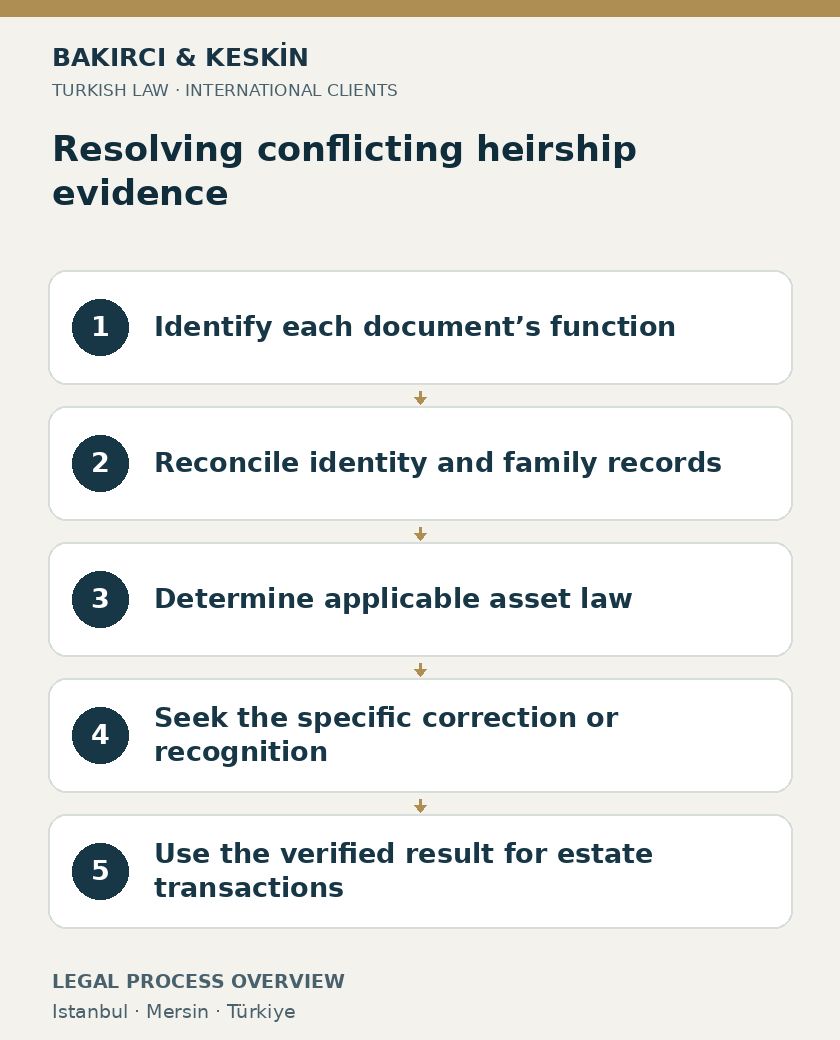
Identify what each document actually decides
The word “probate” does not have one universal legal meaning. A grant appointing a personal representative, a certificate identifying beneficiaries, a court judgment resolving a contested succession dispute and a document admitting a will are different instruments. A person named as executor is not necessarily the beneficial owner of the estate. Equally, a beneficiary of one asset is not necessarily an heir entitled to a fractional share of the whole estate. Comparing the names alone can therefore create a false conflict.
Read the complete foreign instrument, including its operative provisions, schedules and any limitation on the grant. Record the issuing authority, case reference, date, legal basis, territorial scope and whether the document has been amended. Obtain the will where the document relies on one. If an overseas representative appears in the foreign papers but only relatives appear in the Turkish certificate, establish whether representation and ownership have simply been confused. The Turkish certificate should be examined with its supporting court or notarial file, rather than as an isolated one-page conclusion.
A useful comparison identifies precisely what each instrument proves: death, family relationship, authority to administer, testamentary appointment or entitlement to a particular asset. This keeps the application focused. The general inheritance-certificate guide explains the certificate’s normal function; this article addresses the additional evidence work required when the records disagree.
Reconcile people before calculating inheritance shares
Prepare a family chronology using dates of birth, marriage, divorce, adoption, changes of name and death. Keep a separate identity table for every person whose status affects the distribution. Include the original spelling, transliteration, former surnames, dates of birth and the official identifiers shown on the relevant records. Similar names do not establish that two entries concern the same individual, and a different spelling does not by itself establish two different people.
The legal significance of a discrepancy depends on its subject. A transcription error calls for proof connecting the records. An unrecorded marriage or divorce can affect the asserted status of a surviving spouse. A dispute over parentage is different again: an inheritance certificate is not a substitute for the procedure needed to establish or contest that underlying relationship. The evidence plan should identify which fact the succession court can determine in the pending case and which underlying status question requires a separate legally appropriate process.
Keep the chronology tied to the date the succession opened. Under Civil Code Articles 575 and 580, death opens the inheritance and survival at that time matters to heirship. If someone survived the deceased but subsequently died, the analysis involves a second estate. Removing that person from the first family tree because they are now deceased produces the wrong sequence of succession.
Determine the applicable law for the disputed asset
An apparent contradiction is sometimes the consequence of applying different succession rules. Article 20 of Law No. 5718 states the general rule that succession is governed by the deceased’s national law, while Turkish law applies to immovable property situated in Turkey. The same article separately addresses the opening, acquisition and partition of the estate. It is therefore unsafe to take percentages from an overseas document and apply them unchanged to every Turkish asset.
List the assets concerned by the disagreement. A Turkish apartment, a bank balance and shares in a company are not interchangeable legal objects. A company share does not become direct ownership of the company’s land merely because land is its principal asset. Establish ownership and asset classification before deciding whether a person omitted from one document has been excluded unlawfully or whether the documents govern different interests.
Where foreign law governs a material issue, Article 2 requires the Turkish court to apply the relevant foreign law of its own motion and permits it to request the parties’ assistance in establishing its content. Provide the applicable statutory text, reliable information about its operation and a Turkish translation that distinguishes legal terminology from ordinary language. An unsupported statement that “the foreign lawyer says this person inherits everything” does not resolve the applicable-law question. The existing guide to proving foreign law in Turkish proceedings explains this separate task.
Build a document record that answers the disputed facts
Obtain the documents that establish the contested link, rather than collecting unrelated certificates. Death records establish the relevant deaths and their chronology. Birth and family records connect generations. Marriage and divorce documents address spousal status. Adoption or parentage decisions require attention to their own legal effect. A will and its amendments address testamentary dispositions. The existing inheritance certificate and its underlying application show what the issuing authority originally considered.
For every document, record its source, issue date, whether it is complete, whether another version exists and the fact it is intended to establish. A recent extract can still reproduce an old error. An earlier document can still be indispensable to explaining a later name change. The objective is a coherent evidential chain, with contradictions disclosed and explained, rather than a stack of apparently official papers.
Code of Civil Procedure Article 190 governs the burden of proof, while Article 199 defines documents broadly enough to include electronic records. Nevertheless, an email attaching an overseas certificate is different from a properly authenticated copy of that certificate. Preserve original electronic files, transmission details and complete attachments when they bear on when a party learned of a material fact. Do not alter source files to make names or dates appear consistent.
Separate authentication, translation and substantive accuracy
Article 223 of the Code of Civil Procedure requires a party relying on a foreign-language document to submit its translation. The court can require an official translation, either on its own initiative or at another party’s request. Article 224 addresses the authentication of foreign official documents and preserves the operation of international agreements. The appropriate authentication route therefore depends on the issuing state, the document and the applicable treaty framework.
Authentication does not decide whether the named person is an heir under the law applicable in Turkey. It addresses the document’s official character through the required process. A document can be authentic yet incomplete for the Turkish succession question. Likewise, a translation can accurately reproduce an overseas administrator’s appointment without converting that administrator into the owner of the estate.
The translation should reproduce important qualifications, including “limited grant,” “administrator,” “beneficiary,” “personal representative” and any territorial limitation. Where a legal term has no direct Turkish equivalent, the explanatory work belongs in the legal submissions, supported by the foreign law. Leaving out the schedules or treating every person named in the document as an heir can distort the result. Check seals, certifications and annex references against the actual documents before filing.
Use the correct route to challenge the Turkish certificate
Article 598 expressly allows the invalidity of an inheritance certificate to be asserted at any time. The provision recognises that a certificate can be wrong about heirship or shares. It does not mean that every related claim is free from limitation, that a will can be challenged without observing its own rules, or that completed transactions disappear automatically once someone raises an objection.
The application must identify the certificate in dispute, the proposed correction, the people whose apparent rights will change and the evidence supporting that change. If a person’s entire entitlement is disputed, a request framed merely as correction of a spelling mistake will not capture the real issue. Conversely, an identity discrepancy that leaves the family relationship and shares unchanged should not be presented as a contested redistribution without a reason.
The competent procedure must be selected with regard to whether the document was issued by a court or a notary, whether there is a contested underlying status question and what relief is sought. Article 382 lists the issue of an inheritance certificate among non-contentious matters, and Article 388 generally denies substantive res judicata effect to non-contentious decisions unless the law provides otherwise. These provisions explain why the certificate should not be treated as an unchallengeable final distribution of the estate.
Assess the effect of a foreign court decision separately
A foreign judgment’s effect in Turkey is a distinct question from the evidential use of a foreign birth or death record. Articles 50 and 54 of Law No. 5718 govern enforcement of qualifying foreign judgments, while Article 58 addresses recognition and expressly extends its framework to non-contentious decisions. The nature of the particular probate document and the effect requested in Turkey must therefore be analysed before choosing a recognition or enforcement application.
Do not assume that every foreign probate certificate is a judgment eligible for recognition, or that every foreign order governing an overseas estate determines Turkish immovable succession. Examine whether the instrument is judicial, whether it has the required finality under the issuing state’s law, what it actually decides and whether the relevant recognition conditions are satisfied. Questions of exclusive jurisdiction and public policy arise within that statutory analysis; they should not be replaced by a blanket statement that all foreign probate papers are either binding or worthless.
A foreign document can still be relevant evidence even where the legal effect sought requires a different procedure. The submission should say precisely whether the document is offered to prove a fact, establish a representative’s authority or support recognition of a judicial determination. That clarity prevents a Turkish authority from being asked to infer an effect that the application has never legally explained.
Protect the estate while the disagreement is examined
Correcting the evidential record and preserving the estate are related but separate tasks. Under Civil Code Article 589, the Civil Court of Peace can take measures needed to protect estate property and secure its transmission to the right holders. Depending on the statutory conditions, the Code provides for inventory, sealing and official administration. Article 640 also permits each heir to seek protection of estate rights for the benefit of the inheritance community.
The request should identify actual assets, the present holder, the transaction or risk that requires attention and the protection sought. A disputed apartment transfer requires different information from an unexplained withdrawal from an estate bank account. State what is known, identify the source and separate it from facts still being investigated. A general disagreement among relatives does not itself establish every factual ground for every protective measure.
Obtain current title or account information through lawful channels. Preserve correspondence concerning a planned distribution, sale or payment. If assets have already moved, assess the legal basis for recovery or a claim against the relevant person separately. Article 598’s rule on the certificate is not a complete statutory cause of action for undoing all subsequent transactions. The remedy must follow the transaction, the recipient’s legal position and the applicable substantive rules.
Organise a cross-border evidence file without repeated travel
Heirs abroad can improve the usefulness of the first legal review by supplying complete scans of the competing documents and a concise explanation of the disputed relationship. Include the address and contact details of known interested parties, the locations of Turkish assets and any existing court references. Keep an index showing which originals are available and which must be obtained from an overseas authority.
Representation should be arranged with authority appropriate to the actual proceedings and any connected estate transaction. A mandate to seek a certificate should not be assumed to authorise the sale of property, the settlement of a contested share or the abandonment of a claim. Authentication and translation arrangements should be planned around the issuing authority’s requirements and the intended Turkish use.
Communication should distinguish documents requested, documents received, unresolved contradictions and procedural steps actually taken. A family member’s promise to obtain a record is not the record itself. Keep the case chronology current as new evidence arrives. Bakırcı & Keskin Law Office coordinates Turkish succession matters for clients abroad through its Istanbul and Mersin offices, with Mersin-based services throughout Turkey and direct communication in English.
Check the corrected result before distributing assets
At the end of the relevant process, compare the operative decision or certificate with the issues originally identified. Check every name, the legal capacity in which each person appears, the shares, the deceased’s identity and the treatment of any successive death. Confirm that the result concerns the asset and legal issue for which it will be used. A corrected family entry, an amended certificate and a decision recognising a foreign judgment are different outputs.
Provide the appropriate document to the institutions handling the estate and identify which earlier document it supersedes or qualifies. Land-registration steps, bank release requirements and estate tax formalities must then be addressed on their own terms. If an institution still relies on the earlier certificate, preserve its written position and resolve the remaining discrepancy rather than submitting inconsistent copies without explanation.
The central objective is a legally supported chain from identity and family relationship to applicable law, heirship and the specific estate transaction. Each link must be established. That method addresses the real conflict and gives Turkish authorities a coherent basis for acting on the estate.
Frequently asked questions
Does an apostille prove that the foreign document names the correct heirs?
No. Authentication and the substantive succession decision are separate. The applicable law and the document’s actual legal function still have to be examined.
Is an overseas executor automatically an heir in Turkey?
No. An appointment to administer an estate does not by itself establish beneficial entitlement. Read the appointment and the instrument creating the asserted inheritance right separately.
Can an incorrect Turkish inheritance certificate be challenged years later?
Article 598 permits its invalidity to be asserted at any time. Separate claims concerning wills, recovery of assets or completed transactions must still be checked under their own rules.
What if one document uses a maiden name and another uses a married name?
Build the identity connection with the relevant official records. A spelling or name difference is not, by itself, proof of a different person or a different inheritance share.
Does a foreign probate order always need recognition?
The answer depends on the document and the effect sought. Evidential use, recognition of a judgment and enforcement are separate questions under Law No. 5718.
Can a Turkish apartment follow different inheritance rules from a bank account?
Yes. Article 20 specifically subjects Turkish immovable property to Turkish law and sets a different general national-law rule for succession. Classify the assets before calculating shares.
Who establishes the content of the foreign succession law?
Under Article 2 of Law No. 5718 the court applies the relevant foreign law of its own motion and can request the parties’ assistance in establishing its content.
Must foreign documents be translated?
Article 223 requires a translation when a party relies on a foreign-language document. The court can also require an official translation.
What if the disputed heir has also died?
Establish whether that person survived the original deceased. If so, their inheritance right passes through their own succession, requiring the second estate to be considered.
Should the estate be distributed before the conflict is resolved?
Distribution requires a defensible entitlement record. Where assets need protection while the conflict is examined, request the specific statutory measures supported by the evidence rather than treating the disputed certificate as conclusive.
Official legal sources
- Law No. 4721 — Articles 575, 580, 589, 598, 640
- Law No. 5718 — Articles 2, 20, 50, 54, 58
- Law No. 6100 — Articles 190, 199, 223, 224, 382, 388
Recorded primary-source check dates: 26 October 2026. The official Turkish legislation controls. A new publication-date check is still required.
Contact information
Do not include confidential documents or identity numbers in an initial message. An enquiry does not establish representation or suspend any legal deadline.
Istanbul and Mersin contact details
Bakırcı & Keskin Law Office is Mersin-based. Turkish matters are handled under the applicable jurisdiction and agreed mandate. The competent court and the scope of representation are assessed for each matter.
Istanbul — Polaris Plaza
Maslak Ahi Evran Caddesi, Polaris Plaza No:21, Floor 9, 34475 Sarıyer/İstanbul, Türkiye.Mersin — Profit İş Merkezi
İhsaniye Mahallesi, 4903. Sokak, Profit İş Merkezi No:23, Floor 3, Office 14, 33070 Akdeniz/Mersin, Türkiye.+90 552 224 43 66 · Contact details in English. An enquiry does not establish representation or suspend a legal deadline.
Istanbul Office – Polaris Plaza, Maslak / Sarıyer
Bakırcı & Keskin Hukuk Bürosu
Maslak Ahi Evran Caddesi, Polaris Plaza No:21, Kat:9, 34475 Sarıyer/İstanbul
Our physical offices in Istanbul and Mersin coordinate matters throughout Turkey, subject to jurisdiction and the local steps required for each case. Please specify your preferred office when arranging an in-person appointment.
Open the Istanbul office on Google Maps · Contact and appointments
Contact regarding a legal matter
In your first message, you may briefly state the subject, your country or city, and any relevant notification or recent procedural date. Please do not send identity numbers, medical data, or personal documents. Messaging alone does not constitute legal advice or create a lawyer–client relationship.
Discover more from Bakırcı & Keskin Hukuk Bürosu
Subscribe to get the latest posts sent to your email.