A Co-Owner Excludes You from Turkish Property: Judicial Regulation of Use Under Article 693
Short answer: Civil Code Article 693 gives each co-owner a right to use shared property compatibly with the others’ rights and allows the judge to determine disputed use, including allocation by time or place. The remedy can preserve co-ownership. Existing agreements, management decisions, expenses and registry annotations must be examined separately.
Have a general question about this article? Ask anonymously
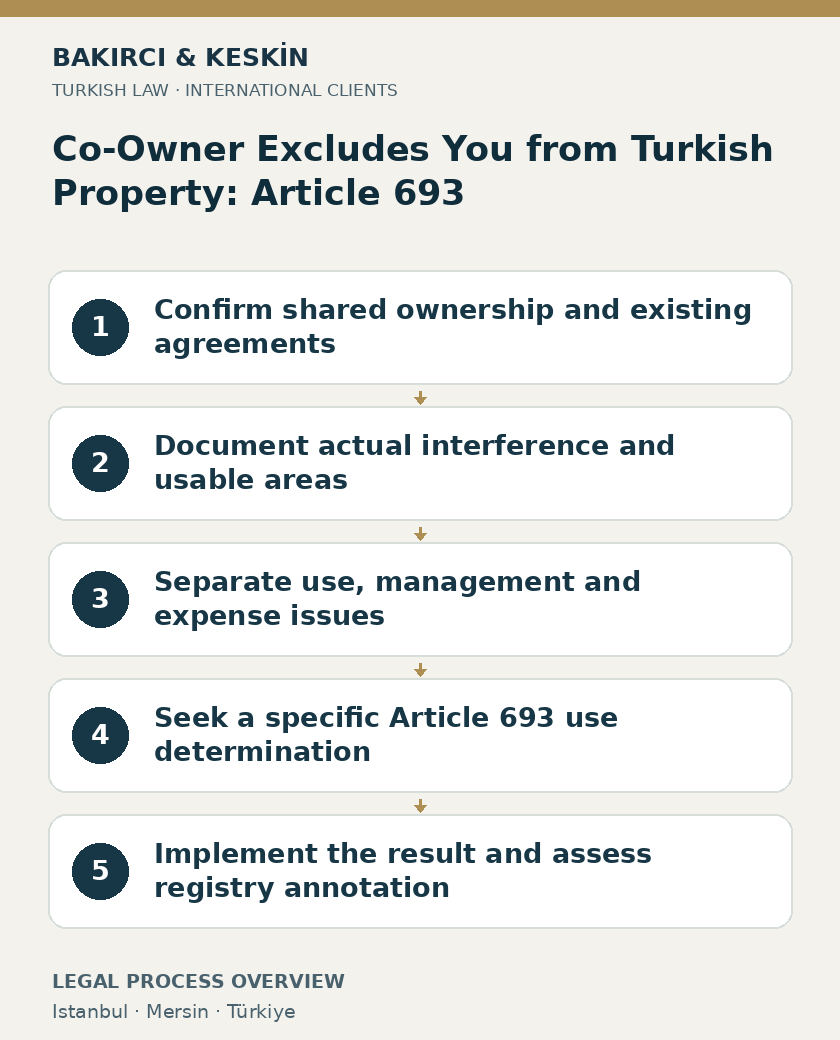
Quick summary
| Legal issue | A Co-Owner Excludes You from Turkish Property: Judicial Regulation of Use Under Article 693 |
|---|---|
| Short answer | Civil Code Article 693 gives each co-owner a right to use shared property compatibly with the others’ rights and allows the judge to determine disputed use, including allocation by time or place. The remedy can preserve co-ownership. Existing agreements, management decisions, expenses and registry annotations must be examined separately. |
| Key legislation | Law No. 4721 — Articles 688–695, 696; Law No. 6100 — Articles 1, 2, 4, 12, 190, 199, 389–393; Law No. 6325 — Articles 18/B |
Confirm the kind of co-ownership before choosing a remedy
A registered share in Turkish property represents ownership of the undivided asset. It does not normally identify a particular bedroom, floor or corner of the land as the exclusive property of that shareholder. Civil Code Article 688 defines shared ownership in this way. The distinction matters when one owner keeps the keys or occupies the entire building while another owner remains overseas.
Obtain the current title and the documents creating the ownership relationship. Confirm the parcel, independent unit, shares and every current owner. An inheritance community in joint ownership is not automatically the same arrangement as shared ownership with independently defined fractions. Condominium owners of different apartments also have a different statutory structure for their common areas. The correct classification determines which rules govern the requested access.
Separate the ownership dispute from the immediate use dispute. A request to establish a missing ownership share, an action to end co-ownership and an application to regulate existing co-owners’ enjoyment do different work. Article 693 supplies a route for determining use while shared ownership continues. The petition and supporting evidence should identify that objective clearly rather than describe every disagreement as a demand for partition.
Article 693 protects compatible use by every co-owner
Article 693 permits each co-owner to enjoy and use the shared property to the extent compatible with the others’ rights. It does not allocate the whole asset to the person who happens to live nearby, pays the utility bill or holds the only physical key. Equally, a small share does not carry an unrestricted entitlement to prevent every reasonable use by the remaining owners.
The practical question is how the property can be used consistently with the ownership rights already established. Identify the physical areas, access points, existing occupation and activities that interfere with another owner’s use. The owner’s place of residence abroad is relevant to arranging practical access, but it does not itself change the registered share or extinguish the statutory entitlement to compatible enjoyment.
Describe the interference precisely. A denied request for entry, refusal to supply an agreed key, exclusive storage in an allocated area and obstruction of a shared access point are different factual propositions. Preserve the relevant communications and physical records. The legal review needs the actual conduct and its effect, rather than a general assertion that the other owner is difficult or unwilling to cooperate.
Read any existing agreement about occupation and access
Under Article 689, co-owners can unanimously agree on arrangements for enjoyment, use and management that differ from the statutory defaults. The agreement may therefore be important even when the title itself records only fractions. Obtain the complete document, amendments and annexed plan. Establish which owners agreed, what property it covers and whether its operation depends on a stated condition or period.
An agreement about using particular rooms does not automatically divide the land into separately owned properties. Keep the contractual allocation of use separate from title ownership. The distinction becomes particularly important when a party proposes to sell a share, grant a mortgage or advertise an exclusively owned section. Those acts require assessment of the actual rights held and the relevant formal requirements.
Article 689 also protects rights that the owners cannot remove or restrict through their agreement. These include necessary management to preserve usability and value, recourse to the court for the corresponding measures, and immediate measures needed to prevent damage or its increase. A clause giving one owner general management authority should therefore be read with those mandatory protections, not as a complete exclusion of every other owner.
The court can allocate use by place or by time
Where the owners disagree, Article 693 expressly authorises the judge to determine the manner of enjoyment and use. The provision states that this can take the form of dividing use between the owners by time or place. The court’s task is to establish an appropriate operating arrangement for the shared asset. It is not a statutory promise that every claimant receives the exact room or dates requested.
Prepare a concrete proposal that can be assessed against the property. Identify entrances, shared facilities, essential services, safe access and the areas needed for each proposed use. A floor plan or survey can explain an allocation more accurately than broad language about equal access. The proposal should also identify practical points that need resolution, including keys, handover records and access for necessary maintenance.
A time-based arrangement needs equally clear boundaries. State the periods sought and the reason they are workable, while addressing the other owners’ rights. The purpose is to enable a defined judicial determination rather than leave the parties to repeat the same dispute after an order is made. Neither the share percentage nor overseas residence supplies an automatic calendar without consideration of the asset and the competing rights.
An occupation dispute does not give one owner every management power
Articles 690–692 distinguish ordinary, important and extraordinary management. Under Article 690, each co-owner can carry out ordinary management, including small repairs, subject to the statutory framework and any permitted different arrangement. The person who deals with routine work does not thereby become the sole owner or acquire unlimited power to determine who can enter the property.
Article 691 requires both a majority of shares and a majority of co-owners for important management matters, including entering or ending ordinary or produce leases and specified changes to operation. Necessary maintenance, repair and construction beyond ordinary management use the same majority. A party claiming that occupation is justified by a lease should therefore produce the lease and the decision or authority supporting it.
Article 692 addresses more substantial changes, construction beyond preservation or ordinary use, and dispositions over the whole asset. Subject to a unanimously agreed different arrangement, acceptance by all co-owners is required. A majority decision about a particular management issue should not be described as authorising every structural change or whole-property transaction. Identify the decision and the statutory category before treating it as an answer to the access dispute.
Different kinds of deadlock have different statutory answers
For an important-management deadlock involving equality of shares and co-owners, Article 691 allows a judge to make an equitable decision considering all owners’ interests. The judge may appoint a trustee from among the owners or from outside them for the work considered necessary. That mechanism concerns the management problem described in the provision. Article 693 separately concerns the manner of enjoyment and use.
The application should connect the requested judicial assistance to the actual obstruction. A repair decision, a lease decision and physical access may arise together, but they are not identical requests. Explain which act requires approval, which access is necessary and which records demonstrate the disagreement. This makes the relief intelligible and avoids asking the court to administer the entire property indefinitely without a defined legal basis.
A trustee appointment should also be distinguished from expulsion of a co-owner. Civil Code Article 696 contains a separate framework for exclusion from shared ownership. Regulating use under Article 693 does not itself transfer the difficult owner’s share or impose a compulsory purchase. A party seeking that different outcome needs the separate grounds, procedure and financial analysis appropriate to it.
Account for expenses without treating them as a purchase of access rights
Article 694 generally allocates management expenses, taxes and other obligations arising from shared ownership or concerning the asset in proportion to shares, unless a different rule applies. A co-owner who pays more than their part can seek proportionate recourse against the others. Maintain an account identifying the expense, date, payee, purpose, supporting document and payment already made by each owner.
The expense account should remain distinct from the use arrangement. Payment of a repair invoice does not automatically increase the payer’s ownership fraction or establish an exclusive right to occupy the whole property. Conversely, a demand for access does not eliminate a properly established obligation to contribute to shared costs. Both questions should be recorded and addressed on their own legal basis.
Separate taxes, necessary preservation, routine services and disputed improvements. The authority to incur the particular expense must be examined alongside the allocation rule. A single balance described as household costs can conceal charges that concern personal occupation rather than the shared asset. Clear classification helps the parties resolve money issues without turning every disputed payment into an indefinite barrier to practical access.
Build an evidence file showing both rights and actual interference
Code of Civil Procedure Article 190 supplies the general burden-of-proof rule for facts from which a party derives a favourable legal consequence. For a use dispute, organise the title, any agreement, the proposed allocation, actual occupation and the acts preventing compatible enjoyment. Identify what each document proves instead of submitting a large unindexed archive.
Article 199 recognises plans, photographs, electronic data and other relevant information carriers as documents. Retain the original communications and dated images lawfully available to you. A photograph of a locked entrance proves only what it depicts; the surrounding access requests and responses explain the legal dispute. Avoid editing a message chain so that a qualified reply appears to be an unconditional refusal.
Technical information can be essential where the owners disagree about whether proposed areas are independently accessible or require shared facilities. Obtain the approved layout and relevant existing survey records. Distinguish physical feasibility from legal approval for alterations. A use arrangement should be assessed against the existing property and applicable permissions, rather than assume that new doors, walls or separate units can be created without further legal work.
Match the court and pre-action route to the relief actually sought
Article 12 of the Code of Civil Procedure gives the property-location court exclusive territorial jurisdiction for the specified real-right and possession disputes. Subject-matter jurisdiction requires separate analysis. Article 2 supplies the general civil-court rule, while Article 4 assigns partition, dissolution of co-ownership and possession-only claims to the civil court of peace. A label such as property case does not settle which of those routes applies.
The same care is needed with mediation. Law No. 6325 Article 18/B makes mediation a precondition for the listed categories, including partition and dissolution of co-ownership, condominium-law disputes and neighbour-right disputes. Do not assume that every disagreement between co-owners is automatically a partition case. Classify the actual claim and any combined remedies before deciding which preliminary procedure is required.
The site’s inherited-property partition guide addresses the different objective of ending shared ownership. That route may be considered alongside a use proposal, but the client should understand what each proceeding seeks. A temporary or continuing use arrangement, an account for money and a final sale have different consequences and should not be merged into one unexplained demand.
Preserve the property and assess urgent relief separately
Article 693 permits a co-owner to protect indivisible common interests on behalf of the others. Article 689 also preserves immediate protective steps against damage. These provisions should be applied to the particular risk and necessary response. They do not supply a general licence to remove another owner’s belongings, alter the building or use force to decide a disputed occupation arrangement.
Where the Article 389 conditions concerning effective protection or harm are met, the interim-measure framework requires judicial assessment. Article 390(3) requires the applicant to identify the ground and type of measure clearly and provide approximate proof of the merits. The measure should address the actual risk; overseas residence or a registered share does not itself establish entitlement.
Article 392 ordinarily requires security for potential loss to the opposing party and third persons if the request proves unjustified. The court can dispense with security for the stated evidential or circumstantial reasons, giving an express explanation; a person receiving legal aid is exempt. Review the order’s security and implementation requirements rather than assume that every applicant must provide the same fixed amount.
An interim order also has procedural follow-through. Article 393 requires implementation to be requested within one week after pronouncement or service on the party seeking the measure; otherwise the measure lapses under that provision. This implementation step is separate from obtaining the order. The representative handling urgent protection should track the actual order, communication and implementation requirements in the file.
Use arrangements and later buyers require registry attention
Article 695 addresses the effect of arrangements, co-owner decisions and judicial decisions concerning enjoyment, use and management on later co-owners and persons acquiring rights in rem over a share. For immovables, the provision requires annotation in the land register for those decisions to bind such later acquirers. An agreement kept only in one owner’s private files should not be treated as providing the same registry protection.
Article 689 permits annotation of an agreement concerning an immovable on the application of one co-owner where the signatures have been notarised. The document and intended annotation should be reviewed together. The registry step records the relevant arrangement; it does not turn an allocated room into a separately owned apartment. Keep the final recorded text consistent with the agreement or judgment actually obtained.
The site’s foreign property-purchase guide explains the wider acquisition checks. A buyer of a fractional share should ask for use agreements and annotations before committing funds. A current owner abroad should preserve the final order, any annotation evidence, keys and handover record so that practical access and the legal record remain aligned.
Frequently asked questions
Does my share give me exclusive ownership of a room?
Not by itself. Article 688 concerns a share in the undivided property. A use arrangement and separately registered ownership are different legal concepts.
Can the co-owner living in Turkey keep all the keys?
Location alone does not override Article 693. Each owner’s use must remain compatible with the others’ rights; the actual agreement and interference must be examined.
Can a court allocate use by different dates?
Article 693 expressly permits regulation by time or place. The court assesses the actual property and competing rights; no automatic calendar follows from the share percentage.
Must we sell the property to resolve an access dispute?
Regulation of use under Article 693 can preserve co-ownership. Partition or sale is a different objective with its own procedure.
Does paying all maintenance give me a larger share?
Payment does not automatically alter ownership. Article 694 provides the relevant expense-allocation and recourse framework.
Can one co-owner rent the whole property without checking the others?
Article 691 treats entry into and termination of ordinary or produce leases as important management requiring both share and owner majorities under its framework. Existing agreements and authority must also be checked.
Can a use agreement remove emergency preservation rights?
Article 689 protects the specified necessary-management and immediate damage-prevention rights against contractual removal or restriction.
Is every co-owner dispute subject to partition mediation?
No universal conclusion follows from co-ownership alone. Article 18/B lists categories; the actual use, partition, condominium or neighbour claim must be classified.
Will a private use agreement bind a later share buyer?
For immovables Article 695 requires registry annotation for the relevant decisions to bind later acquirers. Article 689 supplies an annotation route for qualifying notarised-signature agreements.
What should an owner abroad send first?
Send the current title, full use agreement, access correspondence, layout, expense account and a precise description of the requested use. Include every current court order and service record.
Official legal sources
- Law No. 4721 — Articles 688–695, 696
- Law No. 6100 — Articles 1, 2, 4, 12, 190, 199, 389–393
- Law No. 6325 — Articles 18/B
Recorded primary-source check dates: 26 October 2026. The official Turkish legislation controls. A new publication-date check is still required.
Contact information
Do not include confidential documents or identity numbers in an initial message. An enquiry does not establish representation or suspend any legal deadline.
Istanbul and Mersin contact details
Bakırcı & Keskin Law Office is Mersin-based. Turkish matters are handled under the applicable jurisdiction and agreed mandate. The competent court and the scope of representation are assessed for each matter.
Istanbul — Polaris Plaza
Maslak Ahi Evran Caddesi, Polaris Plaza No:21, Floor 9, 34475 Sarıyer/İstanbul, Türkiye.Mersin — Profit İş Merkezi
İhsaniye Mahallesi, 4903. Sokak, Profit İş Merkezi No:23, Floor 3, Office 14, 33070 Akdeniz/Mersin, Türkiye.+90 552 224 43 66 · Contact details in English. An enquiry does not establish representation or suspend a legal deadline.
Istanbul Office – Polaris Plaza, Maslak / Sarıyer
Bakırcı & Keskin Hukuk Bürosu
Maslak Ahi Evran Caddesi, Polaris Plaza No:21, Kat:9, 34475 Sarıyer/İstanbul
Our physical offices in Istanbul and Mersin coordinate matters throughout Turkey, subject to jurisdiction and the local steps required for each case. Please specify your preferred office when arranging an in-person appointment.
Open the Istanbul office on Google Maps · Contact and appointments
Contact regarding a legal matter
In your first message, you may briefly state the subject, your country or city, and any relevant notification or recent procedural date. Please do not send identity numbers, medical data, or personal documents. Messaging alone does not constitute legal advice or create a lawyer–client relationship.
Discover more from Bakırcı & Keskin Hukuk Bürosu
Subscribe to get the latest posts sent to your email.