Employer Holding Your Passport in Turkey: Return Rights and Urgent Steps
Short answer
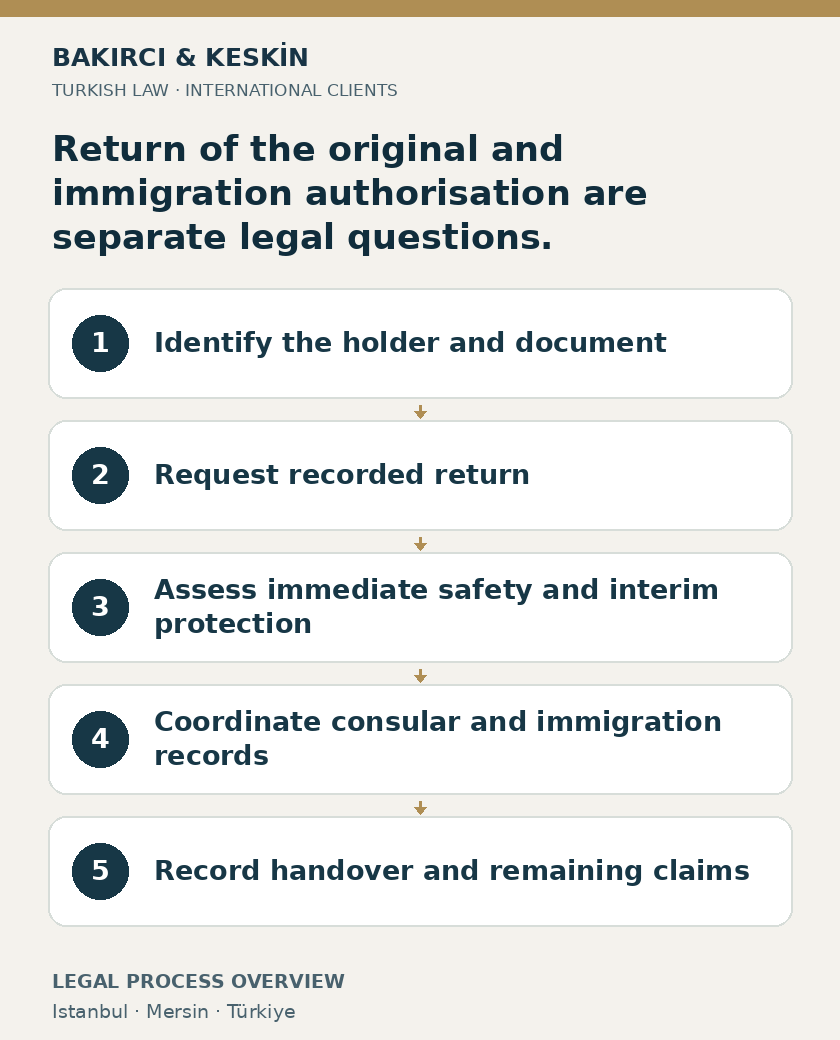
A Turkish employer’s involvement in a work-permit application does not itself give the employer a right to keep a foreign employee’s original passport. The legal analysis separates consent to temporary handling, the duty to return an entrusted document, protection of the employee’s personality, and any genuine public-authority restriction. Turkish Civil Code Articles 24–25 and 951, together with Code of Obligations Articles 417 and 564, provide relevant grounds for challenging continued private retention. Record the handover and refusal, request a defined return arrangement, and obtain urgent assistance where retention accompanies threats or restrictions on movement.
Have a general question about this article? Ask anonymously
Quick summary
| Legal issue | Employer Holding Your Passport in Turkey: Return Rights and Urgent Steps |
|---|---|
| Short answer | A Turkish employer's involvement in a work-permit application does not itself give the employer a right to keep a foreign employee's original passport. The legal analysis separates consent to temporary handling, the duty to return an entrusted document, protection of the employee's personality, and any genuine public-authority restriction. Turkish Civil Code Articles 24–25 and 951, together with Code of Obligations Articles 417 and 564, provide relevant grounds for challenging continued private retention. Record the handover and refusal, request a defined return arrangement, and obtain urgent assistance where retention accompanies threats or restrictions on movement. |
| Key legislation | Turkish Civil Code No. 4721; Code of Obligations No. 6098; Civil Procedure Code No. 6100 |
Identify the holder, the document and the claimed authority
The first task is to establish where the original passport is and who controls its release. An employer, recruitment agency, payroll provider and immigration adviser are different persons. A statement that the document is “with the company” leaves unresolved whether the company actually possesses it, has delivered it to another private person, or has submitted it to a public office. The return demand and any later proceeding must identify the relevant holder as accurately as the evidence permits.
Record the passport number, issuing state, expiry date and date of delivery without circulating that information publicly. Retain the receipt, message or application record explaining why the original was handed over. A passport is also distinct from a work-permit card, residence-permit card, certified copy or application printout. Recovery of one item does not establish recovery of all identity and immigration documents.
A private employer’s claimed authority must be examined independently of a genuine official seizure, surrender requirement or court restriction. Ask for the issuing authority, file reference and written document supporting any claim that the passport cannot be released. An employer’s verbal reference to “immigration rules” is not the same evidence as an actual administrative or judicial measure.
Temporary consent does not answer a later request for return
Consent to let an employer inspect, copy or temporarily deliver a passport for a stated procedure has a defined purpose. It does not establish unrestricted permission to hold the original throughout employment. The surrounding correspondence matters: instructions to return the passport after a particular appointment, a stated storage arrangement and a later withdrawal of consent each help explain the legal relationship.
Where the arrangement qualifies as safekeeping, Code of Obligations Article 561 identifies the undertaking to protect a delivered movable. Article 564 requires its return on the depositor’s request even when a storage period has been agreed, while preserving the specified claim for expenditure made in reliance on that period. The provision supplies a direct return framework; it does not make a personal travel document collateral for every disputed employment cost.
Not every delivery is a standalone safekeeping contract. An original handed over for an application can also form part of an employment or representation arrangement. The legal ground should fit the actual instructions and relationship. In each case, distinguishing the original limited purpose from the later refusal makes the claim clearer than relying only on the fact that the employee once handed over the passport voluntarily.
A passport is not an ordinary asset that an employer can retain for a debt
Employers sometimes connect release of documents with recruitment charges, accommodation balances, training expenses or a claimed contractual penalty. Whether any such monetary claim is valid requires its own examination. A disputed invoice does not, by itself, establish a right over a passport. Nor does the employer’s payment of an application expense transfer public powers over the employee’s travel documents.
Civil Code Article 950 sets conditions for the creditor’s right of retention over certain movables and securities, including possession obtained with consent, a due debt and the required connection. Article 951 then excludes movables that are inherently unsuitable for realisation in money. It also excludes retention inconsistent with the creditor’s undertaking, the depositor’s delivery instructions or public order.
A passport functions as a personal travel and identity document; it is not an asset available for sale to discharge an employee’s debt. Applying Article 951 to that function provides a distinct answer to a purported ordinary creditor’s lien. The claim for a training balance, the enforceability of a penalty and the return of the passport should therefore be addressed as separate legal questions, with the asserted security ground identified expressly.
The employer also has duties concerning the employee’s personality
Code of Obligations Article 417 requires an employer to protect and respect the employee’s personality and maintain an employment environment consistent with good faith. Passport retention that controls an employee’s ability to leave, obtain assistance or conduct personal affairs must be assessed against that obligation. The assessment concerns the actual interference, its duration, the explanation given and the available evidence.
Civil Code Article 24 protects against unlawful infringements of personality. The article recognises consent, a superior private or public interest, and statutory authority as potential grounds of justification. Simply naming an employer policy does not establish one of those grounds. Article 25 provides actions to prevent a threatened infringement, end a continuing infringement and establish unlawfulness where the effects persist, while reserving compensation claims.
These civil rules do not justify calling every administrative delay a criminal offence. Criminal responsibility depends on the conduct and the elements of the relevant offence, investigated by the competent authorities. A careful complaint describes what happened: who refused return, the conditions imposed, the threats made and the restrictions experienced. Accurate facts are more useful than adding unsupported criminal labels.
Make the request specific enough to establish a workable return
A return request should identify the original passport, the person to receive it and a practical handover method. It should state that the employee requires possession of the original and does not consent to continued private retention. Include the earlier delivery date or acknowledgement and ask the holder to confirm the document’s present location. Where another person holds it, request that person’s identity and the basis on which it was transferred.
The request should separate document return from discussions about pay, expenses and termination. Signing a debt admission, employment release or resignation is a substantive legal act; it should not be treated as a routine passport receipt. A simple acknowledgement of receiving the identified original can record the handover without resolving unrelated monetary disputes.
Choose a communication method that preserves the message, date and delivery evidence. A lawyer’s notice or notarial notice can be appropriate where formal proof is needed. There is no universal statutory “passport return notice period” established by the provisions discussed here. Any requested response time should reflect the actual urgency, and an urgent protection application should not be delayed merely to complete an informal exchange.
Keep a compact record of possession, refusal and consequences
The strongest practical file follows the document’s custody. Preserve the employment contract, recruitment communications, handover receipt, messages acknowledging possession, requests for return and the holder’s response. Keep full message threads with dates and sender details. A cropped screenshot omitting the preceding request can make an otherwise clear refusal difficult to interpret.
Preserve evidence of the need for the original, including booked travel, a consular appointment, an official request to present the passport or a pending immigration procedure. These documents show why delay matters. Record actual disruption as it occurs, with receipts and dated correspondence, rather than estimating an unsupported daily loss. Retain the original electronic files where available and make a separate working copy for translations.
A representative preparing the case needs a reliable chronology, not an indiscriminate transfer of every personal file. Mark documents containing passport numbers and immigration information as confidential. Do not obtain access to the employer’s accounts or personnel systems without authority. Evidence already lawfully available to the employee can establish the issue without creating a separate access or privacy dispute.
Urgent danger and urgent civil protection require different responses
When retention accompanies threats, physical confinement, coercion or an immediate danger, personal safety takes priority over arranging a private meeting. Official Migration Management guidance identifies 112 and YİMER 157 as reporting channels for suspected trafficking situations. The current YİMER guidance also describes emergency reporting concerning forced work, forced confinement and threats. A person seeking help should describe the immediate circumstances and location.
For civil protection, Civil Procedure Code Article 389 permits interim measures where a change threatens to make obtaining the right substantially harder or impossible, or delay threatens serious harm. Under Article 390, the applicant must specify the measure and grounds and provide approximate proof of the merits. The court determines whether the requested protection meets those conditions.
Urgency should be evidenced, not asserted solely because a passport is important. The application should connect the continuing retention with the concrete threatened harm and explain the proposed measure. Security, the competent court and subsequent procedural requirements require attention. Interim relief is a judicial decision; an employee’s written demand is not itself an enforceable court order.
Consular assistance can address the travel-document problem
A foreign national should contact the issuing state’s embassy or consulate when the original is withheld, lost or said to be unavailable. The consulate’s requirements for replacement or emergency travel documents depend on that state’s rules. Explain that the document is believed to be in another person’s possession; do not describe it as physically lost when the evidence establishes a different situation.
Ask how issuance of a replacement affects the old document’s validity and what supporting records are required. A replacement process does not automatically decide the civil dispute with the employer. It also does not establish that an airline, transit country or Turkish border authority will accept every type of emergency document for the intended itinerary.
Keep the consular correspondence in the case file. Necessary replacement costs and related travel disruption can be relevant to a properly supported damages claim. The issuing authority’s position also helps prevent later use of an invalidated original after the employer eventually returns it.
Possession of the passport and permission to work are separate
Recovering a passport does not extend a residence permit, cancel a removal decision or authorise work for a different employer. Equally, an employer’s possession of the passport does not give that employer authority to determine immigration status. Check the actual work-permit and residence records, their expiry dates and any notified administrative decisions while the return dispute is being addressed.
An employment departure requires coordination with the applicable permit rules. Our guide to changing employer on a Turkish work permit explains the separate new-employer application issue. A person should not assume that possession of the original passport alone permits immediate work for a new company.
The route for a subsequent application also matters. The article on work-permit applications from abroad and inside Turkey addresses that distinction. In a passport dispute, these administrative records should remain accessible to the employee or authorised representative so that a missed status deadline does not become a second problem.
A compensation claim needs a legal basis and documented loss
Return of the passport is often the immediate objective. Compensation is a separate question requiring the applicable basis of liability, the relevant wrongful conduct, causation and proof of loss. Civil Code Article 25 reserves material and non-material compensation claims; Code of Obligations Article 417 addresses liability connected with breaches of the employer’s duties. Neither provision fixes an automatic payment for every day of retention.
Keep invoices for necessary replacement documents, irrecoverable travel expenses and other actual costs, with the records showing why they arose from the refusal. Distinguish a refundable booking from a final expense and identify any reimbursement already received. A clear calculation prevents the same cost from being claimed twice.
Non-material harm also requires a legal assessment of the infringement and its circumstances. A demand should not attach a standard tariff to distress without a basis. Employment claims, document-return relief and compensation can interact, but their procedural route and any preliminary requirements must be assessed for the actual legal relationship.
Returning the original does not resolve every issue about copies
An employer can have legitimate reasons to hold employment and immigration information. That does not mean every use or circulation of passport data is permitted. Code of Obligations Article 419 restricts use of employee personal data to matters related to suitability for work or necessary performance of the employment contract, while preserving special legislation.
Ask which copies exist, the purposes for which they are kept and who received them where the facts warrant that inquiry. The request for the original should remain clear even while data issues are investigated. A demand to erase every employment record immediately can conflict with lawful recordkeeping duties; the appropriate data request depends on the purpose, legal basis and retention obligation for the particular record.
Record the return and check the remaining issues
At handover, check the document’s identity, pages and condition. A receipt should describe the passport actually returned and the date of return. It should not contain an unreviewed settlement, waiver of wages or acknowledgement of a debt. Where direct contact is unsafe or impractical, arrange a lawful handover through an authorised representative or other appropriate channel.
After recovery, confirm with the issuing authority whether the passport remains valid if a replacement or cancellation process has started. Update the lawyer handling any interim application so that the requested relief reflects the changed circumstances. Preserve the custody record and final receipt: ending the retention resolves the immediate possession issue, while any proven loss, data concern or employment dispute still requires its own assessment.
Frequently asked questions
Can an employer keep my passport because it paid my work-permit costs?
Payment of application costs does not itself establish a right to retain the original. The validity of a cost claim and the return obligation must be assessed separately. Civil Code Article 951 excludes an ordinary retention right over movables unsuitable for realisation in money.
Does voluntarily handing over the passport prevent me from asking for it back?
No. The purpose and scope of the original permission matter. Where the relationship is safekeeping, Code of Obligations Article 564 provides for return on request even when a period was agreed, subject to its expenditure rule.
Should I sign a resignation to obtain the passport?
A resignation changes the employment relationship and should be assessed separately. A document-return receipt should identify what was returned. It should not be treated as permission to insert an unreviewed resignation, debt acknowledgement or release.
Is every refusal to return a passport human trafficking?
No automatic criminal classification follows from the refusal alone. Threats, coercion, restrictions on movement and the purpose of the conduct require investigation. Report the actual conduct accurately and seek immediate help when safety is at risk.
Where can I seek urgent help in Turkey?
Official Migration Management guidance identifies 112 and YİMER 157 for emergency reports and suspected trafficking situations. Explain the current danger, location and restriction. A civil lawyer can separately assess urgent judicial protection for the document.
Can I ask a Turkish court for an urgent measure?
Civil Procedure Code Articles 389–390 provide a framework where the statutory urgency and proof requirements are met. The request must identify the measure, factual grounds and evidence. The court decides whether relief is justified and on what terms.
Can my consulate issue a replacement while the employer holds the original?
The issuing state’s rules determine the available replacement or emergency-document procedure. Tell the consulate accurately that the original is withheld. Ask how a replacement affects the old passport and the proposed travel itinerary.
Does recovering my passport let me work for another employer immediately?
No. Passport possession and work authorisation are different matters. A new employer’s application and the foreign national’s current lawful status require separate review before work begins.
Can I claim compensation for missed travel?
A claim requires an applicable liability basis, causation and evidence of actual loss. Preserve the booking terms, cancellation record, payment evidence and the documents connecting the loss to the refusal. There is no automatic flat compensation amount in the provisions discussed.
Must the employer delete every passport copy when returning the original?
Return and data retention are separate issues. The lawful purpose and recordkeeping requirements for each copy must be assessed. Article 419 limits employment-related use of personal data, while special data-protection rules remain applicable.
Official legal sources
- Turkish Civil Code No. 4721 — Articles 24, 25, 950, 951
- Code of Obligations No. 6098 — Articles 417, 419, 561, 564, 566
- Civil Procedure Code No. 6100 — Articles 389, 390, 391, 392, 393
- Migration Management official emergency guidance — 112 and YIMER 157 reporting channels
- Migration Management current YIMER guidance — Emergency reporting concerning forced work, confinement and threats
Legal sources reviewed on 28 October 2026. The applicable requirements and deadlines must be assessed for the individual case.
Contact information
Do not include confidential documents or identity numbers in an initial message. An enquiry does not establish representation or suspend any legal deadline.
Istanbul and Mersin contact details
Bakırcı & Keskin Law Office is Mersin-based. Turkish matters are handled under the applicable jurisdiction and agreed mandate. The competent court and the scope of representation are assessed for each matter.
Istanbul — Polaris Plaza
Maslak Ahi Evran Caddesi, Polaris Plaza No:21, Floor 9, 34475 Sarıyer/İstanbul, Türkiye.Mersin — Profit İş Merkezi
İhsaniye Mahallesi, 4903. Sokak, Profit İş Merkezi No:23, Floor 3, Office 14, 33070 Akdeniz/Mersin, Türkiye.+90 552 224 43 66 · Contact details in English. An enquiry does not establish representation or suspend a legal deadline.
Istanbul Office – Polaris Plaza, Maslak / Sarıyer
Bakırcı & Keskin Hukuk Bürosu
Maslak Ahi Evran Caddesi, Polaris Plaza No:21, Kat:9, 34475 Sarıyer/İstanbul
Our physical offices in Istanbul and Mersin coordinate matters throughout Turkey, subject to jurisdiction and the local steps required for each case. Please specify your preferred office when arranging an in-person appointment.
Open the Istanbul office on Google Maps · Contact and appointments
Contact regarding a legal matter
In your first message, you may briefly state the subject, your country or city, and any relevant notification or recent procedural date. Please do not send identity numbers, medical data, or personal documents. Messaging alone does not constitute legal advice or create a lawyer–client relationship.
Discover more from Bakırcı & Keskin Hukuk Bürosu
Subscribe to get the latest posts sent to your email.