Industrial Activity Causes Damage in Turkey: Enterprise Owner and Operator Liability Under TCO 71
A business being licensed does not automatically eliminate compensation for damage caused by a significantly dangerous activity. Article 71 of the Turkish Code of Obligations regulates an enterprise presenting a significant danger and makes its owner and, where there is one, its operator jointly and severally responsible for damage arising from the activity. The statute defines the danger threshold and preserves special liability rules. It also expressly addresses activity permitted by law. A claim must therefore identify the enterprise, the relevant danger, the responsible business roles and the causal connection with the loss; describing an incident as industrial is not enough.
Have a general question about this article? Ask anonymously
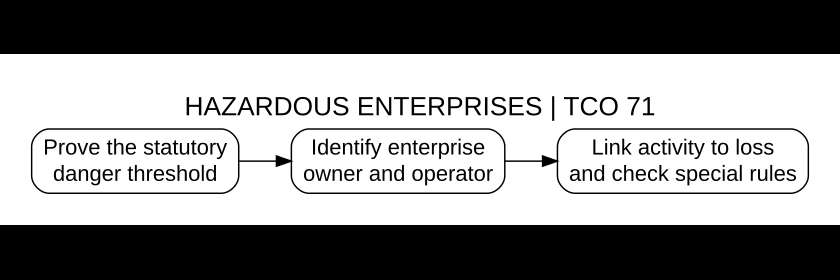
Article 71 does not classify every business as significantly dangerous
The relevant test in Law No. 6098, Article 71 considers the enterprise’s nature and the materials, equipment or forces used in its activity. It asks whether frequent or serious damage remains possible even if all the care expected from a person expert in the activity is exercised.
The threshold therefore needs a technical and factual explanation. The size of the business, the seriousness of one allegation or the word factory in a trading name does not alone establish every statutory condition. Identify the activity and the source of danger rather than relying on a general description of the premises.
The article also treats an enterprise as significantly dangerous where a law provides special danger liability for enterprises presenting similar risks. The claimed similarity should be identified and supported. A reference to an unrelated regulated industry is not enough to explain why the enterprise under examination falls within this rule.
Full expert care is part of the classification test
The statutory definition expressly contemplates danger remaining despite all the care expected from an expert. Consequently, a business cannot answer an Article 71 claim solely by saying that it generally follows precautions, without addressing whether its activity meets this danger-based regime and whether it caused the harm.
This must not be confused with a declaration that every safety measure is irrelevant. Records of the activity, equipment and precautions can help identify the nature of the risk, the event’s cause and the scope of another applicable liability rule. Their evidential purpose should be stated accurately.
The employer-liability guide explains Article 66’s different care and organisation framework. A defence formulated for one provision should not be copied into another without examining the legal basis. The presence of staff does not make Article 66 the only possible rule for an enterprise’s activity.
Identify the enterprise owner and any separate operator
Article 71 identifies the owner of the enterprise and, if present, its operator. Those are business roles that must be established from the actual arrangement. They should not be confused automatically with the owner of the land, the landlord of a building or an individual who holds shares in a company.
Obtain the relevant corporate identity, operation agreements, permits, asset arrangements and records showing who conducted the activity. A group brand can cover several legal entities. The claim must identify the entity or person bearing the asserted role, not merely the best-known name associated with the site.
The owner and operator can be the same person, or the file can reveal a separate operator. Do not create an additional defendant solely because the statute mentions two possible roles. Conversely, do not assume that the enterprise owner disappears from the analysis merely because operational work was entrusted to another business.
Joint and several responsibility is different from equal internal shares
Article 71 expressly makes the identified owner and operator jointly and severally responsible for the relevant damage. That external relationship should be distinguished from the allocation between the responsible persons. The injured party’s claim is not necessarily divided into two equal halves simply because two defendants are involved.
Articles 61–62 address multiple responsibility for the same loss and internal allocation, taking account of all circumstances, particularly each person’s attributable fault and the intensity of the danger created. The person paying more than the appropriate internal share has the stated recourse and subrogation rights.
The joint-debtor guide explains the broader external-versus-internal distinction. An operation contract allocating costs between businesses should be reviewed for that internal relationship; its existence does not by itself prove that the injured outsider agreed to release a statutory defendant.
Connect the harmful event with the enterprise’s activity
Article 71 requires damage arising from the enterprise’s activity. A claimant must identify the event, the relevant activity and the connection with the asserted loss. Geographic proximity alone is not a complete causal explanation, just as an operational permit alone is not a complete defence.
Preserve the event chronology, available measurements, relevant technical records and the condition of affected property. The expert questions should address the alleged mechanism of harm. An opinion that merely labels the activity dangerous without examining how this loss occurred leaves a different part of the claim unanswered.
Competing explanations should be recorded rather than suppressed. An alternative source, a pre-existing condition or another person’s intervention can require examination. The legal analysis should explain what the evidence establishes and what remains disputed instead of presenting the occurrence of an industrial incident as proof of every claimed consequence.
Separate the enterprise’s activity from a building defect
Article 69 concerns damage caused by defective construction or inadequate maintenance of a building or another structure. Article 71 concerns the specified enterprise activity. A claim involving premises can require one, the other or several supported legal grounds, but their elements are not identical.
The building-owner liability guide explains the structure-specific rule and the prevention provision in Article 70. Do not identify an enterprise operator as the registered property owner without checking the relevant records, or assume that a property owner necessarily operates every business on the land.
Article 60 addresses competing grounds of responsibility and directs the judge, subject to its qualifications, towards the ground providing the injured person the best redress. That does not eliminate the need to plead and prove the relevant facts. The file should keep each ground’s factual basis intelligible instead of using a list of article numbers as a substitute for analysis.
Permission to operate is not complete immunity
The final paragraph of Article 71 states that even where the legal order permits the significantly dangerous activity, injured persons can seek appropriate monetary compensation for the damage caused by it. This prevents a licence from being presented as an automatic answer that no compensable harm can exist.
Identify what the permission actually covers. A licence for a defined activity, an inspection record and proof that a particular event occurred within authorised operations are different documents. The application should not assume that the existence of one permit settles every question about the activity or its consequences.
The statutory reference to an appropriate compensating amount should also not be converted into a promise that every amount claimed will be awarded in full. The actual harm, causal connection, applicable legal framework and assessment remain necessary. Authorisation and compensation must each be addressed on their own terms.
Special liability rules are expressly preserved
Article 71 reserves special responsibility provisions for a particular danger. A reviewer must therefore check whether the specific activity is governed by a separate statute before applying only the general Code. The presence of an Article 71 argument does not make other relevant mandatory rules disappear.
The special-regime review can affect the responsible persons, conditions, limits, insurance or procedure. The actual rule must be identified for the activity and claim concerned. This guide does not assign a universal sector-specific rule or fixed compensation cap to every industrial enterprise.
Keep the operating facts sufficiently precise for that classification. Materials, equipment, the activity performed and the timing of the incident are legal inputs as well as technical details. A file describing only a large business or a dangerous site can be too vague to identify the controlling regime.
The damages account must identify the claimant’s actual loss
Article 50 addresses proof of damage and permits judicial estimation where its exact amount cannot be proved under the stated conditions. That is not permission to invent an unsupported total. Preserve the evidence reasonably available and explain why any part requires estimation.
For property damage, identify ownership or the relevant legal interest, the previous condition, repair or replacement evidence and any other supported loss. A quotation, expenditure and residual reduction in value require distinct explanations. An account should not add overlapping measures of the same loss without adjustment.
Where bodily injury is involved, Articles 54 and 56 address pecuniary and non-pecuniary claims separately. Medical and income records should be handled confidentially and assessed for their legal relevance. This article does not diagnose an injury or substitute a legal calculation for professional treatment.
Contributory conduct and payments require separate treatment
Article 52 allows reduction or removal of compensation in the stated circumstances, including contribution to the occurrence or increase of the harm. A party invoking it must identify the relevant conduct and its effect. Mere residence or work near an enterprise is not, without further analysis, proof that a person caused or accepted every loss.
Record payments from defendants, insurers and other sources with their purpose. The same loss should not be recovered twice, but different categories of receipt can have different legal treatment. A bare total of all money received is not a substitute for classifying each payment under the applicable compensation rules.
Where a claimant’s economic circumstances require an early payment, the Article 76 provisional-payment guide explains its separate evidence and need conditions. Establishing that an activity is significantly dangerous does not itself make a provisional payment automatic.
Frame the technical questions before evidence changes
| Question | Evidence to identify |
|---|---|
| What activity was being conducted? | Operating records and the actual process relevant to the event |
| Why does the statutory danger threshold apply? | The activity’s nature and its materials, equipment or forces, assessed against the expert-care test |
| Who owned and operated the enterprise? | Corporate and operation documents for the relevant date |
| How did the activity cause the loss? | Incident chronology, measurements and reasoned technical analysis |
| What loss did this claimant sustain? | Condition, interest in the affected property, expenditure and other relevant records |
| Does a special regime apply? | The precise activity and the applicable statutory provisions |
The questions should be specific enough for an expert to answer. A request to decide all liability without identifying the alleged mechanism risks confusing technical findings with the court’s legal task. Preserve originals and the assumptions used in any calculation.
Evidence preservation and immediate safety measures are not the same remedy
Danger can require action before the damages dispute is finally resolved. The legal basis and competent procedure for a protective or public-safety measure must be identified separately. Article 71’s compensation provision should not be described as an automatic order to close any business named in a claim.
The evidence-preservation guide addresses recording conditions before they disappear or are altered. That process can preserve material for the claim, but it does not itself award final compensation or decide every operating-permit issue.
Do not enter a dangerous or restricted area to collect evidence. Use lawful records and the appropriate authorised inspection process. Urgency should improve the precision of the request, not become a reason to bypass safety or obtain another business’s confidential systems without permission.
Limitation and recourse need their own dated records
Article 72 provides the general tort limitation framework, including the knowledge-based two-year period, the ten-year period from the act and the stated longer criminal-law exception. A special regime or the legal character of the event can require further assessment. The date of a permit is not automatically the starting date of every later damage claim.
Article 73 separately addresses recourse periods and notification to co-responsible persons. An enterprise facing a compensation demand should preserve its internal contractual and incident records and assess the required notification instead of assuming that recourse can always be considered only after the entire case ends.
The limitation-interruption guide explains why correspondence alone should not be assumed to protect the claim. Keep every relevant filing, acknowledgment or payment with its date and scope.
Reviewing the matter for a foreign business or an overseas claimant
A foreign shareholder, business counterparty and injured neighbouring owner can have different legal interests. Identify the person asserting the claim and the entity alleged to own or operate the enterprise. Do not treat a group relationship or nationality as a substitute for the relevant legal role.
Provide the operating and corporate documents, incident chronology, technical evidence, damage schedule and any served proceedings. Retain source-language documents beside translations and distinguish established findings from proposals for further investigation.
The conclusion should state the danger classification, responsible persons, causal basis and remedy supported by the record. Neither a licence nor an alarming description of the event resolves those questions alone. Any pending court or enforcement response must be handled through its own procedure and service timetable.
Frequently asked questions
Does Article 71 apply to every industrial business?
No. The significant-danger threshold must be established from the enterprise’s nature and the materials, equipment or forces used, applying the statutory expert-care test.
Who is identified as responsible under Article 71?
The enterprise owner and any separate operator are jointly and severally responsible for the qualifying damage. Their actual legal and operational roles must be identified.
Is the landlord necessarily the enterprise owner?
Not automatically. Ownership of the premises and ownership or operation of the enterprise are different roles that require evidence.
Does proof of ordinary precautions automatically defeat the claim?
No such automatic conclusion follows. Article 71’s danger definition considers frequent or serious harm remaining even with all care expected from an expert.
Does an operating licence eliminate compensation?
Article 71 expressly permits an appropriate compensating amount for damage caused by the qualifying activity even where the legal order permits it. Causation and loss still need assessment.
Are special liability statutes displaced by Article 71?
No. The provision expressly preserves special responsibility rules for particular dangers. The activity must be classified before selecting the governing framework.
Is being near the business enough to prove causation?
No. Identify the activity, event and mechanism connecting it with this claimant’s damage. Technical evidence should address that connection.
Must owner and operator always bear equal internal shares?
Joint and several responsibility is not the same as equal internal allocation. Article 62 directs attention to the relevant circumstances, fault and danger created.
Does Article 71 automatically close the enterprise?
No automatic closure order follows from the compensation provision. Protective and public-safety measures need their own legal basis and competent procedure.
Which records are central to an overseas review?
Provide the enterprise’s identity and operating records, technical danger and causation evidence, damage account, relevant permissions and any served proceedings.
Official legal sources
Turkish Code of Obligations No. 6098, Articles 50–52, 60–62 and 69–73; official Ministry text, pages 13–14, containing Article 71. The English explanation is not an official translation or a substitute for activity-specific legislation.
Ask about enterprise-related damage
State the activity, event date, type of damage and your role. Do not include confidential industrial, medical or identity records in the initial enquiry.
Istanbul and Mersin offices
Bakırcı & Keskin Law Office is Mersin-based and works throughout Türkiye with an Istanbul and Mersin focus. Arrange a confidential channel for the operating and compensation records.
Istanbul — Polaris Plaza
Maslak Ahi Evran Caddesi, Polaris Plaza No:21, Floor 9, 34475 Sarıyer/İstanbul. Istanbul office directions.
Mersin — Profit İş Merkezi
İhsaniye Mahallesi, 4903. Sokak, Profit İş Merkezi No:23, Floor 3, Office 14, 33070 Akdeniz/Mersin. Mersin office directions.
Call +90 552 224 43 66. An enquiry does not establish representation or suspend a legal deadline.
Contact regarding a legal matter
In your first message, you may briefly state the subject, your country or city, and any relevant notification or recent procedural date. Please do not send identity numbers, medical data, or personal documents. Messaging alone does not constitute legal advice or create a lawyer–client relationship.
Discover more from Bakırcı & Keskin Hukuk Bürosu
Subscribe to get the latest posts sent to your email.