Can a Creditor Challenge an Heir’s Rejection of a Turkish Inheritance?
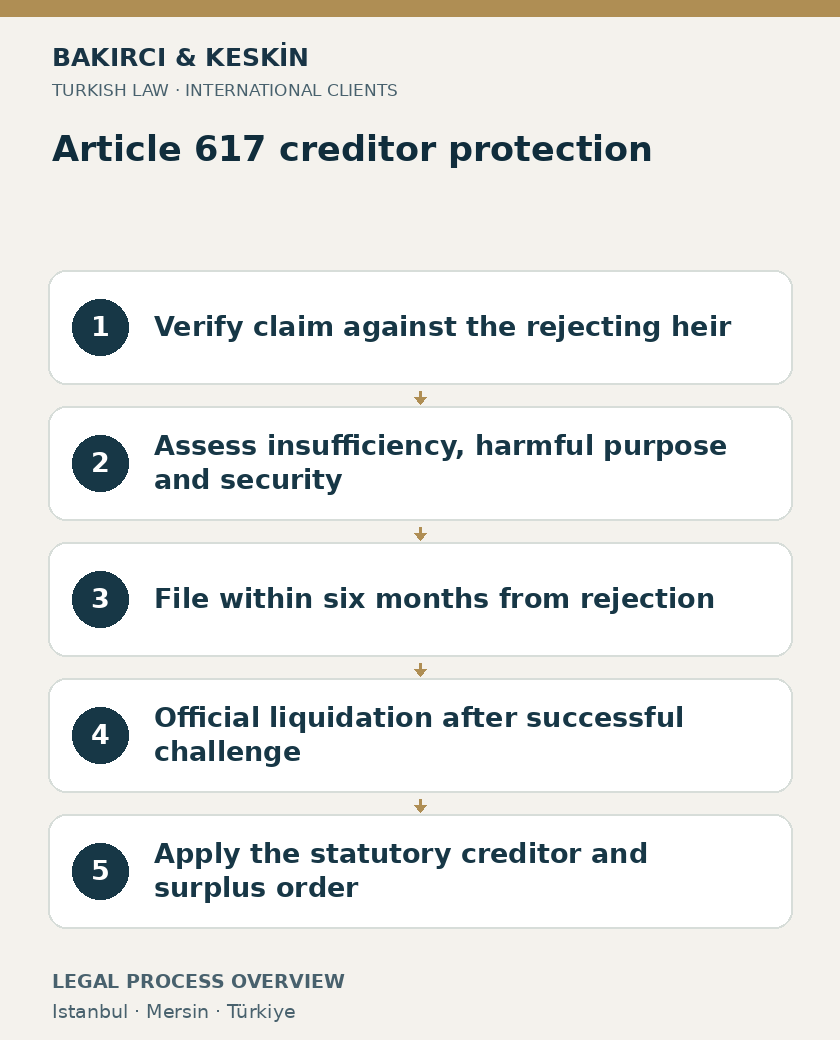
Short answer: Civil Code Article 617 permits an heir’s creditors or bankruptcy administration to challenge a rejection made by an heir whose assets are insufficient for their debts, where the rejection was intended to harm creditors and sufficient security has not been provided. The action must be brought within six months from the rejection date. A successful challenge leads to official liquidation; it does not simply make the debtor heir the unrestricted owner of the rejected inheritance. The statute directs the resulting value first to the challenging creditors, then other creditors, with any surplus passing to those who would have benefited from a valid rejection.
Have a general question about this article? Ask anonymously
Quick summary
| Legal issue | Can a Creditor Challenge an Heir’s Rejection of a Turkish Inheritance? |
|---|---|
| Short answer | Civil Code Article 617 permits an heir's creditors or bankruptcy administration to challenge a rejection made by an heir whose assets are insufficient for their debts, where the rejection was intended to harm creditors and sufficient security has not been provided. The action must be brought within six months from the rejection date. A successful challenge leads to official liquidation; it does not simply make the debtor heir the unrestricted owner of the rejected inheritance. The statute directs the resulting value first to the challenging creditors, then other creditors, with any surplus passing to those who would have benefited from a valid rejection. |
| Key legislation | Law No. 4721 — Articles 605, 617, 618, 648; Law No. 6100 — Articles 190, 223, 224; Law No. 5718 — Articles 20 |
Article 617 protects creditors of the rejecting heir
The identity of the debtor is the starting point. Civil Code Article 617 concerns a person who owes money and rejects an inheritance in the circumstances stated by the provision. The protected creditor is a creditor of that heir. It is not enough that the creditor is owed money somewhere within the wider family or has a claim against the original deceased.
A creditor of the deceased has a different legal position and must examine the provisions applicable to estate debts and the deceased’s creditors. Article 618, for example, deals with specified liability of rejecting heirs in relation to values received from an insolvent deceased during the five years before death. That is a different debtor relationship and a different statutory basis. Mixing the two provisions can produce the wrong facts, parties and remedy.
Article 617 also expressly names the bankruptcy administration as a person entitled to bring the challenge. Where insolvency proceedings exist, obtain the relevant appointment and file information before deciding who should act. A creditor’s individual interest and the administration’s statutory role should not be conflated. The application must identify the claimant’s actual capacity and the claim connecting the rejecting heir to the alleged creditor harm.
The provision requires more than a rejection that disappoints a creditor
Article 617 refers to an heir whose assets are insufficient to meet their debts, a rejection made with the purpose of harming creditors, and the absence of sufficient security. These elements must be addressed in the factual and legal case. A creditor cannot treat every lawful exercise of the rejection right as abusive merely because the inheritance would have been a convenient source of payment.
Equally, the heir cannot answer the claim solely by pointing to the general freedom to reject an inheritance. The Code recognises that right in Article 605 while imposing the specific creditor protection in Article 617. The case therefore requires both the general inheritance position and the special conditions to be considered. The relevant evidence concerns the heir’s liabilities and assets, the reasons and circumstances of rejection, and any security offered or provided.
A careful analysis separates what is established from what must still be proved. The creditor should identify the actual deficiency in the debtor heir’s assets and the evidence supporting the alleged harmful purpose. The heir should respond to those propositions specifically. Neither a family relationship nor the mere fact that another relative benefits is a complete substitute for the statutory analysis.
The six-month period runs from the rejection date
Article 617 requires the action to be brought within six months starting from the date of rejection. Its text does not express that period as six months from the creditor’s later discovery. Obtain the official rejection record promptly and identify the relevant date rather than calculating from a collection letter, a family announcement or the eventual transfer of an estate asset.
Where the record is unclear, request the underlying declaration and court registration information through the appropriate process. Distinguish the date a statement was made, the date it was entered and the date a document was issued. The legal assessment must identify the event the statute uses. An administrative delay in obtaining a copy should not be assumed to alter the statutory starting point.
A demand for payment, a request for security and an Article 617 lawsuit are different acts. Do not assume that negotiation with the heir preserves the six-month period. Identify the required court filing and prepare it with the evidence available, addressing any documents that must be obtained through the proceedings. The deadline should be recorded separately from limitation affecting the creditor’s underlying claim or any enforcement proceeding.
Establish the underlying debt and the heir’s financial position
The creditor’s case needs a reliable basis for the debt: the relevant contract, judgment, instrument, account or other source of the obligation, together with payments, maturity and disputes affecting it. A claimed balance should be reconciled to the underlying record. If proceedings about the debt already exist, provide the file reference and explain their current stage without presenting an allegation as a final determination.
The insufficiency of the heir’s assets is a separate factual question. Assemble lawful evidence of assets, liabilities and the relevant financial position. An unsuccessful informal request for payment does not, by itself, show every element of Article 617. Conversely, the existence of an asset on paper does not establish that it is available and sufficient to satisfy the debt; burdens, competing claims and the asset’s real legal position matter.
Code of Civil Procedure Article 190 supplies the general burden-of-proof framework. Present the facts supporting the legal consequence claimed and identify the necessary records. Avoid treating an insolvency document, financial statement or enforcement return as evidence of more than it actually establishes. The court must evaluate the relevant debtor position, not a label selected by one party.
The purpose of harming creditors must be addressed through evidence
Article 617 expressly refers to the purpose of harming creditors. The rejection record, timing of demands, known financial circumstances, communications and the actual estate position can be relevant to assessing the asserted purpose. The legal argument must explain the connection between those facts and the statutory condition. It should not simply repeat the word “fraud” without identifying the conduct and evidence relied on.
Read communications in context and preserve originals. A message discussing family estate arrangements is not automatically an admission of a purpose to defeat creditors. At the same time, a factual explanation offered by the heir should be assessed against the records, including what was known about the estate’s liabilities and available value. Contradictory statements should be identified precisely rather than paraphrased selectively.
The estate’s apparent value does not replace proof of purpose, but it can be material to the parties’ competing accounts. A financially burdensome inheritance and an inheritance with an established net surplus require different factual examination. The court should receive a defensible picture of the estate as relevant to the rejection, including unresolved liabilities, rather than a presentation containing only its most valuable property.
Sufficient security is an express part of the statutory framework
Article 617 makes the absence of sufficient security part of the creditor-protection mechanism. Establish what security was requested, offered or provided, when it was made available and what obligation it covers. An assurance that payment will eventually be arranged is not the same as an established security right. The actual legal instrument and its enforceability need examination.
Assess the scope and value of any proposed security against the creditor’s position. Relevant questions include the asset or undertaking involved, existing burdens, the person providing it and the legal steps needed to make it effective. A nominal value written into a document does not alone establish sufficiency. Nor should a creditor’s unexplained dislike of a security proposal substitute for a legal assessment of its protection.
Keep negotiations within the six-month litigation timetable. Record any agreement exactly, including the claim secured and the performance required. The parties should not assume that an informal discussion suspends the statutory period or automatically resolves the pending action. The procedural consequences of security provided at a particular stage must be assessed in that case and reflected in the court record where necessary.
Determine the potential net value of the rejected interest
The economic purpose of the challenge is to reach value that would otherwise escape the heir’s creditors under the challenged rejection. The estate’s gross property value is only one part of that analysis. Identify its debts, burdens, claims, testamentary obligations and the rejecting heir’s actual share. A property owned only partly by the deceased should not be entered as though the entire property belongs to the estate.
Obtain the inheritance records, title information, account evidence and documents establishing liabilities. A dispute about heirship or a will can affect the value attributable to the rejecting person. Where valuation is contested, identify the asset and the relevant evidence rather than relying on a general estimate based on its address. Separate established sums from amounts still in litigation.
The estate-debt guide explains the general distinction between estate obligations and heirs’ exposure. In an Article 617 claim, that distinction has an additional practical role: a successful challenge does not manufacture distributable value where the estate has none. The legal merits and the potential recovery should therefore be assessed together, without promising a result from gross asset figures.
Successful cancellation leads to official liquidation and a specific order of payment
Article 617 expressly states the consequence of cancellation: the inheritance is officially liquidated. It does not simply reverse the rejection and release the entire inheritance into the debtor heir’s unrestricted ownership. The statutory distribution mechanism is part of the remedy and must be understood before a creditor commits to the claim.
If value falls to the rejecting heir’s share in that liquidation, the challenging creditors are paid first, then other creditors. Any remaining value goes to the heirs who would have benefited had the rejection been valid. The article therefore both protects creditors and preserves a defined destination for the surplus. An application seeking to hand the remainder to the rejecting debtor without regard to that rule misstates the statutory outcome.
The liquidation’s implementation requires attention after judgment. Obtain the order, identify the resulting liquidation file and submit the relevant creditor information. The official-liquidation guide explains the administration framework. A judgment granting the Article 617 challenge is a major legal step, but it is not itself evidence that the creditor has received money.
Keep rejection challenges separate from attachment and other avoidance claims
An attachment of an existing inheritance share and an Article 617 challenge to a rejection address different legal positions. Article 648 concerns specified persons seeking appointment of a trustee to participate in partition in the heir’s place. It should not be used as though it automatically cancels a rejection. Likewise, a general transaction-avoidance theory requires its own legal conditions and procedure.
Article 618 concerns a rejecting heir’s specified exposure to creditors of an insolvent deceased for certain earlier benefits. Its five-year reference relates to the benefits received before death, not an alternative six-month challenge period for the heir’s own creditor. Keep the identity of the debtor and the purpose of each statutory period clear.
Other proceedings can also be relevant, including determination of the underlying debt, protective measures and enforcement of a resulting judgment. Their availability must be examined separately. The Article 617 action should be described accurately within that larger case strategy, without suggesting that filing it automatically attaches every estate asset or establishes every disputed claim.
Organise the Turkish and foreign evidence as one verifiable record
Prepare separate schedules for the personal debt, the debtor heir’s assets and the rejected estate interest. The first should identify the source of the debt, payments already made and the outstanding claim. The second should distinguish ownership from possession and disclose the evidence supporting the asserted insufficiency. The third should identify the deceased, the opening of succession, the heirship position, the rejection and the assets and liabilities affecting the rejected share. Combining these three subjects in one unexplained total makes the statutory conditions harder to assess.
Use a consistent valuation date and explain any difference in the dates of supporting records. A current balance, an earlier appraisal and a liability stated in another currency cannot simply be added as if they described the same financial position. Identify the conversion date and source where a calculation is necessary, and preserve the original amounts. These are evidential controls for the financial account; they do not create a statutory presumption that the purpose required by Article 617 has been proved.
The proposed judgment and its implementation should also remain distinct. Establishing the grounds for cancellation is the litigation task. Identifying assets, collecting claims and applying the statutory payment order belong to the resulting liquidation framework. The claim should explain the relief Article 617 provides without promising that every estate asset will be sold immediately or that the creditor will receive the amount asserted before liabilities and competing entitlements have been determined.
Where the creditor, heir or deceased has foreign connections, Law No. 5718 requires attention to applicable law, international jurisdiction and the effect of foreign judgments. Article 20 supplies the succession framework. A foreign judgment establishing the creditor’s debt raises a different question from a foreign document showing heirship. Identify the legal effect sought from each document before selecting the procedure.
Foreign-language evidence must be translated for Turkish proceedings in accordance with Article 223 of the Code of Civil Procedure. Article 224 addresses foreign official-document authentication, subject to treaties. Maintain a chronological index of the rejection record, debt evidence, financial records, security correspondence and foreign documents. This makes both the six-month timing issue and the substantive conditions easier to assess.
Bakırcı & Keskin Law Office handles these disputes through Istanbul and Mersin for clients in Turkey and abroad, with Mersin-based coordination nationwide. The practical task is to establish the correct creditor relationship, prove the statutory conditions and preserve the six-month action period. Recovery then follows the court’s decision and the liquidation process, with each stage verified separately.
Frequently asked questions
Can every creditor challenge an inheritance rejection?
Article 617 concerns creditors of the rejecting heir and the bankruptcy administration, subject to its stated conditions.
What are the principal conditions?
The heir’s assets must be insufficient for their debts, the rejection must have the purpose of harming creditors, and sufficient security must not have been provided.
What is the time limit?
The action must be brought within six months from the rejection date under Article 617.
Does the period run from the creditor’s discovery?
The statutory text uses the rejection date. A creditor should obtain the official record promptly and avoid assuming a discovery-based start.
Does sending a payment demand amount to filing the challenge?
No. A demand or negotiation and the required lawsuit are different acts.
Does success make the heir owner of the whole estate again?
Article 617 directs official liquidation and a specific distribution of the rejecting heir’s resulting share.
Who receives the resulting value first?
The challenging creditors are paid first, then other creditors. Any surplus passes to those who would have benefited from a valid rejection.
Is a creditor of the deceased using the same rule?
Not merely by being an estate creditor. The deceased’s creditors must examine the provisions applicable to their distinct relationship, including Article 618 where relevant.
Can sufficient security affect the claim?
Yes. It is expressly part of Article 617’s framework. The legal effectiveness, scope and sufficiency of the actual security require assessment.
Does a valuable property guarantee recovery?
No. Ownership, estate debts, burdens, the heir’s share and the liquidation outcome determine the value actually available.
Official legal sources
- Law No. 4721 — Articles 605, 617, 618, 648
- Law No. 6100 — Articles 190, 223, 224
- Law No. 5718 — Articles 20
The official Turkish legislation controls. Apply the governing provisions to the facts and documents of the individual estate.
Contact information
Do not include confidential documents or identity numbers in an initial message. An enquiry does not establish representation or suspend any legal deadline.
Istanbul and Mersin contact details
Bakırcı & Keskin Law Office is Mersin-based. Turkish matters are handled under the applicable jurisdiction and agreed mandate. The competent court and the scope of representation are assessed for each matter.
Istanbul — Polaris Plaza
Maslak Ahi Evran Caddesi, Polaris Plaza No:21, Floor 9, 34475 Sarıyer/İstanbul, Türkiye.Mersin — Profit İş Merkezi
İhsaniye Mahallesi, 4903. Sokak, Profit İş Merkezi No:23, Floor 3, Office 14, 33070 Akdeniz/Mersin, Türkiye.+90 552 224 43 66 · Contact details in English. An enquiry does not establish representation or suspend a legal deadline.
Istanbul Office – Polaris Plaza, Maslak / Sarıyer
Bakırcı & Keskin Hukuk Bürosu
Maslak Ahi Evran Caddesi, Polaris Plaza No:21, Kat:9, 34475 Sarıyer/İstanbul
Our physical offices in Istanbul and Mersin coordinate matters throughout Turkey, subject to jurisdiction and the local steps required for each case. Please specify your preferred office when arranging an in-person appointment.
Open the Istanbul office on Google Maps · Contact and appointments
Contact regarding a legal matter
In your first message, you may briefly state the subject, your country or city, and any relevant notification or recent procedural date. Please do not send identity numbers, medical data, or personal documents. Messaging alone does not constitute legal advice or create a lawyer–client relationship.
Discover more from Bakırcı & Keskin Hukuk Bürosu
Subscribe to get the latest posts sent to your email.