Interim Salvage Payment in Turkey: Court-Ordered Advance, Salvor Security and Article 1316
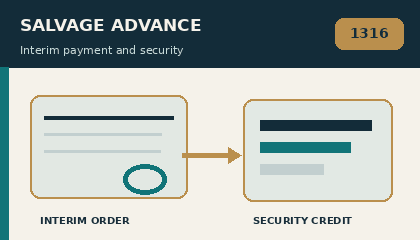
Short and direct answer: Under Article 1316(1) of Turkish Commercial Code No. 6102, the court or arbitral tribunal competent to determine the salvor’s claims may order an appropriate interim advance according to the circumstances of the case. The tribunal may require the salvor to provide security before receiving that advance. Once the advance is paid, the security required under Article 1314 must be reduced correspondingly. The rule grants a discretionary interim-payment mechanism, not an automatic entitlement to a particular percentage of a claimed salvage invoice or a final determination of the reward.
Have a general question about this article? Ask anonymously
This English guide addresses a narrow commercial problem. A salvor has rescued a vessel or cargo, the final salvage reward remains disputed, and the parties hold security pending assessment. The salvor seeks cash now; the owner or insurer is concerned about paying money twice or releasing more security than the law requires. Articles 1314 and 1316 govern different elements of that situation. Careful classification of what was ordered, paid and secured is essential, especially when different companies or foreign owners are involved.
Quick summary
| Primary provision | Law No. 6102, Article 1316(1): discretionary advance by the competent court or arbitral tribunal. |
|---|---|
| Decision type | Interim order pending the final claim determination, not the final salvage-reward award. |
| Advance conditions | Appropriate amount in light of circumstances; the salvor’s receipt can be subject to security. |
| Security adjustment | An advance that has been paid reduces the Article 1314 security by the corresponding amount. |
| Underlying claim | Ordinary salvage under Articles 1304–1305 or qualifying special compensation under Article 1312. |
| General limitation | Article 1319: two years from completion of salvage, subject to its statutory terms and distinct procedural deadlines. |
1. An interim order is not a final assessment of the salvage reward
Article 1316(1) permits an interim decision for a suitable amount to be paid before the salvor’s substantive claim is finally assessed. It is part of the Turkish Commercial Code’s rules concerning a salvor’s rights. The legislature deliberately describes an advance and empowers the competent adjudicator to choose an appropriate sum in the circumstances. It does not specify that a tribunal must award a fixed percentage of the salvor’s invoice whenever a rescue was carried out.
The final entitlement requires its separate legal foundation. Article 1304 addresses a salvage activity that produces a useful result, subject to other specific provisions. Article 1305 identifies the factors for assessing the ordinary reward when the amount is not agreed or needs adjustment. Article 1312 contains the separate expense-based special environmental compensation rule. The interim process does not dispense with the later analysis of these provisions, the agreement, the saved property or the services actually performed.
The distinction matters if an owner receives a demand saying that payment of an interim amount proves the whole award is admitted. Article 1316 does not say this. Read the terms of the actual order, settlement or payment receipt, and identify what it expressly resolves. Conversely, an owner should not assume that a preliminary dispute over the final amount prohibits every interim order: the specific purpose of Article 1316 is to provide a route to an advance before final determination.
2. The statutory decision is made by the body competent to hear the underlying salvage claim
The wording of Article 1316 identifies the court or arbitral tribunal competent to determine the salvor’s claims. That is an important limit on the legal mechanism. A port agent, salvor, vessel manager or insurance broker cannot transform its own demand into a court-ordered Article 1316 advance merely by describing the amount as urgent. The request and ruling must be connected to a competent adjudicating body.
For an international file, first obtain the salvage agreement and any accepted dispute-resolution clause. Article 1300 gives the master specified contracting authority for salvage, expressly including court or arbitration arrangements. The English guide to the master’s authority and salvage arbitration treats that separate question. The fact that a contract names an arbitration institution does not itself establish that every claim is subject to Turkish law or that a different domestic court necessarily has authority to give this particular relief.
Read the actual procedural document: parties, competent forum, subject of the claim, requested advance, time to respond, and any supporting securities. Court jurisdiction and the effect of an arbitration clause can raise detailed issues beyond Article 1316. Legal advice should preserve those procedural objections on their own terms rather than merge them with the disagreement about how much salvage reward is eventually payable.
3. The amount must be appropriate to the circumstances, not copied from an invoice
Article 1316 uses a discretionary standard: the competent court or tribunal may order an amount appropriate to the circumstances. A salvor should provide evidence of the underlying claim and why the interim amount sought is justified before final assessment. The statute does not create a universal half-payment rule, an automatic fifty-percent advance, or an entitlement to all disputed expenses immediately upon request.
Relevant material includes the salvage operation, available evidence of the services and results, the contract if any, the extent of the disputed amount, records of expenditures and the present security arrangements. The tribunal determines the weight of that information under the applicable procedure. A commercial need for liquidity may explain the request but does not itself replace the statutory conditions or establish the full validity of the reward demanded.
An owner should likewise answer with supported, issue-specific objections. An assertion that “we will never pay until a final judgment” does not address the legislature’s express interim-payment provision. A response should identify genuine disputes about the salvor’s status, legal basis, amount, payments or security, and should present evidence relevant to whether an advance is appropriate. It should not convert a general commercial preference into a rule supposedly written in Article 1316.
4. The salvor’s receipt of an advance can itself depend on providing security
The second sentence of Article 1316(1) states that the salvor’s ability to receive an advance may be conditioned on giving security. This provision balances the temporary nature of the payment against the fact that the final substantive amount remains unresolved. It is not the same security as that furnished by an owner or debtor under Article 1314, and it should be accounted for separately.
The tribunal’s order controls what has to be secured and under what conditions. The legal team should identify whether security is required, which person must provide it, which obligation it covers, the amount or calculation and the terms for release or enforcement. The statute does not mandate the same instrument for all cases, and a general legal article should not invent a particular bank guarantee, jurisdiction or expiry date as a universal requirement.
The salvor should preserve the exact security document and proof it was accepted as meeting the order. The owner should not confuse a security undertaking from the salvor with surrender or reduction of the owner’s existing security: those have distinct roles. If the security condition has not been satisfied, the effect depends on the actual interim order. A statement that an advance was ordered is therefore not necessarily the same thing as proof that an advance was lawfully received.
5. Once paid, an interim advance must reduce the Article 1314 security correspondingly
The final sentence of Article 1316 is particularly relevant to owners and their insurers. When an advance is paid, the amount of security provided under Article 1314 is reduced correspondingly. The provision prevents the initial security arrangement from continuing at its former level without taking account of the cash already delivered to the salvor. A party should insist on an account showing the advance date, currency, amount and effect on the related guarantee.
Article 1314 requires the relevant debtor, on taking delivery of rescued property, to pay the share of the salvor’s claim or provide security for it, including interest and litigation costs as stated. This security protects the claim while the liability and amount are determined. Article 1316 does not state that paying an advance extinguishes the entire claim, but it does require corresponding security adjustment. A financial schedule that ignores the paid advance overstates the outstanding security position.
The timing matters: the text refers to payment of the advance. A merely requested, proposed or ordered advance is not the same event as an amount that has actually been paid. Preserve proof of transfer or the relevant payment instrument. If the security is divided among several interested parties, identify which claim and corresponding Article 1314 arrangement the advance concerns. Do not mechanically reduce an unrelated third party’s guarantee without analysing the persons and claims involved.
6. The order should not confuse different owners and statutory shares
Article 1306 establishes the default statutory allocation of ordinary salvage remuneration among owners of the rescued vessel and other property, proportionate to saved value. It expressly says those statutory debtors are not jointly and severally liable. A salvaged vessel and cargo belonging to several companies do not thereby make whichever company first answered the insurer’s email responsible for all the interests.
The legal file must identify the actual debtor or debtors on the underlying claim and the scope of the security. A cargo consignee may face a distinct personal claim under Article 1307 if the goods were delivered while the consignee knew the relevant reward was payable. The guide on Article 1307 consignee liability explains that separate test. It should not be silently combined with a claim against the vessel owner for an advance.
Where several parties have furnished guarantees or a collective security arrangement, the order’s language and instruments must be read. The statutory requirement to reduce Article 1314 security when an advance is paid must be implemented against the correct secured claim. A lawyer should not assume from the existence of a single insurance communication that every cargo owner, consignee and insurer has agreed to bear all remaining payments jointly.
7. The underlying entitlement can involve ordinary reward or special environmental compensation
An Article 1316 application should identify what the salvor seeks under the rescue chapter. Ordinary reward is generally analysed under Articles 1304–1305 and the relevant salvage agreement. An operation threatening severe environmental damage can engage Article 1312, which defines an expense-based special compensation route and requires comparison with the ordinary reward. The basis of the claim affects the materials that should support an interim application.
Article 1312(4) requires the special amount to be paid only insofar as it exceeds the ordinary reward. Therefore a preliminary request relying on both provisions should not simply add a full ordinary amount to the full special amount without acknowledging that statutory comparison. The English guide to Article 1312 environmental compensation explains the expense definition and possible increases in detail.
Whatever the eventual basis, Article 1316 concerns an interim amount pending determination. The fact that a claimant invokes environmental risk is not automatically a right to immediate full payment. The tribunal must assess the circumstances and, if appropriate, can require security from the salvor. The parties should avoid treating an interim security and cash-management ruling as if it had settled the statutory elements of the underlying environmental claim.
8. Maintain an auditable schedule for advances, claims and security
A useful file contains at least three separate ledgers: the amounts claimed as salvage remuneration, cash actually paid, and security still outstanding. Each entry should identify the currency, creditor, debtor, date, source document and legal purpose. A court order for an advance belongs in the record of directions; the actual execution of the payment belongs in the cash ledger; and the corresponding Article 1314 adjustment belongs in the security ledger.
Do not assume that a cash payment from an insurer necessarily matches the face value of a bank security that secures a different person or claim. The transaction documents should show the actual covered obligation. Where a deposit secures principal, interest and litigation costs, adjustments require careful reconciliation, not blind subtraction from an unrelated headline number. Article 1316 requires a corresponding reduction; it does not supply an excuse to stop analysing the components of the guarantee.
Any later final judgment, arbitration award or settlement should be checked against prior interim payments. The tribunal’s final determination and the wording of payment receipts govern the resulting account. An advance is not automatically a second full recovery entitlement. If the final figure differs, the consequences must be assessed under the order, applicable procedure and security instruments rather than invented from a general description of Article 1316.
9. A security reduction does not itself dissolve every maritime lien or restraint
Article 1315 gives the salvor a maritime lien over the rescued vessel and a specified retention right over other rescued property, and addresses certain restrictions on removal from the first port or place after salvage until sufficient security is provided or consent is obtained. Article 1316 requires the Article 1314 security to be reduced after an advance is paid. These rules are connected but do not state that every maritime lien or restriction disappears automatically whenever any advance is transferred.
The relevant legal question is whether sufficient security remains, which claims it covers and which lawful release arrangement was agreed or ordered. Obtain the exact instrument, any court or arbitral order, the balance of the asserted claim and evidence of satisfaction of the applicable conditions. A party should not confuse a bookkeeping reduction with authorisation to move restrained property in violation of a still-effective order or legal requirement.
The same distinction protects the salvor. An owner cannot necessarily insist on the total release of a guarantee based on a partial payment that covers only one component of the disputed claim. Conversely, the salvor should not insist on retaining unchanged security for money already paid where Article 1316’s express proportional adjustment applies. Proper case management requires the real payments and the scope of remaining liabilities to be reflected accurately.
10. Evidence for an interim application and its opposition
The salvor’s bundle should identify the operation, vessel and property, participants, relevant agreement, dates, claimed statutory or contractual remuneration and documents explaining the requested interim amount. It should disclose any sums already received and security already taken. If an Article 1312 environmental component is relied on, preserve the threatened harm, work performed and expense records rather than using the phrase “environmental protection” without supporting material.
For the opposing owner or insurer, prepare a response organized around the legal claim, the amount sought and the security already furnished. Useful exhibits can include the guarantee, payment records, relevant contract, owner and cargo documents, alternative calculations and any factual objection to the claimed service. Avoid asserting that the tribunal lacks all power to order an advance merely because a final reward has not been fixed; Article 1316 expressly allows interim consideration.
Both sides should identify the actual procedural forum. Evidence may need formal submission, authentication, translations or an expert explanation under the applicable procedure. The article does not declare that a private spreadsheet or a unilateral expert opinion must be accepted without review. The objective is a transparent record that enables the competent adjudicator to determine a suitable interim amount while preserving the issues left for final determination.
11. International owners and insurers must distinguish security, jurisdiction and currency
A foreign insurer may arrange security while an overseas vessel owner contests the merits. Those roles should be specified rather than merged. Identify the entity issuing the guarantee, the stated beneficiary, the debt and currency covered, the tribunal named in the instrument and any terms governing reduction or expiry. The Article 1316 order and the private guarantee must be read together where the payment affects the latter.
Salvage can involve an incident outside Turkish territorial waters, property ultimately delivered in a Turkish port, an international arbitration clause and several legal systems. This guide addresses the Turkish statutory mechanism where it is applicable. Article 1316 does not independently settle all conflict-of-law issues or authorise every foreign adjudicator to order the same form of relief. The actual agreement and governing law must be identified before predicting the procedural result.
Foreign-currency calculations require accurate recording of the payment currency, any conversions, and the security currency. Do not treat a transfer in euros as automatically equal to an unspecified lira guarantee on a different date. The relevant order or agreed exchange rule needs review. Similarly, Article 1313 governs interest in the salvage chapter, but its existence does not make every privately stated interest or penalty charge lawful without identifying the correct legal basis.
12. Limitation and procedural deadlines remain separate
Article 1319 generally provides a two-year limitation period for claims arising from salvage, running from completion of the salvage operation, with a statutory mechanism for extension by a declaration of the person against whom the claim is asserted. This is a different subject from the deadline for responding to a pending interim application or complying with an actual tribunal order. Do not assume that the two-year period permits waiting until near its end before taking a procedural step.
Preserve every notice, service record, arbitration communication and judicial order with its date and source. An advance may be ordered in an existing proceeding with deadlines not described by Article 1316 itself. No universal response period can properly be supplied without the procedural context. A party abroad should ensure that the qualified legal representative has the necessary documents and that the appropriate forum is identified.
The practical rule is straightforward. Establish the underlying salvage claim and competent body; distinguish the interim payment from the final award; examine whether the tribunal requires the salvor’s security; record when an advance is actually paid; and reduce the corresponding Article 1314 security. This protects both the legitimate interim-payment mechanism and the debtor’s right not to maintain duplicative security for the same sum.
Frequently asked questions
Does Article 1316 guarantee the salvor a fixed percentage of its invoice?
No. The competent court or arbitral tribunal may order an appropriate interim advance according to the circumstances. No universal percentage is specified.
Can an insurer order the Article 1316 payment itself?
No. The statutory interim-order power belongs to the court or arbitral tribunal competent to determine the salvor’s claim. Private payments or agreements have their own separate legal basis.
Must the final salvage reward be established before an advance is ordered?
No. Article 1316 provides an interim mechanism; the final substantive assessment remains separate.
Can the salvor have to provide security to receive an advance?
Yes. Article 1316 expressly permits a security condition for the salvor’s receipt of the advance.
Does ordering an advance immediately reduce the existing Article 1314 security?
The text links the corresponding reduction to an advance being paid. An application or an unpaid order is not the same as actual payment.
Does an advance automatically prove the full salvage invoice is correct?
No. Interim payment and final valuation are different legal steps; read the actual order and supporting claims.
Can the advance concern environmental special compensation?
Article 1316 concerns the salvor’s claims in the chapter. Any reliance on Article 1312 must identify and support that distinct environmental compensation basis.
Does payment eliminate every maritime lien and guarantee automatically?
No such general automatic rule follows. Article 1316 requires a corresponding reduction in Article 1314 security; other applicable rights and release terms must be examined separately.
Does the owner have to respond before the general two-year limitation period expires?
The general Article 1319 limitation is distinct from procedural deadlines for an interim application or formal notice. Check the actual proceeding without delay.
Which documents should a foreign owner provide immediately?
Supply the salvage agreement, procedural notices, complete security instrument, payment records, owner and cargo documents, claim calculation and any existing court or arbitration order.
Must every application produce an interim salvage advance?
No. Article 1316 gives the competent court or arbitral tribunal discretion to determine an appropriate interim amount.
Must the salvor always provide security before an advance?
Not necessarily. Article 1316 permits but does not universally require a security condition imposed by the tribunal.
Related English legal guides
Environmental salvage compensation under Article 1312; Master authority and salvage arbitration; Consignee liability after delivery of rescued cargo.
Türkiye-wide legal support
Author: Av. Halil Bakırcı, Bakırcı & Keskin Hukuk Bürosu. Physical offices are in Istanbul and Mersin; Turkish matters can be handled across Türkiye for clients abroad by appropriate representation and online communication. This article provides general legal information, not a prediction or guarantee of any individual proceeding. For representation arrangements consult the English power-of-attorney guide.
Mersin and Istanbul offices
Bakırcı & Keskin Hukuk Bürosu has physical offices in Mersin and Istanbul. For an appointment call +90 552 224 43 66 or see the contact page.
Mersin office
İhsaniye Mahallesi 4903 Sokak Profit İş Merkezi No 23 Kat 3 Daire 14 33070 Akdeniz Mersin Türkiye
Istanbul office
Maslak Ahi Evran Caddesi Polaris Plaza No 21 Kat 9 34475 Sarıyer İstanbul Türkiye
Contact regarding a legal matter
In your first message, you may briefly state the subject, your country or city, and any relevant notification or recent procedural date. Please do not send identity numbers, medical data, or personal documents. Messaging alone does not constitute legal advice or create a lawyer–client relationship.
Discover more from Bakırcı & Keskin Hukuk Bürosu
Subscribe to get the latest posts sent to your email.
