Two Salvors Claim the Same Reward in Turkey: Articles 1308–1309, One Award and Case Consolidation
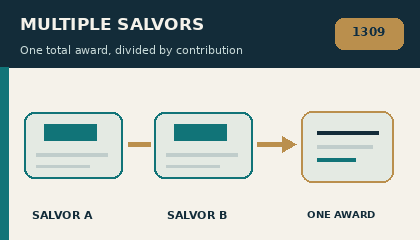
Direct answer: Turkish Commercial Code Article 1308 requires a single reward for the defined salvage operation, and all participating salvors claiming shares take them from that total. Article 1309 allocates between salvors proportionately to their participation, applying the criteria in Article 1305. Article 1308(2) sets a specific hierarchy for consolidating multiple lawsuits, including an express process when the overall reward is being determined by arbitrators. Several invoices do not automatically establish several full rewards for the same maritime danger.
Have a general question about this article? Ask anonymously
This guide focuses on competing claims by multiple professional salvors and the procedural treatment of their share disputes, rather than repeating the rules about a rescuing ship’s internal crew schedule or ordinary freight payments. Apply these Turkish provisions to the individual case only after the controlling substantive law and forum have been identified.
Quick summary
| Governing provisions | TCC Articles 1308–1309; criteria in Article 1305 |
|---|---|
| Total award | One common salvage reward for the defined activity |
| Different participants | Proportional shares, not separate complete awards |
| Multiple actions | Special consolidation hierarchy in Article 1308(2) |
| Arbitration | Court waits for the total reward determination in the prescribed circumstances |
| Supporting proof | Incident records, participants, saved value, payment and security account |
The one-operation boundary under Article 1308
A maritime casualty may require help from several ships and service providers at different moments. Article 1308(1) concerns the period from the danger that caused salvage until the point specified in Article 1303(2)(c) when return of the property may be requested. The law calls for one reward covering the qualifying salvage activities in that defined period. Neither an extra tug nor a second invoice automatically creates another total reward for the same rescued property. The real chronology must determine whether the work belongs to the same operation.
Document when danger first arose, how each party responded, what was saved, and when the return condition was reached. The logs should distinguish later ordinary port handling, repair and other activities from qualifying salvage work. Work performed under a contract made before danger arose has its own exclusion under Article 1298(4)(c). A claimant cannot avoid that question merely by naming every task an emergency rescue. The single-reward rule and the threshold definition of salvage must both be satisfied.
This creates two separate evidentiary tasks. First, identify what services are legally salvage. Second, determine which of those services fall within the period covered by Article 1308. A claim may fail on one or the other. The analysis protects legitimate independent work while preventing the same incident from being artificially fragmented into many full ship-wide rewards.
One aggregate reward, not one new total for every claimant
Article 1308 requires every participant seeking a share in the statutory reward to take it from the same total. The provision addresses the risk that several separate lawsuits or invoices may each calculate a hypothetical full award, effectively charging the saved interests repeatedly. Establish the legally supportable total once, then assess the shares of the different qualified participants. That is not a conclusion that only one provider worked or that later participants must accept whatever the first contractor offers.
For a shipowner or insurer receiving demands, a common account should identify every claimant and the operation alleged. Include the amount requested, contractual basis, actual service, payments made and security already furnished. A payment to one contractor may affect the total award or a participant share, but its exact effect depends on the underlying obligation and receipt. Do not simply subtract unrelated service payments or accept several full salvage rewards without examining whether they represent the same statutory amount.
A second salvor is not deprived of a real claim because the lead company submitted an invoice earlier. Its entitlement must be assessed as a share under Article 1309 or under another legally established contractual obligation. The correct account respects both sides: no duplicate full awards, and no exclusion of actual participation merely because the owner prefers to deal with one commercial counterparty.
Distinguish independent salvors from personnel and subcontractors
The record may identify a rescuing tug, separate salvage vessel, diving contractor, pilot, support boat and crew of the main assisting ship. Each name may describe a different legal role. The fact that a person took part does not by itself establish that the person is an independent salvor entitled to claim directly against the saved property. The actual agreements and performance should identify whether the asserted right is an independent share of the reward, an employment entitlement or payment due under a subcontract.
Article 1309 governs distribution among several salvors. Article 1310 governs a different internal sharing arrangement between the operator of the rescuing ship and the master or crew under its conditions. That article contains requirements for a written share list and a particular objection period, plus exceptions for ships or tugs dedicated to salvage. These rules must not be collapsed into a single list of supposed independent creditors, each requesting a new total reward.
For subcontractors, retain the agreed service scope and invoices. An operator could owe a subcontractor contract money without converting that subcontractor into a direct salvor under the relevant facts. Conversely, genuine independent salvage may exist despite another company’s coordination of operations. The proper analysis is based on work, contracting capacity and the statutory criteria, not a generic description of everyone as a rescuer.
The allocation criteria in Articles 1309 and 1305
Article 1309 requires allocation among several salvors proportional to their participation, taking account of Article 1305. Those criteria include the value saved, degree of success, dangers faced, efforts and skills, environmental protection, time spent, expenses, losses, liability risks and readiness or use of relevant equipment. They are not in a statutory order of priority and do not dictate a single universal weight for one factor.
The claimant should show what it actually did and why the work contributed to the result. An intervention may be short but decisive; a lengthy response may have required substantial resources. Hours alone are therefore an incomplete allocation formula. Equally, a claim that one operator supplied the most impressive ship is not necessarily a sufficient explanation for the largest share if the operational record demonstrates different responsibilities and risks.
A reasoned allocation can map each participant’s services against the statutory factors, identify supporting contemporaneous evidence and explain proposed shares of the one total. This should be transparent enough that the other parties can test the factual assumptions. An unsupported equal division can be as weak as an arbitrary ninety-percent claim by the first provider. The law calls for consideration of actual participation, not a predetermined business commission.
The special case-consolidation hierarchy in Article 1308(2)
When separate lawsuits seek salvage shares, Article 1308(2) gives an express order for combining them. The relevant case is that of the exclusive salvor if there is one. If there is none, the case of the salvor who concluded the salvage contract controls. If that route does not identify the case, the statute points to the salvor contributing the greatest number of salvage vessels, or as relevant the largest equipment contribution. The hierarchy is not simply an instruction to join every case to whichever was filed most recently.
An application should identify the existing claims and the statutory branch relied on. Evidence of the contracting party, exclusive position and participating vessels should be provided. A company asserting a preferred procedural position without showing why it fits the legal sequence does not establish the correct consolidation file. The actual parties and causes of action should be compared rather than assuming that every invoice filed at a court belongs to one procedural category.
The point of consolidation is to make one overall reward determination and one coherent distribution possible. An owner should not have to defend multiple complete assessments of the same rescue as though they were unrelated events. At the same time, participating salvors need an orderly method of presenting their shares. The procedural file should preserve each claim and the evidence supporting the chosen consolidation destination.
What happens when the total reward is before arbitrators
Article 1308(2) expressly addresses the case in which the salvage reward is being determined by arbitrators. The related actions in court are combined in the first court case and the court awaits final resolution of the total salvage reward in arbitration as a preliminary issue. Once that amount has been determined, the court allocates the reward within the consolidated matter. The provision separates determination of the total from distribution between participants.
The exact arbitration clause and the parties bound by it still need review. Article 1300 gives specified contracting powers to a shipmaster, including certain arbitration agreements; this does not mean that every maritime party automatically accepted one particular forum. An overseas owner or salvor should preserve the full agreement, arbitration notices, procedural decisions and final award. A summary from a broker is not a substitute for the operative terms or a tribunal’s decision.
The court’s statutory waiting arrangement should not be mistaken for a rule that all possible maritime disputes must be suspended. It is linked to the defined salvage total and its allocation. Distinct contractual fees or separate claims may need different handling. Proper pleading identifies what is being decided in arbitration, the actual court cases and the participants whose shares will ultimately be assessed.
The operator’s internal crew schedule is a different legal stage
Article 1310 concerns the shares of the master and other crew where a ship saves another vessel or property, subject to that article’s conditions and exclusions. It requires the ship operator to account for defined loss and expenses, prepare a written share schedule and notify the crew. An objection is linked to arrival at the first relevant place in Türkiye after notification. This is not the same as Article 1309’s proportional distribution among separate salvors.
If the operator receives a share of the overall award, the internal crew calculation must still be conducted under the proper rules. A crew member should not be told that the total participation of outside salvors automatically eliminates a statutory crew share. Conversely, an internal crew claim should not be counted as a completely new full reward against the ship or cargo owner. The correct sequence separates the external reward distribution from the internal allocation.
There are express exceptions for vessels or tugs dedicated to salvage, and a distinct rule for a rescue from a craft that is not a ship. An employee bonus under a contract must be examined on its own legal basis. The proper documents include crew lists, service roles, the share schedule, notice and arrival records. These are different from the documents required for a salvor-to-salvor distribution under Article 1309.
The value limit and separate environmental compensation
Article 1304(3) limits the ordinary salvage reward to the value of the property after rescue, with interest and court costs excluded from that ceiling’s calculation. The total should therefore be assessed against evidence of what property was saved and its legally relevant value. A valuation made for insurance or marketing purposes may be relevant evidence but is not automatically conclusive. An amount for cargo not actually saved should not be inserted solely to enlarge the statutory ceiling.
The single-reward principle is especially important when multiple full hypothetical awards would exceed this limit. Combining properly quantified participation shares within the common total prevents the same saved value from being used to justify repeated complete rewards. A court or arbitral tribunal must still consider the Article 1305 criteria where relevant rather than assuming that the maximum allowed by value is automatically the amount earned.
Special environmental compensation under Article 1312 is a separate conditional statutory calculation involving eligible expenses and specified uplift conditions. It also requires comparison against the ordinary reward. A financial report dealing with ordinary and environmental claims must distinguish them, rather than simply adding every requested amount. The same event may generate both issues, but a common incident does not abolish their separate statutory conditions.
Create a contribution ledger rather than competing narratives
Build a chronology that identifies the distressed vessel, the risk, each participant and the actions taken at every material time. Collect logs, contemporaneous communications, operational orders, equipment records and relevant expenses. Distinguish equipment actually deployed from equipment held ready where that matters under Article 1305. Do not invent hours, technical risks or degree of success merely to complete a percentage table.
Keep the signed salvage agreement and any subsequent amendments or release documents. Identify the legal entities issuing invoices, receiving money and providing security. A parent company, crewing agency, ship manager and insurer may appear in a file without being interchangeable creditors or debtors. The document bundle should specify each entity’s relevant legal capacity and show whether it participated as a salvor, contracting party, agent or insurer.
A contribution ledger should also list all advances, settlements and security. Article 1316 requires a corresponding reduction in Article 1314 security when an advance has actually been paid. Reconcile any cash payments against the properly identified share of the common award. The goal is to avoid both duplicate recovery and a misleading claim that a payment to one person necessarily settled all other unrelated contractual claims.
Foreign owners, insurers and the choice of law
International salvage often includes a foreign-flag ship, a Turkish port, overseas insurers, several cargo owners and contractual arbitration. Turkish Articles 1308 and 1309 govern where Turkish substantive law applies; presence at a Turkish port alone should not be described as an absolute answer to every governing-law question. Read the actual contracts, authority, forum agreement and incident circumstances before determining the applicable rules.
An overseas owner should obtain all known claims and distinguish court papers from arbitration notices. Formal documents may create procedural deadlines separate from the general limitation rule in Article 1319. A company should not delay responses because the claimants are still discussing their percentages. The relevant legal clock depends on the actual proceeding and the documents served.
The same principle applies to cargo owners and consignees. Article 1306 addresses the saved-property owners under its default allocation. Article 1307 concerns a consignee who receives goods with the specified knowledge of the salvage debt. A claim for the full common reward cannot be placed automatically on the easiest-to-contact import company merely because that company arranged delivery. Correct capacity and property share matter.
How to plead a salvor’s share or defend against duplication
A salvor seeking a share should establish its qualification, the common operation, relevant participation, Article 1305 factors and the amount claimed within the statutory total. If several lawsuits exist, the consolidation hierarchy must be addressed. Where a tribunal is determining the total, the court relationship under Article 1308(2) should be described accurately. A separate demand for a complete additional ship-wide reward is not the same as a properly pleaded participation share.
An owner or insurer can dispute a claim that duplicates the statutory total, challenges unsupported work or applies an incorrect valuation. A denial should distinguish these points. A legitimate independent contribution should not be erased solely because it appeared in a second invoice, while the owner should not be required to pay the whole reward repeatedly for the same rescue. A complete account is the central practical evidence.
Article 1319 generally prescribes a two-year limitation period for salvage claims from completion of the activity, with a specified extension method. This is different from court or arbitral deadlines and the Article 1310 crew objection rule. Date each document and preserve service evidence. Legal representation may be arranged from outside Türkiye, but instructions should be given in time for the particular proceeding rather than on the assumption that a general limitation period controls everything.
Frequently asked questions
Can two salvors each demand the full reward for one incident?
No. Under Article 1308 there is one reward for the defined operation; eligible participants take shares from the common total.
How are the shares of independent salvors determined?
Article 1309 requires proportionate distribution by participation using Article 1305 criteria. Equal shares are not imposed as a universal rule.
Do separate invoices prove that there are two salvage operations?
No. The statutory danger-to-return period and the actual qualified services determine whether the work belongs to one Article 1308 operation.
Which case takes priority in consolidating multiple salvage-share actions?
Article 1308(2) specifies a hierarchy: exclusive salvor, then contract-signing salvor, then the participant with the largest number of salvage vessels or equipment as relevant.
What if the overall reward is being arbitrated?
Article 1308(2) provides for consolidation of court actions in the first court case, awaiting final arbitral determination of the total, then distributing that amount.
Can the ordinary reward exceed the post-rescue property value?
Article 1304(3) caps the ordinary salvage reward at that value, excluding interest and litigation costs for the cap.
Are crew shares independent ship-wide salvage rewards?
No. The Article 1310 crew mechanism is a separate internal distribution distinct from Article 1309’s allocation between salvors.
Does a contract for earlier towage automatically become salvage?
No. Article 1298(4)(c) excludes services performed or required under a contract concluded before the danger arose.
Does an advance affect existing salvage security?
Article 1316 requires a corresponding reduction of Article 1314 security once an advance is actually paid, against the relevant secured obligation.
What evidence should a foreign insurer request?
Request the common operation chronology, every participant’s work and contracts, saved-value evidence, total award calculation, payment and security ledger, and all formal notices.
When does the single reward’s period end under Article 1308?
It uses the defined return stage connected to Article 1303(2)(c), not every later commercial service.
Does payment of an advance create a second full salvage reward?
No. Article 1316 governs interim payment; Articles 1308–1309 still govern the one overall reward and shares.
Related English legal guides
- Crew share schedule under Article 1310
- Interim advance and security under Article 1316
- Environmental special compensation under Article 1312
- Towage contract versus new salvage work
- Foreign clients’ power of attorney
Türkiye-wide file handling and two offices
Author: Av. Halil Bakırcı, Bakırcı & Keskin Hukuk Bürosu. The firm has physical offices in Mersin and Istanbul; representation and file management can extend throughout Türkiye for clients abroad through appropriate authorisation and remote communication. This article is general information and does not guarantee a result in any particular maritime matter.
Mersin and Istanbul offices
Bakırcı & Keskin Hukuk Bürosu has physical offices in Mersin and Istanbul. For an appointment call +90 552 224 43 66 or see the contact page.
Mersin office
İhsaniye Mahallesi 4903 Sokak Profit İş Merkezi No 23 Kat 3 Daire 14 33070 Akdeniz Mersin Türkiye
Istanbul office
Maslak Ahi Evran Caddesi Polaris Plaza No 21 Kat 9 34475 Sarıyer İstanbul Türkiye
Contact regarding a legal matter
In your first message, you may briefly state the subject, your country or city, and any relevant notification or recent procedural date. Please do not send identity numbers, medical data, or personal documents. Messaging alone does not constitute legal advice or create a lawyer–client relationship.
Discover more from Bakırcı & Keskin Hukuk Bürosu
Subscribe to get the latest posts sent to your email.
