Can a Landlord Enter a Rented Home in Turkey? Repairs, Viewings and Advance Notice
A Turkish landlord has a right to necessary access in defined circumstances, not an unrestricted right to enter an occupied home whenever convenient. Article 319 of the Turkish Code of Obligations requires the tenant to tolerate work to remove defects or prevent damage and to allow visits necessary for maintenance, sale or subsequent letting. The landlord must give appropriate advance notice and consider the tenant’s interests during the work or viewing. The article preserves rent-reduction and compensation rights. A lawful access arrangement therefore identifies the purpose, people, timing and limits of the visit instead of relying only on ownership or possession of a spare key.
Have a general question about this article? Ask anonymously
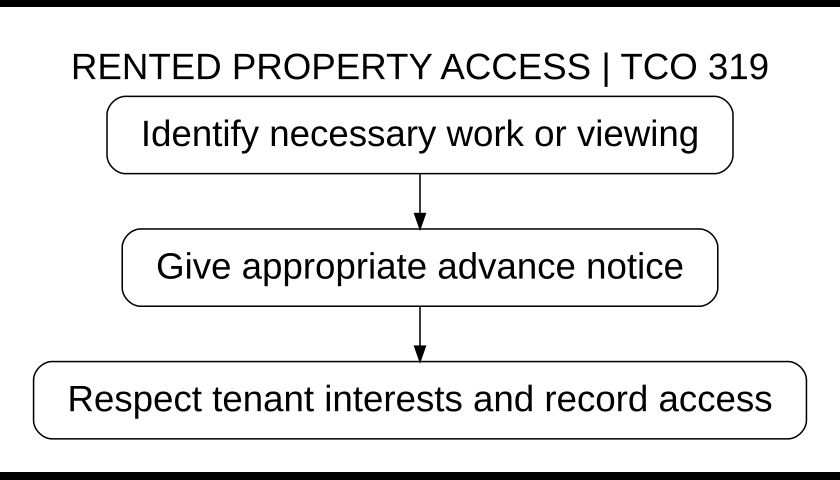
Article 319 contains two connected access duties
The first concerns work directed at removing defects in the rented property or preventing damage. The second concerns allowing the landlord and a third person designated by the landlord to inspect or view the premises to the extent necessary for maintenance, sale or subsequent letting. Work and a preliminary viewing should be identified separately.
An invitation should explain which purpose applies. A technician investigating a reported leak, a purchaser inspecting the apartment and a person proposing a decorative redesign are not carrying out the same activity. The access duty cannot be assessed from the visitor’s job title alone.
The governing source is Law No. 6098, Article 319. Its necessity requirement and notice obligation should appear in any advice to both sides. Quoting only the tenant’s duty while omitting the landlord’s obligations gives an incomplete account of the provision.
Reporting a defect and arranging access are complementary duties
Article 318 requires the tenant to notify the landlord without delay of defects the tenant is not responsible for remedying. Failure to notify creates responsibility for the resulting damage. The tenant should therefore preserve the report and avoid treating a disagreement over appointment times as a reason not to identify the underlying problem.
The landlord should respond with an intelligible proposal for assessment and work. A message merely saying that someone will come sometime does not explain the intended task or allow a meaningful scheduling response. Keep the reported defect, planned visit and work actually performed connected in the records.
Distinguish an ordinary maintenance expense under Article 317 from a defect engaging the landlord’s duties. Article 301 requires delivery and maintenance of the premises in a condition suitable for the agreed use. Allowing a repair visit does not itself decide which party must ultimately bear every cost.
There is no universal twenty-four-hour rule in Article 319
The statutory wording requires notification an appropriate period in advance. It does not prescribe a fixed twenty-four-hour or forty-eight-hour period for every repair, inspection and viewing. A proposed timetable must be assessed against the purpose, urgency and practical circumstances rather than an invented universal number.
Record the proposed date, approximate duration, task and persons expected to attend. These are practical details that make the statutory arrangement workable; the article does not set out a compulsory form with those exact fields. A written record is useful evidence even though Article 319 does not itself prescribe one exclusive notification channel.
The agreement may contain a scheduling provision, which must be read with the applicable law. A contractual clause is not proof that notice was actually given on a particular occasion. Preserve the communication and response rather than rely only on the existence of the clause.
The tenant’s interests must be considered during the visit
Advance notification is not the landlord’s only duty. Article 319 also requires the landlord to consider the tenant’s interests while the work or viewing takes place. An appointment that is properly announced can still raise a problem if the actual activity departs substantially from what was described.
Discuss the areas to be accessed, expected disruption and any relevant arrangements for occupants or possessions. A viewing should not quietly become prolonged building work, and a narrow technical inspection should not be used as permission to search unrelated private belongings.
A practical response to an unsuitable appointment can identify the objection and propose workable alternatives. That differs from an unexplained refusal of every necessary visit. Keep the complete exchange so a later review can distinguish genuine cooperation, excessive demands and an actual refusal to perform a duty.
A sale viewing does not terminate the tenancy
Article 319 includes necessary visits for sale. The tenant’s cooperation with a prospective purchaser does not mean consent to leave the property, waive the lease or accept the seller’s promises about vacant possession. The access arrangement and the intended sale transaction concern different legal consequences.
Article 310 generally makes a new owner a party to the existing lease after ownership changes. A purchaser’s later claim to possession requires its own basis and procedure. A sales appointment should therefore not be presented to the tenant as notice that the lease has already ended.
The guide to buying a tenanted property addresses the purchase-stage review. A buyer should verify occupancy and lease records before completion, while arranging any inspection through a lawful and appropriately notified visit.
Reletting does not justify unlimited or unexplained tours
The statute also covers visits necessary for subsequent letting. Identify the actual reletting purpose and the proposed arrangement. The words subsequent letting should not be used to avoid examining whether the particular visit, frequency and scope are necessary.
Group appointments sensibly where possible and keep their purpose clear. Article 319 does not print a universal maximum number of weekly viewings, but its necessity and tenant-interest requirements remain operative. The absence of a numerical cap is not the same as unrestricted access at any hour.
A landlord and tenant can record an appointment schedule without deciding every other dispute between them. Cooperation with viewings need not be described as acceptance of a disputed termination date. Conversely, a continuing rent dispute does not automatically erase the separate obligation to allow a properly justified visit.
A designated third person should be identifiable
Article 319 refers to the landlord and the third person the landlord designates. The recipient of an access request should be able to connect the visitor with the landlord’s actual instruction. A person’s claim to be an agent, purchaser or contractor is not itself proof of that connection.
For a landlord abroad, identify the local representative, the task authorised and the limits of the proposed visit. Giving an agent permission to show the property does not necessarily authorise that person to agree a new rent, sign a surrender or dispose of the tenant’s possessions.
The representation-authority guide explains the separate cross-border inquiry. Keep the access authorisation proportionate to the intended act instead of using an unnecessarily broad instruction to solve a scheduling problem.
Necessary repairs differ from the landlord’s elective alterations
Article 319 addresses defect-removal and damage-prevention work. Article 320 separately allows improvements and alterations that do not require termination of the lease and that the tenant can reasonably be expected to tolerate. It again requires consideration of the tenant’s interests and preserves rent-reduction and compensation rights.
Identify the actual work, not merely the label used in a message. Replacement of a failed component, redesign of a usable room and major works requiring the premises to be emptied can raise different issues. Calling all of them maintenance does not establish that the same access and tolerance analysis applies.
Prepare the work scope, expected duration and effect on ordinary use. A landlord should not use a limited access agreement as a substitute for the legal assessment required by extensive redevelopment. Equally, the tenant should distinguish an objection to a particular improvement from obstruction of genuinely necessary damage-prevention work.
Urgency changes the facts, not the need for lawful authority
A reported danger requires an appropriate response. Preserve the information about its nature, timing and risk, and involve the relevant authorised professionals or emergency services where necessary. Do not delay protective action solely to create a better litigation record.
At the same time, Article 319 should not be described as a general power to force entry whenever the owner asserts urgency. The legal basis for an emergency intervention and the necessary action must be assessed in the actual circumstances. A routine sale viewing cannot be converted into an emergency by using stronger wording.
Record what was known, whom the parties contacted and what was done. This separates the immediate protective step from later arguments about cost, responsibility and compensation. It also avoids treating every event occurring after a refused appointment as automatically caused by that refusal.
Allowing work does not waive rent-reduction rights
Article 319 expressly preserves the tenant’s rights to rent reduction and compensation. A tenant who cooperates with necessary repair work does not, by that cooperation alone, acknowledge that the premises were fully usable throughout the disturbance.
Article 307 permits a reduction proportionate to defects affecting use for the period from the landlord learning of the defect until it is remedied. The record should establish the problem, its effect, the notification or knowledge date and the remedy date. A general statement that the visit was inconvenient does not quantify that claim.
Do not substitute an arbitrary deduction or complete payment stoppage for a supported legal calculation. Rent, a claimed reduction and a separate expense reimbursement must be reconciled. The entitlement and amount should be analysed before a payment decision creates an additional default dispute.
Compensation and repair expenses are separate accounts
Article 308 makes the landlord responsible for damage arising from a defect unless absence of fault is proved. Article 306 separately regulates the tenant’s request to remedy a defect within a reasonable period and, where its conditions are met, repair at the landlord’s expense and deduction of the resulting claim.
Those provisions should not be reduced to a rule that every receipt connected with an access visit is automatically reimbursable. Identify the legal basis, causal connection, payment and amount. Keep repair expenditure separate from loss of use and damage to personal property.
The evidence-preservation guide addresses recording a condition before it disappears through repair. A record of the defect supports the facts; it does not itself determine every compensation issue or authorise unrelated work.
Photographs and keys should remain within the agreed purpose
An inspection may need a record of the relevant defect or the area viewed. Clarify what will be recorded and why. Necessary access under Article 319 is not an automatic authorisation to publish identifiable residents, confidential documents or the contents of private storage as advertising material.
Where keys are temporarily provided, record the person receiving them, the permitted use and their return. A spare key retained for one purpose does not prove permission for every later visit. The practical record should show the actual consent or lawful authority rather than infer it solely from physical possession of a key.
Keep evidence lawfully. The electronic-evidence guide explains the value of complete communications and original records. Do not obtain access to another person’s accounts or manufacture a record that makes an unannounced visit appear agreed.
A refused appointment is not an automatic eviction order
When access is disputed, establish the specific request, its necessity, the notice and the reason given for refusal. Failure to agree one inconvenient time and rejection of all justified access are different factual situations. The remedy must address the established breach, not a simplified account omitting the tenant’s response.
Article 319 does not itself set out an automatic eviction consequence for every refused appointment. Any demand for performance, protective relief, damages or termination must be assessed under the applicable legal conditions and procedure. A landlord cannot replace that inquiry with unilateral lock changes or removal of belongings.
Article 18/B(1)(a) of Mediation Law No. 6325 generally requires mediation before a rental-relationship lawsuit, while preserving its stated enforcement-eviction exception. The actual claim and any urgent protective measure need separate procedural classification; do not assume that one informal complaint fulfils every requirement.
Keep a short record that both sides can verify
| Record | Useful content |
|---|---|
| Reason for the visit | The defect, maintenance task, sale or reletting purpose and why access is necessary. |
| Advance communication | The proposed date, duration, people attending and evidence of notification. |
| Tenant’s response | Acceptance, a specific objection or practical alternative arrangements. |
| Actual attendance | Who entered, what was inspected or done, and any departure from the proposal. |
| Condition and disruption | Relevant before-and-after records and the period ordinary use was affected. |
| Financial issues | Separately supported rent-reduction, repair-cost and damages calculations. |
For an overseas landlord or tenant, keep source-language records alongside translations and confirm the local representative’s role. A useful agreement can settle access dates without releasing unrelated claims. Any existing court papers or orders must be reviewed on their own terms; an access discussion does not suspend a procedural deadline.
Frequently asked questions
Can a landlord enter a Turkish rented home whenever they wish?
Article 319 provides defined access and tolerance duties, with necessity, appropriate advance notice and consideration of the tenant’s interests. Ownership alone is not unrestricted entry permission.
Does the statute require exactly twenty-four or forty-eight hours’ notice?
No such fixed period appears in Article 319. Appropriate advance notification must be assessed against the purpose, circumstances and any applicable agreement.
Must the tenant allow necessary sale viewings?
Article 319 includes visits necessary for sale, subject to notice and tenant-interest requirements. The proposed visitors, timing and scope still need to be identified.
Does showing the apartment mean the tenant agrees to leave?
No. Access for a sale and termination of the tenancy are different matters. Article 310 generally continues the lease with the new owner.
Can an agent or technician attend instead of the landlord?
Article 319 includes a third person designated by the landlord. Establish the actual designation, task and lawful access arrangement.
Are elective renovations the same as necessary defect repairs?
No. Article 320 separately addresses improvements and alterations that do not require termination and can reasonably be tolerated. Identify the actual work and its effect.
Does accepting repairs waive a rent-reduction claim?
Article 319 expressly preserves rent-reduction and compensation rights. Their legal conditions, period and amount must still be established.
Can a landlord use a spare key as proof of consent to every visit?
Possession of a key is not itself proof of unrestricted permission. Record the purpose, consent or lawful authority for the particular entry.
Does refusal of one appointment automatically permit eviction?
Article 319 contains no automatic eviction rule for every refusal. Examine the request, notice, response and the conditions of the specific remedy sought.
What should someone abroad send for an access dispute?
Provide the lease, visit request, complete responses, defect or sale information, representative details and any condition records, invoices or served papers.
Official legal sources
Turkish Code of Obligations No. 6098, Articles 301, 305–310 and 317–320; Mediation Law No. 6325, Article 18/B. This English explanation is not an official translation or permission to force entry into occupied premises.
Ask about repairs or viewing access
State the purpose of the proposed visit, the notice given and the response. Arrange a confidential channel before sharing the lease, private photographs or access details.
Istanbul and Mersin offices
Bakırcı & Keskin Law Office is Mersin-based and works throughout Türkiye with an Istanbul and Mersin focus.
Istanbul — Polaris Plaza
Maslak Ahi Evran Caddesi, Polaris Plaza No:21, Floor 9, 34475 Sarıyer/İstanbul.
Mersin — Profit İş Merkezi
İhsaniye Mahallesi, 4903. Sokak, Profit İş Merkezi No:23, Floor 3, Office 14, 33070 Akdeniz/Mersin.
Call +90 552 224 43 66. An enquiry does not establish representation or suspend a legal deadline.
Contact regarding a legal matter
In your first message, you may briefly state the subject, your country or city, and any relevant notification or recent procedural date. Please do not send identity numbers, medical data, or personal documents. Messaging alone does not constitute legal advice or create a lawyer–client relationship.
Discover more from Bakırcı & Keskin Hukuk Bürosu
Subscribe to get the latest posts sent to your email.