Singapore Convention Evidence in Turkey: Proving a Foreign Mediated Settlement
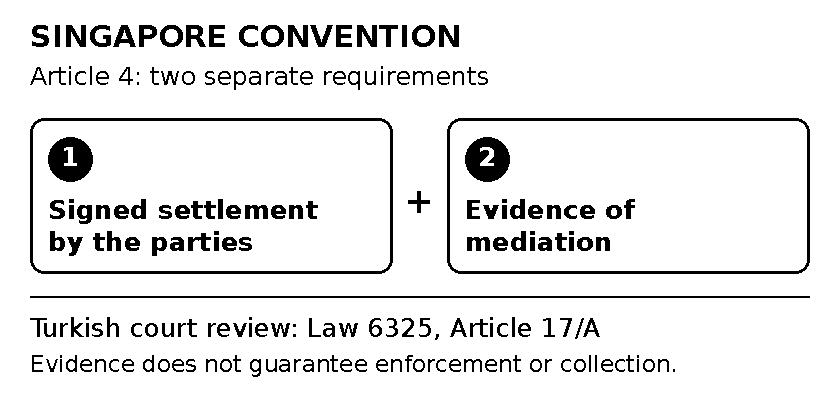
A missing mediator signature does not, by itself, defeat reliance on an international mediated settlement in Turkey. Article 4 of the Singapore Convention provides alternative ways to prove that an agreement resulted from mediation. The separate requirements are a settlement signed by the parties and evidence of the mediation process. For enforcement in Turkey, Article 17/A of Law No. 6325 also requires an enforceability endorsement from the competent commercial court of first instance.
Have a general question about this article? Ask anonymously
This guide addresses the evidence file for an overseas business pursuing a Turkish counterparty after a mediated commercial settlement. It is not a guide to signing an ordinary Turkish mediation agreement remotely. That separate issue is covered in our English guide to Turkish mediation settlements signed from abroad. The central question here is how the creditor connects the actual agreement, the mediation, the signatories and the outstanding obligation in one coherent application.
1. Confirm that the particular settlement falls within the Convention
Start with the agreement, not the country named in the mediator’s letterhead. Articles 1 and 2 of the official Convention text establish the international commercial scope, the meaning of mediation and the recorded-writing requirement. A negotiation conducted solely between the two businesses is not transformed into mediation by adding that word to the final document. There must have been assistance from a third person without authority to impose a resolution.
Record the parties’ relevant places of business when the agreement was concluded. Where a business has several establishments, identify the establishment connected most closely with the dispute, rather than selecting an overseas address simply because it makes the transaction look international. Keep the contract and correspondence that explain the connection. Different-country places of business are not the only internationality route: Article 1(1)(b) also addresses a foreign place of substantial performance or the closest connection to the subject matter.
Consumer transactions for personal, family or household purposes, and family, inheritance and employment matters, are excluded. Article 1(3)(a) excludes settlements approved by a court or concluded during court proceedings and enforceable as a judgment in that court’s State. Article 1(3)(b) excludes settlements recorded and enforceable as arbitral awards. Obtain any court order or consent award before classifying the instrument; a private settlement and a settlement recorded in an award require different starting points.
Turkey ratified the Convention on 11 October 2021, and its entry into force for Turkey was 11 April 2022 under Article 14. Article 9 limits application to settlements concluded after the relevant entry-into-force date. The UN depositary record, checked on 26 October 2026, records no Turkish Article 8 reservation. Do not import another country’s opt-in reservation into an application made in Turkey.
2. Party signatures and mediation evidence perform different functions
Article 4(1)(a) concerns the parties’ signed settlement. Article 4(1)(b) concerns evidence that it resulted from mediation. Treat these as two separate columns in the file review. An institution’s confirmation that a mediation occurred does not supply a missing party signature. Conversely, signatures from both businesses do not, without more, explain whether a mediator assisted the process.
Identify the complete operative document, including incorporated schedules and any execution counterparts. Keep the final transmission email alongside the signed version. A signature page separated from the terms creates a version-identification problem even when nobody disputes that the page contains a genuine signature.
Prepare a short document map showing which evidence addresses each requirement. Its purpose is practical: a judge or opposing party should be able to locate the signed agreement and the process evidence without reconstructing a long correspondence chain. This map is an explanatory aid, not a substitute for the underlying records.
3. A separate mediator document can address a missing mediator signature
The first listed form of mediation evidence is the mediator’s signature on the settlement. The next is a document signed by the mediator confirming that mediation was carried out. Article 4 therefore does not make signature of the commercial bargain by the mediator the sole route.
When requesting a separate confirmation, identify the actual participants, process reference and settlement being addressed. Ask the mediator to confirm facts within their knowledge. Do not request a statement that the agreement is legally valid in Turkey, that every signatory had corporate authority, or that the debtor still owes a particular balance unless there is an independent basis for those assertions.
A useful confirmation connects the process to the relevant agreement rather than merely saying that the parties attended discussions at some point. Where the mediator stopped participating before later negotiations, preserve that chronology accurately. Do not ask anyone to backdate a certificate or describe later bilateral bargaining as a mediation session that did not occur.
Keep the original confirmation and its delivery record. If the mediator has retired or cannot be contacted, record that fact and assess the other evidential routes. Replacing missing evidence with an unsupported assertion in the creditor’s application weakens the file rather than curing the gap.
4. An administering institution can provide a different form of proof
Article 4(1)(b)(iii) identifies an attestation from the institution that administered the mediation. First establish which institution actually administered the case. A venue that supplied meeting rooms, a platform used for video calls, and an administering mediation institution are not interchangeable descriptions.
Provide the institution with the case reference and the relevant final agreement when requesting confirmation. Check that the response identifies the correct legal entities, not only their brands or the individual employees who attended. Where a business changed its name during the process, keep the corporate record linking the old and current names.
Retain the attestation in its original format. An email containing the confirmation should be preserved with its sender information and attachments. A screenshot cropped to remove the sender and date is a poor replacement for an available source record. The object is to show how the confirmation relates to the mediation actually relied upon, not to collect several impressive-looking certificates addressing different proceedings.
5. Other evidence is a fallback, not automatic acceptance of every document
In the absence of the listed mediator or institutional evidence, Article 4(1)(b)(iv) permits other evidence acceptable to the competent authority. The words addressing acceptance matter. They do not make a calendar invitation or the creditor’s unilateral statement conclusive proof.
Organise the available records by what each one establishes. An appointment letter identifies a mediator’s engagement. An attendance record identifies participants. Process correspondence connects the dispute to the mediation. A final circulation email links a particular agreement to the closing stage. None should be described as proving more than it actually shows.
Explain missing records candidly. A mediator’s refusal to sign the settlement, a lost archive and an institution’s inability to locate a file present different evidential problems. Preserve requests made to obtain proper confirmation and the responses received. Do not alter an old document to add a settlement reference that was not originally present.
The court’s power under Article 4(4) to request necessary documents also makes organised source records valuable. A file assembled only from selected screenshots can become difficult to complete when the court asks about authenticity, sequence or the relationship between two versions.
6. Electronic execution must identify both the signer and the intention
Article 4(2) contains its own functional test for electronic signatures: identification and intention, supported by an appropriately reliable method or proof that those functions were fulfilled in fact. Article 2(2) separately addresses accessible electronic recording of the agreement. These questions should not be reduced to whether a document bears a familiar platform logo.
Preserve the executed electronic file, completion report, relevant certificate information and final version history. Record which person signed for each party and which document was presented to that person. Where schedules were sent separately, explain how the signed agreement incorporates them.
Do not convert a source file repeatedly and discard the original. A printed PDF can be convenient for reading but may omit verification information present in the original electronic record. Likewise, a pasted signature image does not explain who placed it, with whose authority, or on which version.
The legal analysis must use the Convention route actually invoked rather than automatically applying a general statement about every foreign signature. Our electronic evidence guide explains the separate practical importance of preserving complete messages and their context.
7. Translate the operative document without changing its legal effect
Article 4(3) permits the competent authority to request a translation into its official language. Plan the Turkish translation with the lawyer handling the application, including the applicable certification and procedural requirements. The Convention does not itself state that every settlement must be apostilled.
Compare names, defined terms, payment conditions, dates, currency and references to schedules line by line. A translation that changes a conditional payment into an unconditional debt is not a harmless stylistic difference. Retain the source-language agreement beside the Turkish version so that disputed wording can be checked directly.
Keep authentication of supporting corporate or representative documents separate from proof of mediation. An apostille on a public document does not establish that the settlement arose from mediation or that its commercial obligation remains unpaid. Determine what each certification authenticates before relying on it to answer a different legal question.
Where a lawyer acts for a foreign company, assemble the company’s authority chain and the lawyer’s mandate. Our foreign company authority guide addresses that distinct document chain. A mediator’s process confirmation should not be used to fill a corporate-authority gap.
8. Article 17/A identifies the Turkish endorsement procedure
Law No. 6325, Article 17/A requires an enforceability endorsement from a commercial court of first instance for performance of settlements within the Convention. The application is made to the court at the place agreed by the parties; absent agreement, the statutory sequence uses the counterparty’s Turkish domicile and then residence. If neither exists in Turkey, Ankara, Istanbul or Izmir is available under the provision.
Article 17/A(3) provides for examination on the file under the Convention and Article 18, with a reasoned decision to hold a hearing when necessary. The provision was introduced by Law No. 7445, Article 33. The office handling the matter is not, by itself, a statutory ground for choosing the court.
Separate the endorsement application from later collection steps. The application must identify the relief requested and the obligation supporting it. A favourable procedural decision does not establish that the debtor has sufficient assets, and the Convention does not create assets where none exist.
9. Connect the requested relief to the current agreement and unpaid balance
A technically complete mediation certificate does not resolve every enforcement issue. Article 5 addresses refusal grounds including non-binding or non-final terms, subsequent modification, performed or unclear obligations and relief contrary to the settlement. Review these matters before treating a signature package as a finished enforcement file.
Prepare a dated performance ledger. For each instalment, record the contractual trigger, due date, amount, payment received and balance claimed. Attach the documents establishing completion of any condition that activates payment. Do not demand a future instalment as already due without a valid basis in the operative terms.
Include later amendments, extensions and credits. An informal exchange granting additional time may become central to identifying what was enforceable when the application was made. It should not be omitted merely because it is inconvenient to the creditor’s original timetable.
Where a third party paid on the debtor’s behalf, reconcile that receipt. Where payment is disputed, show the bank record and the competing explanations. Our foreign-currency debt evidence guide addresses a separate accounting problem: currency, conversion and partial-payment proof. Never report money already received as still outstanding simply because the settlement certificate predates the transfer.
10. Disclose what proves the application without publishing negotiations
The evidence exercise does not require indiscriminate publication of the mediation archive. Separate the final settlement and process confirmation from offers, admissions and private discussions. Review the confidentiality rules and any lawful disclosure exception before selecting material for a Turkish filing.
Articles 4 and 5 of Law No. 6325 distinguish confidentiality and evidential restrictions within their applicable framework. A document’s presence in a mediation file is not a reason to assume either that it is freely usable everywhere or that it can never be produced. Identify the purpose of disclosure and the rule governing the particular material.
When seeking institutional confirmation, request a process attestation rather than an unnecessary account of the parties’ concessions. For internal reporting, use an evidence index and obligation ledger instead of forwarding the entire archive to every employee. Preserve originals securely while limiting working copies to the people responsible for the application.
11. Build a bundle that answers specific questions
Arrange the file in a sequence that allows another reader to test the application. Begin with party identification and the international connection. Follow with the complete signed settlement, incorporated schedules and amendments. Place the mediator or institutional confirmation next to the document it connects with the mediation.
Then add execution evidence, translations, corporate and representative authority, the performance ledger and the documents supporting the amount requested. Keep a separate note of missing material and the steps taken to obtain it. This is more useful than concealing an evidential gap behind hundreds of pages of unrelated correspondence.
For every exhibit, identify its source and the proposition it supports. Distinguish a document received from the mediator from a summary prepared by the creditor. Keep filenames and page numbering consistent between the source-language and Turkish bundles. Where the court requests an additional record, the index should make it possible to supply that record without replacing the whole application with a conflicting version.
For an overseas business, the initial instruction should identify the settlement date, mediator or institution, Turkish counterparty, unpaid obligation and any existing litigation or enforcement file. The Turkey debt-collection guide addresses the broader collection assessment. This article’s narrower purpose is to establish the evidence needed to rely on the mediated settlement itself.
Frequently asked questions
Must the mediator sign the settlement itself?
No. Article 4 also identifies a separate signed mediator confirmation, an administering institution’s attestation and, in their absence, other evidence acceptable to the competent authority. Party signatures remain a separate requirement.
Does an institution’s letter replace a party signature?
No. It addresses evidence that mediation occurred. Article 4 separately requires the settlement signed by the parties, including electronic execution that satisfies the applicable Convention test.
Can a meeting invitation prove mediation by itself?
An invitation shows what was proposed, not necessarily what occurred or how the settlement resulted. Its evidential value depends on the complete record and the competent authority’s assessment.
Are electronic settlements automatically excluded?
No. Articles 2(2) and 4(2) expressly address electronic records and signatures. Preserve evidence of the signer’s identity, intention, relevant method and executed version.
Does the Convention require an apostille on every settlement?
Article 4 does not impose a universal apostille requirement. Supporting public documents, translations and representative authority require their own procedural assessment.
Which Turkish court supplies the endorsement?
Article 17/A assigns the matter to a commercial court of first instance. Territorial jurisdiction follows the agreed place and the statutory sequence, with Ankara, Istanbul or Izmir available in the stated absence of Turkish domicile or residence.
Can an employment settlement use this Convention route?
No. Employment matters are excluded by Article 1(2). An overseas signature or foreign mediator does not remove that subject-matter exclusion.
Should later payment extensions be included?
Yes. The file must identify the operative agreement and current obligation. Later modifications and actual payments are relevant to the relief requested and the Article 5 analysis.
Does an endorsement guarantee collection?
No. Enforceability, the outstanding balance and the debtor’s available assets are separate questions. A court endorsement is not evidence that funds have already been recovered.
What should an overseas creditor prepare first?
Prepare a chronology identifying the agreement, mediator or institution, counterparty and unpaid obligation. Use a confidential channel for signed agreements, identity documents and bank records.
Official sources and scope
UN certified Convention text, especially Articles 1–5, 9 and 14; UN depositary status and reservations; Law No. 6325, Articles 4, 5, 17/A and 18; Law No. 7445, Article 33. Legal-source review: 26 October 2026. This is an English explanation, not an official translation or a prediction of a particular court decision.
Contact information
Do not include confidential documents or identity numbers in an initial message. An enquiry does not establish representation or suspend any legal deadline.
Istanbul and Mersin contact details
Bakırcı & Keskin Law Office is Mersin-based. Turkish matters are handled under the applicable jurisdiction and agreed mandate. The court competent to examine a settlement is determined by law, not by the address used for correspondence.
Istanbul — Polaris Plaza
Maslak Ahi Evran Caddesi, Polaris Plaza No:21, Floor 9, 34475 Sarıyer/İstanbul, Türkiye.Mersin — Profit İş Merkezi
İhsaniye Mahallesi, 4903. Sokak, Profit İş Merkezi No:23, Floor 3, Office 14, 33070 Akdeniz/Mersin, Türkiye.+90 552 224 43 66 · Contact details in English. An enquiry does not establish representation or suspend a legal deadline.
Contact regarding a legal matter
In your first message, you may briefly state the subject, your country or city, and any relevant notification or recent procedural date. Please do not send identity numbers, medical data, or personal documents. Messaging alone does not constitute legal advice or create a lawyer–client relationship.
Discover more from Bakırcı & Keskin Hukuk Bürosu
Subscribe to get the latest posts sent to your email.