Tenant Declared Bankrupt in Turkey: Future Rent Security and Lease Termination
A tenant’s bankruptcy does not, by itself, give a Turkish landlord an immediate right to change the locks or treat the lease as automatically ended. Article 332 of the Turkish Code of Obligations provides a specific sequence when bankruptcy occurs after delivery of the rented property: the landlord can request security for future rent, must give the tenant and the bankruptcy estate a reasonable period in writing, and can terminate without a further notice period if security is not provided within that period. Existing rent arrears, a contractual deposit and a concordat application require separate analysis. An overseas landlord should establish the insolvency event and the notice record before selecting a recovery or termination route.
Have a general question about this article? Ask anonymously
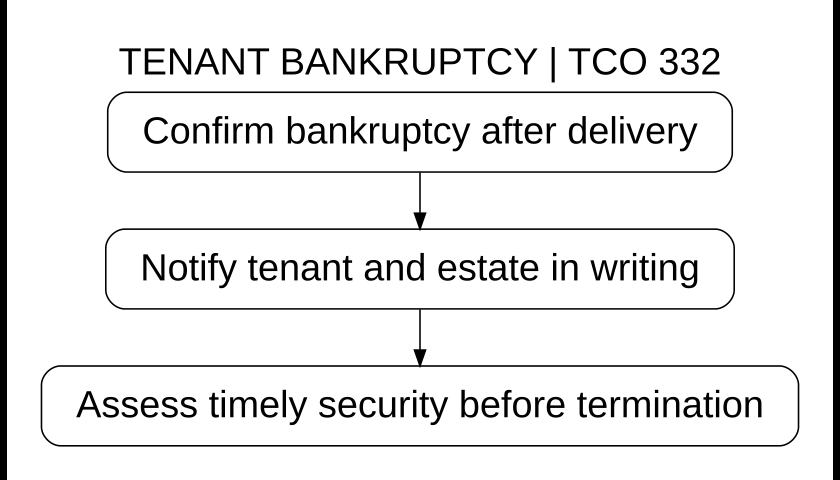
Confirm that the tenant, not merely a related business, is bankrupt
Start with the tenant named in the executed lease and the person or entity identified in the bankruptcy decision. A trading name on the shopfront, a company shareholder and the company renting the premises are not interchangeable. Bankruptcy of a director or affiliated business should not be described as bankruptcy of the contractual tenant without establishing the relevant legal identity.
Obtain the decision and the bankruptcy-file information needed to identify the event and the estate administering the tenant’s assets. A tenant saying that business is insolvent, an unpaid supplier invoice or closure of an office does not establish the same legal event. The word bankruptcy should not be used as a loose translation of every financial problem.
The governing lease provision is Law No. 6098, Article 332. Its first sentence refers to bankruptcy after the rented property has been delivered. Preserve the handover record and compare that date with the insolvency event. The date the lease was signed is not necessarily the date possession or use was delivered.
Financial difficulty before delivery presents a different starting point
Where the problem arose before delivery, do not simply remove the timing condition from Article 332. Article 98 supplies a separate general framework for reciprocal contracts where one party’s inability to perform puts the other party’s entitlement at risk. It addresses withholding performance until security is provided and withdrawal if appropriate security is not supplied within a reasonable period.
That general provision has its own conditions and must be read with the rules applicable to the particular lease. A landlord should not convert an allegation of poor credit into an unrestricted right to refuse an agreed handover. Equally, a tenant cannot answer a properly supported security concern merely by pointing to the existence of a signed agreement.
The reciprocal-performance and security guide explains that separate analysis. Keeping the delivery chronology explicit prevents a notice drafted for one statutory situation from being used for another without the required legal basis.
Article 332 protects rent that will accrue
The security described in Article 332 concerns future rent. Prepare a rent schedule that separates amounts already due from the periods for which protection is sought. The provision is not simply an accelerated collection letter demanding every historical debt under the description security.
Record the contractual rent, due dates, payment history and any supported amendments. Identify whether a sum represents rent, a service charge, damage or another obligation. A combined ledger can be commercially useful, but the statutory purpose of each demand still needs to be identifiable.
Existing arrears require assessment within the applicable collection and bankruptcy procedure. Their classification, registration and priority are not decided merely by citing Article 332. Avoid promising that all rent will be paid ahead of other creditors or that every amount accruing after bankruptcy automatically has the same procedural status. The actual estate position and legal basis must be examined.
The written notice must address both the tenant and the bankruptcy estate
Article 332 expressly requires a reasonable period to be given in writing to the tenant and the bankruptcy estate. Contacting only a former shop manager or sending an informal message to a shareholder does not establish compliance with that two-recipient requirement.
Identify the estate’s proper representative and communication details from the actual bankruptcy file. The estate is not simply another name for the tenant’s former management. Retain evidence of the content sent, the intended recipients and the legally relevant communication dates.
A useful notice identifies the lease, property, post-delivery bankruptcy and future-rent exposure. It states the requested security and the period for providing it, and makes the consequence of non-provision clear. This structure allows the recipient to understand what must be supplied and allows a later reviewer to assess whether the statutory opportunity was genuinely given.
A reasonable security period is not automatically thirty days
Article 332 does not specify a universal number of days. It requires an appropriate period for the particular security demand. The time allowed should be assessed against the circumstances and the security actually requested rather than copied mechanically from a different lease remedy.
Keep the notice date, communication evidence, deadline and response in a single chronology. Where the tenant and estate receive the communication on different dates, that difference must be examined before declaring that the opportunity has expired. A deadline printed in the landlord’s draft does not prove that both required recipients had the relevant period.
This differs from Article 315’s minimum periods for curing payment default. The contractual period-calculation guide addresses counting and calendar issues, but it does not decide whether the particular period chosen for Article 332 was reasonable.
Examine the security actually supplied, not merely a promise to arrange it
The response should be evaluated against the future rent at issue and the legal effectiveness of the proposed protection. Identify the provider, covered obligation, amount, duration and conditions under which the landlord could obtain payment. A document entitled guarantee is not self-proving security for every later rent instalment.
Distinguish an issued instrument from a draft, an application to a bank from the bank’s commitment, and cash actually provided from a promise to transfer it. Preserve the complete wording and any expiry or demand requirements. The question is what protection exists, not only what the tenant intended to arrange.
If a personal surety is proposed, its validity and scope require the separate suretyship review. The personal-security form guide explains why an individual’s signature alone does not always satisfy the applicable safeguards. Article 332 does not cure a defective security undertaking.
An existing rental deposit should be identified and reconciled
Obtain the deposit clause, bank record and any earlier claim against the deposit. Establish which obligation it secures and whether it remains available. A deposit already applied to an admitted debt and a deposit still held in the agreed account are different financial positions.
Article 342 separately regulates contractual security for residential and roofed-workplace leases, including the three-month-rent ceiling and the banking mechanism for money or securities. It should not be confused with Article 332’s special bankruptcy-triggered demand. Neither provision should be used as a slogan to avoid analysing the applicable security arrangement and their interaction.
The rental-deposit guide addresses the ordinary deposit framework. The present question is whether the landlord has the protection relevant to the bankruptcy situation, not whether every deposit can immediately be withdrawn or every existing security automatically settles the future-rent issue.
Immediate termination follows failure to provide security within the required period
If the requested security is not provided within the reasonable written period, Article 332 permits the landlord to terminate immediately without observing a further termination-notice period. The word immediately describes the consequence after the statutory sequence; it does not remove the preceding written demand and opportunity to provide security.
Before exercising that right, compare the notice, the response and the security documents. A late response, a disputed instrument and complete silence are different records. The legal conclusion should identify why the statutory condition is met rather than assume that bankruptcy alone answers it.
Security provided in time must also be considered. A landlord cannot truthfully present an unanswered security demand when the estate supplied an instrument that needs evaluation. The article supplies a defined termination ground, not a general power to choose a different tenant whenever a bankruptcy case exists.
Termination is not the same as physical repossession
A termination declaration, agreement to return the property and legally authorised recovery of possession perform different functions. Record the tenant’s or estate’s response and determine the procedure appropriate to the actual dispute. A disputed entitlement should not be implemented through an unrecorded lock change or removal of property.
Where possession is returned voluntarily, prepare a handover record identifying keys, access devices, meter readings, condition and items left behind. Distinguish property belonging to the landlord, tenant and third parties. The presence of goods inside the premises does not automatically transfer their ownership to the landlord.
Articles 334–335 separately govern return condition and inspection. Ordinary deterioration from contractual use is distinguished from damage for which the tenant is responsible, and the landlord’s notice duties must be assessed. Bankruptcy does not replace the evidence needed to support a particular damage deduction.
A concordat application is not an Article 332 bankruptcy
Turkish konkordato is a distinct legal procedure. Obtain the actual court order and identify whether the matter concerns a concordat respite or a bankruptcy decision. Translating both as insolvency protection does not make their lease consequences identical.
Enforcement and Bankruptcy Law No. 2004, Article 296, protects contracts important to continuation of the debtor’s business against the specified consequences based merely on applying for concordat. In that framework, clauses treating the application as breach, a termination ground or acceleration are not applied, and the contract cannot be ended simply because the debtor applied.
That protection must be examined for the particular contract and event. It is not a finding that every tenant obligation has disappeared or that unrelated supported grounds never require consideration. The immediate point is narrower: a landlord cannot substitute a concordat application for the formal bankruptcy event required by Article 332.
Ordinary rent default has different notice requirements
Article 315 addresses unpaid rent or ancillary charges that become due after delivery. It permits a written period accompanied by a warning that the lease will be terminated if performance is still not made. The minimum is ten days generally and thirty days for residential and roofed-workplace leases, beginning the day after the written notification.
Do not exchange those periods with Article 332’s reasonable security period. The required act under Article 315 is payment of the relevant overdue obligation; under Article 332 it is provision of security for future rent after the qualifying bankruptcy. A document attempting both should distinguish the two demands and their respective legal conditions.
Any collection or eviction step must also be screened against the actual insolvency proceedings. A correctly drafted contractual notice does not itself establish that an individual enforcement step can proceed outside the bankruptcy framework. The substantive ground and the procedure for pursuing it must be reviewed together.
Check mediation and the specific proceeding before filing
Mediation Law No. 6325, Article 18/B(1)(a), generally requires a mediation application before a lawsuit arising from a rental relationship, while excepting the specified non-judgment enforcement eviction provisions under Law No. 2004. A landlord should not treat that exception as covering every court claim described as eviction.
Identify the actual relief: a lease-dispute lawsuit, an enforcement application, a bankruptcy-estate claim or another procedure. Their requirements should not be conflated. The lease mediation rule does not itself decide the registration of a claim in a bankruptcy estate or the representation required for a settlement affecting it.
A settlement should specify the security, unpaid amounts, possession date and treatment of items and deposits. Verify the signatory’s authority. Agreement on handing back keys does not necessarily release all rent claims, and a proposed release should not be described as performed before its stated payment conditions occur.
Documents an overseas landlord should organise
| Issue | Core document | Why it matters |
|---|---|---|
| Tenant identity | Executed lease and entity records | Connects the bankrupt person with the actual tenant. |
| Delivery and bankruptcy | Handover record and bankruptcy decision | Tests the timing condition in Article 332. |
| Rent exposure | Period-by-period rent and payment schedule | Separates existing arrears from future rent. |
| Written opportunity | Notice to the tenant and estate, with communication evidence | Shows the demand, recipients and period allowed. |
| Security response | Complete issued instruments, deposit records and correspondence | Permits an assessment of protection actually supplied. |
| Further procedure | Termination, mediation, estate and handover records | Distinguishes a legal ground from its implementation. |
Keep original-language records alongside translations and identify the authority of anyone acting locally. Do not send banking credentials or unrestricted account access to a prospective representative. Any served court or enforcement paper requires its own response assessment; preparing a security notice or negotiating with the estate does not itself suspend a procedural deadline.
Frequently asked questions
Does tenant bankruptcy automatically end a Turkish lease?
Article 332 instead provides a future-rent security procedure after delivery. The landlord must give the tenant and estate a reasonable written period before relying on non-provision of security to terminate.
Must the bankruptcy occur after delivery?
That is the timing stated in Article 332. A pre-delivery problem requires a separate assessment, including the applicable reciprocal-performance rules.
Does the security demand concern historical rent arrears?
Article 332 identifies future rent. Existing arrears must be accounted for and pursued under the appropriate collection and bankruptcy framework.
Who must receive the written security period?
Both the tenant and the bankruptcy estate. Identify their proper communication and representation details and preserve the notice record.
Does Article 332 always require thirty days?
No fixed thirty-day period appears in Article 332. It requires a reasonable period; Article 315 supplies different minimum periods for payment default.
Is a promise to obtain a guarantee necessarily enough?
Assess the security actually supplied, its validity, scope and timing. An application or draft is not necessarily an effective instrument securing the future rent.
Can the existing deposit simply be ignored?
No. Identify its coverage, availability and prior use. The ordinary deposit rules and the special bankruptcy security demand require distinct but coordinated review.
Is concordat the same as bankruptcy for this purpose?
No. Establish the actual proceeding. Article 296 of Law No. 2004 contains specific contract protections concerning a concordat application.
Does a termination notice authorise changing the locks?
It does not itself establish lawful physical repossession. Voluntary handover or the appropriate legal recovery procedure must be addressed separately.
Is every eviction dispute exempt from mediation?
No. Article 18/B distinguishes rental lawsuits from the specified non-judgment enforcement eviction provisions. Identify the actual proceeding before relying on the exception.
Official legal sources
Turkish Code of Obligations No. 6098, Articles 98, 315, 332, 334–335 and 342; official Ministry text of Article 332; Enforcement and Bankruptcy Law No. 2004, Article 296; and Mediation Law No. 6325, Article 18/B. This is an English explanation, not an official translation or a conclusion about an unidentified insolvency file.
Ask about a tenant’s bankruptcy
Identify the tenant, delivery date, bankruptcy or concordat decision and whether security has been requested. Mention any served deadline and arrange a confidential channel for the documents.
Istanbul and Mersin offices
Bakırcı & Keskin Law Office is Mersin-based and works throughout Türkiye with an Istanbul and Mersin focus.
Istanbul — Polaris Plaza
Maslak Ahi Evran Caddesi, Polaris Plaza No:21, Floor 9, 34475 Sarıyer/İstanbul.
Mersin — Profit İş Merkezi
İhsaniye Mahallesi, 4903. Sokak, Profit İş Merkezi No:23, Floor 3, Office 14, 33070 Akdeniz/Mersin.
Call +90 552 224 43 66. An enquiry does not establish representation or suspend a legal deadline.
Contact regarding a legal matter
In your first message, you may briefly state the subject, your country or city, and any relevant notification or recent procedural date. Please do not send identity numbers, medical data, or personal documents. Messaging alone does not constitute legal advice or create a lawyer–client relationship.
Discover more from Bakırcı & Keskin Hukuk Bürosu
Subscribe to get the latest posts sent to your email.