Shareholding Notifications in Turkey: TCC Article 198, Ten Days and Frozen Voting Rights
Shareholding notifications in Turkey can become due within ten days when a foreign undertaking’s stake in a Turkish capital company changes. Article 198 of the Turkish Commercial Code covers specified direct and indirect shareholding thresholds and reductions below them. It is not merely an annual statistical return. Failure to complete the statutory notification, registration and announcement requirements freezes the rights attached to the relevant shares, including voting rights.
Have a general question about this article? Ask anonymously
This guide concerns the corporate-law notice required by Law No. 6102. It is separate from the legal steps that transfer the shares, foreign-investment reporting, beneficial-owner reporting and securities-market disclosures. An overseas parent buying or selling a Turkish investment needs a closing checklist that identifies each applicable obligation rather than treating one filing as proof that all reporting has been completed.
Short and clear answer
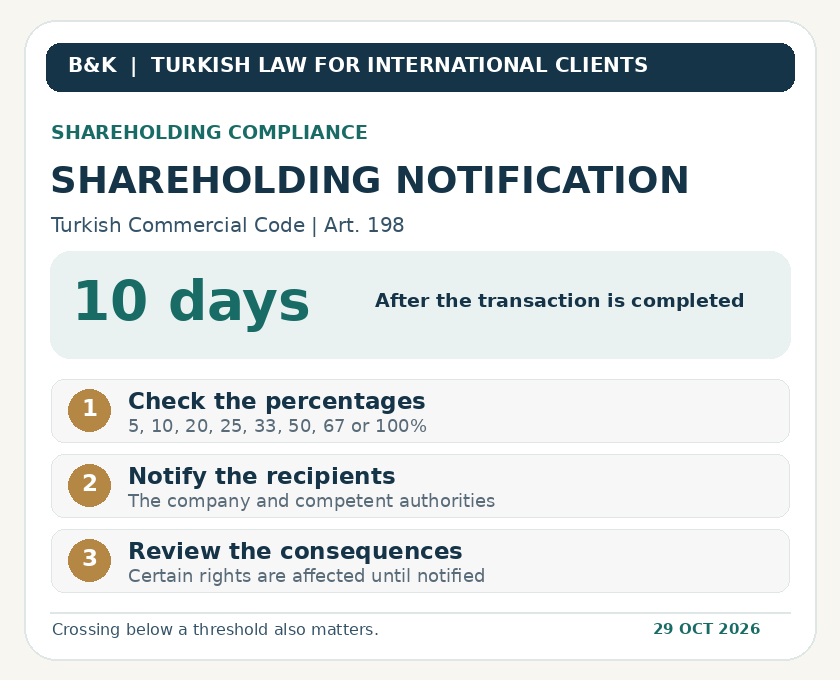
Article 198(1) lists the capital thresholds as 5%, 10%, 20%, 25%, 33%, 50%, 67% and 100%. An undertaking that acquires the specified direct or indirect holdings, or whose holdings fall below those percentages, must notify the capital company and the competent authorities identified by the Commercial Code and other applicable laws within ten days following completion of the transactions. The statutory text says ten days, not a general allowance of ten business days.
The notices are written and are registered and announced through the trade registry. Article 198(2) provides the rights-freezing consequence while the prescribed requirements remain unfulfilled. Sending an informal message to the subsidiary’s finance department is therefore not equivalent to demonstrating completion of the statutory process. The transaction date, percentage calculation, notice evidence and registry publication must form one coherent record.
| Issue | Rule |
|---|---|
| Capital thresholds | 5%, 10%, 20%, 25%, 33%, 50%, 67%, 100% |
| Relevant direction of change | Specified acquisitions and falls below listed percentages |
| Notice period | Ten days following completion |
| Calculation | TCC Article 196 |
| Publicity | Written notice, registration and announcement |
| Unfulfilled duties | Rights attached to the relevant shares, including voting, freeze under Article 198(2) |
Who must examine the Article 198 obligation?
The provision uses the term undertaking and concerns holdings in a capital company. A foreign corporate investor must not assume that its overseas registered office removes the Turkish reporting question. Identify the investing undertaking, the Turkish capital company and the direct and indirect ownership chain. The investor’s legal identity should be stated with its actual registered name, rather than only a group brand used by several different companies.
The analysis is not an assertion that every natural person holding a few shares is automatically subject to every undertaking-related rule. The person’s legal and business capacity matters. Nor should the duty be limited, without reading the provision, to a change that produces majority control. Article 198 includes thresholds below fifty percent. The initial review must therefore consider the statutory subject and the listed percentage event separately from the broader question of whether the investor controls the company.
The threshold list must be applied accurately
The statutory list includes thirty-three and sixty-seven percent. Do not replace those numbers with rounded references to one third and two thirds when calculating a specific filing event. Likewise, twenty percent and twenty-five percent are separate thresholds, and full ownership is expressly included. Use the exact resulting capital position and retain the underlying numbers rather than relying only on a presentation slide that rounds ownership percentages.
The provision covers both acquisition of the specified holdings and a fall below the listed percentages. A disposal therefore deserves the same closing attention as an acquisition. Where several transactions form a staged investment, record the completion of each relevant stage and assess the resulting position. Do not postpone the analysis until the final commercial target stake has been reached. Whether a particular stage has legally completed must be established from the transaction documents and the relevant company-law formalities.
Article 196: the denominator and indirect holdings
Article 198 expressly refers to Article 196 for percentage calculations. Article 196 distinguishes the capital participation ratio from the voting-rights ratio and contains adjustments for the company’s own shares. For the capital ratio, the nominal value of the participation is compared with the relevant capital, with the statutory adjustment for the issuer’s own shares, including holdings acquired for its account through another person. A raw spreadsheet using every issued share without checking those rules can produce the wrong result.
Article 196 also addresses aggregation of shares held by subsidiaries or by third parties for the company’s account. The analysis must consequently look beyond the name appearing as the immediate registered investor. Collect the ownership chain, subsidiary holdings and relevant nominee arrangements. An internal label such as ultimate parent or beneficial owner is not itself the statutory calculation. The legal basis for attributing each block of shares must be identified and the calculation retained with the notice.
Voting control and capital participation should not be silently conflated. Different rights attached to shares or voting arrangements can affect the control analysis under Article 195 without making every figure in the group chart identical. The Article 198 file should explain the relevant capital percentage and show where related voting or control information is being considered for a separate legal purpose. This distinction also prevents a tax or accounting ownership percentage from being reused without checking the Commercial Code’s method.
The ten-day period and the completion record
The statutory trigger is completion of the relevant transactions, not the date when the overseas headquarters finishes its monthly reporting pack. A signed agreement may contain conditions that postpone completion; another document may effect the transfer on signing. The reporting file should identify the event that actually completed the relevant transaction and the evidence supporting that date. Do not assume that the first signature date, payment date and transfer-completion date are always the same.
Prepare the notice materials before closing when the planned transaction is known. Allocate responsibility for confirming completion, recalculating the final stake and submitting the notice. Preserve proof of submission and receipt, and separately track registration and announcement. A closing checklist marked notice prepared does not prove notice delivered; a filing receipt does not necessarily prove publication. Each status should be supported by its own date and record.
The company, competent authorities and the trade registry
Article 198 names the capital company and the authorities designated by the Commercial Code and other laws. The competent-authority analysis therefore cannot be replaced by a single universal address suitable for every Turkish company. Sectoral supervision and the company’s legal position must be checked. A foreign investor should identify the responsible Turkish registry and any additional competent authority before the reporting period begins to run.
The notice is written. It should identify the notifying undertaking and the company, describe the completed transaction, set out the relevant pre- and post-transaction positions and explain the calculation where direct and indirect holdings are involved. These are practical content recommendations for making the statutory event intelligible, not a claim that Article 198 prescribes one universal downloadable form. Signature authority and supporting foreign corporate documents should be checked against the requirements applicable to the actual submission.
Registration and announcement are separate compliance steps
Article 198 expressly requires registration and announcement of the written notices. Article 35 provides the general trade-registry publication framework, including publication in the Turkish Trade Registry Gazette. Keep the submitted notice, the registry record and the relevant announcement together. The existence of a registered share-transfer transaction should not be assumed, without checking its contents, to establish that the separate Article 198 notice was registered and announced.
The statute also addresses explanation of the specified acquisitions and disposals under a separate heading in annual activity and audit reports, and announcement on the capital company’s website. The applicable company-website framework must be read with the current Article 1524, which differs from the original 2011 enactment. A company should not treat a report prepared months later as a replacement for the ten-day notification duty. Immediate notices, registry publicity and later reporting have distinct functions.
Directors, managers and the listed family holdings
The same paragraph contains a separate disclosure sentence concerning board members and managers of the undertaking and capital company. It identifies their own holdings, their spouses’ holdings, holdings of children under their parental authority and holdings through commercial companies in which those persons have at least twenty percent of the capital. A review limited to the direct corporate investor’s share certificate can therefore omit information expressly addressed by Article 198.
Use the statutory relationships accurately. Do not expand the provision into a demand for unrestricted information about every relative, or reduce it to the directors’ personal holdings alone. Request the information necessary to assess the specified categories and preserve the basis on which the disclosure was prepared. Foreign directors should be given a clear explanation of which Turkish company and reporting event are under review so that similarly named group entities are not confused.
What the freezing of rights does—and does not—mean
Article 198(2) states that the rights attached to the relevant shares, including voting rights, are frozen while the first paragraph’s notification, registration and announcement requirements are not fulfilled. The wording is broader than a temporary inconvenience in updating a shareholder list. Before a general meeting, the company and the investor need to establish the compliance position of the affected shares rather than assume that the voting entitlement follows automatically from economic ownership.
The freeze should not be described as an automatic transfer of ownership to the state, a cancellation of the shares or a universal invalidation of every corporate act. Those are different legal consequences and are not what Article 198(2) says. The effect on a particular meeting, resolution or claim must be analysed under the relevant rules and the actual facts. A subsequent completion of reporting duties should not be presented as automatic retrospective validation of every earlier use of the shares.
Correcting a late, incomplete or inaccurate notice
When a defect is discovered, establish what happened rather than backdating the record. Identify the actual completion date, the relevant threshold, what was submitted, which recipient received it, and whether registration and announcement occurred. Correct an inaccurate calculation with a documented explanation and the supporting ownership records. The aim is a reliable compliance history, not a newly created document suggesting that a missed step was performed on time.
Before the affected shares are used at a meeting, review the outstanding duties and the evidence of their fulfilment. Also identify any earlier resolutions for which the status of those shares is material. Article 198 preserves other legal consequences of failing to notify; completion of the missing filing is not a blanket release from every separate claim. No fixed damages amount or universal penalty is asserted here, because those questions require their own legal basis and facts.
Control agreements have their own registration rule
Article 198(3) makes registration and announcement necessary for the validity of a control agreement. That is a distinct rule from a percentage-threshold notice. A group cannot simply rely on an unregistered document labelled control agreement and assume that the validity condition has been met. The legal character of the agreement and its actual registry treatment should be examined rather than inferred from the title on a headquarters template.
The same paragraph states that invalidity of the agreement does not prevent application of group-company duties and liability rules under the Commercial Code and other legislation. In practical terms, failure to satisfy the agreement’s validity requirement is not a general escape from responsibilities arising from the group relationship. Our affiliation-report guide under Article 199 explains a related annual duty, which must be assessed separately from the Article 198 filing.
Do not confuse Article 198 with other reporting systems
Foreign-investment reporting, ultimate-beneficial-owner reporting, sectoral approvals and public-company disclosures can use overlapping ownership information, but their triggers and recipients are not interchangeable. Article 198 is a corporate-law obligation with its own thresholds, timing and rights consequence. A compliant tax declaration or investment-statistics submission is not, by itself, evidence that the written notice was registered and announced under this provision.
Build a separate obligation register for the transaction, recording the legal source, responsible entity, trigger, deadline, recipient and completion evidence for each applicable process. Reconcile the factual ownership data across those filings without assuming that the legal calculations are identical. The minority-shareholder guide and foreign-director responsibility guide cover other corporate questions; neither replaces the Article 198 checklist.
Documents for a Turkish legal review from abroad
Prepare the investor’s corporate identity and signing-authority documents, the Turkish company’s current records, the ownership chain before and after the transaction, the executed transfer documents, completion evidence and the Article 196 calculation. Add any previous notices, registry receipts and Gazette announcements. For director-related disclosure, organise only the information relevant to the statutory categories. Sensitive material should be transferred through an agreed secure channel rather than included in an initial public contact form.
Legal review can then identify the exact reporting event, unresolved recipients, missing publicity steps and the implications for exercising shareholder rights. Bakırcı & Keskin Hukuk Bürosu assists with Turkish corporate matters for clients abroad and coordinates nationwide file management. Consultation and document-review arrangements are available through the firm’s contact page; the first communication should state the company, transaction date and any imminent shareholder meeting.
Frequently asked questions
Which percentages appear in TCC Article 198?
The listed capital thresholds are 5, 10, 20, 25, 33, 50, 67 and 100 percent. Use the exact statutory numbers and Article 196’s calculation rules.
How long is the notification period?
The undertaking notifies within ten days following completion of the relevant transactions. The text does not provide a general ten-business-day allowance.
Does a sale also trigger a notice?
Yes, Article 198 covers a fall below the listed percentages as well as acquisition of the specified holdings. Assess the actual post-transaction position.
Are indirect holdings ignored?
No. Direct and indirect holdings are expressly addressed, and Article 196 supplies the statutory calculation and aggregation framework.
Is notifying the company enough?
The statute also addresses competent authorities and requires written notices to be registered and announced. Keep evidence of each applicable step.
What happens to voting rights when duties remain unfulfilled?
Article 198(2) freezes the rights attached to the relevant shares, including voting rights, while the prescribed notification, registration and announcement requirements remain unfulfilled.
Does the freeze cancel the shares?
No. Freezing shareholder rights is not the same as cancellation of the shares or transfer of their ownership. Other legal consequences require separate analysis.
Does a tax or foreign-investment filing replace Article 198?
Not automatically. Those systems have separate legal triggers and recipients. Their completion does not itself prove the Article 198 notice was registered and announced.
Does an unregistered control agreement avoid group liability?
No. Article 198(3) requires registration and announcement for validity and expressly preserves application of group-company duties and liability despite invalidity of the agreement.
What should be preserved in the closing file?
Ownership calculations, completion evidence, the signed notices, delivery records, registry documents and Gazette announcements should be reconciled with the actual transaction.
Professional information and consultation
Av. Halil Bakırcı · Mersin Bar Association registration 3472 · Bakırcı & Keskin Hukuk Bürosu. The firm’s Istanbul and Mersin office details and appointment arrangements are available on the contact page.
Request a corporate reporting review
General legal information does not replace examination of the actual transaction records or establish an engagement.
Istanbul Office – Polaris Plaza, Maslak / Sarıyer
Bakırcı & Keskin Hukuk Bürosu
Maslak Ahi Evran Caddesi, Polaris Plaza No:21, Kat:9, 34475 Sarıyer/İstanbul
Our physical offices in Istanbul and Mersin coordinate matters throughout Turkey, subject to jurisdiction and the local steps required for each case. Please specify your preferred office when arranging an in-person appointment.
Open the Istanbul office on Google Maps · Contact and appointments
Contact regarding a legal matter
In your first message, you may briefly state the subject, your country or city, and any relevant notification or recent procedural date. Please do not send identity numbers, medical data, or personal documents. Messaging alone does not constitute legal advice or create a lawyer–client relationship.
Discover more from Bakırcı & Keskin Hukuk Bürosu
Subscribe to get the latest posts sent to your email.
