A Blank Turkish Promissory Note Was Filled Against Instructions: TCC 680, Proof and Holder Protection
A blank Turkish promissory note creates a particular legal risk: the signature can be genuine while the amount, date or other details later inserted are disputed. The legal issue is not resolved merely by showing that the paper contained blanks when it was signed. Turkish commercial law recognises incomplete negotiable instruments and separately regulates completion contrary to the agreement. The identity of the person demanding payment is then crucial.
Have a general question about this article? Ask anonymously
Direct answer
Under TCC Article 680, completing an instrument contrary to the completion agreement does not automatically defeat the rights of a protected holder. The statutory exception concerns a holder who acquired it in bad faith or with gross negligence at acquisition. Article 778(2)(f) applies this rule to promissory notes. A dispute with the original contracting party must be distinguished from a dispute with a later holder; the completion agreement, the alleged departure from it and the circumstances of acquisition must be proved through the appropriate procedure.
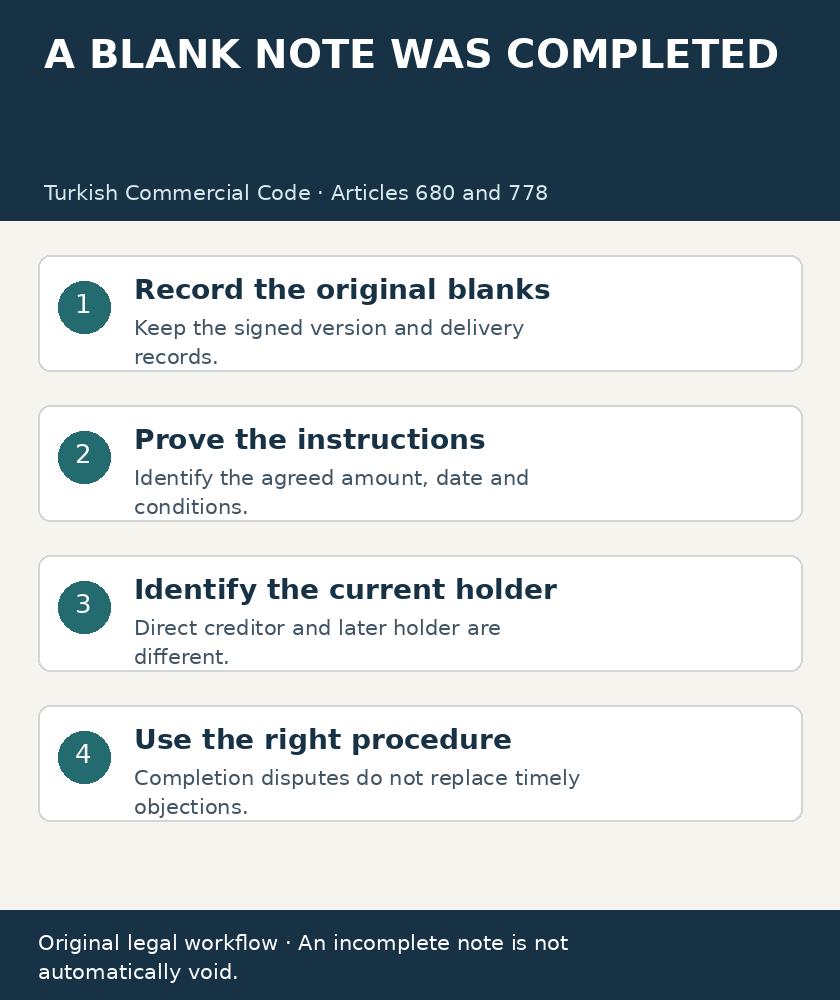
Quick summary
| Question | Answer |
|---|---|
| Is a signed blank note automatically void? | No. TCC 680 expressly regulates incomplete instruments put into circulation. |
| What must be identified? | The permitted completion, the actual completion, the claimant and the acquisition history. |
| What protects a later holder? | The statutory rules on acquisition and available defences, subject to the specified exceptions. |
| Is this always signature forgery? | No. Admitting the signature but disputing inserted particulars is a different allegation. |
| Does a complaint to the creditor stop enforcement? | No. The prescribed court application and any request for interim protection are separate. |
| What is the most useful early evidence? | A complete signed-stage copy, written completion instructions, delivery records and the current original. |
1. Identify an incomplete note rather than a forged signature
Article 680 addresses an instrument that was not completely filled in when put into circulation. It does not say that every signed paper is a valid promissory note regardless of its eventual form. Articles 776 and 777 still determine whether the instrument presented as a bono contains the required elements or benefits from one of the specific statutory alternatives for missing particulars.
Start with the actual allegation. The maker may accept that the signature is genuine while contesting the amount or maturity inserted later. That is not the same as denying the signature. A person who never signed raises a different authenticity issue. Confusing these positions can lead to an irrelevant expert request or the wrong enforcement objection. A legal submission should state which words, figures or dates are challenged and whether the handwriting or signature itself is disputed.
Preserve a copy of both sides and any allonge. A photograph showing only the amount field cannot establish the endorsement chain or the terms appearing elsewhere on the note. Also identify whether the signer acted personally or for a company. Where company representation is disputed, the separate guide to an unauthorised company-note signature under Article 678 explains why authority is not the same issue as permitted completion.
2. Reconstruct the completion agreement precisely
The completion agreement determines which particulars could be inserted and on what basis. Identify the permitted amount, currency, maturity, payee and other fields. Establish whether completion depended on a defined event, an unpaid balance, a calculation or supporting documents. A statement that the note was handed over as security does not, without more, identify every agreed limitation on completion.
Read the supply, loan or other underlying contract together with any separate note-delivery record and completion instructions. Record the relevant dates and the parties to each document. A later account statement may help explain the claimed balance, but it is not automatically proof of what the parties authorised when the incomplete note was delivered. The evidentiary task is to connect the agreed authority to the disputed entries.
Separate the authorised ceiling from the actual unpaid debt. A ceiling establishes an upper limit where agreed; it does not establish that the entire ceiling became payable. Similarly, a calendar date written into a blank maturity field must be assessed against the completion terms, not merely against whether the date is legible. The argument should identify the contractual permission and the concrete departure from it.
3. Separate the original creditor from a later holder
A dispute with the party that received the incomplete instrument and agreed the completion instructions is not identical to a dispute with a subsequent acquirer. Article 687 regulates personal defences arising from relationships with the maker or previous holders. It does not erase the legal significance of the claimant’s own direct relationship with the person resisting payment.
Where the claimant participated in the completion agreement, the analysis therefore addresses that agreement, the claimant’s conduct and the available direct defences. Where a later holder acquired the note, the protection given by Article 680 becomes central. Do not assume that proof of an agreement with the original recipient automatically establishes the same defence against every subsequent holder.
Identify the claimant through the note and the actual transfer documents. The company named in a collection letter, the bank presenting the instrument and the person legally entitled as holder may not have identical roles. An endorsement for collection, an outright transfer and an assignment require different analysis. A creditor’s asserted status should be checked rather than inferred from possession of a scanned copy or the use of a professional letterhead.
4. Apply the Article 680 acquisition tests correctly
Article 680 expressly refers to bad faith or gross negligence when the holder acquired the instrument. The timing matters. A warning sent after acquisition is not automatically proof of the holder’s knowledge at acquisition. Conversely, documented knowledge of the completion restrictions before acquisition can be legally relevant. The evidence should address the acquisition event and the holder’s position at that time.
The statutory test must not be replaced with an automatic rule that every purchaser of a note must investigate every underlying agreement. Nor does the holder’s commercial status provide absolute protection. Relevant documents include the transfer date, correspondence provided before transfer, disclosed completion restrictions and other evidence bearing on the statutory standard. A connection between businesses or a discounted purchase price is not, standing alone, a conclusive finding of bad faith.
Article 687 contains a differently worded exception for personal defences: a holder who knowingly acted to the debtor’s detriment when acquiring the instrument. Do not treat that language and Article 680’s bad-faith or gross-negligence formula as interchangeable. Identify which statutory defence is actually being advanced and explain the facts supporting its own requirements. This avoids an unfocused allegation that a later holder was merely careless in some unrelated respect.
5. Build evidence that can be used in the relevant proceedings
HMK Article 190 supplies the general burden-of-proof framework. The party asserting a restricted completion authority should identify evidence of the restriction and the departure from it. HMK Article 199 recognises documentary material broadly, but that does not remove the specific rules on the evidentiary force of instruments and the restrictions or exceptions concerning witness evidence under Articles 200–203.
The most useful file contains a signed-stage copy, the written completion agreement, the document recording delivery, correspondence discussing the permitted entries, the original as now completed and the underlying payment records. Explain what each document proves. A page showing that a field was blank establishes a different proposition from a contract proving that only a specified amount could be inserted.
Keep the original messages and attachments, not only a selection of screenshots. Preserve the date, sender and context of instructions. Our guide to email and messaging evidence in Turkish courts explains why transmission records and source files matter. Do not alter the only surviving scan by adding labels or annotations; use a separate working copy for counsel’s review.
6. Distinguish completion from alteration of an already completed instrument
Article 680 concerns completion of an instrument issued with blanks. Article 748 addresses alteration of the instrument’s text and distinguishes obligations according to whether signatures preceded or followed the alteration. Article 778 makes the relevant provisions applicable to promissory notes. The legal classification therefore depends on what the document contained when the relevant signatures and entries were made.
Different ink, handwriting or printing can justify a targeted examination, but it does not by itself establish unauthorised completion: the very purpose of a completion agreement can be to permit later entries. The court must connect physical findings with the agreed authority and the legally relevant chronology. An expert cannot decide the parties’ contract merely by identifying that two entries were made with different pens.
Where the signature itself is denied, the applicable authenticity procedure must be pursued. Where the signature is admitted and only completion is disputed, say so accurately. A criminal allegation should not be substituted for a civil or enforcement submission required within a statutory period. The existence of a complaint does not automatically suspend the payment order or establish the holder’s lack of rights.
7. Respond to the correct enforcement procedure
Special enforcement based on negotiable instruments has its own payment-order and objection framework. Article 168 of the Enforcement and Bankruptcy Law provides specified five-day complaint or objection routes and a ten-day payment period. These must not be confused with the ordinary seven-day objection arrangements in a general enforcement proceeding.
The application must match the issue. Lack of negotiable-instrument status, denial of signature, absence or discharge of the debt, limitation and jurisdiction are distinct grounds. A completion dispute must be framed using the legally appropriate ground and evidence. Sending an objection to the creditor or writing a notation on a photocopy is not a substitute for the prescribed application to the enforcement court.
Article 169 states that a debt objection does not stop enforcement acts other than sale merely because it has been filed. Article 169/a regulates examination and the conditions for temporary suspension. The limited evidentiary framework of enforcement review must also be distinguished from a full civil action. For an overseas party, the immediate priority is to provide the entire payment order and service record so that the actual procedural period can be calculated.
8. Consider separate litigation without assuming an automatic stay
A dispute that cannot be resolved through the particular enforcement objection may require consideration of a separate negative declaratory or repayment action. Article 72 of the Enforcement and Bankruptcy Law regulates those remedies and distinguishes the position before and after enforcement has begun. Filing an action is not a universal automatic stay of collection.
The requested interim measure, the procedural stage and the statutory security requirements must be assessed together. Do not promise that a court will stop every attachment merely because the maker says the note was originally blank. The claim needs a defined legal ground, evidence and a remedy available at the actual stage of proceedings.
For commercial litigation falling within its scope, TCC Article 5/A requires pre-action mediation for the specified monetary claims, including negative declaratory and repayment actions. This requirement must not be confused with the deadline for an enforcement-court objection. Preparing one procedural route does not excuse missing the time limit for another. The international debt-collection guide explains the broader collection setting.
9. Document payments, return of the original and settlement
A settlement should identify the exact instrument, its issuer, amount, maturity and holder. Specify the payment credited, the treatment of interest and costs, and the delivery or cancellation of the original. A general statement that the account is settled can leave uncertainty about a note that has already been transferred to another person.
Check whether the person receiving payment can validly discharge the obligation. Preserve the bank record and a receipt identifying the relevant instrument. Where only part of the debt is paid, record the remaining balance without allowing the same economic debt to be collected twice under separate descriptions. Our guide to receipts and return of notes after payment addresses the supporting documentation.
The note and the underlying contract must remain analytically separate. Delivery of a new instrument does not automatically establish novation of the original debt. The parties’ agreement and the applicable law determine that issue, as discussed in the guide to new payment agreements under TCO 133–134. A settlement should state what is released rather than relying on an assumed effect.
10. Define completion authority before delivery
The safest documentary practice is to avoid unexplained blanks and to retain a complete copy of every instrument delivered. When incomplete delivery is part of a documented transaction, identify each field that can be completed, the authorised calculation, any ceiling, the maturity mechanism and the conditions triggering use. Identify the instrument itself so that the instructions cannot be confused with another note in a series.
Record who receives the original and in what capacity. Retain the related delivery and account records, and address what happens after partial payment or termination of the underlying transaction. These practical records do not override the statutory protection of a later holder, but they provide evidence of the actual agreement and reduce disputes between the original parties.
For transactions involving signatures or payment abroad, the conflict-of-laws provisions referred to by Article 778 must also be checked. The involvement of a Turkish company does not make every international instrument issue automatically subject to the same domestic rule. Record the places of signature, issue, transfer and payment rather than treating the correspondence language as the governing-law answer.
Frequently asked questions
Is a signed blank Turkish promissory note automatically invalid?
No. TCC Article 680 regulates incomplete instruments put into circulation, and Article 778 applies it to promissory notes. The completed instrument must still satisfy the applicable formal rules.
Which provision applies the blank-instrument rule to a bono?
TCC Article 778(2)(f) applies Article 680 to promissory notes.
Does proof that the note was blank prove unauthorised completion?
No. The permitted completion and the alleged departure from the agreement must also be established.
Can the same defence always be raised against a later holder?
No. Article 680 protects the holder subject to its bad-faith and gross-negligence exceptions at acquisition. Other defences must be analysed under their own rules.
Is disputing the inserted amount the same as denying the signature?
No. A genuine signature with disputed completion and a signature allegedly never made by the person are different factual and procedural issues.
Does different ink automatically invalidate the note?
No. Physical findings must be evaluated with the completion agreement, chronology and applicable validity rules.
Does a criminal complaint stop enforcement automatically?
No. The required enforcement or civil application and the conditions for interim protection must be addressed separately.
Is the special bill-enforcement objection period seven days?
No. Article 168 contains specified five-day complaint and objection routes and a ten-day payment period. Read the actual payment order and service record.
Should the original note be addressed in a settlement?
Yes. Identify the instrument, holder, payments, remaining balance and return or cancellation of the original.
Can documents be reviewed while the maker lives abroad?
Yes. Initial copies and instructions can be transmitted remotely. Formal representation, original production and any personal court requirement are assessed separately.
Türkiye-wide case management and Mersin practice
Bakırcı & Keskin Law Office handles Turkish disputes for clients abroad from its Mersin office. A useful initial file contains the signed-stage copy, completion instructions, current note, transfer information, payment records and any served order. The review separates liability on the instrument from the underlying transaction and from the procedural steps required to preserve a defence.
Updated: 29 October 2026. This guide explains statutory distinctions; the actual agreement, instrument and procedural record determine the appropriate action.
Istanbul Office – Polaris Plaza, Maslak / Sarıyer
Bakırcı & Keskin Hukuk Bürosu
Maslak Ahi Evran Caddesi, Polaris Plaza No:21, Kat:9, 34475 Sarıyer/İstanbul
Our physical offices in Istanbul and Mersin coordinate matters throughout Turkey, subject to jurisdiction and the local steps required for each case. Please specify your preferred office when arranging an in-person appointment.
Open the Istanbul office on Google Maps · Contact and appointments
Contact regarding a legal matter
In your first message, you may briefly state the subject, your country or city, and any relevant notification or recent procedural date. Please do not send identity numbers, medical data, or personal documents. Messaging alone does not constitute legal advice or create a lawyer–client relationship.
Discover more from Bakırcı & Keskin Hukuk Bürosu
Subscribe to get the latest posts sent to your email.
