A Turkish Judgment Was Enforced and Then Reversed: Restitution Under Article 40
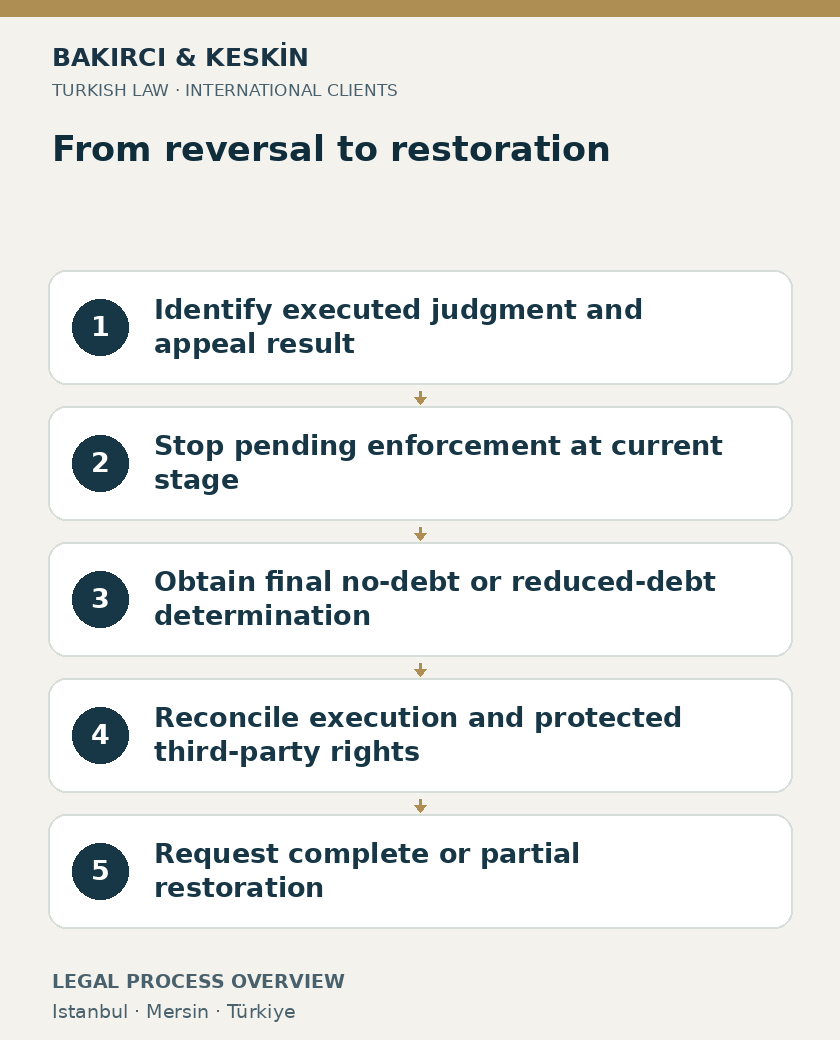
Short answer: Article 40 of the Enforcement and Bankruptcy Law separates stopping further enforcement from reversing enforcement already completed. An appellate setting-aside or cassation reversal stops enforcement at its current stage. Restitution after execution requires the statutory position to be established by a final judgment showing that the person pursued owed nothing or less than was collected. The enforcement can then be restored wholly or partly without a separate judgment ordering that restoration, subject to protection of third-party rights acquired in good faith.
Have a general question about this article? Ask anonymously
Quick summary
| Legal issue | A Turkish Judgment Was Enforced and Then Reversed: Restitution Under Article 40 |
|---|---|
| Short answer | Article 40 of the Enforcement and Bankruptcy Law separates stopping further enforcement from reversing enforcement already completed. An appellate setting-aside or cassation reversal stops enforcement at its current stage. Restitution after execution requires the statutory position to be established by a final judgment showing that the person pursued owed nothing or less than was collected. The enforcement can then be restored wholly or partly without a separate judgment ordering that restoration, subject to protection of third-party rights acquired in good faith. |
| Key legislation | Enforcement and Bankruptcy Law No. 2004 — Articles 40; Code of Civil Procedure No. 6100 — Articles 350, 367 |
A reversal can stop enforcement before it establishes a right to repayment
A person who paid under a Turkish judgment may learn that the judgment has been set aside or reversed on appeal. The immediate reaction is often to request all money back. Enforcement and Bankruptcy Law Article 40 requires a more precise analysis. Its first paragraph concerns the effect on enforcement still underway. Its second paragraph concerns restoration after the judgment has already been executed and the necessary final determination about the debt has been made.
The distinction is particularly important where the appellate outcome sends the case back for further proceedings. A procedural or evidential error can require a new hearing without yet establishing that the debtor owes nothing. The reversal document should therefore be read in full, including its operative result and the scope of any remittal. A favourable sentence in the reasoning is not necessarily a final decision eliminating the monetary obligation.
Keep the merits case and enforcement file connected but distinct. The merits court determines the legal obligation through the applicable proceedings. The enforcement record shows what was collected, delivered, sold or otherwise carried out. A restitution request under Article 40 needs both histories. Reviewing the appeal decision without the enforcement account, or the bank transfer without the final judgment, leaves a material part of the statutory analysis unanswered.
An appeal does not generally stop execution merely because it was filed
Code of Civil Procedure Articles 350 and 367 state that regional appellate review and cassation respectively do not themselves suspend execution, while reserving Enforcement and Bankruptcy Law Article 36. They also contain finality requirements for judgments in the listed personal-status, family-law and immovable real-right categories. Both provisions expressly state that a stay of execution cannot be ordered for maintenance decisions. The legal nature of each operative award must therefore be classified; a maintenance obligation should not be swept into a general statement that every family-related award awaits finality.
These rules explain why money may have been collected while an ordinary monetary dispute remained under review. The fact that the creditor enforced before the appellate outcome does not, by itself, establish misconduct. Conversely, the existence of an appeal does not establish that every enforcement act was valid. The file needs the original judgment, any stay decision and the legal rule governing enforceability at the time each act occurred.
A request for a stay before execution and a request for restitution after execution address different positions. Security deposited for a stay should also be distinguished from money collected and distributed in satisfaction of the judgment. A client should identify each payment’s recipient and purpose rather than describe every transfer connected with litigation as a payment of the debt. The release of security requires attention to the order and procedure governing that security.
Article 40 first stops enforcement where it stands
The first paragraph states that a regional appellate court’s setting-aside or a cassation reversal stops enforcement acts at their current stage. Its wording addresses continuation after that event. It should not be translated into a rule that every completed act is immediately undone or that all money already received by the creditor returns automatically. The distinction between preventing the next act and reversing a completed transfer is central to the article.
Provide the official appellate decision to the enforcement file promptly through the proper procedure. Identify any impending distribution, delivery or sale so that the authority can assess the effect of the decision on the actual stage reached. Do not rely solely on a telephone report that “the appeal was won.” The court, decision date, case number and operative result should be verifiable from the issued document.
Record what had happened before the decision and what remained pending. An attachment, sale, receipt of sale proceeds and payment to the creditor are separate steps. The appropriate request must describe the stage accurately. A debtor who only knows that an account was frozen should not state that the creditor already received the whole judgment amount unless the enforcement and banking records establish that transfer.
Restoration requires a final judgment establishing no debt or a smaller debt
Article 40’s second paragraph addresses a judgment that has been executed and is subsequently set aside, replaced by a new merits decision or reversed in the described appellate process. It requires a final judgment establishing that the person against whom enforcement was pursued had no debt or did not owe that much. That final determination provides the basis for complete or partial restoration. A simple notice that the file has returned to the trial court does not establish the required result.
Obtain the complete later judgment and evidence of its finality. Identify the operative paragraph deciding the obligation and compare it with the earlier judgment used for execution. A finality annotation must relate to the relevant decision and component. Where different claims or parties have different procedural histories, do not assume that finality of one part resolves the whole enforcement file.
The phrase “without a separate judgment” concerns the restoration consequence once Article 40’s conditions are met. It does not dispense with the final judgment establishing that nothing or less was owed. This distinction prevents two opposite mistakes: filing an unnecessary fresh merits claim merely to restate a qualifying restoration entitlement, and seeking immediate repayment before the required debt determination is final.
A reduced award requires a defined restitution calculation
Article 40 expressly permits partial restoration. A later judgment can leave a valid obligation while reducing part of the amount previously enforced. The request should therefore compare each relevant component instead of treating every successful appeal as complete elimination of the debt. Identify which principal items survived, which were removed and which were altered. A general percentage applied to the old total may not reflect the later judgment.
Prepare a comparison using the original operative award, actual enforcement account and final replacement result. Keep different currencies separate until the legally applicable treatment is established. If only one of several judgment debtors obtains a favourable result, identify that person’s position and the source of the payments made. The same final decision should not be used to assume relief for another person whose obligation was not determined in the same way.
Credits already received must also be recorded. A voluntary repayment by the former creditor, an amount still held in the enforcement account and money never collected cannot all be demanded again as though outstanding. The calculation should show the amount originally transferred, the part remaining supported by the final judgment, sums already restored and the specific balance now sought.
Keep each figure linked to its source document and date. If the parties disagree about one component, identify that disagreement expressly rather than concealing it in a net total. The authority can then distinguish the effect of the final judgment from an unresolved accounting dispute and decide the requested restoration on an intelligible record.
Trace the execution rather than relying only on a bank debit
The enforcement file should identify the legal title, attachment or collection acts, money received, deductions and distributions. A bank debit can show that money left the debtor’s account, but it may not show whether it remains with the bank, reached the enforcement office or was paid to the creditor. Those distinctions affect the practical restoration request and the authority able to act.
For a sale, preserve the sale decision, buyer information, payment record and distribution documents. For delivery of goods, preserve the identifying inventory and handover record. The objective is to establish what execution changed. A request based on an assumed asset history can seek something that was never transferred or overlook money already held within the proceeding.
Payments made outside the enforcement file need careful classification. Record why they were made, which judgment or agreement they concerned and how they were acknowledged. Do not assume that every voluntary transfer between the parties falls within Article 40 simply because litigation existed. The statutory route should be assessed from the payment’s connection with execution and the authoritative procedural record, with any separate substantive claim considered on its own basis.
A restoration request should identify the statutory conditions and exact result
The request should place the original enforceable judgment, appellate decision, final debt determination and execution records before the competent enforcement authority. Explain how those documents satisfy Article 40 and what complete or partial restoration is requested. A demand containing only the later judgment’s first page gives an incomplete account of finality, the scope of relief and the amount actually collected.
Identify the parties by the names and legal capacities used in the relevant documents. A corporate name change, merger, assignment or death can require supporting records connecting the person requesting restoration or expected to return money with the original proceeding. The existence of a new commercial name should not lead to an unsupported demand against a different company in the same group.
Obtain and review the enforcement authority’s actual decision. A filed request is not proof that restoration has been ordered or completed. If the authority refuses or limits the request, the applicable procedural remedy and period must be assessed from that decision. Keep the service record and do not assume that continued correspondence with the former creditor preserves a separate right to challenge the enforcement act.
Article 40 protects rights acquired by third parties in good faith
The article expressly preserves third-party rights acquired in good faith. That qualification matters where execution resulted in an asset passing to someone outside the original creditor-debtor relationship. A successful merits challenge does not itself permit the former debtor to disregard every intervening acquisition. The person’s identity, acquisition, timing and good faith require examination under the applicable legal rules.
Distinguish the former judgment creditor from a third-party purchaser or another rights holder. A transfer to someone else does not become protected merely because the transferee is called a third party, and the claimant cannot deny good faith solely because restoration would otherwise be inconvenient. The relevant documents and facts must support the legal position. Preserve the acquisition records instead of relying on assumptions about relationships between participants.
The remedy sought should reflect that qualification. A request for return of a particular asset and a request concerning money collected from its realisation are not necessarily interchangeable. Article 40’s protection should be addressed before promising that ownership will automatically revert. Where another person’s acquired rights intervene, the available restoration and any separate claim must be identified specifically rather than concealed behind a general instruction to “undo everything.”
Interest, enforcement costs and consequential loss need their own account
Separate principal from interest, court-awarded costs, enforcement charges and any alleged additional loss. The final merits judgment and relevant statutory rules determine how each item is treated. A reversal of one principal component does not justify an unexplained reversal of every entry in the file. The request should show the relationship between the removed obligation and the amount proposed for restoration.
Do not insert a current flat interest percentage taken from an old guide. The legal basis, relevant period and calculation must be verified for the particular claim. Likewise, financing costs, business interruption and exchange losses should not be presented as automatically awarded by Article 40. Whether they support a separate claim is distinct from restoring the enforcement that the statute addresses. Keep evidence of those alleged losses without mixing them into a supposedly mechanical refund total.
Restitution is distinct from correcting a judgment or disputing payment
A clerical correction or clarification does not necessarily set aside a judgment or establish the final no-debt position required by Article 40. The guide to correction, clarification and completion of judgments explains those separate mechanisms. The exact decision obtained must be classified before its effect on completed enforcement is asserted. A corrected spelling should not be described as reversal of the monetary award.
A debt paid independently after judgment but nevertheless pursued raises a different payment-defence issue. A foreign judgment later changed abroad also requires a separate analysis of its Turkish enforcement basis and the foreign decision’s legal effect. The guide to enforcement of foreign judgments in Turkey addresses that framework. Article 40 should not be treated as an automatic international recognition mechanism for every later overseas ruling.
Build a complete restitution file while remaining abroad
An overseas client’s first package should contain every relevant judgment, finality and service record, the enforcement-file number, bank evidence and a dated procedural chronology. Identify the money or property actually transferred and any known third-party acquisition. State whether the immediate task is stopping a pending act, obtaining the final debt determination or restoring completed enforcement. These are different instructions even when they arise from the same successful appeal.
For a company, verify who can authorise the request and receive any returned funds. Confirm the proper destination through established communication, retain the restoration and transfer records, and reconcile the final account. The statutory entitlement and actual recovery are separate outcomes. Article 40 supplies a defined route when its conditions are established; the client’s records should show which stage has been reached without describing a pending request as money already recovered.
Frequently asked questions
Does reversal immediately refund everything I paid?
No. Article 40 distinguishes stopping enforcement from restoration after a final judgment establishes that nothing or less was owed.
What happens to enforcement still underway?
The first paragraph provides that the qualifying appellate setting-aside or cassation reversal stops enforcement at its current stage.
Is a remittal for a new hearing enough for full restitution?
A remittal alone does not establish the required final no-debt or reduced-debt determination. Read the operative outcome and later proceedings.
Must I always obtain a separate refund judgment?
Article 40 permits restoration without a separate judgment when its conditions, including the final determination of the debt, are met.
Can only part of the collection be returned?
Yes. The article expressly permits partial restoration where the final judgment establishes a smaller debt.
Why was the judgment enforced while my appeal was pending?
HMK Articles 350 and 367 generally provide that appeal alone does not suspend execution, while preserving stay rules and specified finality exceptions.
Is security deposited for a stay the same as payment of the debt?
No. Identify the purpose, holder and governing order for each payment. Security release and restitution of collected money require their respective analysis.
Can a third-party purchaser lose the asset automatically?
Article 40 preserves third-party rights acquired in good faith. The actual acquisition and available remedy must be assessed.
Does Article 40 automatically compensate all business losses?
No. Consequential loss and other additional claims need their own legal basis and proof, separate from the restoration account.
What records should an overseas client provide?
Provide the original and later judgments, appellate decision, finality evidence, enforcement records, payment history and information about any third-party acquisition.
Official legal sources
- Enforcement and Bankruptcy Law No.2004 — Articles 40
- Code of Civil Procedure No.6100 — Articles 350, 367
Legal sources reviewed on 28 October 2026. The official Turkish legislation controls; individual facts and later amendments must be checked before action.
Contact information
Do not include confidential documents or identity numbers in an initial message. An enquiry does not establish representation or suspend any legal deadline.
Istanbul and Mersin contact details
Bakırcı & Keskin Law Office is Mersin-based. Turkish matters are handled under the applicable jurisdiction and agreed mandate. The competent court and the scope of representation are assessed for each matter.
Istanbul — Polaris Plaza
Maslak Ahi Evran Caddesi, Polaris Plaza No:21, Floor 9, 34475 Sarıyer/İstanbul, Türkiye.Mersin — Profit İş Merkezi
İhsaniye Mahallesi, 4903. Sokak, Profit İş Merkezi No:23, Floor 3, Office 14, 33070 Akdeniz/Mersin, Türkiye.+90 552 224 43 66 · Contact details in English. An enquiry does not establish representation or suspend a legal deadline.
Istanbul Office – Polaris Plaza, Maslak / Sarıyer
Bakırcı & Keskin Hukuk Bürosu
Maslak Ahi Evran Caddesi, Polaris Plaza No:21, Kat:9, 34475 Sarıyer/İstanbul
Our physical offices in Istanbul and Mersin coordinate matters throughout Turkey, subject to jurisdiction and the local steps required for each case. Please specify your preferred office when arranging an in-person appointment.
Open the Istanbul office on Google Maps · Contact and appointments
Contact regarding a legal matter
In your first message, you may briefly state the subject, your country or city, and any relevant notification or recent procedural date. Please do not send identity numbers, medical data, or personal documents. Messaging alone does not constitute legal advice or create a lawyer–client relationship.
Discover more from Bakırcı & Keskin Hukuk Bürosu
Subscribe to get the latest posts sent to your email.