Subsidiary Information Rights in Turkey: What a Parent-Company Shareholder Can Ask Under TCC 200
Subsidiary information rights in Turkey are not limited to people who directly own the subsidiary’s shares. Article 200 of Turkish Commercial Code No. 6102 gives every shareholder of the controlling company a right to request satisfactory information at that company’s general meeting about the subsidiaries’ financial and asset positions, results and specified group relationships. A shareholder of a Turkish holding company therefore has a statutory basis for asking about relevant downstream operations even though those operations belong to separate legal entities.
Have a general question about this article? Ask anonymously
This guide concentrates on an investor holding shares in a Turkish joint-stock parent company, or A.Ş. It explains the group-specific questions Article 200 covers and their connection with Article 437. A shareholder in a foreign parent must also examine the law governing that parent’s own corporate organs; the existence of a Turkish subsidiary does not justify assuming that every foreign general meeting follows Turkish procedure. Limited-company information rights likewise have their own Article 614 framework.
Short and clear answer
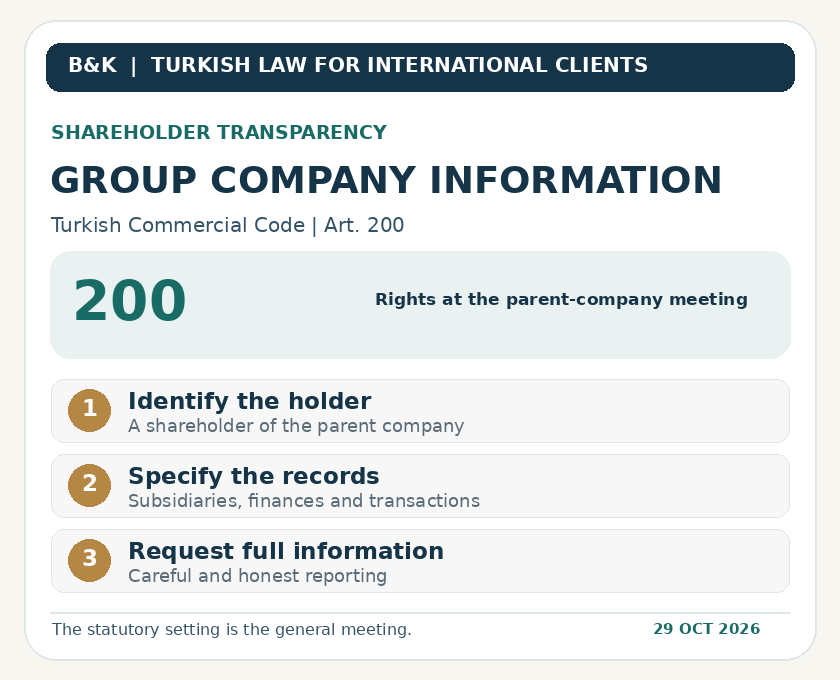
Article 200 grants the right to each shareholder of the controlling company, without prescribing a minimum capital percentage, and places its exercise at the general meeting. The information must be satisfactory, careful, truthful and consistent with honest accountability. Article 437(2) expressly extends a joint-stock company’s information duty to subsidiaries within Article 200’s framework. The board cannot answer the entire request merely by saying that the operating business is a separate company.
The right does not turn the parent’s shareholder into a direct shareholder of every subsidiary or provide unrestricted access to every group record. Identify the subsidiary relationship and the statutory information sought. For a Turkish joint-stock parent, distinguish the meeting request, any permission needed for inspection of relevant books and correspondence, and court enforcement following refusal or failure to provide information. Each step has its own function.
| Question | Legal position |
|---|---|
| Who holds the Article 200 right? | Each shareholder of the controlling company. |
| Where is it exercised? | At the controlling company’s general meeting. |
| What is covered? | Subsidiary finances, assets, results, specified group relationships, transactions and consequences. |
| What standard applies? | Satisfactory information meeting careful, truthful and honest-accountability standards. |
| What connects it to an A.Ş.? | The express Article 200 reference in Article 437(2). |
| What is not automatic? | Direct subsidiary membership, unlimited inspection or disclosure of every unrelated document. |
Whose shares does the investor actually own?
Start with the applicant’s participation in the controlling company. A holding-company shareholder owns that participation; the holding company itself owns its investments. The economic effect of subsidiary operations on the investor does not collapse those separate legal positions. Article 200 supplies a parent-level information right precisely relevant to the group structure, while rights requiring direct subsidiary shareholding must be assessed separately.
Obtain the parent’s shareholder records and an accurate control chart. Article 195 recognises control through voting rights, appointment powers, agreements and other means, including indirect control. A commercial affiliate is not automatically a subsidiary merely because it uses the same brand. The request should identify the entity and the facts supporting its inclusion in the group-information inquiry rather than use an undefined description such as all associated businesses.
Article 200 contains several distinct information categories
The first category concerns subsidiaries’ financial positions, assets and accounting results. The second concerns relationships between the parent and subsidiaries and between subsidiaries themselves. The third extends to relationships involving the shareholders and managers of the parent and subsidiaries and their relatives. The provision also addresses the transactions carried out and their results. These categories make the right more specific than a request for a generic presentation on group performance.
Organise questions under those statutory headings. Identify the relevant company, period and transaction before requesting an explanation. The reference to relatives concerns the described company relationships; it is not a general entitlement to investigate every aspect of a director’s family life. Keeping the request within the statutory subject strengthens its clarity and avoids mixing legitimate corporate questions with unrelated personal information.
Financial position and asset questions need identifiable figures
Use the available accounts to identify the figure requiring explanation: an intercompany receivable, a debt, an asset disposal, a guarantee exposure, an impairment or a material change in results. Ask which entity is affected, which period the figure covers and which transaction produced it. These are document-preparation steps, not allegations that the transaction was unlawful. An unexplained financial movement should first be described accurately.
Separate principal amounts from interest, balances from movements and individual-company figures from consolidated totals. An answer that uses a different reporting period or combines several entities can appear responsive while leaving the original question unresolved. The meeting record should therefore identify both the requested figure and the figure actually supplied. A comparison requires the same entity, period and accounting subject unless the answer explains why a different basis is necessary.
Group transactions and connections with related persons
Article 200 expressly reaches the specified relationships, transactions and their results. Requests can therefore seek an explanation of the parties to a group arrangement, the obligations undertaken, the performance received and the financial effect shown in the accounts. The statutory subject is not exhausted by giving the name of the counterparty. A meaningful account explains the relationship and the transaction whose consequences the shareholder is asking about.
Distinguish the contracting company, the person approving the transaction and any other entity benefiting from it. Those roles can be different. Where the records indicate a connection involving a shareholder, manager or relative, identify the relevant relationship and its significance to the company transaction. Do not state that a connection proves misconduct. The purpose of the request is to obtain a satisfactory account of the dealings, not to substitute a family or ownership link for evidence of a legal breach.
Consolidated accounts do not answer every subsidiary question
Consolidation presents the group from an accounting perspective and can eliminate internal balances for that purpose. Article 200 nevertheless expressly addresses relationships between group entities. A consolidated total should therefore be distinguished from an explanation of a particular intercompany transaction. The board’s answer should identify how the disclosed figures relate to the subsidiary, relationship and result covered by the question.
Conversely, the existence of an information right does not mean the shareholder can demand a new report in any preferred format without regard to the statutory inquiry. State what needs explanation and why the information already provided does not answer it. Use an entity-level reconciliation where the question concerns a transaction that disappears into consolidated figures. This is a practical method of making the request intelligible, not a claim that Article 200 mandates one universal spreadsheet template.
Prepare a question schedule before the general meeting
Article 200 identifies the general meeting as the setting for the request. For a Turkish joint-stock parent, Article 437(1) makes specified financial and reporting documents available before the meeting. Review those documents and prepare a numbered schedule of group-specific questions. Written advance delivery can help the board prepare, but it should not be treated as automatically replacing the statutory exercise of the right at the meeting.
A useful schedule has columns for the subsidiary, period, transaction or balance, existing source, question and requested explanation. Keep each question focused enough for the answer to be assessed. State follow-up questions where the response changes the subject, uses an unexplained aggregate or omits the result of the transaction. Preserve the meeting notice, relevant documents, submitted questions and evidence of their delivery.
At the meeting, request an accurate record of the material questions, answers, refusals and reasons. A later dispute depends on what was actually asked and how the company responded. Do not rely solely on a recollection that management was evasive. The distinction between an express refusal, postponement and an answer that fails to address the request matters to the legal assessment and to the timing of any subsequent application.
The standard is a satisfactory account, not merely a spoken response
Article 200 requires information that is satisfactory and reflects careful, truthful and honest accountability. Article 437(2) reinforces the care and truthfulness requirements for the joint-stock information duty. A response should therefore address the requested subject rather than merely repeat the consolidated revenue total or a broad statement that all companies are professionally managed. Whether an actual answer satisfies the standard must be tested against the actual question and records.
Accuracy also matters on the shareholder’s side. Record qualifications in the answer and distinguish confirmed figures from matters management says remain under review. Do not edit a cautious response into an admission of a completed transaction or remove a stated explanation from the minutes supplied to counsel. A precise record makes it possible to identify the unanswered issue without exaggerating either the request or the company’s reply.
Information and inspection are not the same right
An Article 200 question about a subsidiary does not itself confer physical or electronic access to all of that subsidiary’s files. In a Turkish joint-stock company, Article 437(4) separately addresses inspection of the portions of commercial books and correspondence relevant to the shareholder’s question. It requires express general-meeting permission or a board decision and permits inspection through an expert once permission is obtained.
The proposed inspection should identify the relevant records and the question they clarify. Access to the parent’s records, access to documents held by a subsidiary and an expert investigation are different practical and legal steps. Do not present the parent-level information right as authority to enter a subsidiary’s systems without permission. The firm’s general Article 437 guide explains the broader distinction between questions, inspection and enforcement.
Company secrets and selective disclosure must be assessed under Article 437
For the joint-stock parent, Article 437(3) permits refusal only on the stated grounds concerning disclosure of company secrets or danger to other protected company interests. A group relationship does not make every transaction confidential by definition. The company should identify the specific protected interest and the information to which the concern relates. Discomfort about a question is not, by itself, the statutory ground.
Article 437(2) also contains an equal-information rule where information was supplied outside the meeting to another person in that person’s shareholder capacity. On the qualifying request, the same information must be provided with the same scope and detail, and the board cannot rely on the third-paragraph ground in that situation. Identify the prior disclosure and the recipient’s capacity before invoking the rule; it does not mean every communication to a director or contractual adviser was necessarily a shareholder disclosure.
Court enforcement for a Turkish joint-stock parent
Article 437(5) provides an application to the commercial court of first instance at the company’s registered office for qualifying failures to provide information or inspection. Following an express refusal, the statute specifies ten days; in other described situations, it refers to a reasonable period. For this parent-level claim, identify the parent company whose information duty is being enforced rather than automatically selecting the subsidiary’s court location.
The application is examined under the simplified procedure. The court can direct that information be supplied outside the general meeting and determine how it is supplied; the statutory text describes its decision as final. Preserve the request, response and timing evidence. Continuing informal discussions should not be assumed to extend the express-refusal period. A separate damages claim, special-audit request or resolution challenge must be assessed under its own conditions rather than treated as an interchangeable substitute for obtaining information.
Four group-information mechanisms that must not be confused
Article 199(1) requires the subsidiary board’s annual affiliation report. Article 199(4) gives each member of the parent’s board a distinct right to request a report from the chair concerning the specified group matters. Article 200 gives each shareholder of the controlling company the general-meeting information right. Article 207 gives each subsidiary shareholder a particular court route when a qualifying audit or committee opinion indicates the specified irregularity.
The applicant, trigger, recipient and output differ across those provisions. An overseas investor should identify the capacity in which it is acting before selecting the route. Our affiliation-report guide and Article 207 special-audit guide address the separate mechanisms. Their existence does not remove the parent’s Article 200 information duty or automatically give a parent shareholder direct subsidiary standing.
Preparing the request while the investor is overseas
Confirm the shareholder’s legal identity and the representative’s authority before the meeting. A foreign corporate investor should supply its own corporate documents, not merely the passport of an employee attending on its behalf. Prepare the questions in a form usable in the Turkish meeting record, with a consistent translation for the overseas decision-makers. Keep company names, currencies, reporting dates and accounting terms aligned across versions.
Bakırcı & Keskin Hukuk Bürosu assists overseas investors with Turkish corporate document review, meeting preparation and nationwide file coordination. For an initial review, organise proof of the parent shareholding, the group chart, meeting notice, available accounts and the proposed questions. Use the contact page to arrange a consultation, particularly where an express refusal or imminent meeting creates a time-sensitive issue.
Frequently asked questions
Must I directly own the subsidiary to ask questions under Article 200?
Article 200 grants the right to each shareholder of the controlling company. It is a parent-level information right and does not require direct subsidiary shareholding.
Is a minimum percentage required?
Article 200 does not prescribe a minimum capital percentage. The applicant must establish its shareholder status in the controlling company and the relevant group relationship.
Where is the Article 200 request exercised?
The provision identifies the controlling company’s general meeting. Advance written preparation is useful but should not automatically be treated as a substitute for the meeting request.
Does the provision cover transactions between subsidiaries?
Yes. Article 200 expressly includes relationships between subsidiaries, their transactions and the results, together with the other specified group matters.
Are relationships involving managers and relatives included?
The statute includes the described relationships involving parent and subsidiary shareholders, managers and their relatives. It is not an unrestricted inquiry into unrelated private life.
Do consolidated accounts necessarily answer every question?
No. The answer must address the particular subsidiary or group relationship within the statutory scope. An aggregate figure and an explanation of an intercompany transaction are different information.
Can I inspect every subsidiary document without permission?
No. Information, inspection permission and access to another entity’s records are distinct questions. Article 437(4) contains the joint-stock inspection framework for relevant books and correspondence.
What follows an express refusal by a Turkish joint-stock parent?
Article 437(5) specifies a ten-day court application period following refusal. The request, refusal and relevant dates should be reviewed promptly with the actual records.
Is a limited company’s procedure identical?
No. Article 614 provides a distinct limited-company information and inspection framework. Joint-stock procedural details should not simply be copied to a limited company.
Which records should an overseas investor prepare?
Parent-shareholding proof, the control chart, meeting notice, available financial documents, a numbered question schedule, representative authority and any previous responses.
Professional information
Av. Halil Bakırcı · Mersin Bar Association registration 3472 · Bakırcı & Keskin Hukuk Bürosu. The appropriate request and remedy depend on the investor’s actual corporate position and the company’s records.
Istanbul Office – Polaris Plaza, Maslak / Sarıyer
Bakırcı & Keskin Hukuk Bürosu
Maslak Ahi Evran Caddesi, Polaris Plaza No:21, Kat:9, 34475 Sarıyer/İstanbul
Our physical offices in Istanbul and Mersin coordinate matters throughout Turkey, subject to jurisdiction and the local steps required for each case. Please specify your preferred office when arranging an in-person appointment.
Open the Istanbul office on Google Maps · Contact and appointments
Contact regarding a legal matter
In your first message, you may briefly state the subject, your country or city, and any relevant notification or recent procedural date. Please do not send identity numbers, medical data, or personal documents. Messaging alone does not constitute legal advice or create a lawyer–client relationship.
Discover more from Bakırcı & Keskin Hukuk Bürosu
Subscribe to get the latest posts sent to your email.