An Auditor Flags Fraud in a Turkish Subsidiary: A Shareholder’s Court Application Under TCC 207
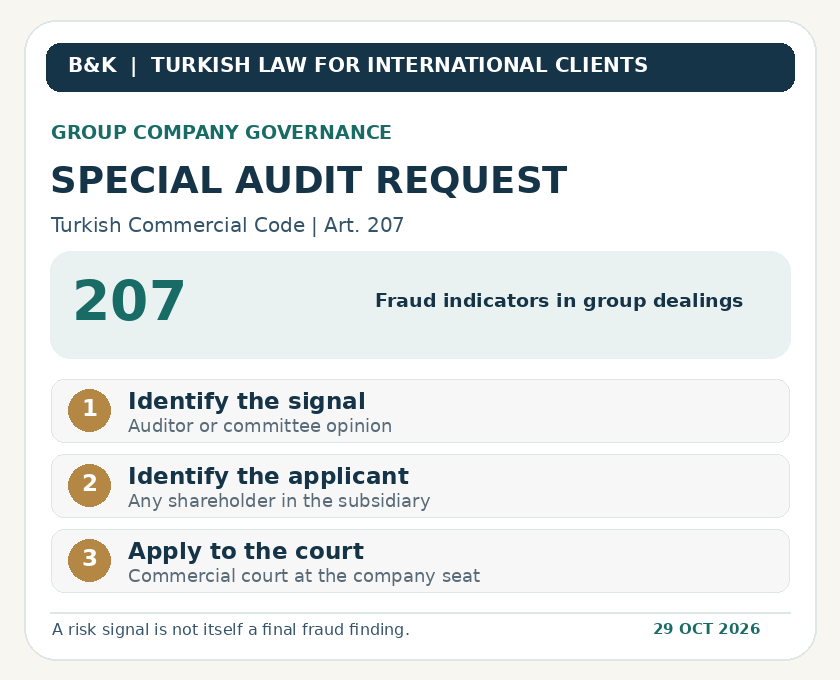
A Turkish subsidiary special audit can be requested through a specific statutory route when an auditor, special auditor or the early risk detection and management committee has expressed an opinion indicating fraud or circumvention in the subsidiary’s relations with its parent or another subsidiary. Article 207 of Turkish Commercial Code No. 6102 gives that application right to each shareholder of the subsidiary. The application goes to the commercial court of first instance at the subsidiary’s registered office.
Have a general question about this article? Ask anonymously
This guide is for overseas shareholders who already have a relevant audit or committee opinion and need the underlying group dealings clarified. It is not a general guide to every request for company information. The decisive starting point is the qualifying opinion described in Article 207, not simply dissatisfaction with the annual profit, a disagreement with management or an unsupported allegation against the parent company.
Short and clear answer
Article 207 provides a direct application to the commercial court at the subsidiary’s registered office when the specified professional or committee opinion indicates fraud or circumvention in the relevant group relations. The statute refers to every shareholder of the subsidiary. It does not set the ten-percent or five-percent capital thresholds associated with a different special-audit route under Article 439. The grounds and claimant should be identified under the correct provision before the petition is drafted.
The purpose is to clarify the matter identified by the opinion through appointment of a special auditor. An appointment application is not itself a damages judgment, a criminal conviction or an automatic cancellation of a group transaction. The petition should explain the qualifying opinion, the relationship it concerns and the questions requiring investigation. Separate substantive remedies require their own legal grounds and evidence.
| Issue | Article 207 position |
|---|---|
| Qualifying source | Auditor, special auditor, or early risk detection and management committee. |
| Relevant opinion | Indications of fraud or circumvention in the subsidiary’s dealings with the parent or another subsidiary. |
| Applicant | Each shareholder of the subsidiary. |
| Court | Commercial court of first instance at the subsidiary’s registered office. |
| Immediate objective | Appointment of a special auditor to clarify the identified matter. |
A qualified concern is different from an unexplained financial loss
Article 207 focuses on an opinion indicating fraud or circumvention in specified group relationships. A loss shown in the accounts is not, by itself, the same statutory fact. Nor is a general management warning that commercial conditions are difficult. The application must identify the relevant passage in the opinion and explain how it concerns the subsidiary’s dealings with the parent or another subsidiary. That connection is central to the chosen court route.
The opinion need not be presented as a final criminal adjudication. The provision is designed to permit clarification through special audit. Requiring the applicant to describe the professional concern accurately is different from assuming that the suspected conduct has already been conclusively proved. The petition should maintain that distinction: identify what the opinion actually says, what remains unresolved and why the requested investigation addresses the unresolved matter.
Identify the author and legal capacity of the opinion
The current text lists an auditor, a special auditor and the early risk detection and management committee. Establish the author’s capacity and the document’s provenance. Obtain the complete signed report or opinion, its date, relevant appointment or committee records and any annexes necessary to understand the conclusion. A document bearing the word audit on its cover is not automatically an opinion from one of the statutory sources.
An accountant’s informal email, a consultant’s valuation or a shareholder’s personal memorandum can contain useful information, but the Article 207 trigger must still be established. Do not change the author’s professional description in translation to make the document appear to satisfy the statute. Equally, do not discard a qualifying report because the crucial finding appears in an annex or a section dealing with related-party transactions rather than in its first paragraph. Read the document as a whole.
The inquiry concerns defined relationships, not the entire business world
The provision concerns the subsidiary’s relationship with its controlling company or another subsidiary. Article 195 supplies the group-company framework, including direct and indirect control and the relevant cross-border connection. The petition should identify the companies by their legal names and explain the control chain. A shared brand or a commercial partnership alone should not be substituted for the corporate relationship required by the chosen provision.
Where several entities have similar names, reconcile the audit report with the contracts, invoices and registry records. Identify which company provided services, received a payment, held an asset or issued an instruction. The report’s references to the group should be translated into a specific relationship that the court can investigate. This avoids an application aimed at an undefined collection of overseas businesses rather than the transactions actually identified by the statutory opinion.
Each subsidiary shareholder has the stated application right
Article 207 says that every shareholder of the subsidiary may request the special auditor. It does not express a minimum share percentage. The petition must nevertheless establish that the applicant is a shareholder of the relevant subsidiary. A person who owns shares only in the parent is not automatically a direct shareholder of every subsidiary, and the parent-level information right in Article 200 is a different statutory mechanism.
For a foreign corporate shareholder, identify the investing entity rather than only its ultimate owner or representative. Prepare the records proving its participation and the authority of the person instructing counsel. The shareholder’s nationality does not replace the standing analysis. Any cross-border procedural requirements should be addressed separately from the substantive right stated in Article 207; they are not a reason to invent a minimum capital threshold absent from the provision.
The subsidiary’s registered office determines the named court
Article 207 expressly names the commercial court of first instance at the place where the company has its registered office. In this context, the company is the subsidiary whose group relations require clarification. The foreign parent’s headquarters and the shareholder’s residence abroad are not the court location specified by this article. Verify the subsidiary’s current registry information before identifying the court in the application.
The petition should make the requested order intelligible: appointment of a special auditor to clarify the identified group matter. Identify the applicant, subsidiary, relevant other group entities, qualifying report and proposed investigation questions. Separate the statutory appointment request from any additional relief. An application that combines several remedies without identifying their distinct legal bases makes jurisdiction, procedure and the intended outcome harder to assess accurately.
Turn the concern into focused audit questions
A request to inspect everything in the group is not a useful substitute for a defined investigation. Start with the transaction or course of dealing identified in the qualifying opinion. Identify the period, entities, contractual arrangements, payments or asset movements and the discrepancy requiring explanation. The proposed questions should be answerable from records and should remain connected to the concern that brings the application within Article 207.
For drafting purposes, distinguish factual questions from the ultimate legal conclusion. The special auditor can be asked to clarify which transactions occurred, which obligations and consideration were recorded, which decisions authorised them and how the reported inconsistency arose. A direction merely asking the expert to declare the parent guilty is not a properly framed factual inquiry. The court’s legal assessment and the expert’s examination of records have different functions.
A coherent evidence pack is more valuable than an indiscriminate upload
Organise the qualifying opinion first, with its annexes and a clear reference to the relevant passages. Add shareholder-status records, the subsidiary’s registry extract, the control chart and the documents already available for the identified dealings. A chronology should connect the report date to the underlying transaction dates. Keep the original language version beside any translation so that the professional finding can be checked without relying on an abbreviated summary.
Separate documents already held from documents believed to be held by the subsidiary or another group entity. For missing material, identify the document and its expected relevance instead of pretending it has been reviewed. Preserve original electronic files and the accompanying correspondence. The application should not contain fabricated accounting figures or reconstructed statements presented as contemporaneous records. An accurate account of what is known and what needs clarification is consistent with the investigation’s purpose.
Use the affiliation report without confusing its function
The subsidiary’s Article 199 affiliation report can be important background because it addresses group transactions, measures and their effects on the subsidiary. Compare its account with the qualifying opinion and the transaction records. A discrepancy can help define the factual issue requiring clarification. However, the affiliation report is not automatically one of the professional opinions listed in Article 207 merely because it discusses related-party transactions.
Our Article 199 affiliation-report guide explains that separate reporting obligation. Keep the board’s account, the auditor’s finding and the shareholder’s application distinct. The court should be able to see who made each statement and in what capacity. Combining them into a single narrative without attribution obscures the very inconsistency the proposed audit is meant to clarify.
Do not import the wrong special-audit thresholds
Articles 438 and 439 govern a different special-audit process. Article 438 addresses a shareholder’s request at the general meeting in the circumstances it specifies. Article 439 addresses the court route after rejection and contains its own capital thresholds and time requirement. Article 207 instead supplies the particular trigger based on a qualifying opinion about fraud or circumvention in group relations and states an application right for each subsidiary shareholder.
The petition should therefore explain why Article 207 applies instead of copying a template prepared solely for an Article 439 minority application. The firm’s general special-audit guide covers the broader framework. It should be read alongside, not in place of, the specific group-company provision. Where more than one route is considered, test each route’s conditions independently rather than combining selected advantages from different provisions.
Appointment does not decide damages, criminal guilt or invalidity
The immediate statutory purpose is clarification through a special auditor. The appointment order is not itself a judgment awarding the shareholder the subsidiary’s losses. It does not automatically invalidate a contract, remove a director or establish a criminal offence. Those outcomes require separate legal grounds, the appropriate parties and the relevant procedural steps. The audit can contribute evidence without determining every later dispute in advance.
Group-company compensation rules, including Article 202 and the full-control provisions, address different questions. A shareholder considering those remedies should identify whose loss is claimed and to whom any compensation would be payable. The director-responsibility guide discusses another related area. None of these additional avenues turns Article 207 into a universal shortcut to a predetermined liability finding.
Timing, expense and confidentiality need their own assessment
Article 207 does not itself state the Article 439 three-month period. That does not justify telling a shareholder that every related claim can be left indefinitely. Identify the dates of the opinion, disputed dealings and any corporate resolutions, together with any other remedy being pursued. A deadline belonging to another application should neither be imported without a legal basis nor overlooked because the immediate petition concerns a special auditor.
The article also does not prescribe a fixed all-inclusive fee or promise a cost-free proceeding. Court expenses, the work requested and the expert process must be budgeted under the applicable procedural framework. Corporate confidentiality should be addressed through a properly defined scope and lawful court procedure. The request is not a licence for the applicant to obtain unrelated confidential material from every group entity outside the judicial process.
Preparing the application from abroad
An overseas shareholder should begin with the complete opinion, proof of its shareholding, the subsidiary’s registry details and a short chronology. Corporate authority documents and the power of attorney should be prepared for the actual applicant. Translations must preserve the distinction between an auditor’s finding, management’s explanation and the shareholder’s allegation. A translated extract that removes qualifications from the original opinion can misstate the basis of the application.
Bakırcı & Keskin Hukuk Bürosu assists with Turkish corporate disputes and nationwide file management for clients abroad. The first enquiry should identify the subsidiary, the source and date of the opinion and the group dealings in question. Use the contact page to arrange a document review, and agree a secure transfer method before sending confidential audit and company records.
Frequently asked questions
What triggers the Article 207 application?
A qualifying auditor, special auditor or early risk detection and management committee must have expressed an opinion indicating fraud or circumvention in the specified subsidiary-group relations.
Does a financial loss alone satisfy the provision?
No. The particular opinion and its connection with the subsidiary’s dealings with the parent or another subsidiary must be established. An unexplained loss is not the same statutory trigger.
Must the applicant own ten percent of the subsidiary?
Article 207 grants the right to each subsidiary shareholder and does not state that threshold. The applicant must prove its shareholder status and the provision’s other conditions.
Which court does Article 207 name?
The commercial court of first instance at the subsidiary’s registered office. The foreign parent’s headquarters is not the location specified by this provision.
Is an informal consultant’s email automatically enough?
No. The author’s statutory capacity and the content of the opinion must be established. Other documents can support the file without necessarily satisfying the trigger themselves.
Is a criminal conviction required before applying?
The provision is framed around a qualifying opinion and an application to clarify the matter. It does not state a prior criminal-conviction requirement.
Does appointment automatically award compensation?
No. Appointment serves the investigation’s clarifying purpose. Compensation and other substantive remedies require their own grounds and procedures.
Does Article 207 itself impose Article 439’s three-month period?
Article 207 does not state that period. Dates and deadlines for any separate claims or applications must nevertheless be reviewed on their own legal bases.
Can a parent-company shareholder automatically apply as a subsidiary shareholder?
No. The applicant’s participation in the subsidiary must be established. Ownership of the parent and ownership of the subsidiary are different legal positions.
What documents should be prepared first?
The complete qualifying opinion and annexes, proof of shareholding, registry and control records, a transaction chronology and the relevant documents already available.
Professional information
Av. Halil Bakırcı · Mersin Bar Association registration 3472 · Bakırcı & Keskin Hukuk Bürosu. A statutory appointment application requires review of the actual opinion and corporate records; this article does not prejudge the reported conduct.
Istanbul Office – Polaris Plaza, Maslak / Sarıyer
Bakırcı & Keskin Hukuk Bürosu
Maslak Ahi Evran Caddesi, Polaris Plaza No:21, Kat:9, 34475 Sarıyer/İstanbul
Our physical offices in Istanbul and Mersin coordinate matters throughout Turkey, subject to jurisdiction and the local steps required for each case. Please specify your preferred office when arranging an in-person appointment.
Open the Istanbul office on Google Maps · Contact and appointments
Contact regarding a legal matter
In your first message, you may briefly state the subject, your country or city, and any relevant notification or recent procedural date. Please do not send identity numbers, medical data, or personal documents. Messaging alone does not constitute legal advice or create a lawyer–client relationship.
Discover more from Bakırcı & Keskin Hukuk Bürosu
Subscribe to get the latest posts sent to your email.
