A Foreign Parent Orders a Turkish Subsidiary to Take a Loss: TCC 203–206 and Creditor Claims
A foreign parent cannot treat a wholly owned Turkish subsidiary as an unrestricted source of assets or credit. Articles 203–206 of the Turkish Commercial Code establish a particular regime for complete control: defined group-management instructions are permitted, certain dangerous instructions are forbidden, and harmed creditors have a statutory damages route where instruction-related losses are not properly compensated. The rules do not make every parent a guarantor of every subsidiary debt.
Have a general question about this article? Ask anonymously
This guide addresses directors, overseas group treasury teams and creditors dealing with a Turkish capital company. Its subject is the legal effect of parent instructions to a Turkish subsidiary under complete control, rather than an ordinary unpaid-invoice action or a general account of directors’ duties. The analysis starts with ownership and voting rights, follows the instruction and resulting loss, and ends with compensation, available defences and the correct litigation route.
Short and clear answer
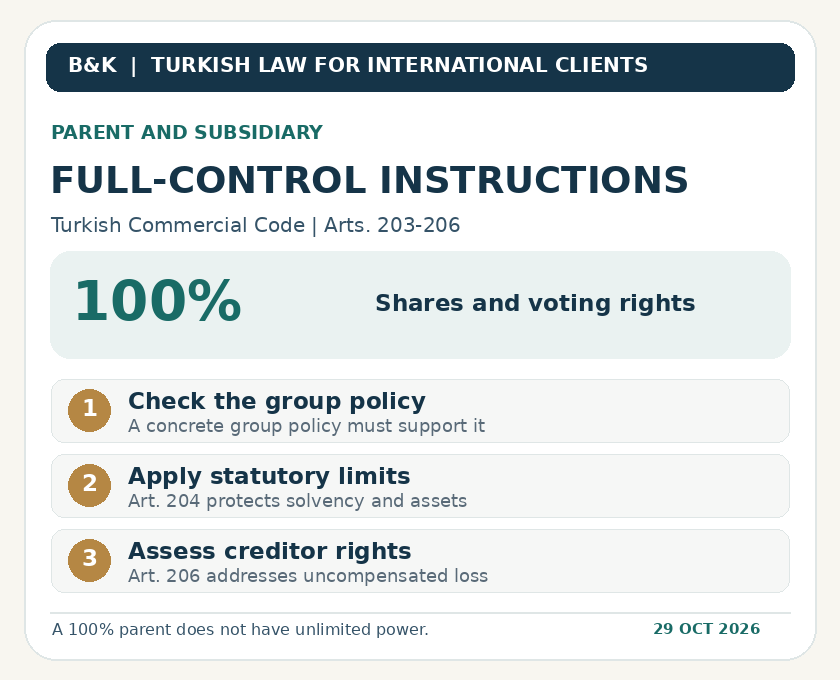
TCC Article 203 applies where a commercial company directly or indirectly owns 100 percent of both the shares and voting rights in a capital company. Its board can issue management and direction instructions required by determined, concrete group policies, even where the instruction could cause loss. Article 204 nevertheless prohibits instructions that clearly exceed the subsidiary’s payment capacity, endanger its existence or cause it to lose important assets.
Article 205 protects the subsidiary’s responsible persons against liability to the company and shareholders for compliance within Articles 203 and 204. Article 206 separately protects harmed creditors where the resulting loss is not compensated during the financial year or an equivalent claim with its time and method specified is not granted. The responsible parent and parent-board members can be defendants. Those propositions must be kept separate; none amounts to unlimited permission, unlimited immunity or automatic group-wide debt liability.
| Question | Rule |
|---|---|
| Ownership threshold | 100% of shares and voting rights: TCC 203 |
| Forbidden instructions | Payment-capacity, existence and important-asset limits: TCC 204 |
| Subsidiary officers’ protection | Limited to the statutory scope and claims by company/shareholders: TCC 205 |
| Creditor remedy | Instruction-related uncompensated loss: TCC 206 |
| Specific defences | TCC 202(1)(d) and 206(2) |
| Foreign-parent venue | TCC 202(1)(e), applied through 206 |
Complete control requires shares and voting rights
Article 203 does not use a ninety-percent or ninety-nine-percent threshold. It requires complete ownership of both shares and votes, whether direct or indirect. A group chart showing the parent as sole controller is therefore not conclusive without the supporting ownership and voting records. Identify the relevant company, the full chain of intermediate holdings and the position when the instruction was given. A later acquisition of the remaining shares should not silently be projected backwards.
The distinction matters when an investor has broad managerial influence but another person retains a shareholding or voting entitlement. Such a structure may still involve control under the broader group-company provisions, but it does not automatically meet Article 203. The special complete-control regime must not be used as a convenient label for any influential parent. Keep the relevant register extracts, share records, articles and voting arrangements with the decision file.
A statutory instruction is more than an informal headquarters preference
The provision identifies the controlling company’s board and connects the instruction to determined and concrete group policies. A file should therefore establish who issued the instruction, in which corporate capacity and under which policy. The expression headquarters requested it leaves essential questions unanswered. The record should also distinguish a parent instruction from an independent subsidiary decision that happens to align with the group’s commercial interests.
For a treasury or asset transaction, retain the instruction itself, the policy relied upon, the relevant board materials and the subsidiary’s proposed implementation. State the contemplated obligations and their financial consequences in the decision record. This is a practical method of preserving evidence, not an extra statutory form invented by this guide. An undocumented commercial discussion is not automatically outside the law, but its purpose, authority and terms still require proof when disputed.
The three Article 204 boundaries
Article 204 prohibits an instruction that clearly exceeds the subsidiary’s payment capacity, threatens its existence or is capable of causing the loss of important assets. These are alternative statutory concerns; the wording does not require all three to occur together. A subsidiary’s separate financial position therefore remains legally significant even in a group with a strong consolidated balance sheet. The parent’s total assets do not themselves establish the subsidiary’s ability to meet the proposed obligation.
The review should connect current cash requirements, liabilities, contractual commitments and assets to the particular instruction. A proposed transfer of an essential operating asset requires a different analysis from an ordinary allocation of administrative work. A statement that the group as a whole benefits does not answer the subsidiary-level limits. Where a prohibited consequence is identified, Article 203’s instruction power cannot be invoked without addressing Article 204.
Financial projections should identify their assumptions and the information available when the decision was made. An optimistic forecast does not become a legal exemption merely because it was approved internally. Conversely, a later commercial setback does not by itself prove that every earlier instruction violated Article 204. The evidence must address the actual instruction, the relevant financial circumstances and the statutory boundary said to have been crossed.
Article 205 is a limited protection, not general immunity
Article 205 concerns subsidiary board members, managers and other potentially responsible persons who comply with instructions falling within Articles 203 and 204. Its stated protection is against liability to the company and shareholders for that compliance. The scope of both the instruction and the claimant matters. It is inaccurate to transform this wording into immunity from every creditor claim, criminal rule, public-debt obligation or independent breach of duty.
A director reviewing an instruction should therefore record why the complete-control conditions and Article 204 limits are satisfied, rather than rely only on the parent having selected the board. The protection also should not be extended automatically to an act materially different from the instruction actually issued. If implementation adds a separate undertaking or exposes additional assets, that difference belongs in the legal and financial assessment.
Compensation during the financial year and equivalent claims
Article 206 addresses loss in the subsidiary resulting from instructions within Article 203. It requires attention to whether that loss was compensated in the relevant financial year or whether an equivalent claim was granted, specifying the time and manner of performance. A vague promise that the parent will support the subsidiary when convenient does not describe the same legal position as an identifiable compensation claim with defined performance arrangements.
The compensation file should connect the original loss with the payment, transfer or claim relied upon to address it. State the amount or valuation basis, the liable undertaking, the date the right arose and the agreed performance mechanism. Do not count the same payment twice or assume that an unrelated capital contribution automatically settles every group-law loss. The legal significance of the compensatory step depends on what it actually accomplishes.
The annual affiliation report under Article 199 is a related reporting document, not an extension of the compensation timetable. Preparing that report during the following year’s first three months does not turn its preparation date into the deadline under Article 206. A coherent file distinguishes the instruction date, the loss period, the grant of any equivalent claim and the later reporting date. Those dates answer different statutory questions. See the English guide to the affiliation report.
What a harmed creditor must distinguish from simple non-payment
Article 206 creates a damages route for harmed creditors against the controlling company and the parent-board members responsible for the loss when its conditions are met. The claim is not established solely by attaching an unpaid invoice and a corporate group chart. The creditor must identify the relevant instruction-related loss, the absent or inadequate compensation and the connection with the harm alleged. Separate corporate personality is not erased simply because an invoice remains unpaid.
Start with the underlying creditor relationship, but then build the group-law chronology. Identify what the subsidiary was required to do, what changed in its assets or obligations, how that change affected the creditor and what compensatory right or performance was provided. The invoice balance and the statutory damages claim should not automatically be treated as identical amounts. The relief sought must follow the legal basis and the evidence, including the provisions incorporated by Article 206.
The independent-company defence and the creditor-knowledge defence
Article 206(1) allows defendants to rely on Article 202(1)(d). That provision concerns proof that an autonomous company’s prudent manager, acting in good faith to protect company interests, would have undertaken or omitted the same or a similar transaction in the same circumstances. It is not enough merely to restate that the group wanted the transaction. The comparison requires the subsidiary’s circumstances and an independent-company perspective.
Article 206(2) adds a specific defence for claims arising from credit and similar relationships. Defendants can avoid liability by proving that the creditor entered the relevant relationship knowing that compensation had not occurred or an equivalent claim had not been granted, or that the nature of the transaction required that knowledge. This is not an automatic rule that every bank knew all internal group arrangements. The information available to the creditor and the timing of the relationship are central.
Credit approval records, disclosures, due-diligence requests, correspondence and the final facility documents can therefore matter on both sides. Preserve what was actually communicated before the creditor assumed the relevant exposure. A document supplied only after the relationship began should not be silently treated as evidence of earlier knowledge. Nor should the distinction between awareness of a group relationship and awareness of the specific missing compensation be lost.
Identify the responsible parent and board members accurately
The statutory defendants are the controlling company and its board members responsible for the loss. It does not say that every employee of the international group, every subsidiary director or every company using the same brand is automatically liable. Corporate names, registration details, appointment periods and the connection between each person’s conduct and the alleged loss must be checked before a claim is addressed or filed.
Article 206 refers to Article 202(1)(e), which brings specified liability provisions into the analysis by analogy, including Articles 553, 555–557, 560 and 561. Those cross-references affect the proper presentation of the claim and cannot be replaced with a general demand against the group. Where several defendants are involved, the file should explain each proposed defendant’s role instead of assuming identical responsibility from a shared job title.
Court, mediation and limitation questions
For a controlling undertaking whose registered office is abroad, Article 202(1)(e), applied through Article 206, identifies the commercial court of first instance at the Turkish subsidiary’s registered office for the damages action. That jurisdictional rule does not eliminate the need for correct party identification, international service and proper procedural documents. The foreign parent’s location should be addressed expressly rather than treated as a reason that no Turkish remedy exists.
Commercial claims seeking a monetary amount in compensation fall within TCC Article 5/A’s pre-action mediation framework, subject to any applicable statutory exception. The filing strategy should therefore check the mediation requirement before proceedings begin. The current wording also covers other listed monetary commercial actions; a party should not assume that renaming a compensation dispute automatically avoids the procedural condition.
Article 560, incorporated through the statutory cross-reference, provides a two-year period from learning the damage and responsible person and a five-year period from the harmful act, with its longer criminal-limitation qualification where applicable. These are not universal periods running from the unpaid invoice’s due date. Record the relevant knowledge and act dates, assess any applicable interruption or suspension separately and avoid promising that a claim is timely without that chronology.
A focused evidence package and corporate response
A useful review package contains the ownership and voting chain, the parent instruction, the group policy, the subsidiary’s financial position, the implementation documents and the compensation record. Add the creditor contract, payment history and evidence of the alleged harm. The parent and subsidiary should preserve versions contemporaneous with the decision rather than relying exclusively on a later narrative prepared after the dispute began.
For cross-border teams, organise translations around the documents that prove authority, timing and financial effect. Preserve original dates, signatures, attachments and entity names. An English summary can help coordinate the review, but it should distinguish established facts from disputed allegations and unresolved valuation questions. The practical objective is a legally coherent record showing which statutory conditions are met or contested, not a generic declaration that all group instructions are lawful.
Related issues remain separate: foreign board members’ duties and the financial-assistance prohibition in share acquisitions require their own analysis. Group instructions do not automatically disapply other mandatory company-law provisions.
Frequently asked questions
Does Article 203 apply to a ninety-nine-percent subsidiary?
Its special complete-control regime requires 100 percent of both shares and voting rights, directly or indirectly. Other control relationships require separate analysis under the broader group-company rules.
Can a parent issue an instruction that causes a loss?
Article 203 permits specified instructions required by determined and concrete group policies, but Article 204’s limits and the compensation framework remain applicable.
Which instructions are forbidden by Article 204?
Instructions that clearly exceed the subsidiary’s payment capacity, endanger its existence or can cause loss of important assets are prohibited. All three consequences need not coexist.
Are subsidiary directors immune from every claim?
No. Article 205 states a specific protection against company and shareholder liability for compliance within Articles 203 and 204. It is not universal immunity.
Does the parent automatically guarantee the subsidiary’s invoices?
No. Article 206 requires its instruction-related loss, compensation and creditor-harm conditions. An unpaid invoice and a group relationship alone do not establish the statutory claim.
Is an informal promise of future support enough?
The statute addresses compensation or an equivalent claim with time and manner specified. A general promise must not be treated as proof that those requirements are satisfied.
Can a lender’s knowledge defeat a claim?
Article 206(2) provides a defence for credit and similar claims where the specified knowledge or required knowledge of missing compensation or an equivalent claim is proved.
Where is a claim against a foreign parent brought?
Article 202(1)(e), incorporated through Article 206, identifies the commercial court of first instance where the Turkish subsidiary has its registered office when the controlling undertaking is based abroad.
Does the affiliation-report deadline extend compensation time?
No. The Article 199 reporting calendar and the financial-year compensation framework are distinct. Record each relevant date separately.
What evidence should be preserved first?
Preserve the ownership chain, actual instruction and policy, contemporaneous financial information, implementation and compensation documents, and the creditor’s contract and disclosures.
Nationwide file management and a document review
Av. Halil Bakırcı · Mersin Bar Association registration 3472 · Bakırcı & Keskin Hukuk Bürosu. Corporate matters connected with Turkey can be reviewed with overseas clients through agreed document-transfer and consultation arrangements.
Discuss a Turkish subsidiary or creditor matter
Istanbul and Mersin meetings are by appointment. This article is general information, not a conclusion about an unreviewed instruction or claim.
Istanbul Office – Polaris Plaza, Maslak / Sarıyer
Bakırcı & Keskin Hukuk Bürosu
Maslak Ahi Evran Caddesi, Polaris Plaza No:21, Kat:9, 34475 Sarıyer/İstanbul
Our physical offices in Istanbul and Mersin coordinate matters throughout Turkey, subject to jurisdiction and the local steps required for each case. Please specify your preferred office when arranging an in-person appointment.
Open the Istanbul office on Google Maps · Contact and appointments
Contact regarding a legal matter
In your first message, you may briefly state the subject, your country or city, and any relevant notification or recent procedural date. Please do not send identity numbers, medical data, or personal documents. Messaging alone does not constitute legal advice or create a lawyer–client relationship.
Discover more from Bakırcı & Keskin Hukuk Bürosu
Subscribe to get the latest posts sent to your email.