Your Turkish Property Is Smaller Than Promised: Area Shortfall and Article 244
A smaller apartment or parcel does not produce a reliable compensation calculation until the competing area figures have been defined. Turkish Code of Obligations Article 244 contains a specific rule for a shortfall from the area stated in a property sale contract and a separate rule concerning an area entered in the register following official measurement. Articles 219 and 227 address defective sale remedies, while consumer housing purchases may engage Law No. 6502. Net internal area, gross marketed area, parcel area and land share are not interchangeable measurements.
Have a general question about this article? Ask anonymously
This guide explains how an overseas buyer can investigate an area discrepancy, preserve the relevant promises and frame a remedy using the correct measurement and legal basis. It does not assume that the number on a title document describes the usable floor area of the apartment.
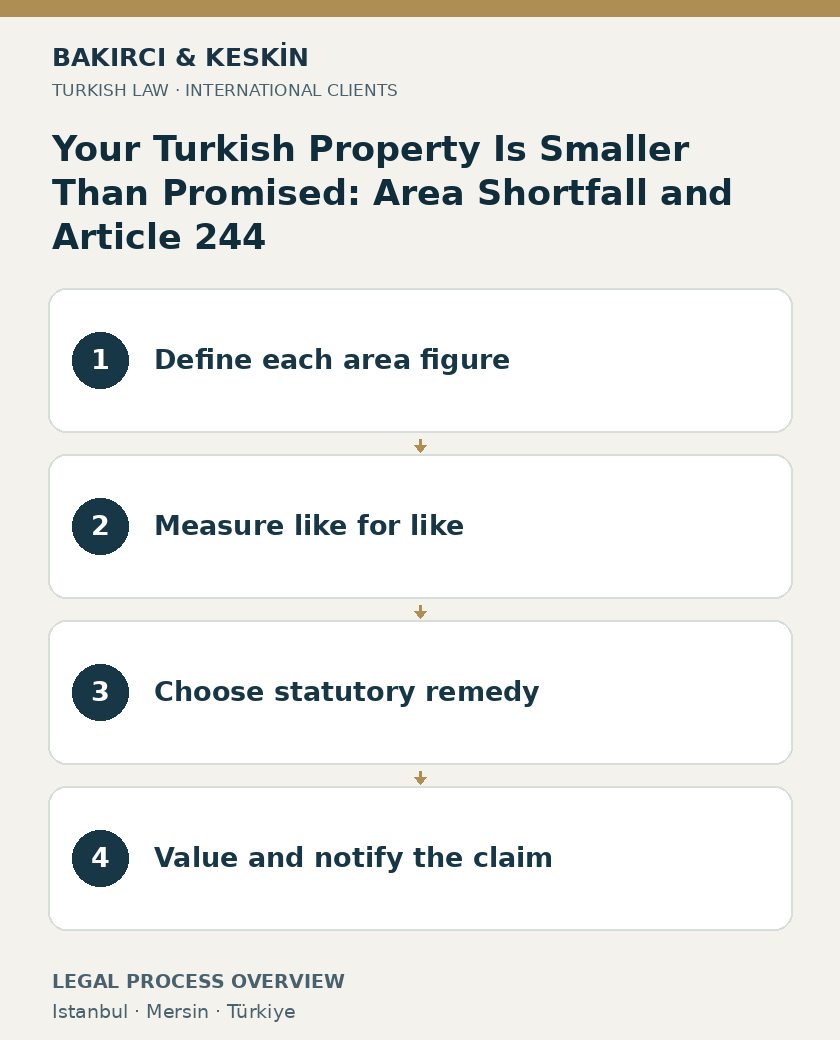
Quick summary
| Legal issue | Your Turkish Property Is Smaller Than Promised: Area Shortfall and Article 244 |
|---|---|
| Short answer | A smaller apartment or parcel does not produce a reliable compensation calculation until the competing area figures have been defined. Turkish Code of Obligations Article 244 contains a specific rule for a shortfall from the area stated in a property sale contract and a separate rule concerning an area entered in the register following official measurement. Articles 219 and 227 address defective sale remedies, while consumer housing purchases may engage Law No. 6502. Net internal area, gross marketed area, parcel area and land share are not interchangeable measurements. |
| Key legislation | Law No. 6098 — Articles 219, 223, 227, 244; Law No. 6502 — Articles 3, 8-12 |
Identify what every square-metre figure describes
List each number and its source before calculating a difference. A title document can identify the parcel’s area and the apartment’s share in the land; a brochure can state gross or net apartment area; an approved plan can describe a measured independent unit. A land share is a fractional ownership relationship, not a promise that the apartment contains that fraction of the parcel as usable rooms.
Record the terminology in the original language and the definition attached to it. Determine whether balconies, terraces, external walls, shafts, common circulation or other spaces were included. If the sales contract uses a term without defining it, preserve the accompanying plans and explanations rather than silently choosing the measurement favourable to either party.
Do not subtract an interior measurement from a parcel figure and label the result a contractual shortfall. The first technical question is whether the figures describe the same subject under the same method. The legal claim becomes clearer when unlike measurements have been removed from the comparison.
Read the actual undertaking rather than an isolated advertisement
Obtain the signed contract, technical schedules, plans, pre-contract information and relevant advertising. Identify the apartment precisely, including any later renumbering. A drawing of a larger unit elsewhere in the development does not establish a promise about the purchased apartment unless the contract or communication connects it to that unit.
Preserve any express statement guaranteeing a particular area or measurement. Note qualifications, exclusions and explanations communicated before contracting. A general disclaimer requires legal evaluation; it should not be assumed either to erase every promise or to be irrelevant. The particular contractual and consumer rules govern its effect.
Article 219 addresses the seller’s responsibility for stated qualities and material, legal or economic defects that affect the relevant value or expected benefit. An area representation can therefore require analysis beyond the arithmetic alone. The evidence should show what was said, by whom and how it relates to the transaction.
Apply the two area rules in Article 244 separately
Article 244 first provides, unless otherwise agreed, that a seller must compensate the buyer for a shortfall where the property does not comprise the area stated in the sale contract. Its next paragraph addresses a shortfall from an area entered in the land register on the basis of official measurement: the seller is not responsible for compensation unless it has specifically undertaken that responsibility.
These are distinct statutory statements. The second should not be omitted from an explanation that promises compensation for every register discrepancy. Equally, the first should not be ignored when the seller has undertaken a particular contractual area. Obtain the official measurement basis and the contract before deciding which rule controls the claim.
The article does not eliminate the need to classify an apartment’s marketed area correctly. Determine whether the dispute concerns land area, the construction itself, a promised attribute or another defect. A legal opinion should explain why the chosen provision applies to the particular figure rather than attaching Article 244 to every disagreement involving square metres.
Commission a measurement that answers the contractual question
An independent technical report should identify the property, method, inspected spaces and documents used. Ask the expert to compare like with like and explain exclusions. A bare conclusion that the apartment is a certain size provides less assistance than a plan showing the measured rooms and the treatment of walls, balconies and common areas.
Record whether later alterations changed the physical layout. Compare the delivered condition with the approved plan and contractual specification. A buyer’s subsequent enclosure of a balcony or removal of a partition should be disclosed rather than allowed to distort the original delivery assessment.
Keep photographs and measurement notes in their original form. If the parties disagree about access, preserve the request and response. The report should distinguish direct observation from a calculation based on supplied drawings. This allows another expert and the court to evaluate the result rather than having to repeat an unexplained exercise.
Distinguish a smaller area from other defective performance
A measured shortfall can coexist with missing rooms, an altered layout, unauthorised construction or an incorrect independent-unit transfer. Identify each issue separately. A buyer who received a different apartment needs to establish unit identity as well as area. A planning violation cannot be resolved merely by paying for the missing square metres.
Article 227 lists the general sale remedies for defects, subject to the statutory conditions: withdrawal with readiness to return the property, proportionate price reduction, qualifying repair or replacement. It preserves damages under the general rules. The appropriate remedy depends on the nature and significance of the problem; enlarging a completed apartment may not be a realistic repair.
The condominium and construction-servitude guide addresses a separate title-status issue. Keep that question distinct from whether the seller delivered the physical and contractual qualities it promised.
Check whether consumer legislation supplies the remedy
Law No. 6502 Articles 8 and 9 address conformity with agreed and advertised characteristics and the seller’s obligation to supply goods in accordance with the contract. The statutory definition includes residential and holiday immovable property. First confirm that the seller and buyer meet the consumer-transaction criteria.
Article 11 provides the consumer’s choices and the conditions governing them. A request should identify the right chosen and the defect supporting it. The fact that the buyer lives abroad does not require the buyer to accept the seller’s preferred voucher or future purchase credit as the only response.
Consumer law and the Code of Obligations must be applied through the proper legal relationship. Do not combine the most favourable phrase from each statute without examining scope and interaction. The legal assessment should explain the governing route, relevant evidence and any additional damages claimed.
Preserve inspection, discovery and notification evidence
Article 223 of the Code of Obligations regulates inspection and notification in the general sale framework. It distinguishes defects discoverable in ordinary inspection from those discovered later. Whether that provision governs the particular purchase requires the transaction’s classification, including the applicable consumer regime.
Make a dated record of when the discrepancy was discovered and how it was measured. Preserve the handover document and any reservation entered at delivery. A signed statement of acceptance should be read in context, but it should not be omitted from the file because it appears inconvenient.
Notify the seller through a suitable, provable channel after legal review. Identify the contract, unit and discrepancy without overstating an unverified survey. If a technical report will follow, preserve the initial complaint and subsequent report separately. Informal conversations may establish part of the history but should not be assumed to satisfy every legal requirement.
Calculate the monetary remedy using the right valuation question
A shortfall percentage is a starting measurement, not necessarily the final legal award. Identify whether the claim seeks statutory shortfall compensation, a proportionate price reduction or damages for a particular loss. The relevant valuation method and reference date must match the remedy.
Do not assume that multiplying missing area by the average purchase price per square metre resolves every claim. A missing enclosed room, a smaller terrace and a discrepancy in land area can affect value differently. An expert should explain the comparison and any market evidence used, with the legal method determined in the case.
Keep consequential expenses separate. Survey fees, financing effects or another alleged loss require their own basis and supporting records. Avoid claiming the same diminution twice under a price-reduction heading and a damages heading. A transparent schedule should distinguish principal relief, additional loss, interest and costs.
Check limitation rules for the claim actually being brought
Article 244 provides a five-year limitation for claims arising from defects in a building, running from transfer of ownership, and twenty years where the seller is grossly at fault. Do not present those periods as universal for every dispute about a plot’s recorded area. Identify the cause of action and its statutory commencement event.
Law No. 6502 Article 12 separately provides a five-year period from delivery for residential or holiday immovable property within its scope, with specific rules for second-hand sales and defects concealed through gross fault or fraud. Transfer of ownership and physical delivery can occur on different dates, so the legal classification affects the calculation.
Prepare both dates and the discovery chronology for review. Neither the buyer’s return from overseas nor the date of an informal valuation automatically resets the statutory period. Supply previous correspondence and proceedings so the lawyer can assess any legally relevant interruption or other effect rather than relying on an assumed fresh start.
Distinguish compensation from correction of the register
An error in the registry or cadastral record requires examination of the appropriate correction route. Paying compensation does not itself correct the registered property description. Conversely, correcting a record does not necessarily resolve every contractual loss. State which outcome is required.
If the wrong independent unit was transferred, obtain the official transaction documents and approved unit plan. The dispute concerns identification of the acquired asset, not merely a smaller usable area. The title-transfer guide explains why the asset’s legal identifiers should be checked before completion.
Where the property is mortgaged or shared, assess how a proposed correction or agreement affects other registered rights. A private arrangement between buyer and seller should not be treated as binding persons whose rights require separate involvement.
Review what a settlement actually closes
A settlement should identify the accepted measurement, legal issue and agreed remedy. If the seller pays a price reduction, state the amount, currency and payment date. Clarify whether the agreement resolves only the area claim or also unrelated construction defects. A broad release can exceed the dispute the buyer intended to settle.
If physical works are proposed, identify the lawful and technically feasible work, required approvals and completion evidence. Do not accept an unlawful enclosure as an uncomplicated cure for a contractual shortfall. Any work affecting common property or the approved project requires separate review.
Keep the payment record and final technical documents with the settlement. A promise to address the issue at a later resale is different from present compensation. The buyer should be able to tell exactly what has been received and what remains outstanding.
Prepare an overseas buyer’s measurement file
Send the contract, title record, approved and marketed plans, advertisements actually relied on, handover record and independent measurement. Include a table naming each competing area figure and its source. This is more useful than a message stating only that the apartment “feels smaller”.
Explain access arrangements for further inspection and identify any planned repairs. Preserve the condition before alterations erase relevant evidence; the evidence-preservation guide addresses that practical risk. A representative can help collect documents, but settlement and property-related acts require the appropriate mandate.
The resulting assessment should answer three distinct questions: what area was legally promised, what was actually delivered under a comparable method, and which remedy follows under the applicable rule. Keeping those questions separate prevents an inaccurate figure from becoming the foundation of the entire dispute.
Ask the surveyor to answer defined questions
The instruction to the surveyor should reproduce the contractual area description and identify each plan to be compared. Ask which spaces were included in the advertised figure, which are included in the measured figure and whether the two use compatible definitions. A report should not quietly change its method halfway through the comparison. If a definition cannot be established from the documents, record that uncertainty expressly for legal assessment.
Request a clear distinction between a physical measurement and an interpretation of a sales promise. The surveyor can describe dimensions and technical terminology, while the legal review determines which promise governs and what remedy follows. Keeping those functions distinct avoids a technical report asserting that the buyer automatically wins a particular legal claim merely because one measurement differs.
Ask whether the shortfall concerns the whole independent unit or only a particular component. The effect of a reduced room, excluded balcony or smaller land parcel may require different analysis. Preserve the plan marking the affected area. If the buyer’s own later works changed the dimensions, the report should identify that change and explain how the delivered condition is reconstructed.
Where official measurement is relevant under Article 244, obtain the actual official record and explain its relationship with the register. The phrase official area in a brochure does not establish that the number derives from an official measurement. Conversely, a register extract should not be treated as a survey of the apartment’s usable interior without checking what it records.
Before relying on the report in a claim, compare names, property identifiers, dates and units. Correct an obvious transcription error through a transparent revised report, retaining the earlier version. Do not alter an expert’s signed conclusion informally. A coherent technical file lets the seller, court and opposing expert test the claimed discrepancy rather than arguing over avoidable differences in terminology.
If the seller provides a different measurement report, compare the assumptions before alleging that either surveyor is dishonest. Identify the same property, measurement date, included spaces and method. A genuine methodological difference can explain part of the discrepancy while leaving a contractual question unresolved. Ask for clarification in writing and retain both reports. The legal claim should use the comparison supported by the evidence rather than selecting the larger or smaller figure solely because it favours the desired result.
Frequently asked questions
Does the title deed always state usable apartment area?
No. Identify whether the figure concerns the parcel, land share or independent unit and compare it with the contractual definition.
Can I compare gross advertised area with net interior area directly?
Not reliably. Establish the definition and measurement method for each figure first.
What does Article 244 say about the contract’s area?
Unless otherwise agreed, it provides compensation for a shortfall from the area stated in the sale contract.
Is the rule identical for official registry measurements?
No. Article 244 contains a separate rule requiring a particular undertaking by the seller in the circumstances stated there.
Can a consumer claim a price reduction?
Article 11 of Law No. 6502 includes that remedy where its conditions apply.
Is compensation always missing square metres times average price?
No. The valuation must correspond to the legal remedy and the actual difference in the property.
When does the consumer property limitation run?
Article 12 uses delivery for the residential or holiday property rule. Other legal bases can use different events.
Does a correction of the register settle my damages claim?
Not automatically. Registry accuracy and contractual loss are separate questions.
Should I accept construction works that increase the area?
Review their legality, technical feasibility and effect on common property before treating them as a remedy.
What is the most useful first document?
A comparison table linking each area figure to its contract, plan, register or independent measurement source, supported by those records.
Official legal sources
Code of Obligations No. 6098, Articles 219, 223, 227 and 244; Consumer Protection Law No. 6502, Articles 3 and 8–12. Source review: 26 October 2026. Measurement and valuation conclusions require the relevant technical evidence.
Contact information
Do not include confidential documents or identity numbers in an initial message. An enquiry does not establish representation or suspend any legal deadline.
Mersin physical office and Istanbul appointment information
Bakırcı & Keskin Law Office is Mersin-based. Its physical office is in Mersin; Istanbul contact details are for appointment coordination and do not identify a separately staffed physical office. Turkish matters are handled under the applicable jurisdiction and agreed mandate. The competent court and the scope of representation are assessed for each matter.
Istanbul — Polaris Plaza (appointment coordination only)
Maslak Ahi Evran Caddesi, Polaris Plaza No:21, Floor 9, 34475 Sarıyer/İstanbul, Türkiye.Istanbul location directions (confirm appointment availability before travelling)
Mersin — Profit İş Merkezi
İhsaniye Mahallesi, 4903. Sokak, Profit İş Merkezi No:23, Floor 3, Office 14, 33070 Akdeniz/Mersin, Türkiye.+90 552 224 43 66 · Contact details in English. An enquiry does not establish representation or suspend a legal deadline.
Istanbul Office – Polaris Plaza, Maslak / Sarıyer
Bakırcı & Keskin Hukuk Bürosu
Maslak Ahi Evran Caddesi, Polaris Plaza No:21, Kat:9, 34475 Sarıyer/İstanbul
Our physical offices in Istanbul and Mersin coordinate matters throughout Turkey, subject to jurisdiction and the local steps required for each case. Please specify your preferred office when arranging an in-person appointment.
Open the Istanbul office on Google Maps · Contact and appointments
Contact regarding a legal matter
In your first message, you may briefly state the subject, your country or city, and any relevant notification or recent procedural date. Please do not send identity numbers, medical data, or personal documents. Messaging alone does not constitute legal advice or create a lawyer–client relationship.
Discover more from Bakırcı & Keskin Hukuk Bürosu
Subscribe to get the latest posts sent to your email.