Turkish Subsidiary Restructuring: Minority Compensation or a Share Buyout Under TCC 202(2)
A Turkish subsidiary restructuring does not become immune from a minority shareholder’s claim merely because the parent controls the vote. Article 202(2) of Turkish Commercial Code No. 6102 provides a particular judicial remedy for specified transactions implemented through control without a clearly understandable justified reason for the subsidiary. A shareholder who satisfies the prescribed opposition requirement can request compensation from the controlling undertaking or judicial purchase of the shares at the statutory value.
Have a general question about this article? Ask anonymously
This guide concerns that minority-initiated remedy. It is not the parent’s 90% purchase right under Article 208, and it is not simply an application to annul a general-meeting resolution. The grounds, defendant, relief, valuation and time rules must be identified under the actual provision being used. Foreign investors holding a minority participation in a Turkish subsidiary should organise the decision record before the restructuring is implemented, not only after the commercial consequences become visible.
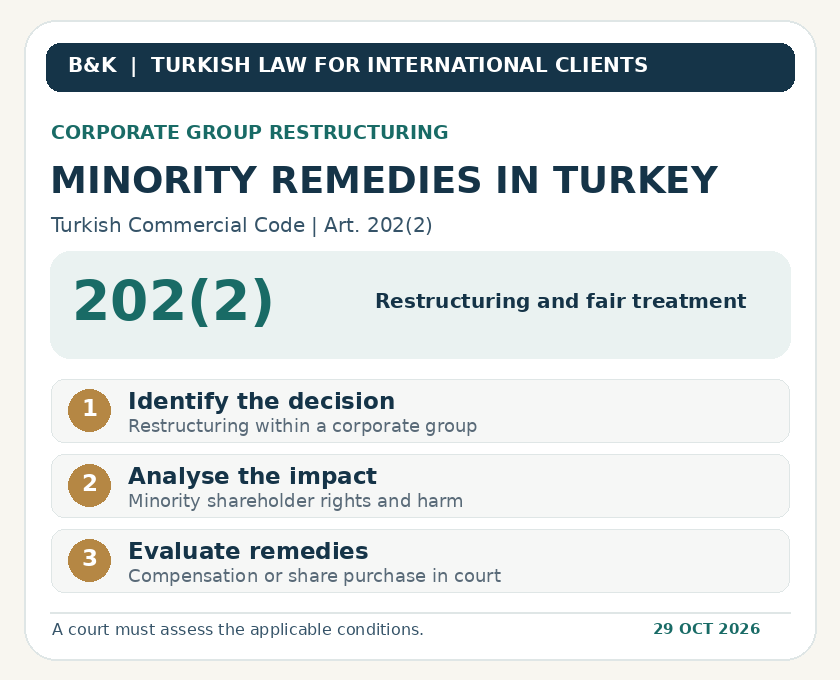
Short and clear answer
Article 202(2) combines three substantive elements: a transaction implemented through control, the absence of a clearly understandable justified reason for the subsidiary, and a shareholder who has opposed it in the statutory manner. The provision lists mergers, divisions, conversions, dissolution, securities issues and significant amendments to the articles as examples. A shareholder’s disagreement with any business decision is not, by itself, proof that all these elements exist.
The shareholder can ask the court for compensation or purchase of the shares by the controlling undertaking. The statute specifies a two-year limitation period with different starting events for a general-meeting resolution and a board resolution. Article 202(3) then provides a court-ordered security mechanism. These features distinguish the claim from an ordinary voluntary exit negotiation and from a demand based solely on the subsidiary’s poor financial performance.
| Issue | Statutory rule |
|---|---|
| Relevant transactions | Control-driven transactions of the kind listed in Article 202(2). |
| Subsidiary-level requirement | No clearly understandable justified reason for the subsidiary. |
| General-meeting opposition | A negative vote recorded in the minutes. |
| Board-decision opposition | A written objection to the relevant board decision. |
| Relief | Compensation or judicial purchase of the shares by the controlling undertaking. |
| Limitation | Two years from the general-meeting decision or announcement of the board decision. |
| Security | The Article 202(3) judicial deposit mechanism. |
What type of restructuring does Article 202(2) address?
The statutory list includes merger, division, change of legal form, dissolution, issuance of securities and important amendments to the articles. Its wording describes transactions of that kind rather than announcing a remedy for every managerial disagreement. The legal file should identify the exact corporate act, its approving organ, the decision date and the implementation steps. A transaction’s commercial label does not replace examination of the actual resolutions and documents.
Distinguish a planned transaction from an adopted decision and an implemented transaction. Those stages affect the evidence, the procedural choices and the relevant dates. Obtain the merger or division documents, proposed amendments, issue terms or dissolution materials appropriate to the act under review. A minority shareholder should not be asked to accept a generic presentation on group efficiency as a substitute for the actual terms of the decision affecting the subsidiary.
The decision must be connected to the exercise of control
Article 202(2) addresses transactions carried out through the exercise of control. Article 195 provides the underlying group-control framework. Identify the controlling undertaking and the means through which it influenced the decision. Share percentages, voting arrangements, appointment rights and the decision-making record can be relevant. The presence of a large investor is not a reason to omit the legal and factual explanation of control in the particular file.
The provision separately asks whether the subsidiary lacks a clearly understandable justified reason for the transaction. The subsidiary’s position must therefore be examined, not merely the group’s aggregate benefit. Record the stated purpose, expected effects, burdens and benefits for the subsidiary. The analysis should address management’s actual explanation and supporting documents rather than assume that a parent-directed decision is necessarily unjustified or that group benefit necessarily supplies the subsidiary’s justification.
Separate the information available when the decision was made from later developments. Later results can be relevant evidence, but they should not silently replace the reasons and data on which the decision was taken. Preserve forecasts, valuations, business plans and communications explaining the corporate act. The claim must be grounded in the statutory conditions, not in hindsight alone or an invented assertion that the parent had no business purpose.
The opposition requirement depends on the deciding organ
For a general-meeting resolution, Article 202(2) describes shareholders who vote against the decision and have that opposition recorded in the minutes. Attendance, silence and abstention are not the same as the negative vote and record stated by the provision. Prepare representative authority and the intended position before the meeting. After the vote, check that the minutes accurately identify the opposition rather than relying on an unrecorded conversation outside the meeting room.
For a board decision on the relevant matters, the provision describes shareholders who object in writing. Identify the decision, the objection’s content, the person making it and proof of delivery. A shareholder does not become a board member merely because the disputed decision came from the board; the statute provides a shareholder objection mechanism. Keep that distinction clear when preparing the document and selecting the recipient.
The text does not state one universal number of days for making every written board objection. That does not make timing unimportant. Promptly establish the decision and announcement dates, preserve the objection and review any separate remedy with its own period. Do not confuse the opposition step with the two-year limitation period for the resulting action. The evidence should demonstrate both the qualifying objection and timely pursuit of the chosen judicial relief.
Compensation and a buyout are different requested outcomes
The provision allows a request for compensation of loss or for purchase of the shares by the controlling undertaking. The claimant should identify which outcome is sought and the factual and valuation basis supporting it. A claim for the shareholder’s loss under Article 202(2) should not be mixed without explanation with a claim under Article 202(1) seeking compensation of the subsidiary’s loss. The injured interest and payment destination must be stated correctly.
A buyout request concerns the claimant’s participation and its statutory value. It is not a request to dissolve the entire group or transfer all subsidiary assets to the shareholder. Identify the shares, their rights and any relevant changes in capital. The party invoking the remedy remains responsible for establishing the Article 202(2) conditions; a desire to exit an illiquid investment does not independently create the statutory purchase entitlement.
The price must follow the statutory valuation framework
Article 202(2) refers to at least stock-exchange value where such a value exists. Where there is no such value, or the stock-exchange value is not equitable, it refers to real value or a value determined through a generally accepted method. The statute also directs use of data closest to the court’s decision. Historic subscription cost, nominal capital and the price selected in a parent’s unilateral offer are therefore not interchangeable with the statutory valuation.
The valuation file should identify the relevant company, share rights, financial statements, assets, debts, contingent exposures and material transactions. Reconcile related-party balances and distinguish the subsidiary’s value from the value of an entire international group. An expert needs the actual legal valuation question, not merely instructions to reproduce management’s preferred figure. Any proposed method and adjustment should be explained through the underlying data.
Keep earlier valuations and negotiations in the file, but identify their dates and assumptions. A pre-transaction estimate can be relevant without automatically becoming the correct judicial price. The statutory instruction to use data nearest the decision requires attention to updated information. The article does not prescribe a universal minority discount or a fixed multiplier for every business. Neither should be asserted without a legal and valuation basis.
The two-year limitation period has two stated starting events
For the action described in Article 202(2), the statute uses the date of the general-meeting resolution or the date the board decision is announced as the starting point. It does not state a general rule running from whenever the shareholder later learns the full economic consequences. Record the relevant resolution and announcement evidence immediately. A shareholder based abroad should not assume that a later translation or an internal headquarters review restarts the statutory clock.
The two-year period is a limitation rule for this action, not a universal deadline for every challenge connected with the restructuring. An annulment action or another special merger remedy can have a different period and different requirements. Maintain a separate deadline entry for each route under consideration. Negotiations, information requests and an informal assurance that the parent will reconsider should not be treated as automatically preserving all those rights.
Article 202(3): judicial security and restrictions on implementation
When the action described in paragraph two is brought, Article 202(3) provides for an order requiring a sum covering the claimants’ probable losses or the share-purchase value to be deposited as security in a bank designated by the court, in the court’s name. The wording then prohibits acts relating to implementation of the relevant general-meeting or board decision while the security remains undeposited. This is a specific statutory mechanism, not a generic statement that any shareholder letter suspends a transaction.
The application should identify the decision and explain the amount and basis relevant to security. Keep the court order, bank instructions and deposit evidence distinct from the filing receipt. A request for security, an order granting it and compliance with the order are different procedural facts. The parties should assess implementation against the actual statutory mechanism and judicial record rather than assume that an off-record commercial promise has the same effect as the required deposit.
Security is not a final award of compensation and does not establish the merits of the buyout claim. Its amount and purpose should be explained accordingly. The ultimate determination of the underlying conditions and remedy remains separate. Any question about enforcement of the order or a disputed implementation step should be addressed through the appropriate judicial process, not through self-help access to company accounts or property.
The statute also protects against bad-faith litigation
Article 202(3) states that, where proceedings under paragraphs one or two are brought in bad faith, the defendant can seek joint and several compensation for the resulting loss and request security from the claimants. This is a separate consequence requiring its own basis. The existence of that rule does not mean every unsuccessful claim was brought in bad faith, but it prevents the security mechanism from being described as a cost-free instrument for obstructing a transaction without a genuine legal case.
Prepare a balanced evidence file. Preserve the subsidiary’s stated reasons, documents that support the transaction and the shareholder’s objections. State unresolved matters accurately. A reasoned claim can challenge management’s explanation without concealing it or manufacturing facts. The legal assessment should concern the statutory grounds and requested remedy rather than a strategy of threatening delay as an end in itself.
Other merger and corporate remedies remain distinct
Article 202(4) preserves other rights granted to shareholders and members in mergers, divisions and changes of legal form. The Article 202(2) claim therefore does not exhaust every possible restructuring remedy. Each additional route must be assessed on its own terms. The party against whom relief is sought, the required opposition, the relevant period and the remedy can differ even when the same restructuring documents supply part of the evidence.
The parent’s purchase right under Article 208 runs in the opposite direction and depends on its own threshold and conduct requirements. Our Article 208 guide explains that distinction. An ordinary resolution challenge also has its own framework, discussed in the joint-stock general-meeting challenge guide. Do not combine those rules into one supposed universal exit procedure.
The file should connect control, justification, opposition and value
Organise four groups of records. First, identify the controlling undertaking and the subsidiary relationship. Second, assemble the corporate decision and the materials explaining its subsidiary-level purpose. Third, preserve the negative vote and minutes or the written board objection and delivery record. Fourth, collect the loss and valuation documents supporting the requested relief. A short chronology should connect these groups without changing the dates or legal identities.
Information requests can help clarify missing matters, but they are not automatically a substitute for the opposition or filing steps. The parent-shareholder information guide concerns a different corporate position and should be used only where its conditions fit. Likewise, the subsidiary’s affiliation report supplies context without replacing proof of the particular restructuring decision.
Foreign investors and the correct controlling defendant
Article 202(2) directs the compensation or purchase request against the controlling undertaking. Identify that entity precisely; the subsidiary, an intermediate company and the ultimate parent should not be treated as interchangeable defendants. A foreign address creates additional service and representation questions. The applicable commercial-court and territorial rules must be assessed for the relief actually sought rather than inferred solely from the shareholder’s residence or the location of group headquarters.
Bakırcı & Keskin Hukuk Bürosu assists overseas investors with Turkish corporate disputes and nationwide file coordination. For a review, provide the corporate decision, ownership chart, opposition record and the known decision or announcement dates first. Use the contact page for appointment arrangements and agree a secure method before sending confidential restructuring and valuation material.
Frequently asked questions
Does every parent-directed restructuring create an Article 202(2) claim?
No. The statutory transaction, exercise of control, absence of a clearly understandable justified reason for the subsidiary and qualifying shareholder opposition must be established.
Which transactions are listed?
The provision lists mergers, divisions, changes of legal form, dissolution, securities issues and important amendments to the articles as transactions of the relevant kind.
What opposition is required at a general meeting?
Article 202(2) describes a negative vote recorded in the minutes. Silence or abstention is not the same as the stated requirement.
How is opposition to a board decision recorded?
The provision refers to a written objection by the shareholder. Identify the relevant decision and preserve the objection and evidence of delivery.
What can the shareholder ask the court to order?
The stated alternatives are compensation or purchase of the shares by the controlling undertaking under the statutory valuation framework.
When does the two-year period start?
It starts from the general-meeting decision or announcement of the board decision, as specified in Article 202(2), rather than a universal later date of learning the loss.
Does Article 202(3) make a demand letter automatically stop implementation?
No. It provides a specific court-ordered security mechanism following the relevant action. The filing, order and deposit must be distinguished from an informal demand.
Is the purchase price simply the nominal value?
No. Article 202(2) uses stock-exchange value where applicable and real value or a generally accepted valuation method in the stated circumstances, using data closest to the court decision.
Is this the same as the parent’s Article 208 squeeze-out right?
No. Article 202(2) is a shareholder-initiated remedy on its own grounds. Article 208 concerns a controlling company’s purchase right with different threshold and conduct conditions.
Are other merger and division rights removed?
No. Article 202(4) preserves other statutory rights in mergers, divisions and changes of legal form. Each separate remedy requires its own conditions and timing analysis.
Professional information
Av. Halil Bakırcı · Mersin Bar Association registration 3472 · Bakırcı & Keskin Hukuk Bürosu. This guide does not determine whether a particular restructuring lacks justification or promise a court-ordered exit.
Istanbul Office – Polaris Plaza, Maslak / Sarıyer
Bakırcı & Keskin Hukuk Bürosu
Maslak Ahi Evran Caddesi, Polaris Plaza No:21, Kat:9, 34475 Sarıyer/İstanbul
Our physical offices in Istanbul and Mersin coordinate matters throughout Turkey, subject to jurisdiction and the local steps required for each case. Please specify your preferred office when arranging an in-person appointment.
Open the Istanbul office on Google Maps · Contact and appointments
Contact regarding a legal matter
In your first message, you may briefly state the subject, your country or city, and any relevant notification or recent procedural date. Please do not send identity numbers, medical data, or personal documents. Messaging alone does not constitute legal advice or create a lawyer–client relationship.
Discover more from Bakırcı & Keskin Hukuk Bürosu
Subscribe to get the latest posts sent to your email.