Turkish Child Support Arrears Abroad: Proving Missed Instalments and Payment Credits
Short answer: To collect unpaid Turkish child support abroad, the foreign enforcement file must identify the enforceable decision, the instalments actually due and every payment already received. Article 25 of the 2007 Hague Maintenance Convention specifically addresses a dated arrears statement and information needed to calculate indexation. Articles 23 and 24 allow payment of past debt to be raised against enforcement, while Article 32 contains a specific rule comparing limitation periods. A reliable application therefore requires a reconciled account supported by the orders and payment evidence, together with verification that the Convention operates between the relevant countries for the maintenance claimed.
Have a general question about this article? Ask anonymously
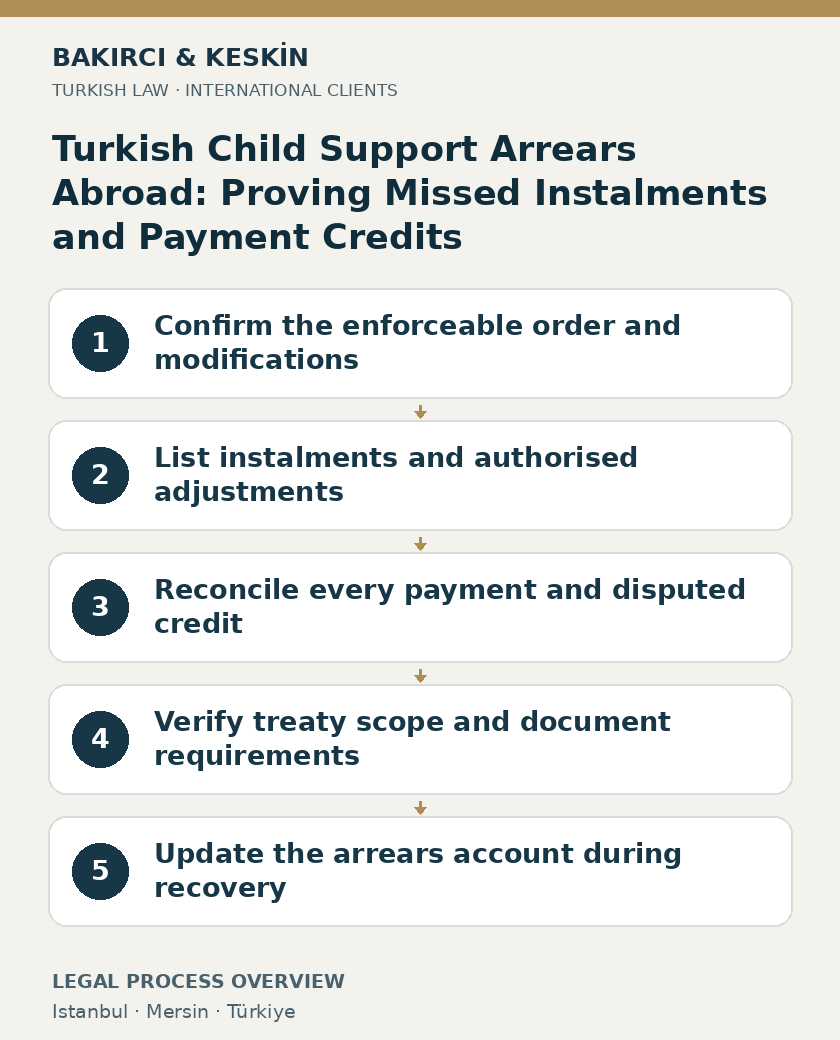
Quick summary
| Legal issue | Turkish Child Support Arrears Abroad: Proving Missed Instalments and Payment Credits |
|---|---|
| Short answer | To collect unpaid Turkish child support abroad, the foreign enforcement file must identify the enforceable decision, the instalments actually due and every payment already received. Article 25 of the 2007 Hague Maintenance Convention specifically addresses a dated arrears statement and information needed to calculate indexation. Articles 23 and 24 allow payment of past debt to be raised against enforcement, while Article 32 contains a specific rule comparing limitation periods. A reliable application therefore requires a reconciled account supported by the orders and payment evidence, together with verification that the Convention operates between the relevant countries for the maintenance claimed. |
| Key legislation | Law No. 4721 — Articles 328, 330, 331; 2007 Hague Maintenance Convention — Articles 2, 9, 23(8), 24(5), 25, 28, 32, 34, 41, 44, 56, 58(5); HCCH 2007 status and declarations — Articles Turkey entry into force 1 February 2017, country reservations and declarations |
Define the unpaid obligation before calculating a balance
A Turkish maintenance order can contain several distinct obligations: child support, temporary support during proceedings, spousal maintenance and litigation costs. The creditor should identify which operative paragraph creates each debt, who is entitled to receive it and the period it covers. Combining those amounts into one family balance obscures both the legal basis of enforcement and the international instrument applicable to each component. A child’s claim should remain identifiable throughout the application.
The domestic starting point is the actual enforceable decision. Under Turkish Civil Code Article 330, child maintenance is determined by the child’s needs and the parents’ living conditions and capacity to pay, with the child’s income also considered; it is payable monthly in advance. That statutory structure does not authorise a creditor to substitute a personally assessed monthly budget for the amount ordered by the court.
The account should separate amounts already payable from future instalments. The arrears calculation needs a stated cutoff date, whereas continuing enforcement requires the operative amount and adjustment mechanism for later months. These serve different purposes. A clear application can ask for enforcement of the existing arrears and continued collection under the decision without describing amounts that have not yet become due as an existing default.
Build the complete order history, including modifications
Obtain the initial decision and each subsequent decision that changes the amount, effective date, creditor or duration. Record the court, case number, decision date and relevant operative paragraph. An increased award cannot safely be entered into every earlier month merely because it is the newest judgment. The calculation must follow the legal effective date established by the decision and the applicable rules, including any expressly retrospective element.
Civil Code Article 331 permits adjustment or removal of maintenance when circumstances change. The existence of a new relationship, a job loss or a disputed change in the child’s residence is therefore information requiring legal assessment. It should not be treated in the ledger as an automatic, self-executing amendment to a court order. Identify any actual variation proceedings and orders instead of allowing an assumption to become an accounting entry.
A pending challenge also needs an accurate description. Obtain evidence of the decision’s enforceability in Turkey and any order affecting enforcement. Article 25(1)(b) of the 2007 Hague Convention requires documentation that the decision is enforceable in its State of origin. A document described as finality evidence should not be substituted mechanically for the enforceability document required by the Convention, since those concepts serve different legal functions.
Where several children are covered by one judgment, maintain a separate running account for each child. Changes in age, education, entitlement and the wording of later orders can affect children differently. This structure also allows the receiving authority to enforce the clearly supported part while asking questions about another component, rather than having to reconstruct a combined family total from the beginning.
Prepare an instalment ledger that another authority can reproduce
For each instalment, show its due date, the order supporting it, the principal amount in the ordered currency, any authorised adjustment, payments allocated to it and the remaining principal. Give each supporting document a stable reference. The ledger should permit the reviewing authority to trace a single unpaid month back to an operative paragraph and forward to the banking evidence, without relying on an unexplained spreadsheet formula.
Article 25(1)(d) requires, where necessary, a document showing the arrears amount and the date on which it was calculated. A total without a date is incomplete for a continuing monthly obligation. State whether the balance includes the instalment due on the cutoff date and identify payments received after it separately. Preserve earlier versions so that a later lower balance can be explained by actual receipts rather than appearing to contradict the initial application.
Arithmetic verification should include the number of instalments, changes in the monthly amount, partial payments and duplicate entries. Reconcile the running total with the underlying statements and any Turkish enforcement-office account. If the two accounts differ, identify the source of the difference before submission. An unexplained enforcement balance may include costs or interest that should not be represented abroad as unpaid child-support principal.
Account for direct payments and disputed credits
Retain bank statements showing the sender, recipient, date, amount, currency and payment reference. A transfer confirmation alone may show an instruction rather than completed receipt; match it to the relevant account information when available. Cash receipts and written acknowledgments also belong in the evidence file. A creditor should disclose payments received directly after the application begins so that parallel collection does not seek the same instalment twice.
Some payments are disputed because the debtor describes school fees, travel expenses, gifts or payments to another family member as maintenance. The ledger should distinguish undisputed credits from contested items and attach the relevant order or agreement. The legal effect of a payment depends on the obligation and applicable law; a transfer’s existence does not, by itself, determine which maintenance instalment it discharges or whether it discharges maintenance at all.
A disputed credit schedule should state the debtor’s position, the creditor’s position and the supporting documents without converting an unresolved issue into an established fact. This is particularly useful where a bank reference is vague or several obligations existed between the same people. The aim is a transparent account that lets the competent authority resolve the dispute, rather than an inflated total that conceals information already known to the applicant.
Explain indexation, currency and interest separately
Where the decision provides automatic indexation, Article 25(1)(e) calls for the information needed to perform the calculation. Include the exact adjustment clause, the relevant reference period, the authorised index and the calculation for each change. An annual adjustment must follow the judgment’s mechanism. General inflation data, a later exchange-rate movement or a private estimate of increased living costs does not independently rewrite the award.
Keep the obligation’s currency visible. Where a payment arrives in another currency, retain the original payment amount and record how any conversion was calculated and legally justified. Separate a conversion used to explain a receipt from a conversion demanded for enforcement. Article 32(1) generally places enforcement under the law of the State addressed, subject to the Convention; local currency and execution requirements therefore need checking in that State.
Interest and recoverable costs should have their own schedules, identifying their legal basis, starting dates and calculation method. Do not apply a remembered Turkish statutory rate across the entire history of the debt or assume that all costs in a domestic file travel automatically with the principal. Where the interest basis remains disputed, label that component expressly so that a verified principal claim is not obscured by unsupported additions.
Assemble the Convention documents around the arrears account
Article 25 starts with the complete decision and evidence of enforceability. If the respondent neither appeared nor was represented in the original proceedings, paragraph (1)(c) requires appropriate documentation of notice and an opportunity to be heard, or notice of the decision and an opportunity to challenge or appeal it on fact and law. A payment ledger cannot cure missing procedural evidence about the judgment being enforced.
The documents should also cover arrears, necessary indexation information and, where relevant, the extent of legal assistance received in the originating proceedings. Article 25(3) allows a State to specify particular document requirements, including a certified complete decision. Check the receiving country’s current information before ordering copies and translations. Article 41 removes legalisation or similar formalities within the Convention, while Article 44 separately governs language requirements; authentication and translation should not be treated as interchangeable.
For applications through Central Authorities, Article 9 uses the authority of the Contracting State in which the applicant resides, with mere presence excluded. A Turkish judgment does not mean that every applicant must begin through Turkey regardless of residence. The broader route is explained in our international child-support collection guide; the arrears file must then satisfy the document requirements of the actual route chosen.
Check the destination country, the child’s age and the treaty relationship
The HCCH status table and declarations record the Convention’s entry into force for Turkey on 1 February 2017. Its operation in a particular case still requires examination of the other State, any territorial extension, the effective bilateral relationship and relevant reservations or declarations. A State’s signature or a future entry-into-force date is insufficient. Article 58(5) also makes objections to accessions relevant to particular bilateral relationships.
Article 2 generally covers maintenance arising from a parent-child relationship towards a person under 21, while permitting a reservation limiting that coverage to persons under 18. Extensions under Article 2(3) operate between two States only to the extent their declarations cover the same obligations and Convention provisions. Turkey’s broader declaration therefore does not, by itself, compel every other Contracting State to provide identical coverage for adult children.
Domestic entitlement and treaty coverage must be assessed separately. Civil Code Article 328 addresses continued parental support during education after majority where the statutory conditions apply. That provision does not alone establish that a particular foreign State must process the claim under every part of the Convention. The child’s birth record, educational evidence where relevant and the wording of the operative decision should accompany a properly classified request.
Assess older instalments under the specific limitation rule
Article 32(5) provides that a limitation on the period for which arrears can be enforced is determined by the law of the State of origin or the State addressed, whichever provides the longer limitation period. It is therefore unsafe to reject older instalments solely by applying an assumed universal Turkish period. The comparison requires the relevant laws and the dates affecting the actual obligations, including any legally relevant interruption or suspension.
Distinguish limitation from the duration of the support obligation. Article 32(4) requires effect to be given to applicable originating-State rules about that duration. Whether an instalment arose at all, whether it remains unpaid and whether enforcement is time barred are separate questions. Recording these questions separately prevents an age-related dispute about future support from being confused with the collectability of instalments already due.
Article 56 adds transitional rules. Paragraph (1) addresses requests received after entry into force between the relevant States. Paragraph (3) generally removes a treaty obligation to enforce payments due before bilateral entry into force, but expressly excepts maintenance arising from a parent-child relationship towards a person under twenty-one. The older instalments must be matched to that category and the applicable treaty relationship. Paragraph (2) separately preserves qualifying recognition and enforcement conditions under the earlier Hague maintenance conventions for specified older decisions; it does not automatically include every maintenance category.
Respond to a defence that the debt has already been paid
Under Article 23(8), a respondent’s challenge or appeal may rely on fulfilment of the debt insofar as enforcement concerns past payments. Article 24(5) contains a corresponding ground under the alternative procedure. This is why receipts and allocation records matter even after the Turkish decision has been supplied. Recognition of the judgment does not establish that every instalment remains unpaid on the date enforcement is sought abroad.
The applicable procedure depends on the State addressed. Turkey has declared that it uses Article 24, but that choice does not automatically govern an application to enforce a Turkish decision in another State. Determine the destination’s procedure and actual notices before calculating response periods. A debtor’s payment objection should be answered instalment by instalment, distinguishing genuine credits from a disagreement with the original amount ordered.
Article 28 prohibits review of the merits of the decision by the authority addressed. A challenge about a payment made after judgment is different from asking that authority to retry the original support assessment. Keep the response focused on the relevant ground, while dealing separately with a properly brought modification application. Our guide to Turkish child-support obligations explains the domestic assessment and variation provisions.
Coordinate collection and keep the balance current
Article 32(3) provides that, in Central Authority applications, enforcement proceeds after the decision is declared enforceable or registered under Chapter V without further action by the applicant. Effective coordination still requires accurate information. Report receipts, changed bank details and later decisions through the responsible channel. Preserve a record of what was reported and when, especially where collection continues simultaneously against assets in more than one country.
The Convention requires effective domestic enforcement measures but does not guarantee that every listed method is available in identical form everywhere. Article 34 gives possible measures, while Article 32 places execution under the law of the State addressed subject to the Convention. Information about the debtor’s employer or assets should be current, factual and lawfully obtained. A successful recognition stage and an available collectible asset remain different practical issues.
A useful closing file contains the accepted order set, the dated opening arrears account, acknowledged payment credits, the current outstanding balance and any continuing collection instruction. This allows a change of representative or a later dispute to be handled from a coherent record. The same discipline protects both sides: the creditor can substantiate what is still owed, and the debtor receives credit for payments that actually discharge the obligation.
Frequently asked questions
1. Is the Turkish judgment alone enough to prove the arrears?
No. Article 25 separately addresses a dated arrears statement where necessary. The order establishes the obligation; payment records and calculations establish the unpaid balance.
2. Should payments received after the application be disclosed?
Yes. Update the responsible collection channel and the ledger so that enforcement reflects the remaining debt and avoids duplicate recovery.
3. Do gifts or school fees always reduce support arrears?
No automatic conclusion follows from the expenditure. Its legal effect must be assessed against the order, relevant agreements and applicable law; disputed credits should be identified with their evidence.
4. Can I add inflation to a fixed award myself?
An adjustment must follow an operative legal basis. Article 25(1)(e) concerns the information required where the decision itself provides automatic indexation.
5. Are all older instalments governed by one Turkish limitation period?
No. Article 32(5) requires comparison of the originating and addressed States’ limitation periods and uses the longer period for the specified arrears-enforcement question.
6. Does Turkish educational support automatically fall within treaty coverage abroad?
No. Domestic entitlement under Article 328 and Convention scope are separate. Check Article 2, reservations and any matching declarations for the two States.
7. Must Convention documents always carry an apostille?
Article 41 excludes legalisation or similar formalities in the Convention’s context. Certified-copy requirements and translation rules remain separate matters.
8. Does Turkey’s Article 24 declaration control enforcement overseas?
It describes the procedure Turkey applies when addressed. Enforcement of a Turkish order in another State requires checking that State’s procedure.
9. Can the foreign authority reconsider the original amount?
Article 28 prohibits review of the merits in recognition and enforcement. Payment defences and properly pursued modification proceedings must be distinguished from retrying the original assessment.
10. Does reaching adulthood erase unpaid childhood instalments?
The duration of the obligation and enforcement of existing arrears are distinct. Examine the decision, Article 32, treaty scope and applicable limitation rules before drawing a conclusion.
Official legal sources
- Law No. 4721 — Articles 328, 330, 331
- 2007 Hague Maintenance Convention — Articles 2, 9, 23(8), 24(5), 25, 28, 32, 34, 41, 44, 56, 58(5)
- HCCH 2007 status and declarations — Articles Turkey entry into force 1 February 2017, country reservations and declarations
Legal sources reviewed on 28 October 2026. Treaty coverage, declarations and the applicable rules must be assessed for the countries and dates of the individual case.
Contact information
Do not include confidential documents or identity numbers in an initial message. An enquiry does not establish representation or suspend any legal deadline.
Istanbul and Mersin contact details
Bakırcı & Keskin Law Office is Mersin-based. Turkish matters are handled under the applicable jurisdiction and agreed mandate. The competent court and the scope of representation are assessed for each matter.
Istanbul — Polaris Plaza
Maslak Ahi Evran Caddesi, Polaris Plaza No:21, Floor 9, 34475 Sarıyer/İstanbul, Türkiye.Mersin — Profit İş Merkezi
İhsaniye Mahallesi, 4903. Sokak, Profit İş Merkezi No:23, Floor 3, Office 14, 33070 Akdeniz/Mersin, Türkiye.+90 552 224 43 66 · Contact details in English. An enquiry does not establish representation or suspend a legal deadline.
Istanbul Office – Polaris Plaza, Maslak / Sarıyer
Bakırcı & Keskin Hukuk Bürosu
Maslak Ahi Evran Caddesi, Polaris Plaza No:21, Kat:9, 34475 Sarıyer/İstanbul
Our physical offices in Istanbul and Mersin coordinate matters throughout Turkey, subject to jurisdiction and the local steps required for each case. Please specify your preferred office when arranging an in-person appointment.
Open the Istanbul office on Google Maps · Contact and appointments
Contact regarding a legal matter
In your first message, you may briefly state the subject, your country or city, and any relevant notification or recent procedural date. Please do not send identity numbers, medical data, or personal documents. Messaging alone does not constitute legal advice or create a lawyer–client relationship.
Discover more from Bakırcı & Keskin Hukuk Bürosu
Subscribe to get the latest posts sent to your email.