Creditor Duties to a Turkish Surety: Lost Collateral, Refused Payment and Notice Failures
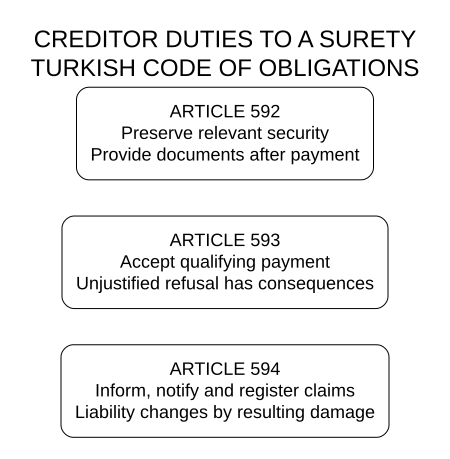
A creditor’s handling of collateral and information can change what it is entitled to recover from a Turkish surety. Article 592 of the Turkish Code of Obligations protects the surety against impairment of relevant security and regulates delivery of documents and collateral after payment. Article 593 addresses refusal to accept a qualifying payment. Article 594 imposes information, notification and claim-registration duties. The consequences are not identical: some rules reduce liability by a corresponding amount, some turn on the damage caused, and others provide release when their specific conditions are met. An objection must identify the actual breach and the remedy attached to it.
Have a general question about this article? Ask anonymously
Identify the creditor’s duty before calculating the defence
The starting documents are the personal undertaking, the secured debt agreement and the security records. Confirm that the obligation is a suretyship governed by the relevant Turkish provisions. An independent corporate guarantee, a pledge given by a property owner and an individual’s suretyship cannot be placed into the same category merely because all support a debt. Article 603 extends specified safeguards to other individual personal-security arrangements; it does not automatically extend every rule in the suretyship chapter to every security instrument.
Next identify the creditor’s alleged conduct. Releasing a mortgage, failing to register a bankruptcy claim, withholding documents after payment and declining an offer of payment are different events. They require different evidence and engage different paragraphs. A general complaint that a bank was careless does not identify which statutory condition has been satisfied or how the surety’s exposure should change.
The primary reference is Law No. 6098, Articles 592–594. Our ordinary and joint suretyship guide concerns the separate question of when the creditor can pursue the surety. This page addresses loss of rights through the creditor’s own conduct, not a general rule that a joint surety can insist on every possible recovery attempt against the borrower.
Article 592: reducing security can reduce the surety’s liability
The first paragraph of Article 592 covers pledge rights, security and preferential rights existing when the suretyship was given, or subsequently obtained from the principal debtor as special security for the claim. If the creditor reduces those rights to the surety’s detriment, the surety’s liability decreases by a corresponding amount unless the creditor proves that the damage is less. The surety’s right to recover an excess payment is expressly preserved.
Three records are therefore needed: what protection existed, what the creditor changed and what effect that change had. For registered security, obtain the relevant historic and current registry records rather than relying only on the latest printout. The current record can show that a mortgage is absent without identifying when, why or on whose instructions it was removed.
The nominal amount recorded for a security is not necessarily the amount of actual lost recovery. Ranking, prior claims, the secured debt, the value available for realisation and the scope of the released right all require examination. Article 592 expressly allows the creditor to establish a smaller loss. A legally useful calculation must address that statutory qualification instead of automatically subtracting a certificate’s face value from the surety’s liability.
Separate creditor-caused impairment from a general fall in asset value
Article 592’s first paragraph concerns the creditor reducing the protected rights to the surety’s detriment. An asset becoming less valuable does not, by that fact alone, establish that the creditor released or impaired a security right. Identify the act or omission attributed to the creditor and the legal protection that was lost. A market valuation and a registry discharge answer different questions.
Compare the documents immediately before and after the disputed event. Record the security’s provider, its creation date, the specific claim it secured, its priority and any replacement security obtained. A replacement arrangement needs substantive comparison; changing a document’s title does not show either equivalent protection or a loss. The evidence should show the real change in the surety’s position.
Where the concern is increased risk caused by deterioration of the debtor’s finances or a decline in security value, Article 595 provides a separate route against the principal debtor for security and, once the debt is due, release from the obligation in the specified circumstances. That debtor-facing remedy should not be confused with a creditor-facing reduction under Article 592. The requested relief must be directed at the correct party.
Special supervision duties where the suretyship concerns an employee
Article 592’s second paragraph addresses suretyship for employees. Where the creditor neglects the supervision it owes over employees or fails to exercise the care that can be expected, and the debt arises or increases because of that failure, the creditor cannot recover the resulting debt or increased portion from the surety. The link between the failure of care and the loss is part of the provision.
A review should identify the employee’s duties, the supervision required, the records of control actually exercised and the point at which the relevant loss arose. Accounting reconciliations, access records, warnings and internal reports can help establish that chronology. Their relevance depends on what they prove about the creditor’s obligation and the resulting debt, not on the sheer number of documents collected.
The rule is not a declaration that every employer must absorb every employee debt, nor does it automatically apply to every shareholder’s guarantee of a company facility. Establish that the undertaking falls within the employee-suretyship situation described by the paragraph. Then separate the debt attributable to the supervisory failure from any amount with a different cause.
Documents and security must be made available to the paying surety
Article 592 requires the creditor to hand over debt instruments useful to a paying surety’s exercise of rights and to supply necessary information. It also requires delivery of the relevant pledges and other security, or completion of the acts necessary to transfer them. This duty supports the statutory rights acquired through payment; it is not satisfied simply by acknowledging receipt of the money.
The request should specify the missing instruments, account information and security records. Identify originals that remain with an enforcement office or another official custodian and the steps needed for access or transfer. Where the creditor claims a reason for retaining an item, obtain that reason in writing. The statute preserves the creditor’s pledge and retention rights for other claims to the extent they rank ahead of the surety’s rights.
Do not describe every request for the entire banking file as a duty to disclose unrelated customers’ information. Connect each requested document to the rights the surety needs to exercise. The guide to recourse after payment explains the separate limits of subrogation and the debtor-notification requirement.
Release and repayment under the final paragraph of Article 592
The final paragraph of Article 592 provides release where the creditor fails to perform its obligations without a justified reason, or through gross fault parts with existing documents, pledges or other security for which it is responsible. In that situation, the surety can seek return of what it paid and compensation for additional loss, if any. Those are express statutory consequences tied to the paragraph’s requirements.
The distinction from the first paragraph matters. A proportional reduction for impaired security, an employee-supervision defence and release under the final paragraph are not interchangeable descriptions. State which conduct supports which remedy. Where alternative legal grounds are advanced, keep the facts, causal connection and monetary calculation for each ground identifiable.
The creditor’s explanation must also be tested against the correct requirement. A legal retention right, an actual transfer step already completed and an unexplained refusal to provide a necessary instrument are not the same event. Preserve the request, response and objective record. The article does not justify announcing a full discharge merely because one informal email was unanswered.
Article 593: a qualifying offer of payment cannot be refused without reason
Once the principal debt is due, including where maturity results from the debtor’s bankruptcy, Article 593 permits the surety to require the creditor to accept payment. Where several persons guarantee the debt, the creditor must accept a partial payment from one surety provided that it is not less than that surety’s share. Maturity and the proposed amount must therefore be established before relying on the refusal rule.
If the creditor declines payment without a justified reason, Article 593 releases the surety; in joint and several co-suretyship, the sureties’ liability is reduced by their respective shares. Preserve the actual offer and response, not merely a statement that funds were available. The proposal must relate to the identified debt and satisfy the provision’s conditions.
Payment before maturity is different. Article 593 permits it with the creditor’s consent, and the paying surety cannot exercise recourse against the debtor before the principal debt is due. A refusal to accept an early payment without that consent should not be described as automatically triggering the same release as an unjustified refusal of a qualifying payment on a due debt.
Article 594: notice of arrears and information about the debt
Article 594 requires notification to the surety when the principal debtor is six months late in the principal or half-year interest payments, or in principal payments scheduled annually, as described in the provision. The payment schedule, due dates and actual receipts are therefore essential. A general reference to a default is not enough to establish the statutory notice point.
The surety also has a right to information about the scope of the principal debt whenever it requests it. That request-based duty is separate from the arrears notification trigger. An overseas surety should identify the obligation and request an intelligible statement of the balance and its components. A request can be documented without assuming that a lack of reminders means the debt has been paid.
Keep information requests, delivery evidence, responses and the account material ultimately supplied. Distinguish the creditor’s Article 594 notice to the surety from a payment demand, a notice making the debt due and formal service of court papers. Similar-looking letters can serve different legal purposes; the heading on the letter is not the complete legal analysis.
Bankruptcy and concordat create additional creditor duties
Under Article 594, a creditor must register its claim and take the steps necessary to protect its rights where the principal debtor has been declared bankrupt or has applied for concordat. The creditor must inform the surety as soon as it learns of the bankruptcy or of the grant of a concordat moratorium. The registration and notification duties should be reviewed separately.
Obtain the actual insolvency or concordat file, relevant announcements, claim-registration record and the creditor’s correspondence. Record when the creditor learned of the event, when the surety was informed and what protection steps were taken. A private statement that the debtor is in financial trouble does not establish a bankruptcy decision or a granted moratorium.
Failure to comply with a duty in Article 594 results in loss of the creditor’s rights against the surety to the extent of the damage the failure caused. The provision does not say that every missed notice automatically erases the entire guarantee. The lost recovery or other proved harm must be connected to the omission. The separate effects of a concordat on debts, co-obligors and enforcement require their own insolvency-law review.
Prepare a breach-and-loss file before responding to enforcement
Organise the evidence into four parts: the undertaking and secured debt; the relevant security or information duty; the creditor’s act or omission; and the resulting legal and financial effect. For a collateral complaint, include the before-and-after security record. For an Article 594 complaint, include requests, notices and the insolvency registration history. For refusal of payment, include the actual tender and its terms.
Separate money already paid from money still demanded. A request to reduce an outstanding claim and a claim to recover an excess payment are different forms of relief. Likewise, the final paragraph of Article 592 separately preserves compensation for additional loss. A schedule should identify each amount and its basis without charging the same loss twice under different headings.
Do not miss a procedural deadline while collecting that evidence. A dispute about the creditor’s statutory duties does not by itself stop service periods or suspend an enforcement file. Preserve the entire served document and delivery record and identify the correct response route. Our guide to Turkish legal documents received abroad addresses that initial procedural review.
Frequently asked questions
Does release of collateral automatically cancel the whole suretyship?
No. Article 592’s first paragraph provides a corresponding reduction where relevant rights are reduced to the surety’s detriment, subject to proof of a smaller loss. Full release under the final paragraph has its own conditions. The correct paragraph and evidence must be identified.
Can the creditor prove that the lost security caused less damage?
Yes. Article 592 expressly permits proof by the creditor that the damage is smaller. The value, ranking and recoverability of the affected security therefore matter; its nominal amount is not the whole calculation.
Does a fall in property prices prove a breach by the creditor?
Not by itself. Identify a creditor act or omission reducing the protected right. Article 595 separately addresses increased surety risk, including deterioration in security value, through specified claims against the principal debtor.
What must a creditor provide after the surety pays?
Article 592 requires useful debt instruments, necessary information and delivery or transfer steps for the relevant security. The creditor’s prior-ranking pledge and retention rights are preserved to the extent stated in the article.
Can a surety ask for a statement before six months of arrears?
Yes. Article 594’s duty to provide information about the scope of the principal debt on request is separate from its six-month arrears-notification trigger. Identify the debt clearly and retain evidence of the request.
Does a missed arrears notice eliminate all liability?
Article 594 removes the creditor’s rights against the surety to the extent of the damage caused by the failure. It does not impose an automatic full discharge for every missed notice without regard to resulting harm.
Must the creditor register its claim in the debtor’s bankruptcy?
Article 594 requires registration and necessary protective steps where the debtor is declared bankrupt or applies for concordat. It also requires notice to the surety upon learning of bankruptcy or a granted concordat moratorium.
Can a creditor refuse a surety’s payment of a due debt?
Article 593 governs the right to require acceptance and the consequences of unjustified refusal. For a payment by one of several sureties, its specific minimum-share requirement must be considered. Early payment follows a separate consent rule.
Can a paying surety claim additional loss under Article 592?
The final paragraph permits repayment and compensation for additional loss when its conditions for release are satisfied. The claim must establish those conditions and the separate loss; it is not an automatic extra payment added to every refund.
What should be provided for a review from abroad?
Prepare the full suretyship, loan records, security history, requests and replies, payment evidence and any served documents. Begin with a short description and deadline, then arrange a confidential channel for the underlying financial records.
Official legal sources
The legal basis is Turkish Code of Obligations No. 6098, Articles 592–595, with Article 603 relevant to the limits of extending safeguards to other personal-security arrangements. The official Ministry text contains the provisions discussed. English explanations are not an official translation; the Turkish statutory text controls.
Istanbul and Mersin offices
Our offices in Mersin and Istanbul coordinate matters throughout Türkiye. For an English-language review of a creditor’s handling of security or notices, start with the alleged event, the debt and any response deadline through the English contact section. Agree a confidential document channel before sending loan or personal records.
Istanbul — Polaris Plaza
Maslak Ahi Evran Caddesi, Polaris Plaza No:21, Floor 9, 34475 Sarıyer/İstanbul. Istanbul office information.
Mersin — Profit İş Merkezi
İhsaniye Mahallesi, 4903. Sokak, Profit İş Merkezi No:23, Floor 3, Office 14, 33070 Akdeniz/Mersin.
Call +90 552 224 43 66. General legal information; an enquiry does not establish representation or suspend a deadline.
Contact regarding a legal matter
In your first message, you may briefly state the subject, your country or city, and any relevant notification or recent procedural date. Please do not send identity numbers, medical data, or personal documents. Messaging alone does not constitute legal advice or create a lawyer–client relationship.
Discover more from Bakırcı & Keskin Hukuk Bürosu
Subscribe to get the latest posts sent to your email.