Surety Recourse in Turkey: Recovering Payment from the Debtor Under TCO 596–597
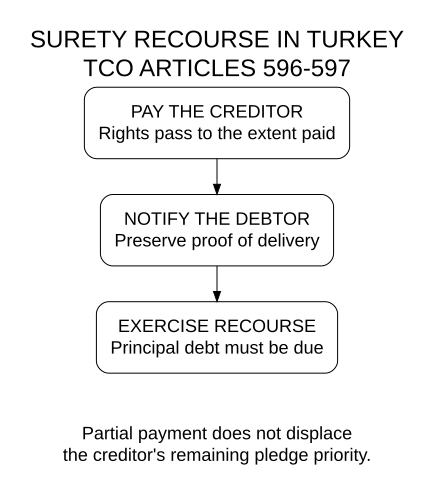
A surety who pays a Turkish debt does not simply become the owner of every claim and security held by the lender. Article 596 of the Turkish Code of Obligations transfers the creditor’s rights to the surety only to the extent of performance and regulates which collateral follows that transfer. Article 597 requires the paying surety to notify the principal debtor. Failure to give that notice can destroy recourse where the debtor, without knowing or being expected to know about the first payment, pays the creditor again. Recovering money after paying a guarantee therefore requires a documented payment, an identified secured debt, the correct rights and a timely debtor notification.
Have a general question about this article? Ask anonymously
Start with the capacity in which the payment was made
The first question is whether the payer performed a suretyship obligation. A shareholder transferring funds to a company, a director making a company payment and an individual satisfying a personal suretyship are not interchangeable transactions. Article 596 concerns the surety who performs to the creditor. Obtain the undertaking, the demand, the payment record and the creditor’s allocation of that payment before selecting the basis of recovery.
A bank-transfer reference saying “company debt” is useful evidence but does not by itself identify every legal relationship. Establish the legal names of the debtor, creditor and payer. Where the payment passed through a lawyer, an enforcement office or another intermediary, retain the records connecting the amount received with the debt actually discharged. The documentary chain is especially important when several group companies use similar trading names.
This article concerns recovery after performance under Turkish suretyship rules. The separate issues of whether a guarantee was validly signed and whether the creditor was entitled to pursue the surety are covered in our personal-guarantee validity guide and ordinary and joint suretyship enforcement guide. A claim for reimbursement should not assume away those earlier questions.
Article 596: subrogation follows the extent of actual performance
Article 596 provides that the surety succeeds to the creditor’s rights to the extent that the surety performs to that creditor. This statutory succession is commonly called subrogation. It is not a discretionary reward for helping the debtor, and it is not established merely by promising to pay. The amount and legal effect of the completed performance determine the starting point of the transferred rights.
A written settlement should record how the creditor treats the payment: which obligation it satisfies, whether the payment is partial or final and what balance remains. The settlement must be read as a whole. A release of the principal debtor, a release limited to the surety and an agreement preserving recovery rights have different objects. The signed wording and the statutory position must be reconciled before describing a recoverable amount.
The surety should not claim the unpaid portion of the creditor’s receivable as though it had also been acquired. Conversely, the creditor’s records should reflect the amount actually received rather than leave the same paid amount appearing as collectible from both debtor and surety. Reconcile the payment confirmation with an updated account statement and the enforcement file, where one exists.
Partial payment does not displace the creditor’s remaining priority
Article 596 specifically addresses partial performance. A surety who makes only a partial payment succeeds to the pledge right only to the corresponding extent. The creditor’s right over the pledged property for the balance of its receivable ranks ahead of the surety’s pledge right. The paying surety does not become first in line for the entire collateral merely because it has contributed to the debt.
The review needs two connected calculations: the amount performed by the surety and the creditor’s remaining secured claim. Keep principal, interest, costs and allocated payments separately identifiable. A single headline figure in a demand letter can conceal whether money was credited to the right facility and whether the lender still retains a higher-ranking balance against the same pledged asset.
Before agreeing a partial settlement, request the creditor’s position on the continuing security and the documentation it will provide. The existence of statutory subrogation does not eliminate the need for registry or delivery steps relevant to the particular asset. Nor does a collateral valuation establish the cash that will actually be available after prior-ranking rights and the remaining creditor claim are considered.
Which pledges and other security rights pass to the surety?
Unless otherwise agreed, Article 596 limits succession to pledges and other security for the same claim that existed when the suretyship was given, or that the principal debtor personally provided afterwards specifically for that claim. The date, provider and secured purpose of each security are therefore essential. A list of all assets pledged to the lender is not a substitute for a schedule of the security relevant to the paid claim.
Separate existing security from later security, and distinguish security supplied by the debtor from security supplied by a third party. Record the instrument, date, owner, secured claim and any contractual clause affecting transfer. This approach avoids treating a third party’s later contribution as automatically identical to collateral within the default statutory categories.
Article 596 also contains a distinct rule for a property owner whose pledge is realised or who pays the secured debt. That owner’s recourse against a surety depends on an agreement between them or the statutory circumstance of a pledge subsequently provided by a third party. A person who pledged property should not be classified as a paying surety simply because both arrangements support the same loan.
Article 592: obtain the documents and transfer assistance needed to use the rights
Article 592 requires the creditor to deliver debt instruments useful for the paying surety’s exercise of rights and to provide necessary information. It also requires delivery of relevant pledges and other security, or the steps needed for their transfer. The statute preserves the creditor’s prior-ranking pledge and retention rights arising from its other claims to the extent they rank before the surety’s rights.
A payment receipt is consequently only part of the file. Request the principal contract, relevant debt instruments, statements showing the payment allocation, security documents and the information needed to identify the debtor and secured assets. Where an original document remains with a court, enforcement office or registry, obtain the exact file and record details instead of accepting an unexplained statement that the papers are unavailable.
The handover should identify what was delivered and what remains outstanding. Do not sign a generic acknowledgment that all records and rights were received when material documents are missing. The remedy for a creditor’s failure to preserve or transfer security is a separate Article 592 analysis; the immediate purpose here is to make the acquired recourse rights usable and provable.
Article 597: tell the debtor that you have paid
Article 597 imposes a notification duty on a surety who pays the debt fully or partially. The notice must communicate the fact of payment to the principal debtor. A message sent only to the original creditor does not fulfil that debtor-facing function. Giving notice of a proposed future payment is also different from establishing that the completed payment was communicated.
The notice should identify the original creditor, secured agreement, amount, payment date and whether the performance was partial or final. Attach or otherwise make available evidence that connects the payment with the relevant debt. Select a delivery method that produces reliable evidence of what was sent, to whom and when. Keep the notice and proof of receipt together with the transaction record.
Where the debtor is a company, confirm its correct identity and the appropriate recipient or service route. A message to a former manager’s private account can leave a factual dispute about whether the company was informed. Overseas location adds communication and evidence issues; it does not remove the statutory duty to notify the principal debtor.
Double payment: the circumstances that defeat recourse
The second paragraph of Article 597 identifies a particular consequence. If the surety fails to notify and the debtor, not knowing and not being required to know of the surety’s payment, also performs to the creditor, the surety loses the recourse right. The issue therefore involves both the missing notice and the debtor’s protected lack of knowledge when making the second payment.
It is inaccurate to say that every late notice automatically extinguishes recourse, regardless of what the debtor did. It is equally inaccurate to say that a bank transfer always preserves recovery against the debtor. Compare the dates and amounts of both payments, the notices, receipt evidence and information available to the debtor. The legal result must be connected to the conditions stated in Article 597.
The surety’s unjust-enrichment claim against the creditor is expressly preserved. That is a different claim against a different defendant, not permission to recover the same amount twice. Identify who retained the duplicate payment and the legal basis for its return. Our mistaken-payment recovery guide discusses the separate importance of recipient identification and payment evidence.
Defences must be reviewed before paying, not only after seeking reimbursement
Article 591 gives the surety the right and duty to assert the debtor’s or its heirs’ available defences that do not arise from the debtor’s inability to pay. It states exceptions concerning knowingly undertaken security for obligations affected by mistake, lack of contractual capacity or limitation. The debtor’s waiver of a defence does not by itself prevent the surety from relying on it against the creditor.
Where the surety paid without knowing of a debtor defence, Article 591 preserves recourse. However, if the debtor proves that the surety knew or should have known of the defence, recourse is lost to the extent that raising it would have avoided payment. The correspondence and documents available before settlement can therefore be decisive after the creditor has already received the money.
Article 596 separately excludes recourse for payment of a debt that affords no right of action or does not bind the debtor because of mistake or incapacity. It contains a specific qualification where the surety undertook responsibility for a time-barred principal debt as the debtor’s mandatary: the debtor’s responsibility then arises under the mandate rules. These provisions rule out an unconditional promise that every sum voluntarily paid under a guarantee is recoverable.
Payment date, maturity and limitation are different entries in the chronology
Article 596 states that limitation for the surety’s recourse right starts when the surety performs to the creditor. Preserve an exact payment chronology, particularly where performance occurred through instalments or more than one enforcement distribution. A later demand for reimbursement should not be assumed to create a new statutory starting point merely because it is the first letter sent to the debtor.
The same article provides that the acquired rights can be exercised when the principal debt is due. Article 593 confirms that a surety can pay before maturity with the creditor’s consent, but cannot exercise recourse against the debtor before the principal obligation becomes due. Early payment and immediate reimbursement are therefore not the same legal event.
The length of the applicable limitation period and any interruption or suspension question require the legal basis and procedural history of the claim. Article 596’s starting-point rule should not be confused with the duration of the suretyship under Article 598. Our suretyship expiry guide addresses that separate issue.
Organise the claim by defendant, amount and evidence
Maintain separate files for recourse against the principal debtor, any contribution claim against another surety, a dispute with a property pledgor and a claim against the original creditor. Article 587 governs particular co-surety relationships; Article 596 does not justify treating every person connected with the borrower as liable for an equal share. Identify the signed obligations and the internal arrangements before naming defendants.
For the principal debtor claim, the essential package consists of the suretyship, principal debt documents, payment and allocation evidence, debtor notification, relevant security and any agreement between debtor and surety. Article 596 expressly preserves claims and defences arising from that internal relationship. A company-shareholding record does not replace the internal agreement or establish every alleged reimbursement term.
A cross-border claimant should retain source-language originals alongside translations and identify any foreign governing-law or jurisdiction clause for separate review. Do not assume that Article 596 alone determines the competent court, mandatory pre-action process or enforcement method. Our debt collection from abroad guide explains why those procedural choices require their own analysis. A substantive recourse right is not a guarantee that the debtor has collectible assets.
Frequently asked questions
Can a surety recover money paid to a Turkish lender?
Article 596 provides subrogation to the extent of performance, subject to its rules and relevant defences. The payer must establish the suretyship, secured debt and payment. Notification under Article 597 and the internal relationship with the debtor must also be checked.
Does a partial payment transfer the lender’s entire claim?
No. Subrogation follows the extent of performance. The corresponding pledge right is limited accordingly, and the creditor’s remaining claim against the pledged property ranks ahead of the surety’s acquired right.
Must the creditor sign a separate assignment for subrogation to arise?
Article 596 establishes statutory succession upon performance to the stated extent. Nevertheless, documents, information and asset-specific transfer steps remain important. Article 592 obliges the creditor to assist with the relevant records and security.
Do all securities held by the bank pass to the paying surety?
No. Unless otherwise agreed, Article 596 identifies security existing at the time of suretyship and later security provided personally by the principal debtor specifically for the same claim. Provider, date and secured purpose must be identified.
Must I notify the debtor after making only a partial payment?
Yes. Article 597 covers both full and partial payment. State the amount and date and preserve reliable evidence that the completed payment was communicated to the principal debtor.
What happens when the debtor pays again without knowing I already paid?
Where the surety failed to notify and the debtor neither knew nor was required to know of the first payment, Article 597 removes the surety’s recourse. It preserves an unjust-enrichment claim against the creditor.
Can payment before the due date be reclaimed immediately?
No. Article 593 permits early payment with creditor consent but postpones exercise of recourse until the principal debt is due. Article 596 likewise ties exercise of the acquired rights to maturity.
When does limitation for the surety’s recourse begin?
Article 596 starts limitation when the surety performs to the creditor. Record each relevant payment. The applicable period and effects of subsequent procedural acts require a separate review of the actual claim.
Can ignoring a known debtor defence affect reimbursement?
Yes. Under Article 591, where the debtor proves the surety knew or should have known of the defence, recourse is lost to the extent that asserting it would have avoided payment. Payment should follow a defence review.
What should an overseas surety send for an initial review?
Begin with a short description of the payment, parties and any approaching deadline. Agree a confidential channel before providing the full guarantee, debt documents, receipts, notifications and security records. Do not post identity or financial documents publicly.
Official statutory sources
Turkish Code of Obligations No. 6098: Articles 587, 591–593 and 596–597. The official Ministry text provides the suretyship provisions. This is an English explanation, not an official translation. The Turkish statutory wording governs.
Istanbul and Mersin offices
For an English-language review after paying a Turkish suretyship, begin with the payment date, the parties and any served procedural document. Use the English contact section to arrange a suitable confidential channel. Our Mersin-based practice has offices in Mersin and Istanbul and coordinates matters throughout Türkiye.
Istanbul — Polaris Plaza
Maslak Ahi Evran Caddesi, Polaris Plaza No:21, Floor 9, 34475 Sarıyer/İstanbul. Istanbul office information.
Mersin — Profit İş Merkezi
İhsaniye Mahallesi, 4903. Sokak, Profit İş Merkezi No:23, Floor 3, Office 14, 33070 Akdeniz/Mersin.
Call +90 552 224 43 66. General legal information; an enquiry does not establish representation or suspend a deadline.
Contact regarding a legal matter
In your first message, you may briefly state the subject, your country or city, and any relevant notification or recent procedural date. Please do not send identity numbers, medical data, or personal documents. Messaging alone does not constitute legal advice or create a lawyer–client relationship.
Discover more from Bakırcı & Keskin Hukuk Bürosu
Subscribe to get the latest posts sent to your email.