Unauthorised Representation in Turkey: Ratification and Liability Under TCO 46–47
A contract signed in somebody else’s name without authority does not automatically bind that person, and the signatory does not automatically become the contractual debtor. Article 46 of the Turkish Code of Obligations makes the principal’s approval decisive where a person acts as an unauthorised representative. The counterparty can request a decision within an appropriate period. If approval is not given, Article 47 provides a separate claim for loss resulting from the transaction’s invalidity, subject to the counterparty’s knowledge and the other statutory conditions. That sequence must be distinguished from a transaction made under valid external authority despite an internal breach of instructions.
Have a general question about this article? Ask anonymously
Identify the alleged principal and the capacity in which the person acted
Article 40 supplies the starting distinction. A legal act performed by an authorised representative in another person’s name and on that person’s account produces effects directly for the principal. The file should therefore identify the named party, the signature capacity and the act that the representative purported to perform. A company stamp, email domain or job title is evidence to examine, not a substitute for the authority analysis.
The provision also addresses an undisclosed representative capacity. Ordinarily the effects then belong to the person who acted, subject to the stated exceptions where the other party inferred or should have inferred the representative relationship, or was indifferent between dealing with the representative and principal. That situation is different from somebody expressly signing for an identified principal without authority.
Keep the entire transaction rather than only the signature page. The opening party description, operative promises, annexes and correspondence can identify whether a person signed personally, as an agent or in both capacities. An additional personal guarantee is a distinct undertaking with its own requirements. Our personal-guarantee validity guide explains why a company signature and a personal security promise must not be merged.
Prove the absence or excess of authority before applying Article 46
Article 41 determines the content and extent of authority by its legal source. Where authority arises from a legal transaction, that transaction supplies its scope. Where it has been communicated to third persons, its content and extent are determined according to the communication. An internal instruction and a representation made externally to the counterparty can therefore require different evidence.
Obtain the power of attorney or other authorisation as it stood at the time of the act. Identify the permitted transaction, amount, subject matter, duration and any requirement for joint action. Then identify the exact feature said to exceed the power. A general assertion that management did not like the bargain is not proof that the person lacked external authority to conclude it.
Also examine the principal’s own communications. A direct confirmation of a representative’s powers can be more relevant to Article 41 than an undisclosed approval policy. The legal significance depends on the source and scope of the authority and the special rules applicable to the person involved. The review must not use Article 46 to bypass those rules.
Revoked authority has separate third-party protection rules
Article 42 allows a principal to limit or withdraw authority arising from a legal transaction, while preserving rights under the internal relationship. A principal cannot waive that revocation right in advance. If authority was communicated expressly or indirectly to third persons, the principal cannot invoke an uncommunicated withdrawal against third persons acting in good faith. Revocation within an organisation is therefore not the whole external-authority analysis.
Article 45 separately addresses acts performed while the representative does not know that authority has ended. The principal or successors remain bound under that provision, except where the third person knows of the ending. Establish who knew what and when. A notice to the agent, a notice to the counterparty and an internal decision can occur on different dates.
Article 44 requires return of a written authority document, or its deposit at the place designated by a judge, when authority ends. A principal or successor who fails to take the necessary steps to retrieve it must compensate the resulting loss to third persons in good faith. Those duties prevent the review ending with a bare assertion that the old document should no longer have been used.
Ratification is the principal’s decision about the identified act
Under Article 46, an unauthorised act binds the principal only if the principal approves it. Identify the particular contract or act submitted for approval. Approval of one transaction should not be described without evidence as an unlimited grant of authority for all future transactions. A fresh power of attorney and approval of an earlier act are related but different legal events.
Article 47 expressly refers to approval given either expressly or by implication. The review must therefore include conduct as well as formal correspondence. That does not mean silence or any later interaction automatically proves approval. Identify the conduct relied on, the transaction it concerns and whether it is attributable to someone able to act for the principal.
Where the alleged principal is a company, an approval letter signed by the same unauthorised employee cannot simply resolve its own authority problem. Establish the person or organ competent to approve the transaction and the applicable corporate rules. Preserve the decision and its scope. Article 48 reserves the special provisions on company representatives, organs and commercial agents.
Transaction-specific form requirements remain a separate issue. Ratification of representative authority does not dispense with the legal form required for the underlying act. Property transfers, suretyship, litigation acts and other formal transactions need their own statutory checks. Article 46 should not be described as a general method of curing every defect in an agreement.
Requesting approval: the statute provides an appropriate period
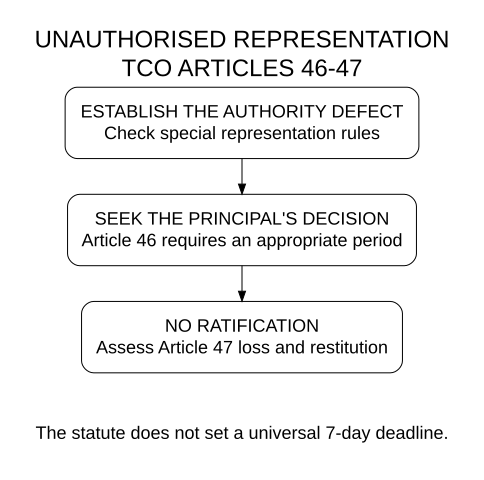
The counterparty that dealt with the unauthorised representative can ask the principal to state whether it approves the transaction within an appropriate period. Article 46 does not set a universal seven-day, fifteen-day or one-month period for that request. The period must be appropriate to the actual act and circumstances; it must not be invented from another procedure.
The request should identify the transaction and include the information needed for a meaningful decision. Send it to the principal through a verifiable channel and preserve its delivery. A request delivered only to the person whose authority is disputed can leave a separate dispute over whether the principal was asked at all.
Record the response period and the actual reply, including any conditions. Approval, rejection and an offer to sign a different agreement are not interchangeable. A document approving only a changed price or altered scope requires examination of what was actually accepted. Do not silently treat a proposed replacement bargain as confirmation of the original terms.
If the act is not approved within the appropriate period, Article 46 releases the counterparty from being bound by it. The provision supplies that consequence; it does not turn the lack of a reply into automatic approval. The next enquiry is whether losses, restitution or another remedy arise, not whether the original contract can be enforced against the principal without the missing approval.
Article 47: the representative’s liability is not automatic assumption of the contract
Where the principal gives neither express nor implied approval, Article 47 allows compensation to be sought from the unauthorised representative for loss caused by the act’s invalidity. The claim is directed at the legal consequence of the failed transaction. It should not be pleaded inaccurately as though the representative necessarily promised to perform every obligation originally attributed to the principal.
The calculation needs a causal explanation. Identify expenditure, commitments or other loss said to result from reliance on the transaction and show the connection with its invalidity. Preserve the supporting invoices, payment records and correspondence. A demand for the entire expected contract price is not a substitute for classifying and proving the loss covered by the applicable paragraph.
Article 47 provides a defence for the representative who proves that, when the act was performed, the other party knew or ought to have known of the absence of authority. The information supplied before signing therefore matters. An explicit requirement for headquarters approval, an expired authorisation or a disclosed limitation must be evaluated rather than omitted from the claim narrative.
The knowledge defence does not justify treating every counterparty as automatically aware of every internal restriction. It requires the relevant facts and proof. Separate what was communicated from what existed only inside the principal’s organisation. The same record can be important both to the preliminary scope-of-authority question and to the later Article 47 defence.
Fault, fairness and additional loss require a separate assessment
The second paragraph of Article 47 permits recovery of other loss from a culpable unauthorised representative when equity requires it. Fault and the equitable basis must therefore be addressed for that additional claim. The paragraph should not be converted into an automatic entitlement to all anticipated profit whenever approval is refused.
Identify the conduct said to be culpable and the additional loss separately from the ordinary invalidity loss. The account should make clear what has already been reimbursed and avoid counting one expense twice. A claim can be presented under alternative legal grounds, but alternative characterisations do not justify duplicate recovery.
A principal’s refusal to ratify is not, by itself, proof of criminal fraud by the representative. Any allegation of deception requires its own evidence and legal elements. Preserve suspicious communications and payment information without publishing accusations or treating the civil authority rule as a criminal finding.
Payments and benefits already transferred: unjust enrichment is preserved
Article 47 expressly reserves rights arising from unjust enrichment. When money or goods changed hands before the authority issue was resolved, identify the recipient and the legal basis on which it retained the benefit. The recipient might be the alleged principal, the representative or another person. The failed contract’s party label does not prove who actually received the value.
Separate restitution from compensation. Returning an advance and compensating an additional proved loss are different claims. Identify the sum paid, what was returned, what benefit was retained and the defendant responsible for each claim. Do not assume that a refusal to ratify means the principal can keep every benefit without any further legal analysis.
A transfer to an unintended recipient also needs a payment-specific review. Our mistaken-bank-payment guide addresses recipient identification and recovery evidence. The bank record should be preserved alongside the authority documents rather than treated as proof that the signatory was authorised.
Foreign principals and special representatives need the correct preliminary law
For an international transaction, first determine the law governing authority and the representative’s relationship with the counterparty. MÖHUK Article 30 provides the relevant connecting rules, including an express rule for the unauthorised representative and third person. An English governing-law clause in the proposed contract does not automatically answer every authority question.
Article 48 of the Code of Obligations preserves special rules for company representatives, organs and commercial agents. Corporate registry records, joint-signature requirements and applicable commercial provisions must consequently be examined before concluding that Article 46 supplies the result. Court representation and special transaction powers also need their own procedural analysis.
For an initial review, prepare the complete signed act, original authority, later changes, notices, approval correspondence and records of performance. Arrange them by date and actor. If a lawsuit or enforcement document has been served, preserve the service record and address its deadline separately. A pending request for ratification does not automatically suspend that procedural obligation.
Frequently asked questions
Does the principal have to perform an unauthorised contract?
Article 46 requires the principal’s approval where the act was genuinely unauthorised. First check the actual external authority, third-party protection and applicable special rules. A breach of an internal instruction is not automatically the same as lack of authority.
Does the person who signed become the buyer or borrower instead?
Not automatically under Article 47. That provision concerns loss caused by invalidity where approval is absent. A personal contractual undertaking, an undisclosed agency situation and liability for unauthorised representation require separate classification.
Is there a fixed seven-day ratification deadline?
No. Article 46 permits a request for a response within an appropriate period. The statute does not prescribe one universal number of days. Identify the actual request, its delivery and the circumstances supporting the period.
Does no reply mean the principal approved?
Article 46 provides that the counterparty is released if approval is not given within the appropriate period. Non-response is not stated to be automatic approval. Any separate allegation of implied ratification must be supported by the actual conduct.
Can approval be inferred from conduct?
Article 47 recognises express or implied approval. Identify the conduct, the transaction and the authority of the person responsible for it. Not every interaction or silence establishes ratification.
Can the representative rely on the counterparty’s knowledge?
Article 47 excludes the stated compensation claim where the representative proves that the other party knew or should have known of the absence of authority when the act occurred. Preserve the information actually supplied before contracting.
Is revocation inside a company enough against everyone?
Articles 42 and 45 contain protection rules concerning communicated authority and knowledge of its ending. Record notices to the representative and third persons separately. An internal decision alone does not resolve every external effect.
Does ratification cure a missing property-transfer form?
No general rule in Article 46 removes the underlying transaction’s statutory form. Authority, approval and compliance with a required official or written form are separate legal questions.
Can an advance be recovered when approval is refused?
Article 47 preserves unjust-enrichment rights. Identify who received the advance, any continuing legal basis and what has already been returned. Restitution and additional compensation should be calculated separately.
What records matter most for an overseas principal?
Keep the authority as it existed on the transaction date, the signed act, communications about powers and revocation, approval requests and performance records. Arrange a confidential channel before sending personal or commercial documents.
Official legal references
Turkish Code of Obligations No. 6098, Articles 40–48; official Ministry text on unauthorised representation; and Law No. 5718, Article 30. The English explanations are not an official translation; the Turkish statutory text controls.
Istanbul and Mersin offices
For an English-language review of a disputed signature, identify the alleged principal, the signatory, the transaction date and any approval or response deadline. Use the English contact section to arrange a confidential document channel. Our Mersin-based practice coordinates matters throughout Türkiye through offices in Mersin and Istanbul.
Istanbul — Polaris Plaza
Maslak Ahi Evran Caddesi, Polaris Plaza No:21, Floor 9, 34475 Sarıyer/İstanbul. Istanbul office information.
Mersin — Profit İş Merkezi
İhsaniye Mahallesi, 4903. Sokak, Profit İş Merkezi No:23, Floor 3, Office 14, 33070 Akdeniz/Mersin.
Call +90 552 224 43 66. General legal information; an enquiry does not establish representation or suspend a deadline.
Contact regarding a legal matter
In your first message, you may briefly state the subject, your country or city, and any relevant notification or recent procedural date. Please do not send identity numbers, medical data, or personal documents. Messaging alone does not constitute legal advice or create a lawyer–client relationship.
Discover more from Bakırcı & Keskin Hukuk Bürosu
Subscribe to get the latest posts sent to your email.