Harm from Unsafe Buildings in Turkey: Owner Liability and Prevention Under TCO 69–70
The owner of a building or other constructed structure must compensate damage caused by defective construction or inadequate maintenance under Article 69 of the Turkish Code of Obligations. The provision separately makes holders of usufruct and habitation rights jointly responsible with the owner for damage arising from maintenance deficiencies. Article 70 allows a person exposed to danger from another person’s structure to request the measures necessary to remove that danger before damage occurs. These rules are distinct from a purchaser’s contractual warranty claim against a developer and from the internal division of apartment-building expenses.
Have a general question about this article? Ask anonymously
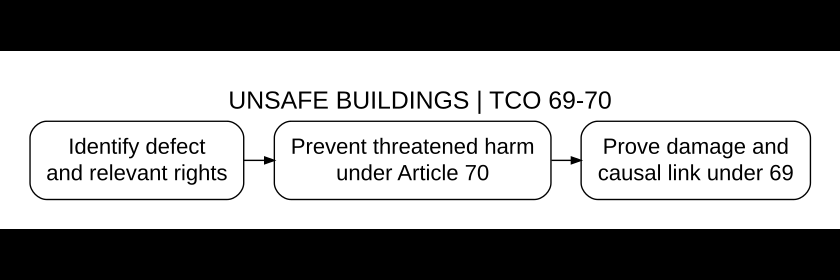
Identify the structure and the defect that caused the harm
Article 69 concerns a building or another constructed structure. The claim must identify the relevant physical feature and the construction defect or maintenance deficiency relied on. The fact that an incident occurred near a building does not establish those elements by itself.
Record the location, affected part, condition and event. Distinguish an allegation about how the structure was built from one about deterioration or omitted maintenance. A structural assessment should explain the mechanism connecting the condition with the loss rather than merely state that the premises were old or poorly managed.
The statutory source is Law No. 6098, Articles 69–70. The useful starting questions are what structure caused the danger, which defect is alleged, what harm followed and who held the relevant rights. An answer supported by dated records gives the legal reviewer a concrete basis for selecting the claim.
Ownership is not the same as occupation or management
Article 69 expressly identifies the owner. Establish ownership and any relevant limited property rights through the appropriate records for the period in issue. An occupant, caretaker, managing agent and registered owner can be different people. A contact name on the entrance notice does not necessarily identify the defendant for the statutory owner claim.
Where a company owns the property, use its correct legal identity rather than the trading name of a tenant’s business. Where several people hold rights, identify the nature of those rights instead of treating every person associated with the address as automatically liable for the entire loss.
An owner living abroad does not cease to be an owner because maintenance was entrusted to a local representative. The representative’s duties and the owner’s possible claim against that person are separate questions. Our agent accounting guide addresses a related internal relationship, not a replacement for Article 69’s liability framework.
The statutory claim is not confined to the owner’s personal building work
Article 69 appears within the Code’s no-fault liability framework and links the owner’s responsibility to defective construction or insufficient maintenance. The injured person does not have to recast every claim as proof that the owner personally designed, installed or repaired the defective part.
That does not make ownership alone sufficient for compensation. The relevant defect, damage and causal connection remain central. Evidence that the owner did not personally carry out the work answers a different question from evidence that the alleged defect did not exist or did not cause the harm.
A contract allocating maintenance to somebody else should be retained, but it does not automatically resolve the injured third party’s Article 69 claim. The statute expressly preserves recourse against others responsible to the person who pays. The external claim and the internal allocation must be analysed separately instead of assuming that outsourcing maintenance removes every obligation towards the victim.
Usufruct and habitation holders have a defined additional exposure
The second paragraph of Article 69 makes usufruct and habitation-right holders jointly and severally responsible with the owner for damage caused by maintenance deficiencies. The wording concerns those identified property rights. It should not be extended automatically to every tenant, visitor or family member living in the building.
The paragraph also specifies maintenance deficiencies. A legal explanation should not silently substitute all construction defects for that stated basis of their joint responsibility. Other grounds of liability can require separate examination, but their elements should be identified rather than attributed to this paragraph without analysis.
Obtain the documents establishing the right and the technical evidence classifying the defect. A dispute about whether deterioration resulted from missing maintenance can affect both the responsible persons and their internal claims. It cannot be resolved solely by listing everyone who used the property.
Article 70 allows prevention before someone is injured
A person facing danger of damage from another person’s building or structure can request necessary measures from the relevant rights holders under Article 70. Waiting for a piece to fall or for water to damage neighbouring property is not a condition stated in that provision. The legal objective is removal of the identified danger.
A prevention request should describe the threatened person or property, the structure, the observed condition and the measure sought. Preserve earlier reports and responses. A general demand that a neighbour improve the appearance of a building is different from a supported request to remove a danger of harm.
The requested measure must be linked to the risk. An assessment explaining the source and seriousness of the danger is more useful than an unexplained demand for total reconstruction. The legal and technical reviews should distinguish immediate protective action from permanent remedial work.
Public safety measures remain a separate channel
Article 70 expressly reserves public-law rules protecting persons and property. The private prevention right does not replace a competent authority’s safety powers, and a report to an authority does not by itself establish a final civil compensation award.
Where danger is immediate, protecting people takes priority over obtaining the perfect photograph or negotiating costs. Keep the records of official notifications, inspections and measures without entering a dangerous area to create evidence. The legal article does not authorise unsafe access or unapproved demolition.
Different decisions can serve different purposes. An administrative safety finding, a private technical opinion and a court expert report should be described by what each actually establishes. A document ordering a precaution is not necessarily a final determination of every person’s civil share of responsibility.
Preserve the physical evidence before repair changes it
The relevant condition can disappear when a wall, fitting, pipe or other component is repaired. Record the condition, damage pattern and work proposed before evidence is altered, insofar as this can be done safely and lawfully. Retain removed components or technical observations where their preservation is appropriate.
Our evidence-preservation guide addresses the procedure for recording facts that risk disappearing. That procedure is distinct from a damages judgment or a preventive order. The application should identify the fact that needs preservation rather than assume one examination resolves the whole dispute.
Keep the repair contractor’s records, invoices, photographs and explanation of what was replaced. A final invoice alone can leave the original cause unclear. Conversely, a claimant should not refuse necessary safety work solely to preserve a hazardous condition; the evidence strategy and protective action need to be coordinated.
The damage schedule must connect each loss with the defect
Separate physical property damage, repair expenditure, lost use and any other claimed loss. Identify the owner of the damaged item, its earlier condition and the documents supporting the amount. A quotation and a paid repair invoice have different evidential roles, and neither automatically proves every consequential claim.
Article 50 allows the judge to assess the amount equitably where it cannot be proved precisely, taking account of the ordinary course of events and the injured person’s precautions. That provision is not permission to invent an unsupported total. Preserve the evidence reasonably available and explain why any remaining amount cannot be established exactly.
Article 51 governs the assessment and form of compensation. The claim should distinguish an amount requested from an amount already judicially established. A demand letter carrying a precise figure does not make the figure conclusive merely because the owner has not immediately answered.
Bodily injury requires its own evidence and categories
Article 54 identifies bodily-injury losses including treatment expenditure, lost earnings, reduced or lost working capacity and impairment of economic prospects. These items should not be replaced with a single arbitrary daily rate. Their relevance and amount depend on the injury and supporting records.
Article 56 separately addresses non-pecuniary compensation for injury and, in cases of serious bodily harm or death, the position of relatives. It does not set a universal award based solely on nationality or the location of the property. A legal assessment must distinguish the injured person’s own claim from another person’s independently recognised claim.
Retain medical and income evidence through lawful channels. This is a legal evidence requirement, not medical advice. Emergency treatment should never be delayed to obtain a report for litigation, and a later translated summary should be accompanied by the original records on which it relies.
The injured person’s conduct can affect compensation
Article 52 allows reduction or removal of compensation where the injured person consented to the harmful act, contributed to the occurrence or increase of the damage, or aggravated the liable person’s position. The conduct and its causal significance must be identified rather than invoked as a standard denial in every building incident.
A warning notice can be relevant evidence, but its existence does not automatically answer every question about the defect or the person’s conduct. Record where the warning was, what it said and whether it relates to the actual danger. A general instruction to be careful should not be treated as proof that the victim caused the entire loss.
The same care is required when calculating increased damage. Identify what additional loss is said to have resulted from an avoidable act after the incident. The distinction prevents a debate over later mitigation from obscuring responsibility for the original harm.
Recourse against contractors or maintenance providers is preserved
Article 69 expressly preserves the responsible persons’ rights of recourse against others who are liable to them on account of the same circumstances. A building owner who pays a qualifying claim can therefore need a separate examination of the construction, maintenance or management relationship.
Preserve the contracts, work orders, inspection records and notices necessary for that internal claim. The existence of recourse does not establish its amount automatically. The other person’s duty, breach, applicable limits and the loss being passed on must be identified.
Articles 61–62 address multiple responsibility for the same damage and internal allocation, considering the circumstances, fault and danger created. Their tort-allocation framework should not be confused with an unsupported assumption that every contractor and owner always bears an equal share. The joint-debtor guide explains the broader external-versus-internal distinction.
Limitation requires a chronology, not just the building’s age
Article 72 states the general tort limitation periods: two years from learning of the damage and the person liable, and in any event ten years from the act. It also preserves the longer criminal-law limitation where the compensation arises from an act requiring punishment and the criminal legislation provides a longer period.
The act, damage, knowledge and potentially continuing condition must be legally characterised in the actual case. The construction date alone should not be advertised as a universal expiry date for every later maintenance or structural claim. Different asserted grounds can require separate time calculations.
For internal recourse, Article 73 has its own starting events and a notification rule. A person asked to pay compensation should not leave the potential co-responsible parties uninformed while assuming all later recourse periods remain unaffected. Obtain the relevant demand, payment and knowledge records before giving a deadline conclusion.
Prepare an overseas owner’s or injured person’s file
The core dossier should identify the structure, rights holders, alleged defect, event and damage. Add technical reports, photographs, maintenance records, prevention requests, repairs, insurance communications and payments. Keep the victim’s claim separate from the owner’s proposed claim against a contractor.
An insurance policy should be reviewed for its actual coverage, notice and settlement provisions. Opening an insurance file is not proof that liability has been admitted or that the full civil claim is insured. Record payments and outstanding items accurately to prevent double recovery.
Where a court or enforcement document has been served, preserve its complete contents and service record. A request for a technical report or an ongoing repair discussion does not itself replace the procedural response. The court-expert report guide addresses a separate stage when an expert opinion in proceedings needs to be challenged.
Frequently asked questions
Must the owner personally have built the defective structure?
Article 69 links owner liability to defective construction or inadequate maintenance, not only to work personally performed by the owner. The defect, damage and causal connection still need to be established.
Does every accident near a building establish liability?
No. Identify the building or structure, the construction or maintenance defect and the damage caused by it. Location alone does not establish all elements.
Are usufruct and habitation holders also responsible?
Article 69 makes those rights holders jointly responsible with the owner for damage arising from maintenance deficiencies. That paragraph should not be extended automatically to every occupant.
Can action be requested before damage occurs?
Yes. Article 70 allows a person facing danger from another person’s structure to request the measures necessary to remove the danger from the relevant rights holders.
Does a maintenance contract automatically remove the owner’s exposure?
The internal arrangement does not by itself resolve the injured person’s statutory claim. Article 69 separately preserves recourse against others responsible to the paying party.
Should repairs wait until a damages lawsuit ends?
Safety and evidence preservation must be coordinated. Record the relevant condition through the appropriate lawful process rather than maintain a danger solely for litigation.
Can the victim’s conduct affect compensation?
Article 52 permits reduction or removal in its stated circumstances, including contribution to the damage or its increase. The actual conduct and causal effect must be assessed.
Is the building’s construction date the only limitation date?
No universal calculation follows from age alone. Article 72 requires analysis of the act, damage, knowledge of the liable person and any applicable longer criminal-law period.
Does an official safety report automatically award compensation?
No. Public safety measures and the private compensation claim serve different purposes. The report’s findings must be connected with the elements and amount of the civil claim.
What evidence should a foreign owner or injured person retain?
Keep rights records, technical evidence, maintenance and repair documents, damage records, notices, payments and any served proceedings. Separate external compensation from internal recourse.
Official legal sources
Turkish Code of Obligations No. 6098, Articles 50–56, 61–62 and 69–73; official Ministry text, pages 13–14, containing the structure-liability and limitation rules. This English guide does not replace the Turkish statutory text.
Ask about a building-related risk or loss
Identify the structure, the danger or damage, the event date and your role as owner or affected person. Do not include sensitive identity or medical documents in the initial enquiry.
Istanbul and Mersin offices
Bakırcı & Keskin Law Office is Mersin-based and coordinates Turkish matters from Istanbul and Mersin. Arrange a confidential channel for title, technical and claim records.
Istanbul — Polaris Plaza
Maslak Ahi Evran Caddesi, Polaris Plaza No:21, Floor 9, 34475 Sarıyer/İstanbul. Istanbul office directions.
Mersin — Profit İş Merkezi
İhsaniye Mahallesi, 4903. Sokak, Profit İş Merkezi No:23, Floor 3, Office 14, 33070 Akdeniz/Mersin. Mersin office directions.
Call +90 552 224 43 66. General information; an enquiry does not establish representation or suspend a deadline.
Contact regarding a legal matter
In your first message, you may briefly state the subject, your country or city, and any relevant notification or recent procedural date. Please do not send identity numbers, medical data, or personal documents. Messaging alone does not constitute legal advice or create a lawyer–client relationship.
Discover more from Bakırcı & Keskin Hukuk Bürosu
Subscribe to get the latest posts sent to your email.