Business Partner Withholding Accounts in Turkey: Ordinary Partnership Rights
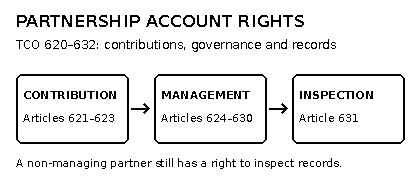
A non-managing partner in a Turkish ordinary partnership still has a statutory right to information and access to the partnership’s records. Article 631 of the Turkish Code of Obligations protects inspection, copies and a financial summary, and makes contrary agreements absolutely void. Article 630 separately requires the manager to account and pay profit shares at least once a year; an agreement extending that accounting period is also invalid. Those rights should be assessed after establishing that the relationship is an ordinary partnership, rather than a loan, a company shareholding or a contract with an independent agent.
Have a general question about this article? Ask anonymously
Establish the partnership before demanding a partner’s rights
Article 620 of Law No. 6098 defines an ordinary partnership as an agreement by two or more persons to combine their efforts and assets to attain a common purpose. It also brings a partnership that lacks the distinguishing characteristics of another statutorily regulated partnership within this framework. The agreement’s substance is therefore more important than an informal business label.
For an overseas participant, the initial question is what the transferred money represented. A capital contribution, a recoverable advance, the purchase price of company shares and a personal loan have different legal consequences. Bank records should be read with the agreement, negotiations and conduct showing the common purpose and the parties’ commitments.
This guide concerns an adi ortaklık, not the statutory information rights of a shareholder in an incorporated limited company. The limited-company management guide addresses that separate structure. A company registration or a share-transfer instrument should not be ignored simply because the parties also call one another partners.
Contributions can take forms other than cash
Article 621 allows a contribution consisting of money, a claim, another asset or labour. Unless the agreement states otherwise, contributions must be equal and of the significance and nature required by the partnership’s purpose. The file should identify the contribution each person undertook, its agreed value where applicable and evidence of actual performance.
The same provision distinguishes giving the use of an item from transferring its ownership. Lease rules are applied by analogy to a contribution consisting of use; sale rules on risk, defects and third-party title claims are applied by analogy when ownership is contributed. That distinction later affects how the assets and obligations are understood.
Maintain a contribution record separate from later operating expenditure. Money paid after formation can be an additional contribution, an advance or reimbursement of a particular cost, depending on the arrangement. Treating every payment as more capital can produce an incorrect profit calculation and obscure a partner’s independent claim for an advance.
Profit percentages do not automatically follow the size of an investment
Article 622 requires partners to share gains that belong by their nature to the partnership. Article 623 then provides the allocation rule: unless otherwise agreed, each partner’s share of gains and losses is equal regardless of the value and nature of the contribution. A larger transfer of money does not automatically establish a larger contractual percentage under that default.
Where the agreement fixes only the profit share or only the loss share, Article 623 treats that allocation as applying to the other as well. Record the exact wording. A financial model prepared by one partner after the dispute began is not necessarily evidence of an agreement changing the statutory position.
An agreement that a partner participates only in profits and not losses is valid under Article 623 only for a partner whose contribution consists solely of labour. This qualification should be checked before promising that a cash contributor bears no partnership risk. The contractual terms and the actual nature of the contribution need to be assessed together.
Decision-making and day-to-day management are separate
Article 624 requires partnership decisions to be unanimous. Where the contract provides for majority decision-making, the majority is determined by the number of partners. A voting system based on amounts invested should not be assumed merely from a contribution schedule. Identify the agreed decision mechanism before treating a message from the largest contributor as a partnership decision.
Article 625 separately gives all partners management rights unless the contract or a decision entrusts management to one or more partners or a third person. Where several partners manage, each can act without the others’ participation, but another authorised manager can prevent the act by objecting before it is completed. Timing is therefore material to a management objection.
Appointing a general representative and conducting extraordinary business require unanimity, subject to the article’s exception for urgent circumstances in which delay is harmful. An ordinary purchase, an extraordinary transaction and a change to the management structure should not be placed in one undifferentiated approval category. The relevant decision and authority records should show which act was authorised.
Removal of a manager needs its own legal basis
Under Article 629, management authority given to a partner by the partnership contract cannot be removed or restricted by the others without just cause. A disagreement about commercial strategy therefore does not automatically establish a right to disregard the agreed manager. The basis and seriousness of the alleged problem must be identified.
The article permits each of the other partners to revoke authority for just cause even where the agreement calls it irrevocable. It particularly identifies substantial neglect of duties and loss of the ability needed for sound management. An irrevocability clause is consequently not a complete answer to a supported serious management failure.
Keep the removal question separate from exclusion from the partnership. Taking away management authority does not, by that act alone, explain whether the person’s partnership status or economic rights have ended. A notice should state precisely which right is being exercised and why, rather than use a general instruction that the person is no longer involved in anything.
Annual accounting is a mandatory minimum under Article 630
Article 630 generally applies mandate rules to the manager’s relationship with the partners unless this part of the Code or the partnership agreement provides otherwise. It then expressly requires managers to account and pay partners’ profit shares at least once each year. The same rule applies when the manager is not a partner.
An agreement extending that accounting period is absolutely void. A clause saying that no accounts will be provided until a long project ends should therefore be examined against the statutory annual requirement. The project timetable and the duty to account are not automatically identical.
An account should be distinguishable from a statement that the business is doing well or needs more cash. The underlying records must make the income, expenditure, assets, liabilities and relevant profit calculation intelligible. The exact scope of any payment claim follows the established accounts and allocation; the annual duty does not guarantee a positive profit where none exists.
Article 631 protects access even without management authority
Every partner may obtain information about the partnership’s operation, inspect its books and records, take copies and prepare a summary of its financial position. Article 631 expressly gives these rights even to a person without management authority. A manager cannot defeat the statutory entitlement merely by describing the other participant as passive or overseas.
Contrary agreements are absolutely void. A purported waiver in a standard investment document should therefore not be accepted as a complete reason to refuse all inspection. At the same time, the request should concern the partnership’s affairs and records. A right to inspect the partnership is not an unrestricted entitlement to unrelated private information belonging to another person.
A practical request identifies the accounting periods and categories needed: bank statements for partnership transactions, invoices, contracts, asset records, loan or advance entries and distribution schedules. Clear scope makes compliance measurable. It also allows the record to show exactly what was requested, what was supplied and which items remain missing.
Inspection, accounting and payment are three different objectives
An inspection request seeks access to existing information. An accounting demand seeks a structured explanation of the manager’s dealings. A profit claim seeks payment of the amount established as due. These objectives support one another, but a single unsupported demand for a round figure does not necessarily answer all three.
| Objective | Primary provision | Useful record |
|---|---|---|
| Inspect books and obtain copies | Article 631 | Specific request and the response or refusal |
| Receive the annual account | Article 630 | Accounting periods, management records and previous accounts |
| Establish the profit allocation | Articles 622–623 | Partnership terms and supported income-and-expense calculation |
| Recover an advance or expense | Article 627 | Payment, purpose, authorisation and reimbursement history |
| Address misconduct | Articles 626, 628–629 | The duty, conduct, loss and proposed remedy |
The record should distinguish an unavailable document from a disputed interpretation of a document already supplied. That distinction helps frame the appropriate court request and avoids claiming that every accounting disagreement is a total refusal of information. Where expert examination is required, preserve the original electronic records and their supporting documents.
Expenses, advances and additional work need separate entries
Article 627 makes the other partners responsible towards a partner for expenditure incurred or obligations assumed for partnership affairs. It also addresses direct losses arising from management work and losses resulting from management risks. The connection with partnership business must be established; personal expenditure is not transformed into a partnership debt merely because a partner paid it.
A partner who advances money to the partnership can request interest from the date of the advance. A partner who contributes work to partnership affairs despite not being obliged to do so can request a payment required by fairness. These statutory rules distinguish an advance and extra work from the contribution originally promised.
For each claimed item, record the payer, amount, date, purpose, supporting document and whether reimbursement already occurred. Keep original currency and conversion calculations visible. A consolidated account that silently combines capital, expenses, advances and profit distributions prevents both sides from checking the legal basis of the balance.
Competition and lack of care are not excused by unrelated successes
Article 626 prohibits partners from conducting, for themselves or third persons, business that obstructs or harms the partnership’s purpose. A misconduct claim should identify the competing or harmful activity and its relationship to the agreed purpose. The fact that a partner has another business does not dispense with that statutory connection.
Article 628 requires each partner to exercise the effort and care used in their own affairs. It also requires a partner to compensate the others for damage caused by that partner’s fault without setting off benefits produced for the partnership in other business. A profitable project is therefore not automatically a defence to a separate culpable loss.
A partner managing for remuneration is responsible under mandate rules. The agent-accounting guide addresses related duties under that framework. Article 630 also applies the rules on work without mandate where an unauthorised partner intervenes or an authorised manager exceeds authority; the unauthorised-work guide explains that separate question.
A partner cannot unilaterally admit a new partner
Article 632 requires all partners’ consent to admit a new partner. A partner who unilaterally gives a third person participation in their share or transfers the share does not thereby make that person a partner. This matters when an overseas investor is told that a private purchase from one participant automatically grants inspection rights against everyone else.
Obtain the admission agreement and the consents, not only the bilateral payment document. An economic arrangement with one partner and membership of the partnership are legally different. The person requesting Article 631 access must establish the partnership status relied on, while any contractual claim against the transferring participant requires its own assessment.
Likewise, an individual partner’s representation of the others is governed by Articles 637–638 and the relevant authority rules. The right to receive accounts does not automatically confer authority to sign every external contract. Our representation guide explains why the capacity in which an agreement was signed remains important.
Preparing a records dispute from outside Turkey
Start with proof of the relationship, the common purpose, agreed contributions and management arrangements. Add bank records, previous accounts, profit payments and the request-and-response history. A short chronology should identify when access stopped and which records are still controlled by the manager or another participant.
Preserve lawful access routes. Article 631 does not authorise breaking into a partner’s personal email or obtaining passwords without permission. Request the relevant partnership records and use appropriate legal measures where access is refused. A valid substantive entitlement does not make every method of collecting information lawful.
The applicable law and legal structure require particular care in cross-border joint ventures. A foreign document using the word partnership can describe a different entity or relationship. Once the Turkish ordinary-partnership basis is established, the information claim, account and payment calculation can be framed consistently. Served court or enforcement documents still require their own timely response.
Frequently asked questions
Can a passive partner inspect the partnership’s records?
Yes. Article 631 protects information, inspection, copies and a financial summary even where the partner has no management authority.
Can the agreement remove those inspection rights?
Article 631 makes contrary agreements absolutely void. The claimant must still establish partnership status and identify records relating to the partnership.
How often must the manager account?
Article 630 requires accounting and payment of profit shares at least annually. An agreement extending the accounting period is invalid, and the rule also applies to a non-partner manager.
Does the largest cash contributor automatically receive the largest profit share?
No. Article 623 provides equal shares by default, irrespective of the value or type of contribution. A different agreed allocation must be established.
Can a cash contributor agree to profits without losses under Article 623?
The article validates a profits-only arrangement only for a partner contributing solely labour. The actual contribution and agreement require review.
How are partnership decisions normally taken?
Article 624 starts with unanimity. If the contract permits a majority, it is determined by partner numbers. Day-to-day management follows the separate Article 625 rules.
Can an irrevocable management appointment be challenged?
Article 629 permits revocation for just cause despite an irrevocability clause. Significant neglect and loss of the ability required for good management are expressly identified grounds.
Is a partner’s advance the same as a capital contribution?
Not necessarily. Article 627 separately addresses advances and permits interest from the advance date. The payment’s agreed purpose must be identified.
Does buying one partner’s share automatically make me a partner?
No. Article 632 requires all partners’ consent for admission. A unilateral transfer or sub-participation arrangement does not itself confer partnership status.
Does an accounting demand guarantee a profit payment?
No. Accounting establishes the financial position. A payment claim depends on the supported account and applicable allocation, not an assumed positive profit.
Official legal sources
Turkish Code of Obligations No. 6098, Articles 620–632, with Articles 637–638 for the separate external-representation issue; official Ministry text, pages 127–130. This English explanation does not replace the governing Turkish text.
Ask about partnership records
State your role, the accounting periods requested and whether a written refusal was received. Do not submit banking credentials or confidential account records in the initial message.
Istanbul and Mersin offices
Bakırcı & Keskin Law Office is Mersin-based and works throughout Türkiye with an Istanbul and Mersin focus. Arrange a confidential channel for the partnership agreement and accounting documents.
Istanbul — Polaris Plaza
Maslak Ahi Evran Caddesi, Polaris Plaza No:21, Floor 9, 34475 Sarıyer/İstanbul. Istanbul office directions.
Mersin — Profit İş Merkezi
İhsaniye Mahallesi, 4903. Sokak, Profit İş Merkezi No:23, Floor 3, Office 14, 33070 Akdeniz/Mersin. Mersin office directions.
Call +90 552 224 43 66. An enquiry does not establish representation or suspend a legal deadline.
Contact regarding a legal matter
In your first message, you may briefly state the subject, your country or city, and any relevant notification or recent procedural date. Please do not send identity numbers, medical data, or personal documents. Messaging alone does not constitute legal advice or create a lawyer–client relationship.
Discover more from Bakırcı & Keskin Hukuk Bürosu
Subscribe to get the latest posts sent to your email.