When an Employee Harms a Customer or Third Party in Turkey: Employer Liability Under TCO 66
A business cannot answer every injury or property-loss claim by saying that an individual employee, rather than the owner, caused the event. Article 66 of the Turkish Code of Obligations makes the person employing another responsible for harm caused to others during performance of the assigned work. It provides a defence based on the necessary care in selection, instructions, supervision and control, and separately addresses the organisation of an operating business. The victim’s claim against the employer must be distinguished from the employer’s later recourse against the employee, which the statute limits to the employee’s own responsibility.
Have a general question about this article? Ask anonymously
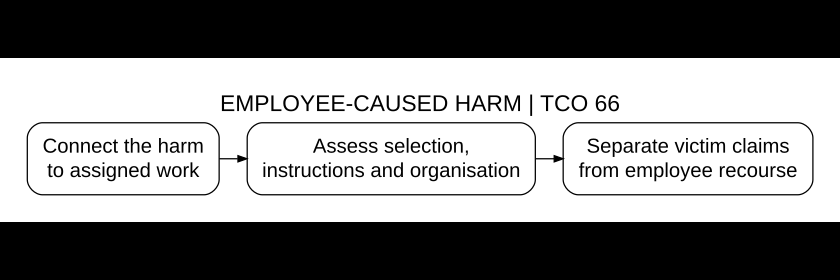
This is a third-party harm claim, not automatically an employment claim
Article 66 concerns damage an employee causes to other people while carrying out assigned work. The person injured can be outside the employment relationship. A customer-facing incident therefore needs a different starting analysis from an employee’s own wage claim or an accident in which the worker is the injured claimant.
Identify the injured person, the person who performed the act, the person employing them and the work being done. A company brand, uniform or premises address is relevant evidence but does not always identify the correct legal entity. A group can contain several businesses operating under similar names.
The primary rule is Law No. 6098, Article 66. It should be applied to the actual relationship and event. Merely placing the words employer liability in a demand does not establish which undertaking employed the person, what work was assigned or how that work caused the loss.
The connection with assigned work must be established
The statutory wording refers to harm caused during performance of the task given to the employee. The incident’s location and clock time are useful but not a complete substitute for that connection. Describe the activity being carried out and its relationship with the employer’s work.
Preserve the service order, delivery or attendance record, customer communications, work allocation and relevant incident report. The evidence should explain what the person was supposed to do and what happened in carrying out that task. A general description of the employee’s job title can leave the operative activity unclear.
Separate facts observed directly from later assumptions. A witness who saw damaged property after the event cannot necessarily explain the act that caused it. Conversely, an incomplete identification of the individual employee should not lead to destruction of records that could establish the employer’s work arrangement and the incident chronology.
Article 66 contains a defined due-care defence
The person employing another avoids responsibility under the provision by proving the necessary care to prevent the damage in choosing the employee, giving work-related instructions, supervising and controlling the work. The defence concerns actual care connected with preventing the loss, not simply a statement that the business generally values safety.
Selection should be examined in relation to the task. Instructions should correspond to the work and its relevant risks. Supervision and control need evidence of what was actually implemented. A signed general handbook can be relevant, but its existence does not by itself establish that the particular work was properly instructed and supervised.
The record should show the position before and during the incident, not only measures introduced afterwards. Later improvements can explain remedial action; they do not automatically prove the earlier system was adequate or inadequate. Keep the dates and purposes of each record clear.
Business organisation is an additional statutory issue
For a person employing staff in a business, Article 66 also requires proof that the working organisation was suitable to prevent the damage. The provision addresses the operation as a whole. Selecting a competent individual is not the same as establishing an adequate system for that person to perform the assigned work.
The review should identify the relevant workflow, allocation of responsibility, access to tools and information, handover arrangements and control steps. Those matters must be tied to the event rather than assessed through an unrelated description of the company’s size or reputation.
Read the personnel-care paragraph and the business-organisation paragraph together. Neither should disappear from the analysis merely because the other has been addressed. A business disputing liability needs a reasoned explanation of the statutory requirements it relies on and the evidence supporting that explanation.
A practical evidence map for the liability assessment
| Issue | Relevant record | What it helps establish |
|---|---|---|
| Assigned work | Order, task allocation and service record | The connection between the employee’s activity and the business |
| Selection and instruction | Role requirements, training and actual instructions | Care appropriate to the work undertaken |
| Supervision | Checks, reporting and handover records | How the task was controlled in practice |
| Organisation | The relevant workflow and responsibility allocation | Whether the system was suitable to prevent the harm |
| Loss | Condition evidence, assessments and payment records | The harm, amount and connection with the event |
The map is not a requirement to disclose every employee record publicly. Evidence should be preserved and obtained through lawful channels, with personal information handled appropriately. A litigation need does not authorise unauthorised access to accounts, recordings or unrelated personnel files.
Where a record is unavailable, identify that gap honestly. A reconstructed account should state its source and preparation date. Retrospectively creating a training acknowledgement as though it existed before the incident would undermine the factual record rather than cure it.
Contractual assistants fall under a different provision
Article 116 concerns a debtor who entrusts performance of an obligation, or exercise of a right arising from an obligation, to assistants. It requires compensation for harm those assistants cause to the other contracting party while doing the work. That contractual framework is not identical to Article 66’s employer liability.
The same incident can therefore require identification of both the contract and the employment-related act. The victim’s relationship with the business matters. A business should not assume that satisfying one proposed defence necessarily answers every distinct legal ground available on the same facts.
The liability-exclusion and assistants guide explains Articles 115–116 separately. Its rules on agreements excluding liability must not be imported mechanically into Article 66. The legal source of the claim should be stated before interpreting the effect of a disclaimer.
Outsourcing requires examination of the actual relationships
An invoice describing someone as a contractor does not resolve every question about who employed, instructed or controlled the relevant person. Equally, hiring an independent business does not automatically make every person in that business the customer’s employee. The relationships and the legal ground asserted must be established from the facts.
Obtain the service agreement, subcontract, task allocation and communications relevant to the incident. Identify which party undertook the obligation to the injured person and which party organised the work. A contract between two businesses can be relevant to internal allocation without conclusively resolving the third party’s claim.
The review should avoid naming every company in the contracting chain as automatically liable for the same amount. Different defendants can be responsible on different grounds, and each ground needs its own factual basis. The purpose of the document map is to identify those grounds rather than replace proof with a long list of names.
The damage and causal connection remain separate requirements
The employment relationship does not establish the amount of loss. Identify the damaged property or injury, the event causing it and the supporting valuation or expenditure. A customer complaint can establish that a report was made; it does not necessarily prove every figure included in the report.
Articles 50–51 govern proof and assessment of damage. Where an exact amount cannot be proved, Article 50 allows assessment in light of the ordinary course of events and the injured person’s precautions. It does not dispense with the need to preserve reasonably available evidence.
Article 52 also permits reduction or removal of compensation in its stated circumstances, including the injured person’s contribution to the loss or its increase. The alleged contribution must be connected with the event. It should not be raised as a generic accusation merely because the claimant was present when the employee acted.
Several responsible persons do not create several recoveries for the same loss
Article 61 applies joint-and-several responsibility where several persons together cause damage or are responsible for the same damage on different legal grounds. The claimant’s external position must be distinguished from the allocation between those responsible.
Article 62 directs internal allocation by considering all circumstances, particularly the gravity of the fault attributable to each and the intensity of the danger created. It provides recourse and subrogation for a person who paid more than the share that person should bear. Equal division is not an automatic substitute for that statutory assessment.
Our joint-debtor guide explains the broader distinction between an external claim and internal contribution. Payments from the employee, employer, insurer or another responsible person must be reconciled against the same loss to avoid demanding an already satisfied amount again.
The employer’s recourse against the employee is limited
The final paragraph of Article 66 allows the employer to recover compensation paid from the employee only to the extent the employee is personally responsible. The employer’s payment to a customer is therefore not, without further analysis, proof that the employee owes the employer every lira paid.
Identify the employee’s act, personal responsibility and the loss actually discharged. A commercial settlement can include concessions or items beyond the employee’s established liability. Its amount should not automatically be treated as a binding assessment against a worker who was not party to the settlement.
The employer’s own organisational contribution also needs examination. The statutory distinction would be lost if every cost of an inadequate business system were simply transferred to the individual employee. Keep the victim’s settlement and the proposed recourse calculation as separate documents with separate explanations.
Article 400 requires the work and the employee’s characteristics to be considered
Under Article 400, an employee is responsible for damage caused to the employer through the employee’s fault. In determining that responsibility, the Code requires consideration of whether the work is dangerous, whether it calls for expertise and training, and the employee’s abilities and qualities known or required to be known by the employer.
Those factors are directly relevant when assessing a proposed recovery after a third-party payment. The record should identify the task, the training needed and the employee’s actual role. A standard clause stating that all customer complaints will be charged to staff does not replace the statutory assessment.
The employee should have access to the factual allegation and calculation through the appropriate process. A deduction labelled damage recovery should not conceal a dispute about whether damage occurred, whether the employee caused it or whether the employer has already been compensated by insurance.
Recourse does not create unrestricted authority to deduct wages
Article 407 generally prohibits setting off the employer’s claim against wages without the employee’s consent. Its exception concerns damage intentionally caused by the employee and established by a court decision, with set-off limited to the attachable part of wages. Those requirements should not be omitted from an explanation of damage recovery.
A manager’s conclusion that the worker was careless is not the same as a judicially established intentional-damage claim. Nor does the existence of a customer invoice establish the required consent or the permissible amount of set-off. The proposed method of collection needs its own review even where some substantive recourse is supported.
The set-off guide explains the general mechanism. Wage protection and any applicable special employment provisions must also be respected. A civil claim and a payroll adjustment are not interchangeable procedures.
Preserve the incident record without prejudging liability
An incident report should state who observed what, the relevant times and the records available. Separate direct observations, statements by others and conclusions requiring technical assessment. An apology or an offer to inspect should be read in context rather than automatically described as admission of every legal and financial allegation.
Where damaged property will be repaired or discarded, preserve the relevant condition through the appropriate lawful method. Our evidence-preservation guide explains that separate procedure. A business should also retain relevant instructions and control records instead of keeping only the final customer complaint.
The same approach protects both sides. It permits an injured person to substantiate a claim and an employer to demonstrate a defence without inventing facts. The objective is a traceable account of the work and loss, not a narrative prepared solely to shift all responsibility to whichever participant has fewer documents.
Limitation, insurance and proceedings require their own checks
Article 72 provides the general tort limitation framework, including the two-year knowledge period, the ten-year period from the act and the stated longer criminal-law exception. Article 73 separately regulates recourse periods and notification to co-responsible persons. The victim’s claim and the employer’s later claim should not automatically be assigned the same starting date.
An insurance policy must be read for its actual coverage, exclusions and notice obligations. A policy’s existence does not establish that the insurer has accepted this incident or that the whole claim is insured. Keep payment records so the outstanding amount remains clear.
For a foreign claimant or business, provide original records with translations and identify the correct legal entities. Include every served court or enforcement document and its service date. An internal investigation or insurance negotiation does not itself replace the procedural response required in the existing case.
Frequently asked questions
Can the employer deny responsibility simply because an employee acted?
No. Article 66 addresses harm caused during assigned work and provides a defined care and organisation framework. The incident and statutory defence must be examined.
Is being at work enough to establish the required connection?
Location and time are relevant but do not replace analysis of the assigned task and how the harm arose during its performance.
What does the Article 66 care defence cover?
It concerns necessary care in selection, work instructions, supervision and control to prevent the damage. The business-organisation paragraph must also be considered.
Does hiring a qualified worker prove adequate organisation?
Not by itself. Article 66 separately addresses whether the business’s working arrangement was suitable to prevent the harm.
Is Article 66 the same as liability for a contractual assistant?
No. Article 116 regulates assistants used in performance of an obligation towards the other contracting party. The legal basis and relationship must be identified separately.
Can the employer recover every settlement payment from the worker?
Article 66 limits recourse to the employee’s own responsibility. The settlement amount does not automatically establish that internal liability.
What factors does Article 400 require for employee responsibility?
The work’s danger, required expertise and training, and the employee’s abilities and qualities known or required to be known by the employer must be considered.
Can a disputed damage claim simply be deducted from wages?
Article 407 generally requires consent for set-off against wages. Its specified intentional-damage exception requires a court decision and is limited to the attachable portion.
Does an insurance file suspend the claimant’s procedural deadline?
Not by itself. Insurance handling and the response required by a served court or enforcement document are separate matters.
What records should be supplied for an international claim?
Provide task and service records, the employer’s identity, incident evidence, relevant care and organisation records, the damage calculation and any served proceedings.
Official legal sources
Turkish Code of Obligations No. 6098, Articles 50–52, 61–62, 66, 72–73, 116, 400 and 407; official Ministry text, pages 12–13, containing Article 66. The English explanation is not an official translation.
Ask about employee-caused third-party harm
Identify your role, the assigned work, the event and any urgent claim date. Do not send sensitive personnel, identity or medical documents through the initial enquiry.
Istanbul and Mersin offices
Bakırcı & Keskin Law Office is Mersin-based and coordinates Turkish matters from Istanbul and Mersin. Arrange a confidential channel for incident, employment and claim records.
Istanbul — Polaris Plaza
Maslak Ahi Evran Caddesi, Polaris Plaza No:21, Floor 9, 34475 Sarıyer/İstanbul. Istanbul office directions.
Mersin — Profit İş Merkezi
İhsaniye Mahallesi, 4903. Sokak, Profit İş Merkezi No:23, Floor 3, Office 14, 33070 Akdeniz/Mersin. Mersin office directions.
Call +90 552 224 43 66. General information; an enquiry does not establish representation or suspend a deadline.
Contact regarding a legal matter
In your first message, you may briefly state the subject, your country or city, and any relevant notification or recent procedural date. Please do not send identity numbers, medical data, or personal documents. Messaging alone does not constitute legal advice or create a lawyer–client relationship.
Discover more from Bakırcı & Keskin Hukuk Bürosu
Subscribe to get the latest posts sent to your email.