Does a Demand Letter Stop Limitation in Turkey? Acknowledgment, Part Payment and Proceedings
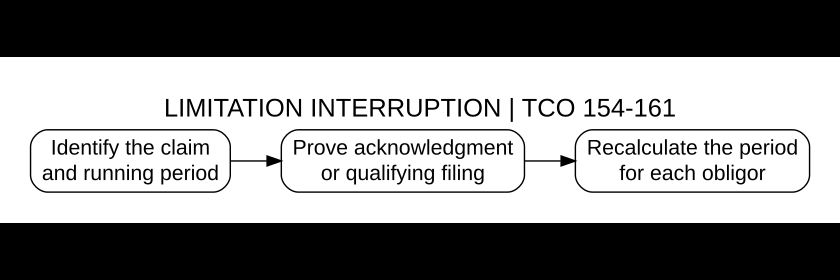
A creditor’s demand letter does not, by itself, interrupt limitation under the general rule in Article 154 of the Turkish Code of Obligations. That provision identifies the debtor’s acknowledgment and specified court, arbitration, enforcement or bankruptcy steps. A demand can lead to an acknowledgment, and a different statute can provide a separate suspension mechanism, but those effects must be established rather than assumed. Article 156 starts a new period after interruption; Article 157 governs later procedural steps. The practical task is to identify the claim, prove the qualifying event and recalculate the period for the correct debtor.
Have a general question about this article? Ask anonymously
The original claim and starting date must be established first
Interruption is not a substitute for identifying the original period. Article 146 supplies a ten-year general period unless law provides otherwise, while Article 147 identifies claims subject to five years. Special provisions can govern particular claims. A contract, invoice or judgment must therefore be classified before the chronology is calculated.
Article 149 generally starts limitation when the claim becomes due. Where maturity depends on notice, it starts when that notice could have been given. A creditor should not assume that indefinitely postponing a demand necessarily postpones the limitation clock. Obtain the terms creating the claim and the evidence establishing when performance could be required.
Article 151 excludes the starting day and requires the last day to pass without exercise of the right. It also refers to the performance-period calculation rules. The contract-date calculation guide explains those units and endpoint issues. The source of the period and any special rule remain part of the analysis.
A default notice is not the same as interruption
A demand can put a debtor in default under Article 117 where its conditions are met. Article 154 asks a different question: did one of the events interrupting limitation occur? A letter’s relevance to default, interest or evidence does not automatically give it the separate effect of restarting limitation.
Keep the creditor’s notice and the debtor’s reply as two distinct records. The notice proves what was requested; the reply can contain a denial, a request for information, an acknowledgment or something else. The legal result must follow from the reply’s actual content and the relevant relationship, not merely from the fact that correspondence continued.
The default-notice guide addresses the contractual remedy framework. This article does not state that every special statutory notice is irrelevant to every time limit. It explains why an ordinary demand alone should not be treated as an Article 154 interruption event without a supporting legal basis.
Article 154 includes acknowledgment by the debtor
Article 154 identifies acknowledgment of the debt and specifically mentions payment of interest, partial performance, giving a pledge and providing a surety. These are legally significant acts, not merely background details in a collection file. Preserve the actual declaration or performance and the evidence connecting it with the claim.
Identify who acted. Where the debtor is a company, examine the sender’s role and authority rather than treating every employee’s statement as a binding corporate acknowledgment. A collection agent’s assertion on the creditor’s behalf is not the debtor’s acknowledgment merely because it repeats an outstanding figure.
The wording and scope matter. A response acknowledging one invoice while disputing another should not automatically be represented as accepting the whole account. Similarly, a conditional proposal needs to be read with its conditions. The analysis should state which obligation was acknowledged and the facts supporting that conclusion.
Part payment must be matched to the relevant obligation
A bank transfer is important evidence, but its legal significance depends on what it pays. Keep the payment reference, accompanying messages, invoices and account allocation. A payment relating to another contract does not automatically interrupt limitation for every debt between the same businesses.
Record whether the payment was principal, interest, an advance, a refund or another performance. Do not erase a contemporaneous reservation when quoting the payment correspondence. The applicable acknowledgment analysis must consider the full transaction rather than a single favourable line extracted from a longer exchange.
The payment-allocation guide explains the separate rules for attributing payments. Allocation and interruption should be coordinated: the file needs a supported explanation of which debt the payment concerns before the date is entered as restarting that debt’s limitation period.
Article 156 starts a new period, but not always ten years
After interruption, Article 156 starts a new limitation period. Its second paragraph provides a ten-year new period where the debt has been acknowledged by an instrument or established by a court or arbitral decision. The text should not be shortened into a statement that every informal conversation or small payment always creates ten more years.
Establish the legal character of the acknowledgment document and the scope of the obligation it records. A signed debt instrument, an unsigned working spreadsheet and a message discussing a possible settlement are different records. Their effect must be assessed instead of assigning the same statutory classification to all written material.
A new payment agreement also raises the separate question of novation. The novation guide explains why a new document does not automatically replace the old obligation. Interruption, amendment and replacement of the debt are different legal consequences and should not be combined without analysis.
Qualifying filings are listed in Article 154
The creditor interrupts limitation by applying to a court or arbitrator through an action or defence, initiating enforcement proceedings, or applying to the bankruptcy estate, as described in Article 154. The record should identify the actual filing, its date, parties and claim. Preparing a draft pleading is not the same event as lodging it.
Obtain the filing receipt and complete application, not only a case number. The scope of the asserted claim and the identity of the respondent are central. A proceeding concerning one obligation should not be assumed to protect every other contractual or non-contractual claim that the creditor might later discover.
A partial monetary claim requires particular attention to the amount and procedural mechanism actually used. Do not promise that every filing automatically interrupts limitation for an unclaimed balance without examining the applicable procedure. The legal basis, claimed scope and any later increase must each be recorded in the chronology.
Article 157 requires attention to what happens after the first filing
Where limitation was interrupted through an action or defence, Article 157 restarts it after each procedural act of the parties or each judicial decision during the proceedings. Where enforcement interrupted it, a new period begins after each act relating to pursuit of the claim. The later procedural history therefore matters as well as the opening date.
Preserve the relevant docket and enforcement records. A creditor’s private reminder about a dormant file is not necessarily an enforcement act by virtue of mentioning the file number. Identify the actual act and why it falls within the statutory description rather than treating any activity connected with collection as sufficient.
For interruption through a bankruptcy-estate application, Article 157 links the new period to the renewed possibility of asserting the claim under bankruptcy rules. That event requires examination of the insolvency record. An estimate of when the administration will finish should not replace the legal event identified by the provision.
Interruption can affect other debtors in a defined direction
Article 155 extends interruption against one joint and several debtor, or one debtor of an indivisible obligation, to the others. First establish the legal basis of that collective responsibility. Several people appearing in the same transaction does not automatically mean that all are joint and several debtors.
The same article states that interruption against the principal debtor also interrupts against the surety. The reverse does not apply: interruption against the surety does not interrupt against the principal debtor. A creditor pursuing only the surety should not assume that the principal claim is protected through symmetry.
The joint-debtor guide and surety-enforcement guide address the underlying relationships. Keep a separate timeline for each obligor, showing the statutory reason why an event concerning someone else affects that person’s period.
Suspension pauses a period; interruption starts a new one
Article 153 identifies situations in which limitation does not begin or stops running. When the suspending ground ends, the period starts or resumes its earlier course. That structure differs from Article 156’s new period after interruption. A deadline table should not use the word stop to obscure which consequence is being applied.
The suspension ground must be established on its own terms. Living outside Turkey does not by itself prove that a claim cannot be asserted in Turkish courts within Article 153. Difficulty arranging travel, dissatisfaction with negotiations and a legal inability to assert the claim are not interchangeable propositions.
Keep the start and end dates of the supported suspending condition, as well as the elapsed time before it. Where another law provides a special suspension mechanism, identify that law separately. The calculation should show whether time is excluded or a fresh period begins, not silently substitute the more favourable result.
Formal mediation has a specific statutory protection
For mediation governed by the pre-action framework in Article 18/A of Mediation Law No. 6325, paragraph 15 suspends limitation and prevents forfeiture periods from running between the application to the mediation office and the preparation of the final record. Those identified events must be documented.
A private invitation to negotiate is not automatically the office application specified by that provision. Retain the application record, the dispute and parties covered, and the final signed record. The relevant scope matters when several debts or defendants are being discussed in parallel.
Do not describe this suspension as automatically producing a new ten-year period. The legal effect and dates must be incorporated into the claim’s existing chronology. Nor should a period that already expired before the relevant application be treated as revived without a separate legal basis. Mediation and the interruption events in Article 154 are different entries in the analysis.
Article 158’s sixty-day period is not available after every dismissal
Article 158 addresses an action or defence rejected because the court lacks territorial or subject-matter jurisdiction, because of a correctable error, or because the action was premature, where limitation or a forfeiture period expired in the meantime. It grants an additional sixty days to exercise the right in those stated circumstances.
The reason for rejection and the intervening expiry must both be established. The provision is not a blanket promise of sixty more days whenever a claimant loses a case. Obtain the full decision and the records needed to determine its procedural effect and the relevant starting point.
Other procedural steps, including a request to send a file to the competent court, can have their own requirements. Do not replace those with an unexplained reliance on Article 158. The additional-period question and the act required to continue or reassert the claim must be reviewed together.
Security and waiver do not mean the clock can be ignored
Article 159 states that securing a claim with a movable pledge does not prevent limitation from running, while preserving the creditor’s ability to obtain satisfaction from the pledge. The personal claim and the security realisation therefore require separate treatment. This paragraph should not be extended indiscriminately to every type of security.
Article 160 prohibits advance waiver of limitation. It also prevents one joint or indivisible debtor’s waiver from being asserted against the others, and prevents the principal debtor’s waiver from being asserted against the surety. These consequences differ from Article 155’s rules on interruption.
A settlement clause should be examined for what it actually does. Acknowledging a debt, changing a payment date and purporting to waive a limitation defence are not necessarily the same act. Do not treat an expired period as a running period that can simply be interrupted; the timing and legal effect of the later declaration require a separate assessment.
The defence must be raised through the proper procedure
Under Article 161, the judge cannot take limitation into account on the judge’s own initiative unless it is raised. A defendant should therefore not assume that the court will calculate and apply every possible time bar without a properly presented defence. The relevant procedural stage and rules must also be respected.
A useful limitation record identifies the claim, original period, maturity, each alleged interruption or suspension, the parties affected and the remaining time. Attach the source document for every event. Keep acknowledgments and filing evidence intact rather than relying on a retrospective statement that the parties were in contact for years.
For cross-border claims, governing law comes first. The MÖHUK Article 8 limitation guide explains that separate inquiry. A Turkish forum does not alone establish that this domestic framework governs every claim. Any served lawsuit or payment order also requires its own procedural response.
Frequently asked questions
Does an ordinary demand letter itself interrupt limitation?
Not under Article 154’s general list merely because it was sent. A debtor’s resulting acknowledgment or a separately applicable statutory mechanism must be established.
Can partial payment be an interruption event?
Article 154 expressly includes partial performance within its acknowledgment framework. Match the payment to the relevant debt and examine its scope and accompanying declarations.
Does every interruption create a ten-year period?
No. Article 156 specifically provides ten years where the debt is acknowledged by an instrument or established by a court or arbitral decision. Other interruptions require the appropriate period analysis.
Which creditor acts does Article 154 identify?
An action or defence before a court or arbitrator, enforcement proceedings and an application to the bankruptcy estate. The actual filing, parties and claim must be documented.
Does the first filing make later procedural history irrelevant?
No. Article 157 addresses renewed periods after the relevant later court and enforcement acts and the special bankruptcy event. Preserve the complete procedural chronology.
Does interruption against a surety also protect the principal claim?
No. Article 155 extends interruption from the principal debtor to the surety, but not from the surety to the principal debtor.
Is suspension the same as a fresh limitation period?
No. Suspension stops or postpones running under its applicable rule; interruption starts a new period under Article 156. The calculation must distinguish them.
Does mandatory pre-action mediation have its own protection?
Article 18/A(15) of Law No. 6325 protects the period from mediation-office application to the final record in its framework. Keep both records and the scope of the dispute.
Does every dismissed case receive sixty additional days?
No. Article 158 specifies grounds of rejection and requires the relevant time limit to have expired in the meantime. The decision and procedural requirements need review.
Will the judge apply limitation without a defence?
Article 161 says the judge cannot consider limitation on the judge’s own initiative unless it is raised. The defence must be presented through the applicable procedure.
Official legal sources
Turkish Code of Obligations No. 6098, Articles 146–161; official Ministry text, pages 30–31, for interruption and related protections; Mediation Law No. 6325, Article 18/A(15). This explanation does not replace special limitation provisions or the governing Turkish text.
Ask about a limitation chronology
State the debt type, original due date and any acknowledgment, payment, mediation or filing dates. Do not send confidential account documents through the initial enquiry.
Istanbul and Mersin offices
Bakırcı & Keskin Law Office is Mersin-based and works throughout Türkiye with an Istanbul and Mersin focus. Arrange a confidential channel for the claim and procedural records.
Istanbul — Polaris Plaza
Maslak Ahi Evran Caddesi, Polaris Plaza No:21, Floor 9, 34475 Sarıyer/İstanbul. Istanbul office directions.
Mersin — Profit İş Merkezi
İhsaniye Mahallesi, 4903. Sokak, Profit İş Merkezi No:23, Floor 3, Office 14, 33070 Akdeniz/Mersin. Mersin office directions.
Call +90 552 224 43 66. An enquiry does not establish representation or suspend a legal deadline.
Contact regarding a legal matter
In your first message, you may briefly state the subject, your country or city, and any relevant notification or recent procedural date. Please do not send identity numbers, medical data, or personal documents. Messaging alone does not constitute legal advice or create a lawyer–client relationship.
Discover more from Bakırcı & Keskin Hukuk Bürosu
Subscribe to get the latest posts sent to your email.