Work Destroyed Before Delivery in Turkey: Contractor Payment and Material Loss Under TCO 483
If a commissioned work is destroyed by an unexpected event before delivery, the Turkish contractor cannot ordinarily demand payment for the work performed or its expenses. Article 483 of the Turkish Code of Obligations makes an express exception where the client was in default in accepting delivery. It separately allocates the material loss to the person who supplied the materials and regulates destruction caused by defective client-supplied materials, the designated land or the client’s instructions. A payment dispute therefore needs three separate findings: whether delivery had occurred, what caused destruction and whether a statutory exception is established.
Have a general question about this article? Ask anonymously
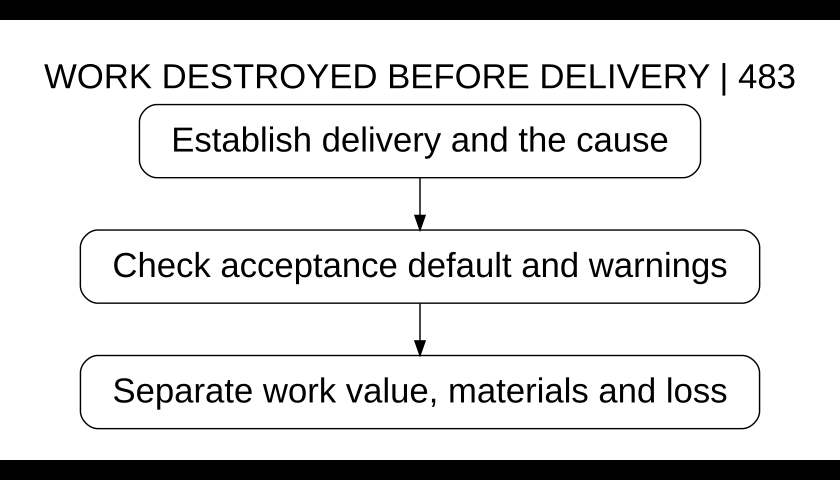
This rule concerns a commissioned result, not every sale of goods
Article 470 defines a contract for work through the contractor’s undertaking to produce a work and the client’s undertaking to pay a price. A custom result, a sale of existing stock and an employment relationship require different classifications. The commercial description of someone as a supplier or contractor is not conclusive.
Read the promised result, production obligations, materials arrangement and delivery terms. In cross-border manufacturing, the applicable law and any relevant sales treaty must also be established. A Turkish production location alone does not establish that every transaction is governed by the domestic works-contract provisions.
The main source for this guide is Law No. 6098, Articles 470–472 and 479–485. The separate sale-risk guide under Article 208 concerns buyer–seller risk in a sale. Its carrier-handover rule should not simply be imported into an Article 483 case.
The contractor’s price risk is distinct from blame for the incident
Article 483’s first paragraph addresses destruction caused by an unexpected event before delivery. Subject to the acceptance-default exception, it prevents the contractor from claiming remuneration for the work and reimbursement of expenses. The contractor’s absence of fault does not itself establish a right to be paid for the lost result.
That is different from an allegation that the contractor negligently caused the destruction. Article 471 requires loyal and careful performance and uses the professional and technical conduct expected from a prudent contractor in a similar field when assessing care. A negligent act requires its own responsibility analysis rather than automatic classification as an unexpected event.
Record both the event and the performance arrangements. A fire, flood or breakage label does not explain its cause or establish that no contractual duty was breached. Technical findings, contemporaneous observations and relevant maintenance or protection records should support the classification actually relied on.
Completion, delivery and payment are different milestones
Article 483 uses delivery as its relevant boundary. A work can be described as manufactured or substantially complete without that description proving delivery. Conversely, an unpaid balance does not itself show that delivery never occurred. The contract and actual handover must be examined.
Retain delivery records, the communications arranging handover and any reservations. A contractor’s internal completion certificate and a receipt signed by an authorised client representative can have different evidential functions. Identify who signed, what was handed over and what the signature acknowledged.
Article 479 ordinarily makes the price due on delivery and addresses agreed staged delivery with separate prices. A project involving separately delivered parts therefore needs a part-by-part record. Do not treat the destruction of one undelivered component as automatically erasing the legal position of every earlier delivered part.
The acceptance-default exception must be proved, not assumed
The first paragraph of Article 483 expressly excepts a client who was in default in accepting the work. The contractor relying on that exception must identify the proper tender and the conduct establishing default. An invitation to discuss an unfinished project does not necessarily amount to offering the agreed performance for delivery.
Article 106 concerns unjustified refusal of properly offered performance or omission of preparatory acts needed for performance. Establish the agreed result, readiness, time, place and required client cooperation. A client’s refusal to receive materially different work cannot automatically be characterised as default merely because a collection notice was sent.
Preserve the notice, delivery evidence and response. The creditor-default guide explains the related statutory framework. The exception’s removal of Article 483’s ordinary bar does not make the contractor’s entire asserted account conclusively correct without examining its components.
Article 483 allocates accidental material loss to its supplier
In the first-paragraph situation, material damage falls on the person who supplied the material. This allocation is separate from the contractor’s entitlement to remuneration. A statement that the contractor did the work does not identify who supplied every material incorporated into it.
Create an inventory distinguishing contractor-procured materials, materials supplied by the client and any goods held for another purpose. Support the classification with purchasing arrangements, delivery records and the contract. Paying a general advance does not, by itself, prove that the client legally supplied all items later purchased by the contractor.
The supplier-of-materials inquiry should not be confused with a universal ruling on title to every object on site. Contractor tools, hired equipment, unused stock and incorporated materials can have different legal positions. Each claimed loss must identify the property and the role attributed to it under the relevant agreement.
Client-supplied materials remain subject to the contractor’s care duties
Article 472 requires the contractor to use client-supplied materials with the necessary care, account for them and return what remains. The material-risk rule is therefore not a general exemption from responsibility for mishandling the client’s property. Accidental loss and a supported breach of the care duty must be distinguished.
Where the contractor supplies defective material, Article 472 refers to seller-like responsibility towards the client. Identify whether the dispute concerns the material’s quality, damage during custody or destruction of the completed work. Those allegations can require different evidence and remedies.
The records should show quantities received, used, retained and lost. A final statement that all materials were consumed or destroyed is not a substitute for an account where the records permit one. Preserve surviving items and relevant condition evidence through safe and lawful arrangements.
The second paragraph covers particular client-related causes
Article 483 separately addresses destruction caused by defects in materials supplied by the client, defects in the land designated by the client, or production in accordance with the client’s instructions. The asserted cause must fit the actual facts. It is not enough that the client chose the project or owned the premises.
The contractor can request the value of work performed and expenses not included in that value if the contractor notified the possible adverse consequences in time. This notification condition must remain in the explanation. The client-related cause and the timely warning are distinct matters to establish.
Where the client was at fault, the provision additionally preserves the contractor’s claim for compensation. Work value, expenses outside that value and additional fault-based loss should consequently be presented as separate components. The same cost must not be counted once in work value and again as an independent expense.
A warning must address the relevant danger and arrive in time
Article 472 also requires immediate notification when defective client materials, an unsuitable designated place or another circumstance threatens proper or timely production. Failure to notify makes the contractor responsible for the resulting consequences. This duty should be read with Article 483’s timely-warning requirement.
Retain the actual warning, its date, recipient and evidence of communication. Identify the risk described and the proposed corrective step. A generic clause saying that the client bears all risks does not necessarily prove that the particular adverse consequences were notified in time.
The response matters as well. A client may change the instruction, supply replacement materials or insist on the original arrangement. Preserve the full sequence instead of keeping only the contractor’s warning or only the client’s final instruction. The causation analysis requires the relationship between that sequence and the actual destruction.
A completed but defective work is a different statutory problem
Article 483 concerns destruction in its stated circumstances. It should not replace the inspection and defect-remedy rules merely because a party describes defective work as worthless. Articles 474–477 address inspection, notification, remedies and acceptance following delivery.
The renovation and defective-performance guide explains that broader framework. A technical report should distinguish loss of the work, repairable damage, non-completion and failure to meet the promised standard. Those descriptions can lead to different legal consequences.
Likewise, the limitation rule for defective works in Article 478 should not be advertised as a universal deadline for every claim arising from a pre-delivery accident. Classify the claim and determine its applicable period and starting event separately.
Destruction does not answer every question about further performance
The fact that the current work was lost does not, without examining the obligation, establish every consequence for its possible recreation. Identify whether the promised result remains capable of performance and whether the circumstances support a particular ending or adaptation rule.
Article 136 regulates qualifying later impossibility and expressly preserves special risk allocations. The impossibility guide explains that general framework. Article 483 supplies a specific works-contract allocation that cannot simply be ignored when assessing payment.
Article 485 concerns completion becoming impossible because of an unexpected event related to the client. It provides for work value and expenses not included in that value, with additional damages where the client was at fault. That is a distinct statutory route, not a reason to label every accidental destruction as client-caused impossibility.
An advance requires reconciliation with the correct legal basis
Identify every advance, milestone payment and direct supplier payment and its contractual purpose. Article 483’s remuneration rule does not permit an unexplained account that treats all money previously received as irrevocably earned merely because the contractor incurred expenditure.
The client should equally distinguish a supported repayment claim from additional compensation. The allocation of material loss, a qualifying work-value claim under the second paragraph, earlier delivered parts and any other valid entitlement can affect the net account. State the basis for each adjustment rather than demand a total detached from the actual contract.
A voluntary decision to abandon a still-performable project raises the separate Article 484 framework. The client-led cancellation guide explains why it should not be used interchangeably with an accidental-loss analysis. The event and the client’s later choice need separate dates and explanations.
Insurance coverage and the contract’s risk allocation are separate inquiries
Obtain the actual policy and endorsements rather than assume that a construction or manufacturing project is fully insured. Identify the insured property, persons, period, event and any notification requirement. An insurer opening a claim file is not proof that coverage or the entire amount has been accepted.
Record salvage, reimbursements, returned items and payments by any responsible person. Those records help determine which economic loss remains outstanding and who is entitled to pursue it. Different contractual, tort and insurance routes do not create duplicate recovery for the same loss.
Read any contractual risk clause together with mandatory rules and its incorporation into the agreement. A clause that allocates storage costs does not necessarily allocate destruction risk. A general liability exclusion requires its own legal review, including the distinctions explained in the liability-exclusion guide.
Preserve a destruction file before clearance and rebuilding
| Issue | Records needed |
|---|---|
| Contract classification | The promised result, production duties and governing-law provisions. |
| Delivery stage | Handover records, staged deliveries and any acceptance invitation. |
| Cause of destruction | Contemporaneous incident records and reasoned technical findings. |
| Materials | The supply arrangement, inventory, usage and remaining items. |
| Client-related risk | The relevant instruction or defect, timely warning and response. |
| Financial balance | Work valuation, non-overlapping expenses, advances and recoveries. |
The evidence-preservation guide addresses recording facts before they disappear. Do not enter unsafe areas or delay necessary protective action solely for litigation. Record the urgency and use appropriate authorised professionals. For an overseas party, retain originals beside translations and provide any served court or enforcement documents with their service dates.
Frequently asked questions
Can a contractor always charge for work destroyed before delivery?
No. Article 483 ordinarily excludes remuneration and expenses where unexpected destruction occurs before delivery, unless the client was in acceptance default. Its separate client-related-cause paragraph also requires review.
Does completion prove that delivery occurred?
Not by itself. Examine the contractual handover and actual records. Completion, delivery, acceptance and payment are distinct factual and legal questions.
Who bears accidental loss of the materials under the first paragraph?
Article 483 places the material loss on the person who supplied the material in that situation. Establish the supply arrangement separately from the contractor’s remuneration claim.
Is the client automatically in default after a collection email?
No. Proper tender and the facts establishing unjustified refusal or missing necessary cooperation must be examined. The email alone does not prove every condition.
What if the client’s defective materials caused destruction?
Article 483 permits work value and expenses outside that value where its client-related cause and timely-warning conditions are met. Client fault can additionally support damages.
Can a contractor omit the warning requirement?
No. The second paragraph expressly requires timely notification of possible adverse consequences. Article 472 also imposes an immediate notification duty in its stated circumstances.
Does the material-risk rule excuse negligent handling?
It is not a general exemption from the contractor’s care and accounting duties. Accidental loss and an independently supported breach must be distinguished.
Is defective delivered work always an Article 483 case?
No. Delivered defects engage their own inspection and remedy framework. Establish whether the facts concern destruction, repairable damage, non-completion or non-conformity.
Does an insurance claim decide the contractor’s payment right?
No. Policy coverage and the works-contract account are separate inquiries. Record payments and recoveries so the same loss is not claimed twice.
What should a foreign client or contractor preserve?
Keep the contract, delivery chronology, incident evidence, material inventory, warnings and responses, payment account and any served proceedings.
Official legal sources
Turkish Code of Obligations No. 6098, Articles 106, 136, 470–472 and 479–485; official Ministry text, page 98, containing Article 483. This English explanation is not an official translation or a technical determination of an incident’s cause.
Ask about work lost before delivery
Identify the promised work, delivery stage, incident date and who supplied the materials. Arrange a confidential channel before sending contracts, technical reports or financial records.
Istanbul and Mersin offices
Bakırcı & Keskin Law Office is Mersin-based and works throughout Türkiye with an Istanbul and Mersin focus.
Istanbul — Polaris Plaza
Maslak Ahi Evran Caddesi, Polaris Plaza No:21, Floor 9, 34475 Sarıyer/İstanbul.
Mersin — Profit İş Merkezi
İhsaniye Mahallesi, 4903. Sokak, Profit İş Merkezi No:23, Floor 3, Office 14, 33070 Akdeniz/Mersin.
Call +90 552 224 43 66. An enquiry does not establish representation or suspend a legal deadline.
Contact regarding a legal matter
In your first message, you may briefly state the subject, your country or city, and any relevant notification or recent procedural date. Please do not send identity numbers, medical data, or personal documents. Messaging alone does not constitute legal advice or create a lawyer–client relationship.
Discover more from Bakırcı & Keskin Hukuk Bürosu
Subscribe to get the latest posts sent to your email.