Late Rent Penalties and Accelerated Rent in Turkey: When Lease Clauses Are Invalid
For a residential or roofed-workplace lease governed by Turkish law, an agreement imposing a penalty for late rent or making later rent instalments immediately payable because rent was late is invalid under Article 346 of the Turkish Code of Obligations. The tenant’s signature does not remove that prohibition. This does not cancel rent already due, legitimate ancillary expenses or a separately supported interest claim. The correct response is to separate the demand into its legal components and address any served proceedings, not to treat an invalid penalty as permission to stop paying everything.
Have a general question about this article? Ask anonymously
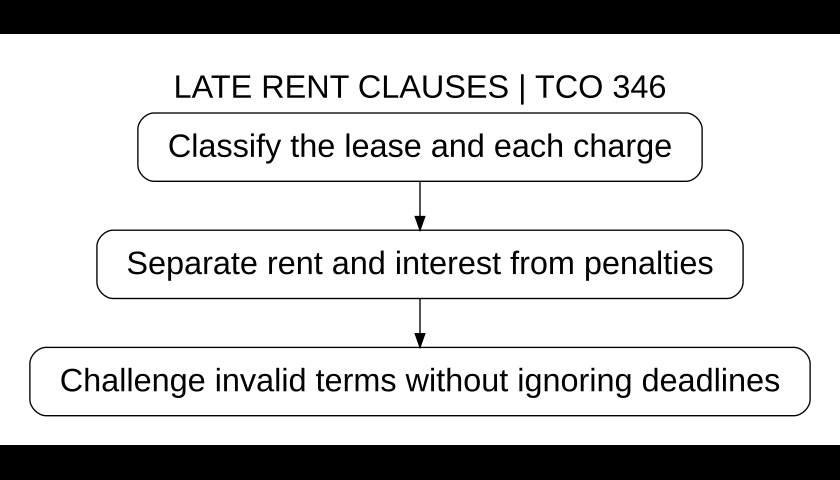
Confirm that the residential or roofed-workplace rules apply
Article 346 appears in the Code’s residential and roofed-workplace section. Article 339 defines that section’s scope and extends it to items supplied for use together with the premises. A rented home or qualifying enclosed business premises must therefore be distinguished from a different kind of lease. A tenant being a company does not, by that fact alone, place a roofed-workplace lease outside the section.
Article 339 excludes property inherently allocated to temporary use when rented for six months or less. Both the property’s temporary-use character and the duration matter. A six-month heading on an ordinary residential agreement should not be treated as conclusive proof of the exclusion without examining what was actually rented and how the relationship operated.
The primary source is Law No. 6098, Article 346, read with Article 339. Keep the lease, handover documents and use provisions. For historical workplace claims, review the applicable transitional legislation rather than convert an old postponement note into a permanent exemption. This guide does not decide historical liability merely from the date printed on a current demand.
The statutory issue is invalidity, not simply whether the penalty is excessive
Article 346 first prohibits additional payment obligations beyond rent and ancillary expenses. It expressly identifies agreements requiring a penalty when rent is not paid on time as invalid. A fixed late charge, a percentage described as a penalty or a recurring surcharge needs to be examined by its actual function rather than its marketing name.
The general contractual-penalty provisions in Articles 179–182 do not replace this special prohibition. A landlord cannot answer the Article 346 issue solely by saying that the penalty is modest or that the tenant negotiated it. The first question is whether the clause falls within the prohibited category, not what smaller figure would be commercially acceptable.
The general contractual-penalty guide addresses other contractual settings. This article concerns the narrower lease protection. It does not declare every clause in every property-related agreement invalid merely because that clause uses the word penalty.
The name of the charge does not establish its legal nature
Article 19 requires the parties’ real common intention to be considered rather than relying on an inaccurate description. Obtain the clause creating the charge, the event triggering it and the calculation. A sum charged only because rent arrived late requires a different explanation from a documented bill for a service connected with the premises.
Ask what the payee actually supplied and whether the amount is tied to an expense. A new invoice headed account administration does not, by itself, prove that a prohibited late penalty became a legitimate service charge. Equally, a genuine expense should not be rejected solely because it appeared on the same statement as a disputed surcharge.
Keep the original wording and each revised statement. A later change in terminology can be relevant to explaining the demand, but it does not erase the earlier contractual mechanism. The review should reach a conclusion about the obligation itself, not merely recommend changing its label.
A missed instalment does not validate default-triggered acceleration
Article 346 also invalidates agreements making subsequent rent payable because rent was not paid on time. This is the acceleration issue: rent that would otherwise fall due later is demanded now by relying on a default clause. Identify the instalment allegedly missed and the later instalments included in the resulting demand.
Prepare the original payment schedule before calculating any balance. Separate rent already mature under that schedule from amounts brought forward solely by the disputed clause. A demand for the whole remaining rental year should not be accepted as an ordinary arrears statement without that comparison.
Invalid acceleration does not extinguish the future instalments. They must be considered according to the valid lease and their own maturity dates while the rental obligations continue. The tenant’s defence against premature collection and the tenant’s later obligation to pay are different propositions.
An original advance-payment obligation requires a different analysis
A payment date agreed from the outset is not automatically the same as an acceleration triggered by later default. Article 314 provides the default payment time where the parties and local custom have not established another arrangement. Read the accepted schedule and determine what actually makes the requested sum payable.
This distinction does not certify every document describing annual advance rent. The substance, formation and applicable mandatory rules still require examination. A clause cannot safely be classified from its heading while an accompanying paragraph says that the full amount becomes payable only after a monthly payment is missed.
The due-date guide explains the separate calendar calculation. Record the contractual maturity event, payment evidence and disputed trigger so the analysis can distinguish an existing due obligation from an attempt to bring forward later rent.
Default interest is not automatically a contractual penalty
Articles 117 and 120 separately address default and default interest. Article 346 should not be paraphrased as saying that a tenant can never owe interest after failing to pay a due debt. Conversely, writing interest beside a figure does not prove that the demand is correctly calculated or that its rate is lawful.
Identify the principal, default date, currency, applicable interest basis and periods covered. Deduct payments at the legally relevant dates. Distinguish a time-based interest calculation from a fixed punishment unrelated to the duration or amount of the unpaid debt. Any alleged interest provision still needs review under the rules governing the particular obligation.
This guide does not give one numerical rate for every Turkish lease or period. The legislation in force for the relevant interest obligation and any applicable special rules must be checked. A foreign-currency entry also requires its own analysis rather than automatic use of a domestic-currency percentage.
Ancillary expenses need supporting documents
Article 341 ordinarily assigns use expenses such as heating, lighting and water to the tenant unless the agreement or local custom provides otherwise. It also requires the party bearing expenses to provide copies of the supporting documents on request. That documentary right is important when a statement combines rent, building charges and penalties.
Obtain the underlying invoice, period, allocation and explanation of who is entitled to collect. A total described as service charges does not identify whether it represents consumption, ordinary maintenance, capital work or a late-payment sanction. Each component requires the correct contractual or statutory basis.
Where obtaining or keeping the premises depends on a separate purchase or service commitment, the linked-contract guide under Article 340 addresses that distinct issue. A prohibited tied obligation and a late-payment penalty should not be treated as the same legal ground.
Article 317 separately addresses ordinary cleaning and maintenance needed for use. Neither provision authorises treating every cost associated with ownership as an unlimited ancillary charge. A clear ledger should preserve the distinction between agreed rent, supported operating expenses and disputed additional obligations.
A deposit and a proven damages claim are separate from a late-rent penalty
Article 342 expressly permits contractual security within its residential and roofed-workplace framework, including the three-month-rent ceiling and the banking rules for money or securities. It must be read alongside Article 346. The existence of the additional-payment prohibition does not make all security arrangements nonexistent.
The deposit guide explains that separate mechanism. A deposit is not automatically forfeited because the tenant paid late. Identify the secured claim, the sum actually due and the applicable release or satisfaction conditions before deducting a contested penalty.
Damage caused by misuse also requires its own assessment under Articles 334–335 and the relevant liability provisions. A supported claim for damaged property differs from a contractual punishment for late rent. The landlord should prove the particular damage rather than use it as an unexplained replacement heading for a prohibited charge.
The rent default procedure survives an invalid penalty clause
Under Article 315, failure to pay rent or ancillary expenses due after delivery can lead to a written payment period accompanied by a termination warning. For residential and roofed-workplace leases, the statutory period is at least thirty days and begins the day after the written notification. The conditions of that procedure must be examined separately from the surcharge dispute.
Invalidity of the penalty does not establish that all principal rent has been paid. A tenant should identify admitted amounts and disputed components clearly. The effect of a notice containing a mixed or inaccurate demand requires review of the actual document; this article does not assume that every such notice is automatically effective or automatically void in every respect.
The default-remedies guide distinguishes demands, opportunities to perform and remedy elections. For a served enforcement payment order or lawsuit, obtain the document and its service record immediately. The contractual thirty-day payment opportunity is not a universal objection period for every procedure.
Send a reasoned response, not only a statement that the clause is unfair
A usable response identifies the lease category, clause number, amount demanded and the Article 346 objection. It separates overdue principal from future rent allegedly accelerated and from penalties or expense items. Attach the payment record needed to explain the balance rather than rely on an unsupported statement that nothing is owed.
Keep correspondence with the landlord distinct from the procedural response required by a court or enforcement office. A letter to the property manager does not automatically constitute a timely objection in a pending proceeding. Equally, making a payment should not be described as formally closing a case without checking its procedural status.
For a landlord preparing a revised demand, remove unsupported charges and reconcile payments before further action. This is not a request to rename the same invalid penalty. The new statement should show the legally supported components and the dates relevant to each.
Money already paid requires a separate recovery analysis
A tenant who already paid a contested sum needs proof of its amount, recipient, purpose and date. Articles 77 and following regulate unjust enrichment, including performance based on an invalid or unfulfilled legal ground. Article 78 separately addresses voluntary performance of a non-existent debt and the stated mistake requirement.
The fact that a clause is invalid does not, without further analysis, resolve every repayment defence, limitation issue or procedural route. Keep the demand that led to payment, the tenant’s response, any reservation and any settlement document. Payment under enforcement requires particular procedural examination rather than an assumption that the same route applies to every transfer.
Article 82 provides the limitation framework for unjust-enrichment recovery. The limitation guide explains why ordinary correspondence should not automatically be counted as restarting a period. Do not replace proof of the relevant dates with the date on which a new adviser first read the lease.
Settlement should preserve a truthful account of what is being paid
Article 18/B(1)(a) of Mediation Law No. 6325 generally requires mediation before a rental-relationship lawsuit, subject to its specified non-judgment enforcement eviction exception. The actual claim and procedure must be classified before relying on that exception.
A settlement can identify admitted rent, disputed additional charges, payment dates and the extent of any release. A document intended to resolve past arrears should not silently introduce a fresh prohibited late-rent penalty or disguise the same accelerated debt. Identify the legal effect of the terms before signing.
For a tenant or landlord abroad, verify the representative’s authority to agree the balance and release. Keep all language versions and the complete account. An English summary should translate the payment trigger and maturity terms accurately instead of treating every Turkish reference to muacceliyet as merely a reminder.
| Component of the demand | Essential check |
|---|---|
| Rent already due | Agreed amount, maturity, payment and credit records. |
| Later rent demanded now | Whether default-triggered acceleration is the only asserted basis. |
| Late charge or penalty | The trigger and operation of the clause under Article 346. |
| Interest | Applicable legal basis, rate, principal and dated calculation. |
| Ancillary expense | Underlying service, allocation and supporting documents. |
| Deposit or damage | The separate security or liability rule and proof of the amount. |
Frequently asked questions
Is a signed late-rent penalty automatically enforceable?
No. Article 346 invalidates late-rent penalty agreements within its residential and roofed-workplace scope. Signing does not remove the prohibition.
Can one missed instalment make all later rent due?
Article 346 invalidates that default-triggered acceleration agreement in the protected lease categories. Identify the original schedule and the later instalments demanded.
Does the tenant then owe no interest?
Not necessarily. Default interest has a separate legal framework. Its basis, rate, dates and calculation must be checked independently of the penalty.
Is advance rent identical to acceleration?
No. An original maturity arrangement and a later default-triggered demand are different. Examine the substance and applicable mandatory rules rather than the heading alone.
Does a company tenant automatically lose Article 346 protection?
Company status alone does not remove a qualifying roofed-workplace lease from the section. Historical claims require separate transitional-law review.
Can the tenant request evidence of operating expenses?
Article 341 requires copies of supporting documents on request from the party bearing the expenses. Identify each charge and its relevant period.
Does an invalid penalty authorise withholding all rent?
No. Separate valid rent and supported expenses from the disputed addition and address any payment notice or proceeding through its own procedure.
Is every six-month rental outside the protective section?
No. Article 339’s exception also requires property inherently allocated to temporary use. Duration alone does not establish that classification.
Can an already-paid penalty simply be deducted from the next rent?
A recovery or set-off needs its own established legal basis and conditions. Do not treat an unresolved repayment demand as an automatically discharged rent instalment.
Which records are needed for an overseas review?
Provide the lease, disputed clause, complete demand, rent ledger, payment records, expense evidence and any served documents with their service dates.
Official sources and scope
Turkish Code of Obligations No. 6098, Articles 19, 77–82, 117, 120, 313–315, 317, 334–335 and 339–346; Mediation Law No. 6325, Article 18/B. This English explanation is not an official translation. The applicable Turkish text, claim period and actual documents control.
Ask about a disputed lease charge
State the type of premises, the charge demanded and any served deadline. Do not send identity documents or banking credentials in the initial enquiry.
Istanbul and Mersin offices
Bakırcı & Keskin Law Office is Mersin-based and works throughout Türkiye with an Istanbul and Mersin focus.
Istanbul — Polaris Plaza
Maslak Ahi Evran Caddesi, Polaris Plaza No:21, Floor 9, 34475 Sarıyer/İstanbul.
Mersin — Profit İş Merkezi
İhsaniye Mahallesi, 4903. Sokak, Profit İş Merkezi No:23, Floor 3, Office 14, 33070 Akdeniz/Mersin.
Call +90 552 224 43 66. An enquiry does not establish representation or suspend a legal deadline.
Contact regarding a legal matter
In your first message, you may briefly state the subject, your country or city, and any relevant notification or recent procedural date. Please do not send identity numbers, medical data, or personal documents. Messaging alone does not constitute legal advice or create a lawyer–client relationship.
Discover more from Bakırcı & Keskin Hukuk Bürosu
Subscribe to get the latest posts sent to your email.