Contractual Penalties in Turkey: Delay, Reservations and Reduction Under TCO 179–182
A contractual penalty in Turkey is not automatically payable merely because an invoice calls it a penalty. The signed undertaking must cover the breach that actually occurred. Article 179 of the Turkish Code of Obligations distinguishes a penalty replacing performance from a penalty for performance at the wrong time or place. Article 180 separates the agreed penalty from proof of actual loss. Article 182 governs amount, invalidity and reduction, while Article 22 of the Turkish Commercial Code restricts a merchant debtor’s reliance on ordinary excessive-penalty reduction. For a delay claim, the acceptance and reservation records are often as important as the penalty percentage.
Have a general question about this article? Ask anonymously
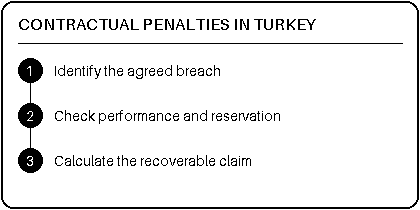
Identify the civil obligation behind the penalty
The Turkish term ceza koşulu, also commonly called cezai şart, describes an agreed contractual consequence. It is not a criminal conviction or an administrative fine. A public authority’s sanction and a supplier’s contractual claim have different sources, recipients and procedures. This article concerns the latter and the general rules in Law No. 6098, Articles 179–182.
Begin with the obligation secured by the clause. Identify the required delivery, service, payment, confidentiality undertaking or other performance and the person who undertook it. The clause must be connected to an actual contract, its incorporated documents and the relevant version. A standard term printed for the first time on a later invoice does not, merely by appearing there, establish that the parties agreed to it.
An English document’s label is not conclusive. Wording described as liquidated damages, a service credit, a cancellation charge or a penalty requires interpretation by its legal effect. Article 19 directs attention to the parties’ real common intention. Our standard contract terms guide separately addresses incorporation and control of pre-written terms. Classification comes before calculation.
Non-performance penalties: performance or the agreed penalty
Article 179’s first paragraph concerns a penalty agreed for complete failure to perform or improper performance. Unless the contract indicates otherwise, the creditor can demand performance of the obligation or payment of the penalty. The default is therefore alternative, not an unrestricted right to collect both the entire promised performance and the penalty covering its absence.
Read the particular clause before selecting the remedy. Identify whether it secures the whole obligation or a separable component, what conduct triggers it and whether the agreement modifies the statutory starting rule. A provision covering abandonment of an entire project should not automatically be applied to a different complaint about the timing of one document.
The demand should state what is being sought. A claim for delivery, a substitute penalty and additional damages are different items with different explanations. Placing all three into an undifferentiated account balance hides the issue Article 179 requires the reviewer to resolve. The creditor’s election and the contractual basis for any cumulative claim should be intelligible from the demand itself.
Time and place penalties follow a different rule
The second paragraph of Article 179 deals specifically with a penalty agreed for failure to perform at the stipulated time or place. The creditor can demand that penalty together with the principal performance unless the creditor expressly waived the right or accepted performance without reservation. This explains why receiving a delayed delivery and preserving a delay claim require coordinated handling.
Establish the actual contractual date or location. A production estimate, dispatch date and delivery deadline are not necessarily interchangeable. Check accepted amendments, agreed extensions and the event that starts any period. The calculation should use the obligation as agreed, not whichever date appears earliest in an email chain.
Separate completion from acceptance. A carrier’s delivery record, a technical commissioning certificate and the customer’s contractual acceptance can document different stages. Their significance depends on the agreement and what was supplied. A delay claim should explain which event ended the relevant period and which document establishes it.
Reservation on acceptance must address the actual right
The reservation issue arises from Article 179 itself. Preserve the acceptance document and any accompanying statement retaining the contractual penalty claim. Identify who made the reservation, to whom it was communicated, which obligation it concerned and when it was made relative to acceptance. A later demand is not a reliable substitute for analysing an earlier unreserved acceptance.
The statute does not provide a universal sentence that solves every acceptance dispute. A reservation needs to be assessed in its context. A notation concerning visible defects does not necessarily explain the separate position on a delay penalty; a general complaint about inconvenience does not automatically identify the agreed contractual consequence being retained.
Article 131 is also relevant when the principal obligation ends. It addresses preservation of accrued interest and penalty rights by agreement, timely notification or circumstances showing a reservation. Read that framework together with the particular acceptance rule. A final receipt or settlement should be reviewed for discharge language before it is treated as an administrative formality.
Paying the penalty does not always buy a right to leave
Article 179’s third paragraph preserves the debtor’s right to prove that the agreement authorises ending the contract through withdrawal or termination by paying the stipulated penalty. The important issue is the contractual entitlement. A debtor cannot assume that every penalty clause gives a free choice between performing and paying an exit fee.
Compare the penalty wording with any express withdrawal, termination and notice provisions. A clause designed to secure continued performance has a different function from an agreed mechanism allowing a party to leave for a defined payment. The distinction also affects how a purported cancellation is communicated and what obligations remain to be settled.
Do not confuse this issue with withdrawal money under Article 178 or an ordinary advance under Article 177. The reservation-deposit guide discusses those payment distinctions in its own property context. The everyday word deposit does not decide whether money secures performance, evidences formation or purchases a withdrawal right.
Article 180 does not require the creditor to prove a matching loss
Under Article 180, the agreed penalty is payable even where the creditor suffered no damage. This separates the stipulated consequence from an ordinary calculation of compensatory loss. It does not remove the need to establish a valid clause, the event triggering it and the absence of a defence that defeats the demand.
A defence consisting only of the statement that the creditor has not produced a loss invoice therefore does not answer Article 180. Conversely, a claimant cannot rely on the absence of a loss requirement to ignore the contractual trigger. The evidence of breach and the evidence of economic damage serve different functions.
Where the loss exceeds the agreed penalty, the creditor must prove the debtor’s fault to request the excess under the second paragraph. The additional claim must identify the greater loss, its connection with the breach and the amount exceeding the penalty. It is not an invitation to recover the same loss twice under different account headings.
Build a calculation that another person can reproduce
A daily penalty calculation should expose its inputs rather than present only a final total. Identify the agreed rate, the contractual calculation base, the period counted and any cap. A fixed-sum clause needs a different calculation from a daily percentage, a per-delivery charge or a provision tied to a particular milestone.
| Calculation component | Document to identify | Question answered |
|---|---|---|
| Trigger | Executed clause and performance specification | Which breach activates the penalty? |
| Starting point | Deadline, notice or agreed milestone | When does the charge begin? |
| Ending point | Completion, delivery or other specified event | When does counting stop? |
| Base and rate | Price schedule and penalty wording | What amount and percentage are used? |
| Limit | Cap, exclusions and amendments | What prevents overstatement? |
| Preservation | Acceptance and reservation records | Was the relevant right retained? |
Keep disputed inputs visible. State whether the disagreement concerns the date, the rate, the covered contract value or the legal entitlement itself. This allows a response to address a specific error without conceding the rest of the demand. Bank payments and agreed credits should also be reconciled separately from the penalty calculation.
Invalidity of the main obligation and later impossibility
Article 182 states that the penalty cannot be demanded where the principal obligation is invalid. It also addresses later impossibility for a reason for which the debtor cannot be held responsible, subject to a contrary agreement for that situation. The secured obligation therefore needs its own validity and performance analysis.
The relationship is not symmetrical in every respect. Invalidity of the penalty clause, or its later impossibility for a reason not attributable to the debtor, does not affect the validity of the principal obligation under Article 182. Defeating a penalty demand does not necessarily establish that the debtor owes no performance at all.
Claims of impossibility must be distinguished from increased cost or inconvenience. The impossibility guide explains Articles 136–137. A penalty dispute should identify the actual event and responsibility position instead of treating a force-majeure label as proof of every condition.
Judicial reduction and the merchant exception must be separated
Article 182 allows the parties to determine the penalty amount and directs the judge to reduce a penalty considered excessive on the judge’s own initiative. A signed amount is therefore not immune from the general statutory reduction rule. The provision does not state a universal reduction percentage or a guaranteed final amount.
However, Turkish Commercial Code No. 6102, Article 22 restricts a debtor with merchant status from requesting reduction of an excessive penalty under the referenced general provisions. Merchant status is a legal classification, not simply an informal description of someone who earns money. Establish the contracting debtor and the applicable status before relying on the general reduction paragraph.
This exception must not be transformed into a claim that every clause in a merchant’s contract is necessarily valid. Formation, interpretation, mandatory rules and invalidity remain separate questions. In particular, a legal argument under Article 27 is not identical to an ordinary request for reduction merely because the penalty is high. The grounds and supporting evidence should be kept distinct.
Forfeited instalments and third-party security
Article 181 applies the penalty rules to agreements providing that a part already performed will remain with the creditor on withdrawal. It expressly reserves instalment-sale provisions. Calling retained money a payment already earned does not eliminate the need to examine whether the actual arrangement falls within this rule.
A surety’s exposure also requires a separate check. Article 589 contains restrictions on making the surety responsible for a contractual penalty. Do not add the borrower’s entire penalty account to a personal-surety demand simply because both obligations appear in the same credit file. Our surety enforcement guide explains why the secured amount and available claims must be reviewed separately.
Special contract categories can impose additional controls. The general rules in this article do not replace the provisions governing the particular employment, tenancy, consumer or other regulated relationship. Classify the contract before copying a commercial penalty clause into another setting.
Employment and protected tenancy penalties have separate limits
Article 420 invalidates a penalty placed only against the employee in an employment contract. This is a validity rule, not merely a discretionary reduction of the amount. Before treating an employee’s signature as sufficient, identify whether the obligation is genuinely a contractual penalty and whether it operates only against that employee. A claim for identified expenditure and a stipulated penalty require separate classification; changing the heading does not resolve the issue.
Residential and roofed workplace leases are subject to Article 346. That provision prohibits imposing payment obligations on the tenant beyond rent and ancillary expenses and specifically invalidates agreements requiring a penalty for late rent or accelerating later rents because of that delay. The general time-and-place rule in Article 179 does not override this protection. The type of lease and the actual clause must therefore be established before calculating a late-payment penalty.
These two provisions illustrate why contract classification precedes arithmetic. A large amount is not the only possible defect in a demand. The clause may instead be invalid under a rule protecting a particular contracting party. Record the contract category, the obligation’s legal character and the rule relied on, then calculate only the claim that survives those preliminary checks. Historical contracts additionally require attention to the applicable transitional provisions.
What an overseas claimant or debtor should provide
Provide the executed contract, incorporated conditions, amendments, the deadline record, performance evidence and every acceptance document. Add the penalty calculation, payment reconciliation and any reservation or release. For a company, identify the legal entity and the authority of the people who signed changes or accepted completion.
Where Turkish law is not already established as applicable, governing law is a preliminary question. An English-language agreement with a Turkish supplier does not by itself answer it. The international-contract governing-law guide explains the separate conflict-of-laws assessment.
Finally, preserve any served payment order, summons or claim with its service record. A penalty objection in commercial correspondence does not automatically constitute the procedural response required in an existing case. The review should distinguish the merits, the amount and the deadline rather than allowing a calculation debate to obscure a time-sensitive defence.
Frequently asked questions
Can a creditor always demand performance and a penalty together?
No. Article 179 distinguishes alternative penalties for non-performance from penalties for time or place violations. The clause and any reservation on acceptance determine the applicable analysis.
Why does accepting late delivery matter?
Article 179 permits the time-or-place penalty alongside performance unless the creditor expressly waived it or accepted performance without reservation. Keep the actual acceptance and reservation records.
Must the creditor prove actual loss equal to the penalty?
Article 180 permits the agreed penalty despite absence of damage. The valid clause and its contractual trigger still need to be established.
Can the creditor claim loss above the agreed amount?
Article 180 requires proof of the debtor’s fault for the excess-loss claim. The additional loss and the amount exceeding the penalty must also be identified without double recovery.
Does paying the penalty automatically allow cancellation?
No. Article 179 preserves the debtor’s right to prove an agreed entitlement to end the contract by paying the penalty. Not every penalty clause grants that entitlement.
Is the penalty recoverable when the principal obligation is invalid?
Article 182 states that the penalty cannot be demanded where the principal obligation is invalid. Invalidity of the penalty itself does not necessarily invalidate the principal obligation.
Can a judge reduce an excessive penalty?
Article 182 contains the general judicial-reduction rule. Article 22 of the Commercial Code imposes a merchant-debtor exception, so the debtor’s legal status must be checked.
Does the law prescribe a standard penalty percentage?
Articles 179–182 do not establish one universal percentage. The agreed rate, calculation base, period, cap and applicable legal controls must be identified.
Can forfeiture of an earlier payment fall under the penalty rules?
Yes. Article 181 applies them to agreements retaining a performed part on withdrawal, while reserving instalment-sale provisions.
Which records are essential for a delay-penalty review?
The executed clause, agreed deadline, amendments, delivery or completion evidence, acceptance record, reservation and reproducible calculation are central. Add any served proceedings and service date.
Official statutory references
Turkish Code of Obligations No. 6098, Articles 19, 27, 131, 177–182, 346, 420 and 589; Turkish Commercial Code No. 6102, Article 22. The official Ministry text sets out the general penalty provisions. The English explanations are not an official translation.
Ask about a contractual penalty
Briefly describe the clause, the amount claimed and any approaching response date. Do not include identity numbers or confidential documents in this initial message.
Istanbul and Mersin offices
For an English-language penalty review, identify the contractual trigger, claimed amount and whether delivery has already been accepted through the English contact section. Bakırcı & Keskin Law Office is Mersin-based and coordinates matters throughout Türkiye from its Istanbul and Mersin offices. Arrange a confidential channel before sending contracts.
Istanbul — Polaris Plaza
Maslak Ahi Evran Caddesi, Polaris Plaza No:21, Floor 9, 34475 Sarıyer/İstanbul. Istanbul office directions.
Mersin — Profit İş Merkezi
İhsaniye Mahallesi, 4903. Sokak, Profit İş Merkezi No:23, Floor 3, Office 14, 33070 Akdeniz/Mersin. Mersin office directions.
Call +90 552 224 43 66. An enquiry does not establish representation or suspend a legal deadline.
Contact regarding a legal matter
In your first message, you may briefly state the subject, your country or city, and any relevant notification or recent procedural date. Please do not send identity numbers, medical data, or personal documents. Messaging alone does not constitute legal advice or create a lawyer–client relationship.
Discover more from Bakırcı & Keskin Hukuk Bürosu
Subscribe to get the latest posts sent to your email.