Turkish Land Has No Road Access: Compulsory Passage Under Article 747
An owner whose Turkish land lacks sufficient access to a public road can request a compulsory passage under Civil Code Article 747, against full compensation. The route is not chosen solely because it is shortest or cheapest for the requesting owner. The statute gives priority according to the previous ownership and road situation, then the neighbour who would suffer least harm, while requiring both sides’ interests to be considered.
Have a general question about this article? Ask anonymously
For an overseas purchaser or owner, the first issue is whether sufficient legal access exists, not simply whether a vehicle has previously crossed neighbouring land. This guide explains the records, technical comparison and legal procedure needed to assess a compulsory passage without assuming that the right also authorises construction, commercial activity or unrestricted use of another parcel.
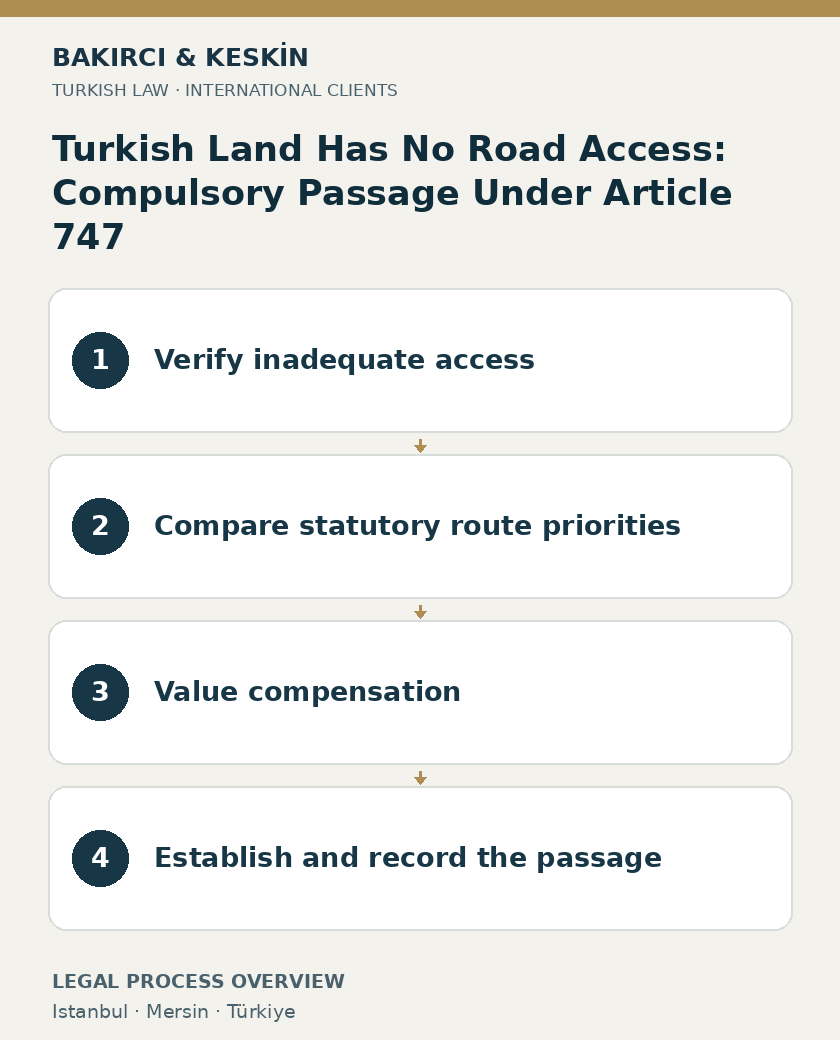
Quick summary
| Legal issue | Turkish Land Has No Road Access: Compulsory Passage Under Article 747 |
|---|---|
| Short answer | An owner whose Turkish land lacks sufficient access to a public road can request a compulsory passage under Civil Code Article 747, against full compensation. The route is not chosen solely because it is shortest or cheapest for the requesting owner. The statute gives priority according to the previous ownership and road situation, then the neighbour who would suffer least harm, while requiring both sides' interests to be considered. |
| Key legislation | Law No. 4721 — Articles 747, 780-781; Law No. 6100 — Articles 12; Law No. 6325 — Articles 18/A(2), 18/B(1)(ç), 18/B(3), 18/B(5) |
Identify the precise reason access is insufficient
Describe the current route from the parcel to a public road. Identify every piece of land crossed and whether the route is physically usable and legally available. A track visible on an aerial image can be private land. Conversely, a legally existing route may need a different assessment if it is physically inadequate for the property’s relevant use.
Record the actual difficulty: no connection, a blocked route, an insufficient connection or a dispute about an existing right. Those problems should not all be treated as a new Article 747 claim. If a registered passage already exists and is unlawfully obstructed, enforcing that right can be the relevant starting point.
Keep photographs and a location plan tied to cadastral identifiers. Explain seasonal conditions or terrain with technical evidence where relevant. Avoid a general statement that the property is “landlocked” until the register, road records and physical position have been checked.
Locate the legally recognised public road
Article 747 concerns sufficient passage to a public road. Obtain the cadastral and relevant administrative records showing the road’s legal status. A proposed road shown on a development plan and a presently available public road should not be assumed to be the same thing.
Trace the full connection. A proposed passage that ends on another private plot without a legally secured onward route may leave the original problem unresolved. The technical plan should show how the route reaches the public network and identify each intervening parcel.
Where the road record is unclear, obtain clarification from the competent authority and preserve its response. The court should not be asked to infer public status merely because several neighbours have used a track. Longstanding physical use is a fact to investigate, not a substitute for identifying the applicable legal position.
Distinguish a servitude from informal permission
Read the current registry for passage rights and obtain the instruments establishing them. Determine the benefited and burdened properties, route, scope and any conditions. A right concerning another parcel or a different purpose does not automatically solve the present access issue.
Informal permission from a neighbour can allow practical use without creating the same protection as a registered right. Preserve the permission and its terms, including any limits or revocation issue. An estate agent’s statement that “everyone uses this way” should not be entered into a purchase report as a completed servitude.
Civil Code Articles 780 and 781 address registration and official form for the establishment of a servitude. Where the parties want durable agreed access, the legal instrument and registry steps should reflect that intention rather than relying only on a handshake or a private sketch.
Assess sufficient access rather than maximum convenience
Article 747 applies where the owner lacks sufficient passage from the property to the public road. The legal test is not simply whether another route would be more convenient or increase the land’s sale price. Explain the actual use, characteristics and access need of the property with evidence.
A technical assessment should address terrain, practicability and the existing connection. Do not assert a universal statutory width: the provision itself does not prescribe one width for every parcel. The appropriate route and dimensions must be supported by the needs and restrictions of the particular case.
Planned development also requires care. A passage right does not itself grant zoning approval, a building permit or permission for an activity prohibited on the land. The need asserted in the property dispute should not rest on an assumed future use that has never been legally examined.
Apply the sequence written in Article 747
The statute first directs the request against the neighbour for whom the passage is most appropriate in light of previous ownership and road conditions. It then refers to the neighbour who would suffer least damage. It also requires the interests of both parties to be considered when determining the compulsory passage.
Obtain records of earlier subdivision and access arrangements. They can explain why the present parcel lost a connection or how the original property related to a road. Do not omit that history and choose an unrelated neighbour merely because its land appears easier to cross.
Compare the burden imposed by each feasible route. The shortest line on a map may divide a cultivated area, pass close to a dwelling or interfere disproportionately with another use. The statutory comparison must address the actual consequences rather than treating distance as the only relevant measure.
Prepare alternatives that can be compared meaningfully
Ask the technical professional to identify realistic routes, their lengths, widths, gradients and affected land. Include existing structures, vegetation, drainage and the connection to the public road where relevant. Each alternative should be understandable on a plan linked to the cadastral record.
Explain why an alternative is feasible or unsuitable. A bare preference for one neighbour’s land provides little assistance. Distinguish engineering difficulty from legal unavailability and from a route that causes a greater burden. These are related but different reasons.
Preserve the source material used for the comparison. If the report relies on an earlier plan, identify its date. If a site condition changed, record the change rather than continuing to use an obsolete drawing. A well-supported comparison helps the court assess both necessity and the statutory balancing of interests.
Understand the requirement of full compensation
Article 747 makes the compulsory passage available against full compensation. The requesting owner should therefore plan for the financial consequences, not assume that access is free because the need is genuine. The relevant valuation must address the particular burden imposed on the affected property.
Obtain a reasoned assessment rather than accepting an arbitrary payment per metre. The route’s effect can depend on the land’s characteristics and the interference with use. The court’s determination requires suitable evidence; a price demanded in negotiation is not automatically the statutory compensation.
Separate compensation for the right from construction, maintenance and procedural costs. An agreement should identify what each payment covers. If several parcels are crossed, the account must explain the treatment of each affected interest. A single unexplained lump sum can obscure whether all necessary rights have actually been secured.
Identify every affected parcel and right holder
Obtain current ownership records for the requesting and proposed burdened parcels. Identify co-owners, estate issues and transfers. A person living beside the route may not be the sole person legally entitled to grant a right over it.
Where the route crosses several parcels, include the complete chain in the legal analysis. Securing access over the first strip while leaving the second unresolved does not establish a continuous route. The parties and relief in proceedings must match the route the court is asked to create.
Check other registered rights that the proposed passage could affect. The legal consequences of existing mortgages, servitudes or restrictions should be assessed before the route is treated as available. A technical drawing cannot by itself resolve those competing legal positions.
Consider an agreed route with proper registration
A negotiated agreement can define access and avoid some factual disputes, but its effect depends on lawful form and completion. Identify the benefited parcel, burdened parcel, route and permitted use. Use an appropriate plan where needed to avoid a vague description such as “the existing path”.
State compensation and the parties’ obligations concerning construction, upkeep, gates and restoration. Check that the person granting the right has the necessary authority and that all required participants are included. A payment to one neighbour should not be assumed to bind every co-owner.
Complete the required registration and retain the result. A promise to register later leaves the intended property protection unfinished. A qualifying mediation agreement follows the special route in Article 18/B(3) and (5): the required judicial enforceability endorsement must be obtained, after which a party can request registration subject to the land registry’s statutory examination, without a separate official deed. An ordinary private access agreement should not be confused with that endorsed statutory instrument. The owner should verify that the actual entry corresponds to the agreed route and that the connection to the public road has been secured throughout.
Prepare the legal and technical case together
Where agreement is unavailable, the file should establish ownership, inadequate access, the public road, route alternatives and the compensation issue. The petition should seek a legally identifiable passage over the relevant property, supported by the necessary documents and technical material.
Code of Civil Procedure Article 12 governs exclusive territorial jurisdiction for the specified disputes concerning immovable property and related rights. A compulsory-passage claim arising from neighbour rights also engages Mediation Law No. 6325 Article 18/B(1)(ç), which requires an application to mediation before the merits action. Article 18/A(2) requires the relevant final non-agreement record to accompany the claim. This is a condition of bringing the action, not an obligation to accept the proposed route or compensation. The owner’s overseas residence does not make the route’s physical location irrelevant.
If access is being obstructed while the case is examined, identify whether an existing right is being enforced or a new right is sought. Interim protection requires its own legal and evidential assessment. Do not assume that filing a passage claim permits immediate entry with vehicles or construction equipment.
Define use without expanding the burden informally
A passage right concerns the use authorised by its legal basis and scope. It should not be treated as ownership of the burdened strip or as unrestricted permission to park, store materials or install utilities. Those uses require separate examination.
Consider how gates, drainage and maintenance will affect both properties. Practical arrangements should preserve the exercise of the right while respecting the burdened owner. A locked gate, damaged surface or obstruction should be documented and addressed through the relevant legal mechanism rather than escalating into physical confrontation.
If the property’s use later changes, review whether the existing right covers the new intensity and purpose. A route adequate for one lawful use should not automatically be described as authorising every later commercial development. The instrument, statutory rules and actual burden require assessment together.
Resolve access as part of the purchase review
An overseas purchaser should ask for the access documents before committing payment. Obtain the registry entries and road information, not only photographs of a vehicle on a path. The foreign property acquisition guide addresses the wider acquisition requirements, while the title-transfer guide explains the significance of checking the precise asset.
If the seller promises to secure access, identify the required result, affected parties and completion evidence in the contract. A clause saying that the buyer can “apply later” does not establish that the Article 747 conditions will be met or that the chosen route will be granted. Price and closing decisions should reflect the actual legal position.
For an existing owner abroad, arrange lawful local inspection and supply the resulting records to the lawyer. Keep the representative’s authority clear: collecting plans is different from accepting compensation or granting reciprocal rights. A complete instruction identifies the current route, the legal gap and the outcome sought.
Before treating the problem as resolved, verify the registered or judicially established route and its physical connection to the public road. Keep the final plan with the title documents for future management and resale. The value of the exercise is an access right that can be identified, used within its scope and explained to the next person reviewing the property.
Make the route comparison usable for negotiation and court review
For each proposed route, prepare the same set of information: cadastral parcels crossed, connection point to the public road, physical dimensions, terrain, affected uses and technical works required. Using a consistent comparison prevents one route from appearing preferable merely because its disadvantages were not investigated. Identify the source and date of the information.
Explain the earlier ownership and road situation separately from present physical convenience. A subdivision plan or historical access record can be important to the sequence in Article 747. If the record is unavailable, state that gap and the enquiries made. Do not replace missing history with a confident account based solely on a neighbour’s recollection.
For the least-harm comparison, describe effects in concrete terms. The report can identify interference with a dwelling’s access, division of a cultivated area, existing installations or required earthworks. The legal assessment then determines how those facts bear on the statutory balance. An unsupported conclusion that one neighbour will suffer no harm is not a substitute for examining that neighbour’s actual property.
Include the complete onward connection. A proposed strip may look suitable on one plan yet stop at a second private parcel. Identify the legal status of that segment and the parties needed for a continuous solution. The buyer or owner should not pay compensation for a partial route believing that it secures access all the way to the public road.
Keep the final agreed or adjudicated plan distinct from preliminary alternatives. Mark superseded drawings clearly and retain them in the history. When the right is registered, compare the operative instrument with the final route. The legal result should be capable of being located on the ground and explained to a future surveyor, purchaser or property manager without reconstructing the entire dispute from informal messages.
After the route is established, retain a record of its physical implementation. Compare works with the final plan and document completion without expanding the width or use informally. If the surface, drainage or access point must change, obtain the appropriate technical and legal review before altering the burdened land. The existence of a passage right does not eliminate the need to respect its defined scope and the neighbouring owner’s remaining rights.
Frequently asked questions
Can land without sufficient road access obtain a passage?
Article 747 permits the owner to request one against full compensation where its conditions are met.
Must the shortest route be selected?
No. Previous ownership and road conditions, the least harmful route and both sides’ interests are relevant under the statute.
Is a visible track proof of legal access?
No. Check the road’s status and any registered right over intervening private land.
Is there one statutory width for every passage?
Article 747 does not prescribe a universal width. The particular need and burden require assessment.
Is the right free because my parcel is landlocked?
No. The provision requires full compensation.
Does passage give ownership of the strip?
No. The right’s scope and legal effect must be distinguished from ownership.
Can a neighbour’s permission replace registration?
Informal permission does not necessarily provide the same durable property protection as a properly established and registered right.
Does a passage authorise building on my land?
No. Planning, construction and permitted-use requirements remain separate.
Can I enter with machinery as soon as I file a claim?
No automatic permission follows from filing. Existing rights and any interim order must be assessed.
What should I check before buying?
The complete legal and physical route to a public road, including every intervening parcel and the relevant registry entries.
Official legal sources
Civil Code No. 4721, Articles 747 and 780–781; Code of Civil Procedure No. 6100, Article 12. Source review: 26 October 2026. The necessary route, compensation and procedure require the actual cadastral and technical evidence.
Contact information
Do not include confidential documents or identity numbers in an initial message. An enquiry does not establish representation or suspend any legal deadline.
Mersin physical office and Istanbul appointment information
Bakırcı & Keskin Law Office is Mersin-based. Its physical office is in Mersin; Istanbul contact details are for appointment coordination and do not identify a separately staffed physical office. Turkish matters are handled under the applicable jurisdiction and agreed mandate. The competent court and the scope of representation are assessed for each matter.
Istanbul — Polaris Plaza (appointment coordination only)
Maslak Ahi Evran Caddesi, Polaris Plaza No:21, Floor 9, 34475 Sarıyer/İstanbul, Türkiye.Istanbul location directions (confirm appointment availability before travelling)
Mersin — Profit İş Merkezi
İhsaniye Mahallesi, 4903. Sokak, Profit İş Merkezi No:23, Floor 3, Office 14, 33070 Akdeniz/Mersin, Türkiye.+90 552 224 43 66 · Contact details in English. An enquiry does not establish representation or suspend a legal deadline.
Istanbul Office – Polaris Plaza, Maslak / Sarıyer
Bakırcı & Keskin Hukuk Bürosu
Maslak Ahi Evran Caddesi, Polaris Plaza No:21, Kat:9, 34475 Sarıyer/İstanbul
Our physical offices in Istanbul and Mersin coordinate matters throughout Turkey, subject to jurisdiction and the local steps required for each case. Please specify your preferred office when arranging an in-person appointment.
Open the Istanbul office on Google Maps · Contact and appointments
Contact regarding a legal matter
In your first message, you may briefly state the subject, your country or city, and any relevant notification or recent procedural date. Please do not send identity numbers, medical data, or personal documents. Messaging alone does not constitute legal advice or create a lawyer–client relationship.
Discover more from Bakırcı & Keskin Hukuk Bürosu
Subscribe to get the latest posts sent to your email.