Can a Surety Demand Security from the Borrower in Turkey Before Paying? Article 595
Short answer
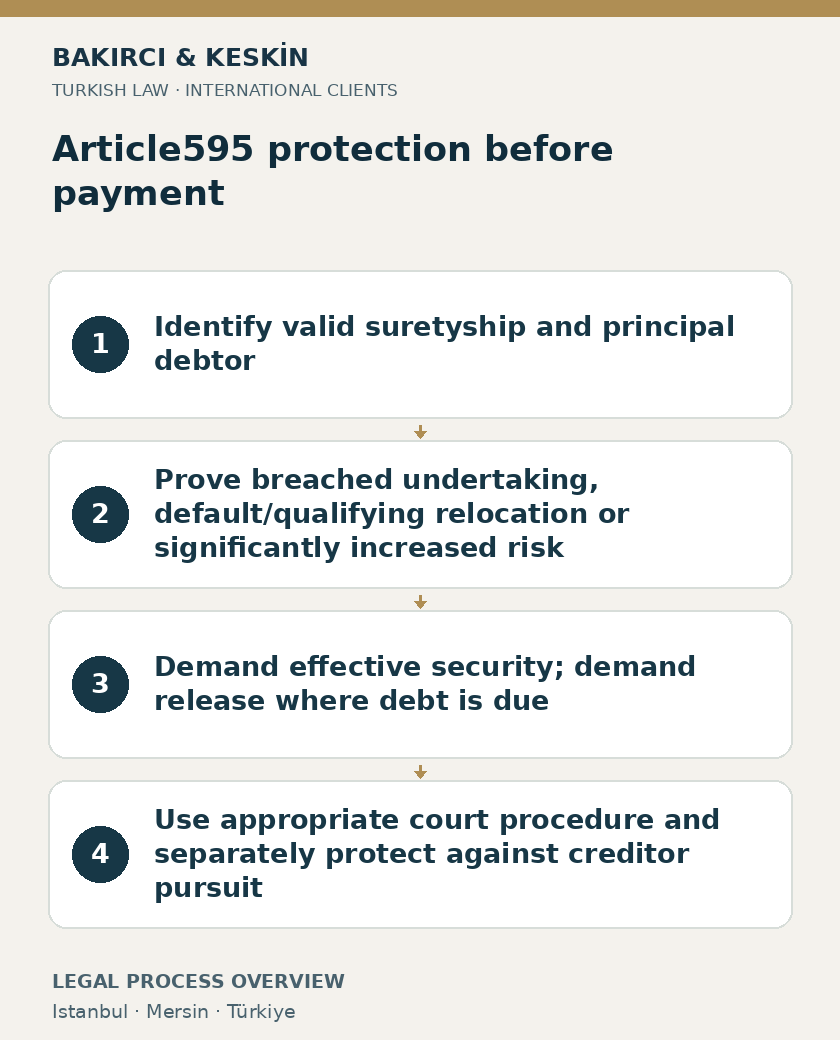
Article 595 of the Turkish Code of Obligations allows a surety to demand security from the principal debtor in specified circumstances and, where the debt is due, to demand release from the debt. The grounds include breach of obligations owed to the surety, debtor default, a move abroad that substantially complicates pursuit, and a significant increase in risk compared with the date of suretyship. This is a claim against the principal debtor. It is distinct from a defence to the creditor’s demand and from reimbursement after the surety has paid.
Have a general question about this article? Ask anonymously
Quick summary
| Legal issue | Can a Surety Demand Security from the Borrower in Turkey Before Paying? Article 595 |
|---|---|
| Short answer | Article 595 of the Turkish Code of Obligations allows a surety to demand security from the principal debtor in specified circumstances and, where the debt is due, to demand release from the debt. The grounds include breach of obligations owed to the surety, debtor default, a move abroad that substantially complicates pursuit, and a significant increase in risk compared with the date of suretyship. This is a claim against the principal debtor. It is distinct from a defence to the creditor's demand and from reimbursement after the surety has paid. |
| Key legislation | Code of Obligations No. 6098; Civil Code No. 4721; Civil Procedure Code No. 6100 |
Article 595 provides protection before a reimbursement claim arises
A surety is exposed to a creditor because of a personal-security undertaking connected with the principal debtor’s obligation. The surety’s relationship with that debtor has its own legal consequences. Article 595 of the Turkish Code of Obligations No. 6098 allows the surety, on the specified grounds, to demand security and, where the debt has matured, release from the debt.
The provision is useful before the surety has paid the creditor. It should not be treated as merely another name for recourse after payment under Article 596. The relief concerns protection against the exposure that already exists, subject to the conditions in Article 595. Whether the principal debt is due affects the available release demand and must be established from the debt documents.
The statute lists separate grounds. A claimant should identify the particular ground supported by the facts rather than assert that every change in the borrower’s business creates an immediate right to cancellation. The claim needs the undertaking, the underlying debt, the relevant event and the protection requested, presented as one coherent legal record.
Identify whose debt was secured and who owes protection to the surety
The principal debtor is the person whose obligation is secured. A company, its shareholder and its manager remain distinct legal actors. A personal security provider should identify the contracting borrower rather than direct the Article 595 demand automatically to the person who arranged the finance. A business relationship or common ownership does not replace proof of the relevant obligation.
The undertaking must also be classified. Articles 582–584 regulate the suretyship framework and its validity requirements, while Article 603 extends specified safeguards to other personal-security contracts made by natural persons under different names. The personal guarantee validity guide addresses those preliminary questions. Calling an instrument a guarantee in English does not settle every issue about its legal nature.
Record the secured debt, maximum undertaking, date, creditor and amendments. Article 589 limits responsibility to the maximum stated in the suretyship agreement. The requested protection should be connected to the actual exposure. A facility’s headline limit, the borrower’s outstanding balance and the surety’s legal maximum should not be merged into a single assumed figure.
The principal debtor’s own undertaking to the surety can supply a ground
Article 595(1) addresses breach of obligations the principal debtor undertook towards the surety, particularly a promise to release the surety within a specified period. The internal agreement is therefore important. Obtain the signed agreement, accepted correspondence and any subsequent amendment setting out what the debtor promised and when performance was required.
A company sale, financing arrangement or separation agreement can contain obligations affecting a continuing suretyship. The document must be read to determine the actual promise: obtaining the creditor’s release, replacing security, paying the debt or taking another specified step. These obligations should not be described as equivalent without examining the wording and legal effect.
Prove the breach through the agreed timetable and subsequent record. A promise that remains subject to an unmet condition needs a different assessment from an unconditional obligation whose deadline has passed. The Article 595 demand should state the obligation relied upon and the failure alleged. It should not rest solely on the surety’s later wish to leave the arrangement.
Debtor default and a qualifying move abroad are separate grounds
Article 595(2) identifies the principal debtor’s default as a ground. Article 117 supplies the general default framework: a due debt ordinarily requires the creditor’s notice, with specified exceptions including expiry of an agreed performance day. Obtain the maturity terms, demands and delivery evidence before characterising an overdue account as a legally established default.
The same paragraph also covers pursuit becoming substantially more difficult because the debtor moves its domicile to another country. The statutory conditions require a move and a causal effect on pursuit. Foreign nationality, international trade or the existence of an overseas bank account does not alone establish that ground. The evidence must explain the relevant relocation and the resulting practical and legal difficulty.
For a cross-border file, preserve the earlier and current domicile records and the information showing why the move affects pursuit. Identify the debtor rather than an unrelated group company or officer. A change of address should not be presented as conclusive without establishing the element of substantial difficulty stated in the provision.
A significant increase in danger requires a comparison with the original position
Article 595(3) addresses a significant increase in the danger faced by the surety compared with the date the suretyship was given. It identifies deterioration in the principal debtor’s financial condition, loss of value in security and the debtor’s fault as relevant causes. The comparison is explicit: the current position must be assessed against the position at the undertaking’s date.
The statutory wording does not require all the listed causes to occur together. The claimant should identify the applicable cause and prove the resulting significant increase. A financial decline should be supported by records relevant to the debtor; a decline in collateral value should be supported by evidence concerning the identified security. General concern about the market does not explain the change in the surety’s own exposure.
The analysis also needs the remaining debt and any payments or new security. A comparison that records losses while omitting a material reduction in the secured obligation can misstate the risk. Present the relevant positive and negative changes together so that the significance of the increased danger can be assessed from the complete position.
Keep documents showing changes to existing security, including releases, priority changes and the valuations relied upon. Article 595 lists loss of security value separately from the debtor’s fault. The assessment should therefore identify the actual statutory limb rather than require every security-value claim to be described as intentional wrongdoing. The claimant must still show the relevant increase in danger and its significance compared with the original suretyship position.
Build an evidence file around the suretyship date
Organise the records into the position when suretyship began and the later position relied upon. The original file should contain the principal agreement, balance or drawdown information, existing collateral and the debtor’s relevant financial records. The current file should show the corresponding information at the date the Article 595 ground is asserted.
Use dated documents and identify their source. Financial statements, official enforcement records, valuations and creditor correspondence answer different questions. A property valuation does not show the legal priority of security, and a registered security amount does not show the property’s current realisable value. The comparison should preserve those distinctions instead of presenting every document as interchangeable proof of recovery value.
Article 194 of the Code of Civil Procedure requires concrete facts and identification of the evidence supporting them. Link each asserted change to the document that proves it and explain its effect on the surety. This makes the claim assessable without relying on general accusations that the borrower is no longer trustworthy.
Request security that can actually protect the identified exposure
Article 595 uses a demand for security. The proposed security should be described sufficiently to assess its legal existence, value and connection to the protected obligation. An asset list or a promise to provide something later is not evidence that effective security has already been created. The demand and any response should identify the specific arrangement offered.
Asset-specific formalities remain important. Article 856 of the Turkish Civil Code provides that an immovable pledge is established through registration in the land register, subject to statutory exceptions, and requires official form for the constituting agreement. A private statement identifying real estate as collateral should not be treated automatically as a registered mortgage.
The security review should address ownership, existing burdens, priority, scope and the person entitled to rely on it. The amount stated in a security document should be reconciled with the surety’s supported exposure. The objective is a legally usable protection arrangement, rather than acceptance of a nominal amount that does not correspond to available value or enforceable rights.
A request for release is not itself a completed release by the creditor
Article 595 permits a release demand against the principal debtor where the debt is due and a statutory ground exists. The addressee matters. The provision does not state that sending the debtor a demand automatically cancels the creditor’s rights under a valid suretyship. The surety must distinguish the right to require action from proof that the exposure has actually ended.
Any proposed resolution should identify how release will occur and what documents establish completion. Payment of the principal debt, a creditor’s effective release and a replacement arrangement require examination on their own terms. Article 598 states that extinction of the principal debt releases the surety, while other ending rules have their own conditions.
Preserve the creditor’s statement and updated account where release or payment is asserted. A debtor’s promise that the bank will remove the guarantee is not the same document as the bank’s completed release. Corporate share transfer or resignation records should also be kept separate from the security instrument; the parties need evidence addressing the actual suretyship obligation.
Continue to assess the creditor’s claim independently
A surety pursuing Article 595 protection can also face a demand or enforcement proceeding from the creditor. Articles 585 and 586 regulate the conditions for pursuing ordinary and joint and several sureties. The surety enforcement guide explains the relevant order of pursuit, notices and collateral distinctions. The Article 595 claim does not replace those defences.
Article 590 provides a separate judicial mechanism under which a surety can request suspension of pursuit against provision of real security, subject to its statutory conditions. That is different from asking the principal debtor to provide security under Article 595. The applicant, purpose and required judicial act should be identified before treating the two provisions as interchangeable.
Record the service date and response requirements of any payment order or lawsuit. Negotiations with the borrower or an Article 595 demand do not themselves constitute the response required in the creditor’s proceeding. The surety’s substantive claim against the borrower and procedural protection against the creditor should be managed on separate, coordinated timelines.
Define the relief and any urgent procedural request precisely
The court claim should identify the Article 595 ground, the evidence establishing it and whether security, release of a due obligation or another legally supported remedy is requested. The competent court and applicable pre-action requirements depend on the parties, relationship and relief. A generic claim for reimbursement is not an adequate substitute when the surety has not paid and seeks prospective protection.
Urgent interim relief requires its own conditions. Civil Procedure Code Articles 389–390 address interim measures and require the applicant to state the grounds and type of measure and approximately prove entitlement on the merits. Article 595 does not by itself authorise seizure of every asset belonging to the debtor. The requested measure must be assessed within the applicable procedural framework.
Where evidence is at risk, Article 400 provides a distinct evidence-preservation route subject to legal interest, including the risk of loss or substantially more difficult use later. Preserving a valuation or other evidence is different from obtaining final security or a release judgment. The application should state the particular procedural result sought.
Payment to the creditor changes the issues that must be recorded
Once the surety performs to the creditor, Article 596 governs succession to the creditor’s rights to the extent of performance, subject to its stated rules. The surety recourse guide addresses recovery after payment. The file should be updated rather than continue to describe the paid amount solely as future exposure.
Article 597 requires notification of payment to the principal debtor and provides a consequence where an uninformed debtor pays again under the specified conditions. Preserve the creditor’s receipt, allocation and the debtor notification. Any existing security obtained for the surety must then be reviewed against the claim it protects and the remaining obligations.
Partial payment can leave both paid and unpaid exposure. Record each separately and reconcile receipts from the debtor, creditor or security. The same economic loss should not be presented twice through a protection demand and a reimbursement account. The legal basis of each remaining request must correspond to the current position.
Prepare the international file without assuming that residence decides the law
Article 24 of Law No. 5718 governs the contractual choice-of-law inquiry. Foreign execution, overseas residence and a Turkish borrower can create separate law and procedure questions. The applicable law of the undertaking and the internal arrangement with the debtor should be examined before relying on Article 595.
Provide complete language versions, authority documents, notices and the financial comparison. Identify the creditor’s current claim and the exact protection sought from the principal debtor. This gives counsel a defined basis for a demand or court application and preserves the distinction between preventing exposure, defending a creditor claim and recovering an amount already paid.
Frequently asked questions
Can a surety demand protection before paying the creditor?
Yes. Article 595 allows a demand for security on its specified grounds and, if the debt is due, release from the debt. This differs from recourse after payment under Article 596. The surety must establish the applicable ground and requested protection.
Who receives the Article 595 demand?
The provision gives the surety a claim against the principal debtor. Identify the person whose debt was secured. A company manager, shareholder or financing intermediary is not automatically the debtor merely because that person arranged the undertaking.
Does a breached promise to remove my guarantee matter?
Article 595(1) expressly includes breach of obligations owed to the surety, particularly a promise to obtain release within a specified period. The actual promise, conditions and deadline must be proved. The wording should be distinguished from a non-binding proposal.
Is the borrower’s foreign nationality enough for the relocation ground?
No. Article 595(2) refers to pursuit becoming substantially more difficult because the debtor moves domicile to another country. The move and its causal effect must be established. Foreign nationality alone does not prove those conditions.
How is increased risk assessed?
Article 595(3) compares the danger to the surety with the position when the suretyship was given. The provision identifies financial deterioration, loss of security value and debtor fault as relevant causes. The increase must be significant and supported by evidence.
Does a demand under Article 595 automatically cancel the creditor’s guarantee?
No automatic cancellation is stated in that provision. The demand is directed to the principal debtor. A completed release, payment or other ending event must be established under the applicable rule and documents before the surety treats the creditor-facing exposure as ended.
Is a promise to mortgage property already effective security?
For an immovable pledge, Civil Code Article 856 requires land-register entry, subject to statutory exceptions, and official form for the agreement. The offered asset’s ownership, priority and scope must also be checked. A private promise is not automatically a registered mortgage.
Does the Article 595 claim stop an enforcement proceeding against me?
It does not itself constitute a procedural suspension or objection. Article 590 contains a separate security-based suspension mechanism with its own conditions. Any served enforcement document must be reviewed and answered through the applicable procedure.
What changes after I pay the creditor?
Articles 596–597 become central to recourse and notification. Record the amount paid, debt discharged and remaining exposure, and notify the debtor as required. The protection claim and any reimbursement claim must be reconciled to the updated facts.
Can I rely on Article 595 for an undertaking signed abroad?
The applicable law and formal validity must first be determined. Article 24 of Law No. 5718 is relevant to contractual choice of law. Overseas execution or a Turkish debtor does not alone answer every question about the governing legal regime.
Official legal sources
- Code of Obligations No. 6098 — Articles 117, 582, 583, 584, 585, 586, 589, 590, 595(1)-(3), 596, 597, 598, 603
- Civil Code No. 4721 — Articles 856
- Civil Procedure Code No. 6100 — Articles 194, 389, 390, 400
- Private International and Procedural Law No. 5718 — Articles 24
The official Turkish legislation controls. The governing law, deadlines and procedural requirements must be assessed for the individual case.
Contact information
Do not include confidential documents or identity numbers in an initial message. An enquiry does not establish representation or suspend any legal deadline.
Istanbul and Mersin contact details
Bakırcı & Keskin Law Office is Mersin-based. Turkish matters are handled under the applicable jurisdiction and agreed mandate. The competent court and the scope of representation are assessed for each matter.
Istanbul — Polaris Plaza
Maslak Ahi Evran Caddesi, Polaris Plaza No:21, Floor 9, 34475 Sarıyer/İstanbul, Türkiye.Mersin — Profit İş Merkezi
İhsaniye Mahallesi, 4903. Sokak, Profit İş Merkezi No:23, Floor 3, Office 14, 33070 Akdeniz/Mersin, Türkiye.+90 552 224 43 66 · Contact details in English. An enquiry does not establish representation or suspend a legal deadline.
Istanbul Office – Polaris Plaza, Maslak / Sarıyer
Bakırcı & Keskin Hukuk Bürosu
Maslak Ahi Evran Caddesi, Polaris Plaza No:21, Kat:9, 34475 Sarıyer/İstanbul
Our physical offices in Istanbul and Mersin coordinate matters throughout Turkey, subject to jurisdiction and the local steps required for each case. Please specify your preferred office when arranging an in-person appointment.
Open the Istanbul office on Google Maps · Contact and appointments
Contact regarding a legal matter
In your first message, you may briefly state the subject, your country or city, and any relevant notification or recent procedural date. Please do not send identity numbers, medical data, or personal documents. Messaging alone does not constitute legal advice or create a lawyer–client relationship.
Discover more from Bakırcı & Keskin Hukuk Bürosu
Subscribe to get the latest posts sent to your email.