You Won a Turkish Residence-Permit Case but the Authority Has Not Acted: Article 28
Short answer: Article 28 of Administrative Procedure Law No. 2577 requires the administration to implement relevant merits and stay decisions without delay, with an outer thirty-day period from service on the administration in the ordinary framework. An appeal does not itself suspend execution under Article 52. Read the operative judgment, verify service and document the action still required; annulment, a new administrative assessment and issue of a residence document are distinct events.
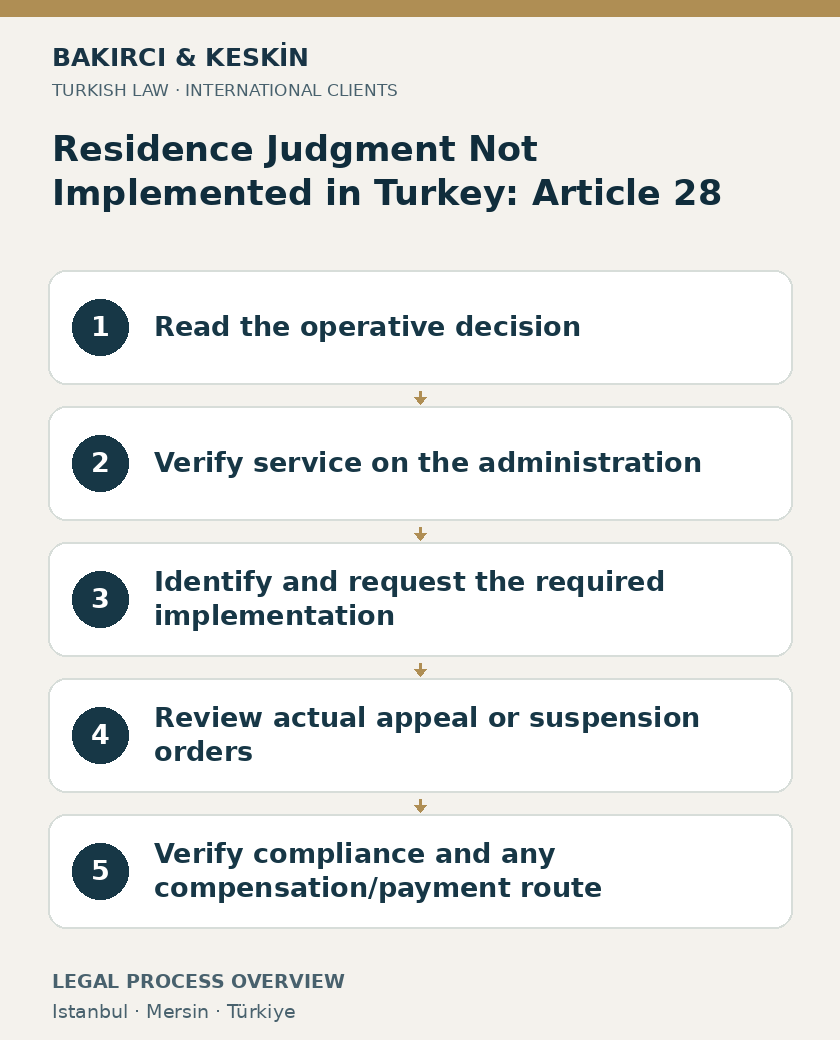
Quick summary
| Legal issue | You Won a Turkish Residence-Permit Case but the Authority Has Not Acted: Article 28 |
|---|---|
| Short answer | Article 28 of Administrative Procedure Law No. 2577 requires the administration to implement relevant merits and stay decisions without delay, with an outer thirty-day period from service on the administration in the ordinary framework. An appeal does not itself suspend execution under Article 52. Read the operative judgment, verify service and document the action still required; annulment, a new administrative assessment and issue of a residence document are distinct events. |
| Key legislation | Law No. 2577 — Articles 2, 27, 28, 52; Law No. 6458 — Articles 25 |
Identify exactly what the administrative court decided
A residence case can produce an interim stay, an annulment judgment, a procedural ruling or a decision rejecting the claim. The expression “we won the case” is not a sufficient description of the order the authority must implement. Obtain the full decision, its operative part, reasoning and service records. Establish whether the result concerns the residence refusal itself or a different procedural question.
Administrative Procedure Law No. 2577 Article 28 requires the administration to act without delay in accordance with the requirements of merits and stay-of-execution decisions within its scope. Implementation must therefore follow the actual decision. The authority’s duty cannot be assessed from a favourable sentence taken out of the reasoning while the operative outcome is ignored.
The residence-refusal litigation guide addresses bringing the original challenge. The issue here begins after a court has made a relevant decision. The file must show what the administration was required to do, when it received the decision and what action has occurred since then.
The maximum thirty days runs from service on the administration
Article 28(1) states that the required action or act must occur without delay and that the period cannot exceed thirty days from notification of the decision to the administration. The relevant service event is not automatically the date the applicant first saw the judgment or the date written at its heading. Obtain the authority’s judicial-service record rather than calculating from an informal message.
Thirty days is an outer limit in this provision, not a general entitlement for the authority to postpone an immediately required act until the last day. The duty is to comply without delay with the decision’s requirements. A representation seeking implementation should identify the actual obligation and the service chronology, not merely ask whether the card can be printed sometime in the future.
Keep the date of the judgment, notification to the applicant, notification to the administration and any later application for implementation separate. They can have different legal functions. If the service information is missing, obtain it through the court file. The applicant’s uncertainty about service should be stated as an evidential gap rather than replaced with an assumed date.
Annulment does not make every requested residence document automatic
Article 2 confines administrative judicial power to legality review and prevents the court from issuing decisions in the nature of an administrative act or eliminating the administration’s lawful discretion. Read an annulment judgment for the defect it identified and the action needed to comply. A judgment requiring the file to be reassessed lawfully should not be reported as though the court itself printed a residence permit.
The distinction does not permit the authority to ignore the judgment. Its subsequent assessment must respect the binding legal and factual requirements of the decision. Identify the issue that was resolved and the issue, if any, left for administrative action. A vague statement that the file will be reconsidered is insufficient to show compliance where the operative result requires a particular corrective step.
The implementation request should connect each necessary action to the judgment. It may concern the treatment of evidence, correction of an identified error, lawful reconsideration or another consequence established by the decision. Do not add a broader entitlement unsupported by the ruling. A precise request makes later review of compliance possible.
A stay-of-execution decision also needs practical implementation
Article 28 expressly includes decisions staying execution. Such an order has a different procedural role from a final determination on the merits, but the administration must comply with its requirements while it is effective. Obtain the complete order and any relevant later decision. The applicant should not rely on an initial stay after a subsequent court act has changed the procedural position.
Identify the administrative act whose execution is stayed and the scope of the court’s ruling. A stay in a residence-refusal case should not be assumed to decide every separate entry-ban, removal or work-authorisation matter. Those issues require their own legal basis and relevant decisions. The lawyer should review all connected immigration acts to avoid overstating the protection of one order.
If a practical difficulty persists, document it and explain how it relates to the order. An appointment, database status or further notice should be assessed against the actual judicial requirement. The existence of an order in the court file and the authority’s compliance with it are different facts; both need to be verified.
An appeal does not ordinarily suspend the judgment by itself
Article 52 states that applying for appeal or cassation does not itself suspend execution of the judicial decision. It provides for a suspension decision by the competent reviewing court within its framework. The administration’s statement that it has appealed should therefore be checked against the actual procedural record rather than accepted as proof that implementation is no longer required.
Obtain any order staying execution of the judgment and read its scope. The fact that such relief was requested is different from a decision granting it. Article 52 also states that reversal of the decision automatically suspends its execution. A reliable implementation assessment must therefore be updated when the reviewing court acts, instead of relying indefinitely on the first-instance result.
Keep the merits judgment, appeal petition and reviewing court’s operative decisions in one file. Identify which document currently governs the implementation position. The applicant should not be told either that every appeal prevents action or that no later judicial development can affect the original judgment. The correct conclusion follows the actual current procedural state.
Send a documented implementation request to the competent authority
A written request should identify the applicant, administrative file, court, case number, decision and action needed to comply. Attach or identify the full judgment and the relevant notification information. Explain the concrete unresolved step. A generic letter stating only that the applicant won can leave the authority and any later reviewing court without a clear description of the alleged non-compliance.
Provide the documents needed for the lawful implementation task without silently abandoning the judgment’s effect. If the authority asks for updated information, examine why it is requested and whether it relates to the required action. Keep the request and response. Supplying an updated passport or contact record should not be confused with accepting an unrelated new ground of refusal.
Obtain evidence of the implementation request’s receipt and preserve all replies. The request is useful for establishing the practical history, but Article 28’s thirty-day reference remains notification of the judicial decision to the administration. Do not automatically restart that statutory period from every later reminder. The dates should be recorded according to their actual legal functions.
A new administrative decision must be read against the judgment
If the authority issues a new decision, obtain its full text and service record promptly. Determine whether it implements the judgment, rests on a legally distinct assessment or repeats a defect already resolved. The conclusion requires comparison of the operative judgment, its reasoning and the new act. A new document number alone does not establish either compliance or non-compliance.
The applicant should not assume that an earlier lawsuit automatically challenges every later act. Identify the remedy and period applicable to the new decision while preserving any implementation complaint. The renewal framework can remain relevant to a separate pending application, but a new application and implementation of the successful case are different procedural matters.
Where the authority’s position is unclear, request the actual administrative act and reasons through the proper channel. A status message that the file is closed may not explain the decision that produced that status. The record should show what was done and why, so the next legal step addresses an identifiable act rather than speculation about internal processing.
Article 28 provides a route for loss caused by non-implementation
Article 28(3) permits material and non-material compensation proceedings against the administration where the relevant court decisions are not implemented by the required act or action. Article 28(4) states that, where officials fail to implement within the period, the compensation action can be brought only against the relevant administration. This statutory route should not be described as an automatic personal damages claim against the individual officer.
Compensation requires a supported account of the loss claimed and its relationship to non-implementation. Identify the period, event and documents establishing the alleged consequence. An unsuccessful residence application, the original refusal and later failure to obey a judgment are distinct events. The claim should explain which loss is attributed to which conduct rather than treating all inconvenience in the immigration history as one undifferentiated sum.
Preserve expenditure records, relevant communications and evidence of the actual legal or practical consequence. A claimed non-material injury must also be presented on its proper legal and factual basis. The fact that Article 28 permits the action does not fix a guaranteed award. The court must assess the claim and evidence in the appropriate proceedings.
Court costs and money awards have their own payment steps
Article 28(2) addresses judgments requiring payment of a stated amount, as well as awarded lawyers’ fees and litigation expenses. It directs payment to the bank account that the claimant or representative notifies to the defendant administration in writing. For that payment, the paragraph expressly starts the timetable from written account notification and applies the first paragraph’s prompt-action and maximum thirty-day framework. The applicant should therefore distinguish implementation of the residence decision from payment of the court’s monetary orders.
Supply accurate account details through a reliable written channel and preserve receipt. Identify the judgment and the amounts for which payment is requested. A lawyer’s privately agreed fee is not necessarily the same as the amount awarded by the court. The payment account should reflect the operative judicial orders and any legally relevant later changes.
Article 28 provides for enforcement under the general rules where payment is not made within the stated period. Its sixth paragraph regulates interest in compensation and tax cases by reference to the deferment-interest rate determined under Article 48 of Law No. 6183. It excludes the interval from notification of the judgment to the claimant until the bank account is notified to the administration. Do not substitute an assumed fixed percentage or apply that particular paragraph indiscriminately to every item. The payment and interest calculation must use the actual award and applicable legal basis.
Review the applicant’s current immigration position throughout implementation
The successful decision must be connected to the applicant’s current file. Obtain the present residence records, application documents and any separate immigration notices. A favourable judgment does not eliminate the need to establish which document or legal basis supports the applicant’s position while implementation occurs. The precise effect depends on the ruling and the relevant status rules.
Law No. 6458 Article 25 requires notification of domestic residence refusal, cancellation and non-renewal to the foreigner, legal representative or lawyer, with information on remedies and obligations. A further notice received during implementation must be reviewed on its own terms. Do not set it aside solely because an earlier decision was successfully challenged.
Plans to travel or work should be assessed against the actual current authorisation and documents. The implementation request, judicial decision and residence card serve different functions. The lawyer’s report should state what each establishes and what remains pending. This prevents a procedural success from being misunderstood as a permission extending beyond its legal scope.
Use a dated compliance record rather than repeated unstructured reminders
Create a short record identifying the judicial obligation, service on the administration, implementation request, replies and steps actually taken. Add subsequent court decisions as they arrive. The record should show whether the authority acted within the required period and whether the act addressed the judgment. Repeated correspondence is useful only if its legal and practical significance can be traced.
For a client abroad, agree who can obtain the court-service information and communicate with the authority. Keep instructions concerning further proceedings or settlement explicit. A representative should distinguish a proposed action from an authorised and completed filing. The client needs the operative documents and a clear account of remaining decisions, not assurances unsupported by the file.
Where several authorities are involved, identify the action required from each within the actual legal process. Do not assume that sending the judgment to an unrelated office establishes service on the defendant administration or completes the necessary implementation step. The proper recipient and documented delivery must be matched to the duty being invoked.
Verify implementation against the court’s actual requirement
When the authority reports completion, obtain the resulting act or document and compare it with the judgment. Check the applicant’s identity, permit or application reference, relevant dates and the issue the court resolved. A changed portal status should be supported by the official decision or record appropriate to the outcome. Record any aspect of the judgment that remains unimplemented.
Also verify monetary performance separately. A decision that the applicant should receive costs is not evidence of a bank payment. Keep receipts and statements showing the amount and allocation actually received. If further action is necessary, identify the outstanding obligation precisely instead of reopening issues already resolved.
Article 28 gives the successful litigant an enforceable implementation framework, with prompt action, an outer thirty-day period and a compensation route in the stated circumstances. Its practical use depends on the operative judgment, the authority’s service date and the acts that follow. Those documents determine whether a legal victory has been carried into effect.
Frequently asked questions
When does Article 28’s maximum thirty-day period start?
It starts from notification of the relevant judicial decision to the administration, not automatically from the judgment date or the applicant’s receipt.
May the authority always wait thirty days?
The statute requires action without delay; thirty days is the stated outer limit in the ordinary framework.
Does annulment itself issue a residence permit?
Read the actual judgment. Legality review and the administration’s implementing act are distinct.
Must the authority implement a stay decision too?
Article 28 includes stay-of-execution decisions while effective and within their actual scope.
Does an appeal automatically suspend implementation?
Article 52 says an appeal or cassation application does not itself suspend execution; actual suspension or reversal decisions require separate review.
Does every reminder restart the thirty days?
No automatic restart follows. The statutory reference is service of the judicial decision on the administration.
Can I claim compensation for non-implementation?
Article 28(3) provides the stated route against the administration, subject to the actual claim and supporting evidence.
Is the individual official automatically the damages defendant?
Article 28(4) directs the stated non-implementation compensation action against the relevant administration.
What is needed for payment of awarded amounts?
Article 28(2) requires written notification of the claimant’s or representative’s bank account to the defendant administration within its payment framework.
What confirms implementation?
Compare the authority’s resulting act with the operative judgment and verify any monetary payments separately.
Official legal sources
Legal review: 28 October 2026. The official Turkish legislation controls. Implementation depends on the operative judgment, service on the administration and any subsequent reviewing-court decision.
Contact information
Do not include confidential documents or identity numbers in an initial message. An enquiry does not establish representation or suspend any legal deadline.
Istanbul and Mersin contact details
Bakırcı & Keskin Law Office is Mersin-based. Turkish matters are handled under the applicable jurisdiction and agreed mandate. The competent court and the scope of representation are assessed for each matter.
Istanbul — Polaris Plaza
Maslak Ahi Evran Caddesi, Polaris Plaza No:21, Floor 9, 34475 Sarıyer/İstanbul, Türkiye.Mersin — Profit İş Merkezi
İhsaniye Mahallesi, 4903. Sokak, Profit İş Merkezi No:23, Floor 3, Office 14, 33070 Akdeniz/Mersin, Türkiye.+90 552 224 43 66 · Contact details in English. An enquiry does not establish representation or suspend a legal deadline.
Istanbul Office – Polaris Plaza, Maslak / Sarıyer
Bakırcı & Keskin Hukuk Bürosu
Maslak Ahi Evran Caddesi, Polaris Plaza No:21, Kat:9, 34475 Sarıyer/İstanbul
Our physical offices in Istanbul and Mersin coordinate matters throughout Turkey, subject to jurisdiction and the local steps required for each case. Please specify your preferred office when arranging an in-person appointment.
Open the Istanbul office on Google Maps · Contact and appointments
Contact regarding a legal matter
In your first message, you may briefly state the subject, your country or city, and any relevant notification or recent procedural date. Please do not send identity numbers, medical data, or personal documents. Messaging alone does not constitute legal advice or create a lawyer–client relationship.
Discover more from Bakırcı & Keskin Hukuk Bürosu
Subscribe to get the latest posts sent to your email.