A Minor and a Parent Inherit the Same Turkish Estate: Conflict of Interest and a Trustee
Short answer: A parent who inherits alongside a child cannot represent the child in a matter where their interests conflict. Turkish Civil Code Article 426 provides for a representative trustee, while Article 345 requires a trustee’s participation and judicial approval for specified transactions that place the child under an obligation. The appointment, transaction permissions and international jurisdiction require separate examination. Living abroad does not remove the child’s protection, and an estate representative appointed for all heirs does not automatically replace the child’s independent representative.
Have a general question about this article? Ask anonymously
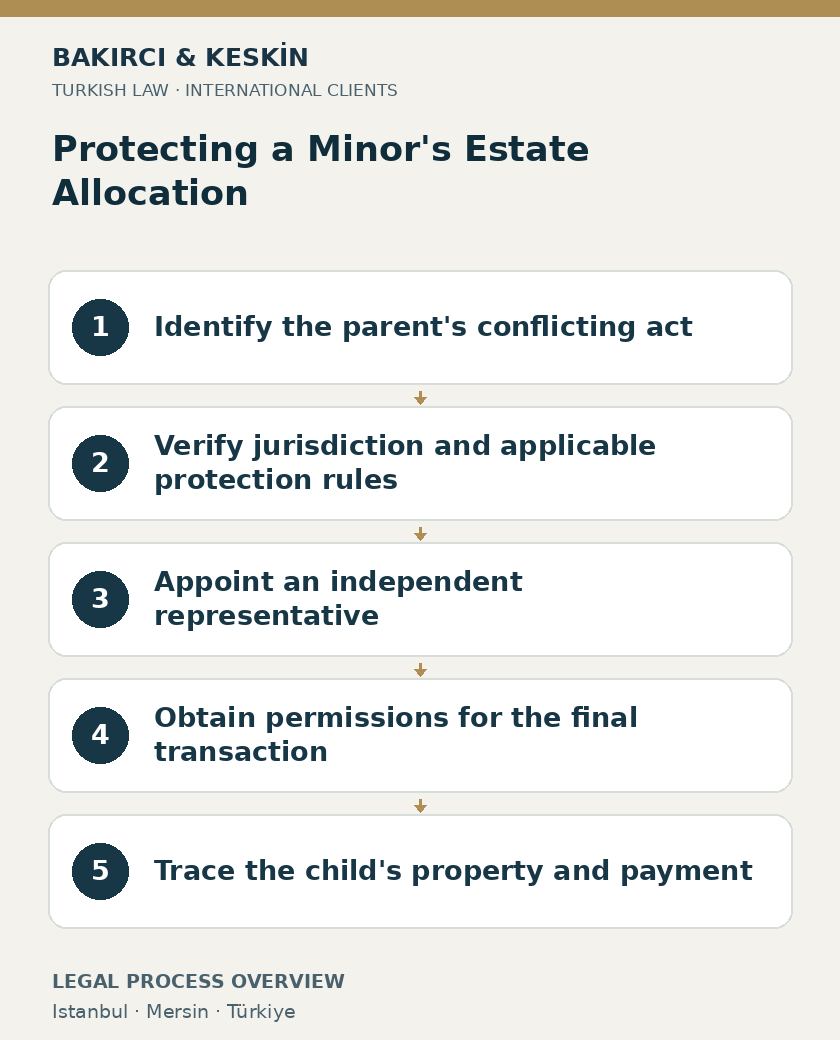
Quick summary
| Legal issue | A Minor and a Parent Inherit the Same Turkish Estate: Conflict of Interest and a Trustee |
|---|---|
| Short answer | A parent who inherits alongside a child cannot represent the child in a matter where their interests conflict. Turkish Civil Code Article 426 provides for a representative trustee, while Article 345 requires a trustee's participation and judicial approval for specified transactions that place the child under an obligation. The appointment, transaction permissions and international jurisdiction require separate examination. Living abroad does not remove the child's protection, and an estate representative appointed for all heirs does not automatically replace the child's independent representative. |
| Key legislation | Turkish Civil Code No. 4721 — Articles 336, 342, 345, 397, 403, 426, 430, 458, 459, 462, 463, 599, 606, 640, 450; Private International and Procedural Law No. 5718 — Articles 10, 20; 1996 Hague Child Protection Convention — Articles 3, 4, 5, 40, 43, 55 |
1. Identify the decision in which the parent’s and child’s interests conflict
The starting point is the proposed legal act, rather than the family relationship alone. A parent and child appearing in the same inheritance certificate does not explain whether a particular application is protective, administrative or adverse to the child. Prepare a precise description of the act: allocation of an apartment, release of a claim against the parent, settlement of estate debts or transfer of the child’s inheritance share.
A partition decision requires separate attention because the participants negotiate which assets and liabilities each receives. The parent seeks an allocation in the parent’s own capacity while the child has a distinct entitlement. The conflict assessment must address those competing positions, including valuation, balancing payments and any liability assumed. Agreement within the family does not itself establish that the same person can validly speak for both sides.
Civil Code Article 426(2) addresses a conflict between the legal representative’s interest and the minor’s interest in a matter. The application should connect that statutory test to the transaction documents. A reasoned account of the actual conflict gives the court a basis to define the representative’s task; a general statement that the family owns property abroad leaves that question unanswered.
2. Parental responsibility does not remove the conflict rule
Under Article 342, parents are their child’s legal representatives within parental authority. Article 336 regulates the exercise of that authority under Turkish domestic law, including the surviving parent’s position after the other parent’s death. These provisions explain ordinary representation. They do not authorise a parent to disregard a conflict arising in the administration or division of an estate.
Article 342 also distinguishes parental representation from guardianship permissions. It applies the representation rules concerning persons under guardianship except for matters dependent on the guardianship authorities’ permission. Consequently, a file must identify whether the signer acts as a parent, guardian or court-appointed trustee. Treating every parent as a guardian subject to every guardianship permission produces the wrong analysis.
Where the child lives abroad, the source and continuation of parental responsibility require the applicable international rules as well. A foreign custody decision, a birth record and a Turkish inheritance certificate answer different questions. The certificate proves the inheritance position; it does not decide which adult has authority to conclude a transaction for the child or whether that adult has a conflicting personal interest.
3. Article 426 provides an independent representative for the conflicted matter
Article 426 requires appointment of a representative trustee on an interested person’s request or of the authority’s own motion in the circumstances it lists. Conflict between a legal representative and a minor is an express ground. The Turkish term is temsil kayyımı. This is a legal appointment for representation, with duties determined by law and the appointment decision.
Article 403 distinguishes a guardian’s broad protective responsibilities from a trustee appointed for specific matters or asset management. The same article generally applies the Code’s provisions concerning guardians to trustees unless otherwise stated. Article 458 explains that appointment of a trustee does not itself change the represented person’s legal capacity. A transaction-specific appointment therefore should not be described as a general removal of parental responsibility.
The proposed representative must be able to evaluate the child’s position independently. The application should disclose relevant connections with the parent, other heirs and the proposed buyer. The objective is effective representation in the identified matter. Replacing the parent’s signature with another person’s signature while leaving all substantive decisions with the conflicted parent does not address that objective.
4. Article 345 adds protection when the transaction places the child under an obligation
Article 345 covers a legal transaction between the child and a parent, or between the child and a third party for the parents’ benefit, through which the child becomes obligated. It requires both a trustee’s participation and the judge’s approval. The statutory conditions must be matched to the agreement, including obligations that appear in an annex or settlement schedule.
An estate agreement must therefore be read beyond the description of the asset the child receives. Check promises to pay balancing amounts, reimburse expenses, assume a debt, release the parent or guarantee another participant’s performance. An apparently favourable transfer can contain a separate obligation. The analysis concerns the entire legal arrangement and the benefit obtained by the parent, rather than the document’s title.
Appointment and approval are distinct. A trustee’s appointment identifies who can represent the child in the assigned matter. It does not by itself constitute approval of an unseen agreement. The proposed terms, asset information and liabilities should be placed before the appropriate judge where Article 345 applies. The resulting decision must be compared with the final document before anyone signs.
5. Check the permissions required for the representative’s particular act
Article 462 lists acts requiring the guardianship authority’s permission within the guardianship framework. Relevant categories include transactions in immovable property, litigation and settlement, inheritance partition agreements and transfers of inheritance shares. Article 463 identifies matters requiring the supervisory authority’s permission in addition, including acceptance or rejection of an inheritance and inheritance contracts. These categories should be read with Article 403 when a trustee acts.
The distinction matters because appointment to represent the child in an estate does not make every later transaction part of one unrestricted mandate. A petition limited to participation in partition should not silently become authority to reject the inheritance, sell another asset or compromise unrelated claims. Prepare an act-by-act permission schedule based on the representative’s legal status and the court’s instructions.
Do not apply these lists mechanically to ordinary parental acts without considering Article 342. The specific conflict, the form of representation and Article 345 remain central. For a court-appointed representative, obtain decisions addressing the actual act and any required additional permission. This sequence allows the registry, bank and other participants to verify authority without inferring powers that the order never grants.
6. The appointment request should define its scope and the competent authority
Article 397 identifies the Civil Court of Peace as the guardianship authority and the Civil Court of First Instance as the supervisory authority. Article 430 provides the domestic territorial rule for a representative trustee by reference to the represented person’s domicile. For a management trustee, it refers to the place where the greater part of the property is managed or where the represented person’s allocated assets are located.
These domestic rules must be applied after addressing international jurisdiction where the child resides abroad. The location of a Turkish apartment alone should not be treated as an explanation of every jurisdictional question. Identify whether the requested order is a protective measure concerning the child’s property, an inheritance determination or approval of a specified transaction, and state the legal basis for the authority approached.
The petition should attach the proposed agreement and explain the tasks requested: reviewing valuations, negotiating allocation, participating in litigation or executing an approved transfer. Under Article 459, a trustee appointed for a particular matter must follow the guardianship authority’s instructions. Accurate scope at appointment prevents later reliance on a broad family description that does not authorise the transaction presented for completion.
7. A child living abroad requires a separate international protection analysis
MÖHUK Article 20 governs the succession choice-of-law inquiry and expressly applies Turkish law to Turkish immovable property. Article 10 separately addresses guardianship and trusteeship; its third paragraph subjects trusteeship to Turkish law within the domestic conflicts framework. Neither provision eliminates the need to examine an applicable international convention and the competent authority for the protective measure.
The 1996 Hague Child Protection Convention includes representation and protection of a child’s property in Article 3, while Article 4 excludes succession itself. Those provisions require separation of the child’s inheritance entitlement from a measure protecting the child in administering or disposing of inherited property. Article 5 gives the habitual-residence authorities the general jurisdictional role, subject to the Convention’s other provisions.
Türkiye has also made an Article 55 reservation preserving its authorities’ jurisdiction to protect a child’s property situated in Türkiye and the stated right concerning incompatible foreign measures. This reservation is directly relevant to Turkish estate property. Verify the Convention’s territorial and temporal operation, the other state’s position and any existing protective order before choosing the route; a foreign parental document is not a substitute for that analysis.
8. An estate representative serves a different function
Article 640 allows appointment of a representative for the inheritance community until partition. That representative concerns the estate held collectively by several heirs. A representative trustee under Article 426 addresses the child’s representation in a conflicted matter. The two appointments solve different problems, even where both appear in the same estate file.
Accordingly, the estate representative’s authority should not be used as proof that the child’s personal interests in allocation or settlement have independent representation. Review each appointment and identify the persons represented, the assets concerned and the permitted acts. The office’s guide to the community of heirs and Article 640 estate representative explains the estate-wide administration mechanism.
9. Give the representative evidence needed to assess the child’s allocation
A useful file contains current title records, ownership restrictions, tenancy documents, balances, liabilities and an identifiable valuation basis. A list stating only the family’s preferred prices does not allow a meaningful comparison between the child’s legal entitlement and the proposed allocation. The representative needs evidence of both the asset’s value and the obligations attached to receiving it.
Separate the arithmetic of inheritance shares from the economics of the transaction. A percentage on an inheritance certificate does not show the net value of an occupied apartment, a disputed receivable or property subject to a mortgage. Record the valuation date and distinguish a valuation estimate from an agreed sale price. Explain any balancing payment, its due date and how payment will be documented.
The child’s money must remain identifiable in the completion documents. Specify the recipient account, the legal owner of the funds and any conditions imposed by the court. A payment to the parent’s personal account should not be treated as evidence that the child received the allocation without examining authority and accounting. The representative’s report should trace what the child gave up and actually received.
The child’s views also deserve a separate record. Article 450 requires the guardian, so far as possible, to obtain the views of a represented person able to form and express them before important decisions. Article 403 supplies the general connection to trusteeship. The child’s agreement does not release the representative from responsibility. Record the explanation given to the child and the child’s response without treating that response as a replacement for independent assessment, judicial permission or a valid transaction.
10. Address inheritance debts and rejection before agreeing to a division
Article 599 provides the general succession framework, including personal responsibility for inherited debts subject to statutory exceptions. A minor’s interest therefore cannot be assessed from valuable assets alone. Collect the known liabilities, enforcement records and creditor correspondence before agreeing that a particular allocation is beneficial. The approval file should distinguish estate debts from a new obligation created by the proposed agreement.
Article 606 establishes the ordinary three-month rejection period and its different starting rules for legal and testamentary heirs. Representation difficulties do not justify inventing an automatic suspension. Record when death or the relevant testamentary notification became known and obtain advice on the specific procedural protection needed. Where rejection is proposed through a guardian or trustee, the additional permission framework must be considered expressly.
Read the applicable succession law before assigning every foreign estate debt to Turkish rules. The MÖHUK Article 20 inheritance guide explains the distinction between Turkish immovables and other cross-border succession issues. The child’s nationality, habitual residence, deceased’s nationality and asset location are separate facts; they should not be collapsed into one label such as “foreign inheritance.”
11. Prepare foreign documents and powers of attorney around the actual roles
The documentary file should connect the child’s identity, parentage, parental responsibility and inheritance position. Obtain the relevant civil-status records and decisions, together with the authentication and Turkish translation required for their use. Record any later custody or protective order. A lawyer evaluating authority needs the operative decision, rather than a family member’s summary of what a foreign court decided.
Where documents are forwarded or delivered under the 1996 Hague Convention, Article 43 exempts them from legalisation or an analogous formality. That exemption must be distinguished from translation needs and documents outside its scope. Article 40 also provides for a certificate identifying a person’s representative capacity and powers, presumed to exist unless the contrary is proved. Assess the actual certificate and treaty route rather than imposing an apostille requirement on every document without distinction.
A power of attorney signed by the conflicted parent cannot itself resolve the underlying conflict. The lawyer’s authority derives from the person legally entitled to instruct for the particular act. Where a trustee is appointed, compare the appointment, permissions and proposed legal mandate. The power of attorney from abroad guide addresses the separate preparation of usable authority.
12. Verify the approved terms against the transaction actually completed
Before signature, compare the final agreement with the court-approved version, property identifiers, price, payment terms and parties. A later alteration to the child’s obligations or allocation requires a renewed authority assessment. Keep the appointment decision, permissions, signed instruments, registry records and payment proof together so that the completed act can be traced to the representative’s lawful mandate.
After completion, reconcile the child’s property and funds with the approved allocation and any reporting requirement in the appointment. Unperformed balancing payments, retained deposits and unresolved estate assets should remain separately recorded. The purpose of the process is a legally supported transaction whose effect on the child can be demonstrated, rather than a set of permissions detached from what the parties ultimately did.
Frequently asked questions
Does every parent who inherits with a child need a trustee?
The relevant question is whether the parent’s interest conflicts with the child’s in the particular matter under Article 426. Identify the proposed act and competing interests. Joint heirship alone does not describe every later transaction.
Can the surviving parent sign a partition agreement for both parties?
A partition that creates a conflict requires independent representation for the child. The agreement, the representative’s appointment and applicable permissions must be examined before treating the parent’s signature as sufficient for both interests.
What does Article 345 require?
For its specified transactions between parent and child, or with a third party for the parents’ benefit, placing the child under an obligation requires a trustee’s participation and the judge’s approval. Review all obligations in the arrangement.
Does a trustee take away parental responsibility?
A representative trustee is appointed for the matter defined by the court. Article 403 distinguishes that role from general guardianship, and Article 458 states that trustee appointment does not itself affect the represented person’s legal capacity.
Is the estate representative also the child’s representative?
Not automatically. Article 640 concerns administration of the inheritance community. Article 426 concerns representation of the minor in a conflicted matter. Each appointment must be examined for its own scope and the interests represented.
Does the child living abroad prevent protection of Turkish property?
No. International jurisdiction requires analysis, including the 1996 Hague Convention where applicable. Türkiye’s Article 55 reservation preserves jurisdiction for measures protecting a child’s property in its territory. Existing foreign measures and the treaty relationship must be checked.
Are guardianship permissions automatically required for every parental act?
No. Article 342 expressly distinguishes parental representation from guardianship permissions. The legal capacity in which the adult acts, the conflict rules, Article 345 and any trustee appointment determine the required analysis.
Can a power of attorney cure the parent’s conflict?
A power of attorney does not establish authority the parent lacks for a conflicted matter. The appropriate independent representative and transaction permissions must first be identified; the lawyer’s mandate then follows that lawful authority.
Does requesting a trustee automatically stop the rejection deadline?
Do not assume an automatic suspension. Article 606 contains the ordinary rejection period and starting rules. Record the relevant dates and address any available extension or other protection under the provisions applicable to the actual file.
Which records should be retained after the property transfer?
Keep the appointment, approvals, final signed agreement, registry result, valuation material and payment evidence. They should demonstrate that the completed transaction matches the authorised terms and identify the property or money received for the child.
Official legal sources
- Turkish Civil Code No. 4721 — Articles 336, 342, 345, 397, 403, 426, 430, 458, 459, 462, 463, 599, 606, 640, 450
- Private International and Procedural Law No. 5718 — Articles 10, 20
- 1996 Hague Child Protection Convention — Articles 3, 4, 5, 40, 43, 55
- Türkiye reservation to 1996 Hague Convention — Articles 55
Legal sources reviewed on 28 October 2026. The official Turkish legislation and applicable conventions control; individual facts and later amendments must be checked before action.
Contact information
Do not include confidential documents or identity numbers in an initial message. An enquiry does not establish representation or suspend any legal deadline.
Istanbul and Mersin contact details
Bakırcı & Keskin Law Office is Mersin-based. Turkish matters are handled under the applicable jurisdiction and agreed mandate. The competent court and the scope of representation are assessed for each matter.
Istanbul — Polaris Plaza
Maslak Ahi Evran Caddesi, Polaris Plaza No:21, Floor 9, 34475 Sarıyer/İstanbul, Türkiye.Mersin — Profit İş Merkezi
İhsaniye Mahallesi, 4903. Sokak, Profit İş Merkezi No:23, Floor 3, Office 14, 33070 Akdeniz/Mersin, Türkiye.+90 552 224 43 66 · Contact details in English. An enquiry does not establish representation or suspend a legal deadline.
Istanbul Office – Polaris Plaza, Maslak / Sarıyer
Bakırcı & Keskin Hukuk Bürosu
Maslak Ahi Evran Caddesi, Polaris Plaza No:21, Kat:9, 34475 Sarıyer/İstanbul
Our physical offices in Istanbul and Mersin coordinate matters throughout Turkey, subject to jurisdiction and the local steps required for each case. Please specify your preferred office when arranging an in-person appointment.
Open the Istanbul office on Google Maps · Contact and appointments
Contact regarding a legal matter
In your first message, you may briefly state the subject, your country or city, and any relevant notification or recent procedural date. Please do not send identity numbers, medical data, or personal documents. Messaging alone does not constitute legal advice or create a lawyer–client relationship.
Discover more from Bakırcı & Keskin Hukuk Bürosu
Subscribe to get the latest posts sent to your email.