Your Turkish Mortgage Creditor Has Changed: Assignment, Payment and the Property Owner
Short answer: Civil Code Article 891 makes assignment of a mortgage-secured claim valid without registration of the assignment itself. The new claimant must still prove the transfer and secured debt. Borrower liability, the non-borrowing owner’s Article 887 demand protection, payment to the former creditor and cancellation of the mortgage are separate questions.
Have a general question about this article? Ask anonymously
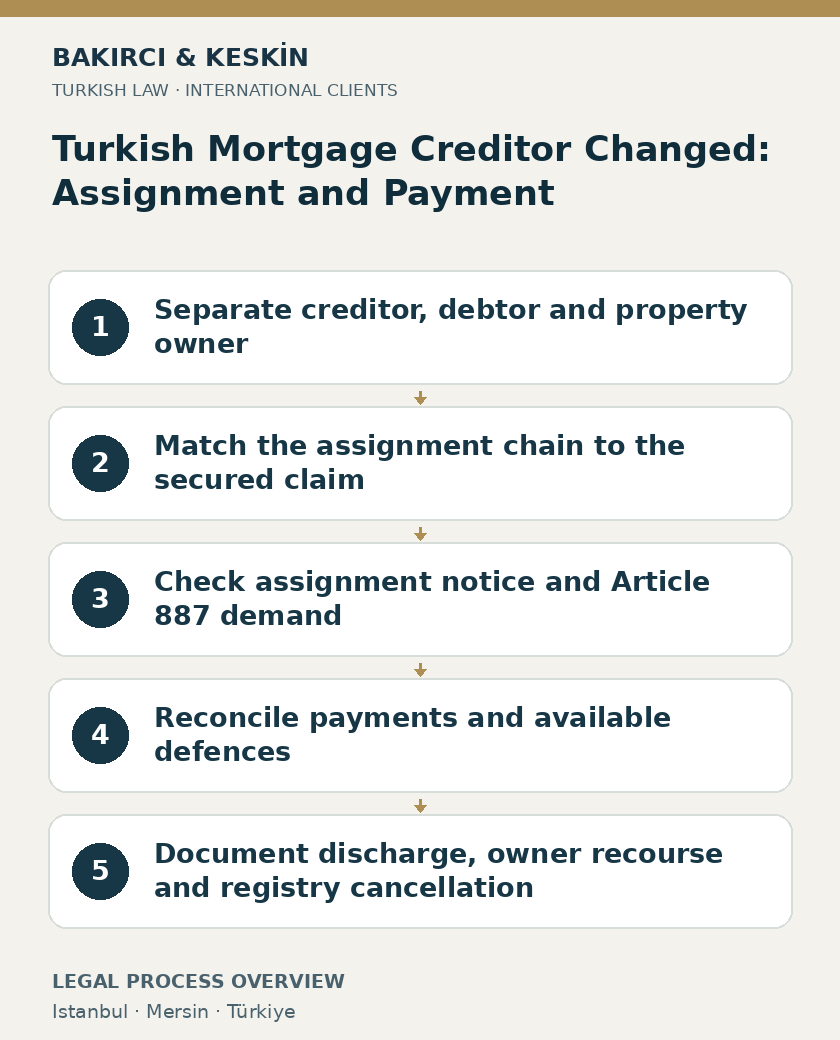
Quick summary
| Legal issue | Your Turkish Mortgage Creditor Has Changed: Assignment, Payment and the Property Owner |
|---|---|
| Short answer | Civil Code Article 891 makes assignment of a mortgage-secured claim valid without registration of the assignment itself. The new claimant must still prove the transfer and secured debt. Borrower liability, the non-borrowing owner’s Article 887 demand protection, payment to the former creditor and cancellation of the mortgage are separate questions. |
| Key legislation | Law No. 4721 — Articles 881, 883, 884, 887, 888, 890, 891; Law No. 6098 — Articles 183–190 |
Identify the creditor, borrower and registered owner separately
A mortgage over Turkish land secures a claim against a debtor, but the debtor and property owner need not be the same person. Civil Code Article 881 expressly permits security over property belonging to someone other than the debtor. A notice saying that the mortgage has been sold therefore requires identification of three roles: the claimant, the person owing the debt and the person whose land provides security.
Obtain the current title, mortgage instrument, underlying loan or other debt agreement and the new creditor’s communication. Record the legal names and identification details of each participant. A trading brand, servicing company or collection lawyer is not necessarily the owner of the secured claim. The notice should explain whether the sender is the assignee, an authorised representative or an administrator acting for another creditor.
An owner abroad should establish their own legal position before answering a demand. Owning the mortgaged apartment does not by itself mean that the owner signed the original loan or became personally liable for it. Conversely, absence of personal liability does not mean that the mortgage can be ignored. The review must address both the underlying debt and the separate exposure of the identified property.
Article 891 does not require registration of the assignment for validity
Civil Code Article 891 provides that the validity of assignment of a mortgage-secured claim does not depend on registration of the assignment in the land register. The continued appearance of the former creditor’s name is therefore not, by itself, proof that no effective assignment occurred. This is a specific rule about transfer of the secured claim, rather than a general exemption from all mortgage formalities.
The rule also does not prove that an assignment actually happened. The person seeking payment must still be able to establish the relevant transfer and the claim transferred. Ask for the document chain linking the original secured creditor to the present claimant. Where a portfolio contains many debts, identify the record connecting this debtor, agreement and mortgage to the transfer rather than relying only on a general announcement.
Keep registration of the original mortgage separate from the later assignment. Article 891 should not be used to argue that an uncreated security right exists merely because a debt was transferred. The mortgage instrument and current title establish the property-security record; the assignment documents establish the creditor succession. The two sets of evidence need to correspond to the same claim.
Check the legal basis and documentary form of the transfer
Code of Obligations Article 183 generally permits assignment without the debtor’s consent unless legislation, the contract or the nature of the obligation prevents it. Debtor consent is therefore a different question from proof of transfer. A homeowner should not assume that refusing to sign the new creditor’s notice necessarily prevents an otherwise valid assignment.
Article 184 requires a voluntary assignment to be in writing. A promise to assign and an actual assignment are different acts under that article. The review should identify the operative signed document and any schedule defining the claim. Article 185 separately addresses transfers arising by law or court decision, which do not require the same special form or a declaration of the former creditor’s consent.
Determine which route the claimant relies upon instead of demanding one universal document for every creditor change. A succession by operation of law, a court-ordered transfer and a negotiated sale of receivables need different supporting evidence. Any special legislation applicable to the creditor or financial asset also requires its own assessment. Article 891 does not decide every regulatory question about who may acquire or service a particular debt.
Match the assigned debt to the mortgage and its scope
Article 881 allows a mortgage to secure an existing claim and a claim whose future existence is certain or possible. The instrument must therefore be examined for the obligation it secures. The registered figure is not automatically a current payoff statement. A demand should identify the actual principal, relevant interest, payments, maturity and the basis of other sums said to fall within the security.
Article 189 provides that qualifying priority and accessory rights pass with the assigned claim, except rights personal to the assignor. It also deems accrued interest transferred with the principal. The new creditor should identify those accessories accurately. Acquisition of one mortgage-secured receivable does not establish ownership of every unrelated debt or security held by the former creditor against the same person.
Compare the mortgage date, journal reference, parcel and independent-unit details with the original debt file. Record any amendments, releases, partial repayments and changes to the secured obligation. A mismatch needs an explanation before a demand is accepted. The purpose of this comparison is to connect the enforceable claim to the relevant security, rather than treat a land-register entry as proof of every accounting assertion.
Notice of assignment affects payment to the former creditor
Article 186 protects a debtor who, without notification of the assignment by the assignor or assignee, performs in good faith to the former creditor. It also addresses successive assignments and good-faith payment to an earlier assignee. The protection depends on the notification and good-faith position at the relevant time. It is not an unconditional right to continue paying the former lender after learning of a transfer.
Preserve the original notice, attachments, delivery information and bank payment records. Distinguish the date the assignment was made from the date the debtor learned of it and the date the payment was completed. A notice received after a disputed instalment requires a different chronology from a payment sent after verified notification. The account should identify which payment is said to remain outstanding and why.
The ordinary assignment-notice question should not be confused with a mortgage payment demand directed to a non-borrowing owner. Article 887 addresses that separate issue. Likewise, an enforcement notice has procedural consequences that cannot be answered solely by explaining Article 186. Retain every official document and its service record so that substantive payment protection and procedural response requirements are reviewed together.
A non-borrowing owner has a separate Article 887 protection
Where the mortgaged property’s owner is not personally liable for the debt, Article 887 makes the creditor’s payment request effective against that owner only when the request is made against both the debtor and the owner. A demand addressed only to the borrower is therefore not automatically a complete answer to the owner’s statutory position. Establish who received which request and in what capacity.
Article 887 does not state that every assignment is invalid unless separately registered or approved by the property owner. Its subject is the effectiveness of the payment request against the non-personally-liable owner. Keeping those issues separate prevents the owner from relying on the wrong objection and prevents the creditor from assuming that notice of transfer alone has satisfied every later demand requirement.
The file should show the owner’s acquisition date, the original borrower’s identity, any debt-assumption agreement and the relevant notices. If the claimant says the owner is personally liable, ask for the particular undertaking or legal basis. The title record establishes ownership; it does not substitute for every document needed to establish personal indebtedness. The answer should be grounded in the actual transaction history.
A change of owner and a change of creditor are different events
Article 888 states that transfer of mortgaged property does not, unless otherwise agreed, change the debtor’s responsibility or the security. A later buyer can therefore acquire property that remains subject to an existing mortgage. Assignment of the secured receivable changes the creditor side, while a property sale changes ownership. The records should track those events separately even when they occurred close together.
The same article contains a distinct rule where the new owner assumes the debt. The former debtor is released unless the creditor gives that debtor written notice within one year that recourse is reserved. Article 890 fixes the start of this period at service of the land registry’s notification of the assumption to the creditor. Record both notices separately: the registry informs the creditor, and the creditor’s reservation must reach the former debtor through the required written notice. Do not infer debt assumption merely from payment of the purchase price or a request for a mortgage statement. Obtain the actual undertaking before applying this rule.
The site’s mortgaged-property purchase guide explains closing and discharge checks. In an assignment dispute, those original closing documents remain useful: they show whether a mortgage was to remain, who was expected to pay it and what release was promised. A later creditor transfer should be reconciled with that history without assuming that private promises automatically removed the registered security.
Assignment does not erase the debtor’s existing defences
Under Article 188, the debtor can assert against the assignee the defences held against the assignor when the assignment was learned of. Identify the relevant defence and supporting documents: payment, calculation, contractual performance and maturity raise different issues. A debt-purchase price paid between the creditors does not determine whether the debtor owes the face amount demanded.
Article 188 also addresses set-off involving a counterclaim not yet due when the debtor learned of assignment, provided it matures before or at the same time as the assigned claim. The dates and parties matter. A general assertion that the former lender owes money is not a complete set-off analysis. Keep the counterclaim, its maturity and any dispute evidence separate from the mortgage account.
The property owner and borrower should coordinate relevant records without assuming they possess identical personal defences. The owner may be challenging the secured amount or the effectiveness of a demand, while the borrower raises an issue under the original debt agreement. The response should identify whose right is invoked and the legal connection to the enforcement being threatened.
Deal with competing creditor demands through the appropriate legal route
When ownership of a claim is genuinely disputed, Article 187 permits the debtor to withhold performance and obtain discharge by depositing the subject of the obligation at a place designated by the judge. The provision does not say that holding money in the debtor’s own account has the same effect. A competing-claim problem requires identification of the claimants and the actual legal dispute.
Article 187 also makes the debtor responsible for the consequences of paying despite knowing that entitlement to the claim is disputed. Preserve inconsistent notices and the explanations received from each claimant. An unexpected bank-account change should be independently verified through established channels. Verification protects the payment record; it should not be presented as a substitute for a court-directed deposit where that procedure is required.
Distinguish competing ownership from a disagreement about the amount due. Two parties claiming the same receivable raise a different issue from one verified creditor demanding an incorrect balance. The selected remedy should address the actual uncertainty. An owner abroad should provide the full notices and any pending court or enforcement documents before instructions are given about payment or withholding.
A non-borrowing owner who pays can acquire the claim
Civil Code Article 884 allows an owner who is not personally liable to pay under the conditions available to the debtor and request removal of the mortgage. The claim passes to the owner who pays. This statutory consequence matters when the owner settles a secured debt to protect the property but expects to recover from the original debtor. The transaction should not be documented as an unexplained gift or personal borrowing.
Before payment, establish the present creditor’s entitlement and obtain a dated calculation identifying the sum and obligations being discharged. The payment instruction, receipt and mortgage-release documentation should identify the same secured claim. A remittance to a collection intermediary needs the relevant authority; possession of the old mortgage file does not alone establish authority to receive money on behalf of the new creditor.
Keep evidence needed for the claim that passes to the paying owner. That includes the original debt, assignment chain, payment and relevant security records. The owner’s potential recovery against the borrower should be assessed separately from the immediate release of the property. Article 884 supplies the statutory transfer rule, but it does not guarantee that the borrower has assets or that every additional expense is recoverable.
A payoff and a clear land-register record are separate completion tasks
Article 883 gives the owner a right to request that the creditor arrange cancellation of the mortgage when the secured claim ends. Obtain the release through the appropriate registry process and check the resulting record. A bank receipt establishes a payment; it does not, on its own, demonstrate that the mortgage entry has been cancelled. The current creditor and its authorised representative must be correctly identified for that step.
Article 190 requires an assignor to hand over the debt instrument, other proof documents in its possession and information necessary to assert the claim. Missing documentation between the creditors is therefore a real evidential issue. It should not be resolved by asking the owner to accept contradictory creditor identities without explanation. The paying party needs a coherent release path tied to the actual holder of the secured claim.
The site’s title-transfer guide explains why current registry records matter. For an overseas owner facing a changed mortgage creditor, the essential package is the title, mortgage instrument, debt agreement, assignment chain, account, notices and any enforcement file. Those records permit a reasoned decision about payment, defence, protective proceedings and cancellation.
Frequently asked questions
Must the new mortgage creditor already appear on the title?
Article 891 makes validity of assignment of the secured claim independent of registration of that assignment. The claimant must nevertheless establish the actual transfer and secured claim.
Does the property owner have to consent to every assignment?
Article 183 generally permits assignment without debtor consent, subject to statutory, contractual and nature-of-obligation restrictions. Ownership of the security does not itself create a universal consent requirement.
Does assignment create a mortgage that was never established?
No. The original security and the later creditor transfer are separate matters. The mortgage instrument and registry evidence must identify the existing security.
Can I keep paying the former creditor after receiving notice?
Article 186 protects specified good-faith payment without notification. It does not authorise ignoring a known transfer; review the actual notice and payment chronology.
What protection does an owner who is not the borrower have?
Article 887 addresses the payment request: to be effective against the non-personally-liable owner, it must be made against both the debtor and that owner.
Does buying mortgaged property automatically make me the borrower?
Article 888 separates ownership transfer from debtor responsibility and the security. Any actual assumption of debt requires its own analysis.
Can the assignee ignore a defence against the former creditor?
Article 188 preserves qualifying defences held when the debtor learned of assignment and contains a specific set-off rule. The defence and its dates must be established.
What if two creditors demand the same secured debt?
Article 187 addresses disputed entitlement and court-designated deposit. Keeping money privately is not equivalent to discharge through that procedure.
What happens if a non-borrowing owner pays to release the land?
Article 884 permits payment under the debtor’s conditions and provides that the claim passes to the paying owner. The payment and acquired claim should be documented.
Does a payment receipt prove the mortgage was cancelled?
No. Article 883 concerns cancellation after the claim ends. Obtain the relevant release and verify the updated land-register record.
Official legal sources
Recorded primary-source check dates: 26 October 2026. The official Turkish legislation controls. A new publication-date check is still required.
Contact information
Do not include confidential documents or identity numbers in an initial message. An enquiry does not establish representation or suspend any legal deadline.
Istanbul and Mersin contact details
Bakırcı & Keskin Law Office is Mersin-based. Turkish matters are handled under the applicable jurisdiction and agreed mandate. The competent court and the scope of representation are assessed for each matter.
Istanbul — Polaris Plaza
Maslak Ahi Evran Caddesi, Polaris Plaza No:21, Floor 9, 34475 Sarıyer/İstanbul, Türkiye.Mersin — Profit İş Merkezi
İhsaniye Mahallesi, 4903. Sokak, Profit İş Merkezi No:23, Floor 3, Office 14, 33070 Akdeniz/Mersin, Türkiye.+90 552 224 43 66 · Contact details in English. An enquiry does not establish representation or suspend a legal deadline.
Istanbul Office – Polaris Plaza, Maslak / Sarıyer
Bakırcı & Keskin Hukuk Bürosu
Maslak Ahi Evran Caddesi, Polaris Plaza No:21, Kat:9, 34475 Sarıyer/İstanbul
Our physical offices in Istanbul and Mersin coordinate matters throughout Turkey, subject to jurisdiction and the local steps required for each case. Please specify your preferred office when arranging an in-person appointment.
Open the Istanbul office on Google Maps · Contact and appointments
Contact regarding a legal matter
In your first message, you may briefly state the subject, your country or city, and any relevant notification or recent procedural date. Please do not send identity numbers, medical data, or personal documents. Messaging alone does not constitute legal advice or create a lawyer–client relationship.
Discover more from Bakırcı & Keskin Hukuk Bürosu
Subscribe to get the latest posts sent to your email.