A Turkish Property Usufruct Ends: Death, Registry Cancellation and the Return Account
Short answer: An individual usufruct holder’s death ends the right under Civil Code Article 797, while Article 796 provides the owner’s cancellation route for immovable property. Return, damage, expenses and income need a separate closing account. Article 802 applies a one-year limitation period from return to the claims within its scope; the date of death is not automatically that starting date.
Have a general question about this article? Ask anonymously
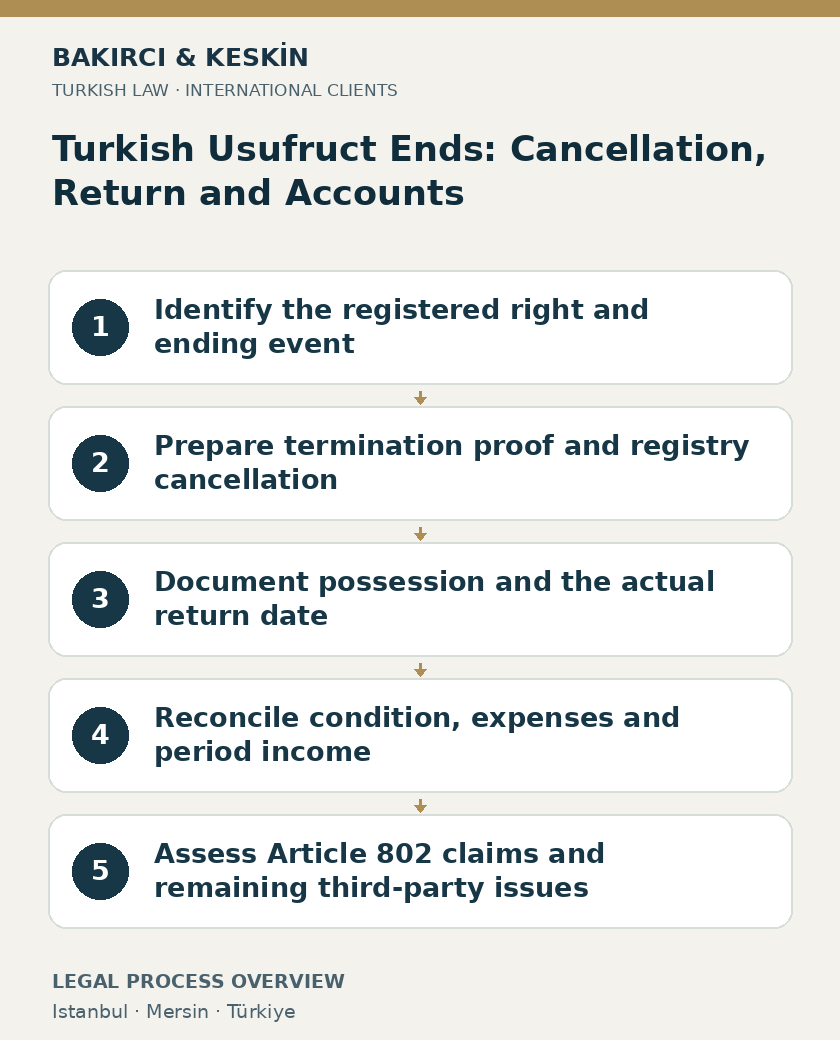
Quick summary
| Legal issue | A Turkish Property Usufruct Ends: Death, Registry Cancellation and the Return Account |
|---|---|
| Short answer | An individual usufruct holder’s death ends the right under Civil Code Article 797, while Article 796 provides the owner’s cancellation route for immovable property. Return, damage, expenses and income need a separate closing account. Article 802 applies a one-year limitation period from return to the claims within its scope; the date of death is not automatically that starting date. |
| Key legislation | Law No. 4721 — Articles 794–806, 1026; Law No. 6100 — Articles 12, 190, 199, 223, 224 |
Read the registered usufruct before treating the property as vacant
A usufruct, described in Turkish records as intifa hakkı, separates ownership from a substantial right to enjoy an asset. Civil Code Article 794 states that, unless otherwise arranged, it gives its holder full enjoyment of its subject. Article 803 includes possession, management, use and enjoyment. The registered owner therefore needs to establish both the end of the right and the practical return of the property.
Obtain the current title, the instrument creating the usufruct and any relevant amendments. Identify the holder, the property, whether the right concerns the whole asset or a defined part, and the stated duration. A translated sale description saying lifetime use is not a substitute for the authoritative record. The legal distinction between usufruct, a residence right, a lease and ownership determines the applicable termination rules.
The site’s foreign property-purchase guide treats usufruct as an important title restriction. The present enquiry begins when the owner says that restriction has ended. A property can still contain occupants, tenant arrangements, income, repairs or disputed belongings even after the event ending the holder’s right. Those matters need their own documented handover.
Identify the precise legal ground for termination
Article 796 addresses termination through total destruction of the subject and, for immovables, cancellation of the registration. It also states that statutory usufruct ends when its legal basis disappears. Expiry, waiver and death are identified as other termination grounds giving the immovable owner authority to request cancellation. The application should state the actual ground instead of describing every inactive usufruct as expired.
Article 797 specifically provides that a natural person’s usufruct ends on the holder’s death. For a legal person, it ends at the agreed term or, where no term was agreed, when the legal personality ceases. A legal person’s usufruct can continue for no more than one hundred years. The different rules require accurate identification of whether the registered holder is an individual or an entity.
An unused apartment is not evidence that the holder died, waived the right or reached the agreed expiry date. Obtain the document establishing the relied-on event. Where the instrument contains a period, identify its legally relevant start and end rather than assume that the date printed on an old title is the entire duration provision. A clear termination file avoids confusing absence from Turkey with loss of the right.
Death of the holder and the estate’s remaining affairs must be separated
Article 797 links an individual holder’s usufruct to that person’s life. It should not be described as a continuing lifetime usufruct automatically inherited by the holder’s children. The end of the personal right is distinct from the settlement of financial claims, expenses, belongings or other obligations connected with the period when it existed. Identify those issues separately in communications with the estate.
The death record must be matched to the registered holder. Compare the name, identity details and any historical passport or spelling variations with the instrument and registry record. A document concerning a similarly named person does not establish the relevant death. Where an overseas record requires authentication or translation for use in Turkey, establish the applicable route before submitting an incomplete cancellation request.
Representation also needs verification. A person describing themselves as the deceased holder’s relative is not automatically authorised to settle every estate account or deliver every asset. Obtain the documents establishing the capacity in which the person acts. The owner should distinguish acknowledging the statutory end of usufruct from accepting a proposed financial release, receipt or settlement on behalf of other interested persons.
Complete the land-register cancellation process
Article 796 gives the owner the relevant cancellation request where the stated ending event occurs. The request should identify the property and registered right and include the documents establishing the ground. Ending events and registry administration should be tracked separately: a death certificate or expiry clause explains why cancellation is sought, while the updated register shows what has actually been recorded.
Article 1026 provides a general mechanism where the ending of a right in rem leaves its registration without any legal value. The burdened property’s owner can request cancellation. If the registry officer grants the request, an interested person can challenge the cancellation within thirty days from notification of that act. The provision also permits the officer to seek a judicial determination that the right has ended and act on the resulting decision.
That thirty-day period concerns the specified challenge to cancellation; it is not the same as the one-year period for return-related claims in Article 802. Preserve the application, official response, updated record and notification evidence. Where the existence or extent of the right remains disputed, the proper judicial issue must be identified. A cancellation request should not be used to conceal a separate dispute over who owns the land.
Article 799 requires return of the subject property
When usufruct ends, Article 799 requires its holder to return the subject property to the owner. Practical return needs an identifiable record. Specify possession, keys, access devices, property documents and the condition in which the asset is handed over. A letter saying that the right has ended does not necessarily establish that the owner has actually regained the property.
Prepare an agreed inventory where possible, with dated photographs and an account of items belonging to different persons. Distinguish fixtures and property components from personal belongings. Record anything missing or disputed without turning the handover document into an unintended release of all claims. The owner should know whether a signature acknowledges physical receipt, accepts the condition or settles a particular monetary disagreement.
Where another person occupies or manages the property, identify the legal basis and the documents through which that person obtained possession. Do not assume that registry cancellation itself physically removes occupants or determines every contract made during the usufruct. The appropriate possession, contractual or enforcement steps depend on the actual relationship. The return file should make that relationship visible before instructions are given.
Distinguish compensable loss from ordinary wear
Article 800 makes the usufruct holder responsible for destruction or reduction in value unless the holder proves the damage did not arise from their fault. It separately requires compensation for things consumed when consumption was unnecessary for enjoyment. The account should identify the actual loss, its timing and the condition of the asset before and after the relevant use.
The same article excludes liability for reductions in value resulting from ordinary use. The owner should therefore distinguish ordinary ageing and use from a claimed breach or abnormal deterioration. A demand for the entire cost of making an older property new does not, by itself, establish the statutory amount recoverable. The evidence should explain the difference between existing condition, ordinary wear and the particular damage alleged.
Preserve the initial inventory, repair records, insurance documents, photographs and relevant technical reports. Where a defect’s cause is disputed, identify what requires expert examination. A quotation for replacement is not automatically proof of responsibility or the full loss. The legal review should connect the alleged conduct, physical result and amount claimed while considering Article 800’s specific burden and ordinary-use exception.
Review the holder’s expense and addition claims under Article 801
Article 801 allows the usufruct holder, at termination, to claim compensation under the rules of management of another’s affairs without mandate for expenses, renewals and additions made without being obliged to make them. It does not say that every amount the holder spent becomes an automatically reimbursable invoice. The obligation to incur the cost and the statutory basis of the proposed recovery need separate examination.
The expense schedule should identify the work, date, supplier, amount, payment and reason it was undertaken. Distinguish ordinary care, compulsory obligations, additional improvements and expenditure serving the holder’s own preferences. Preserve any agreement with the owner. A budget approved for one repair does not automatically establish acceptance of a different renovation or its final price.
Where the owner refuses compensation, Article 801 permits removal of additions subject to restoring the property to its former condition. The proposed removal must therefore be assessed against the actual addition and the restoration requirement. It is not an unrestricted right to damage the property or dismantle unrelated components. Record any agreed removal and the resulting condition at handover.
The Article 802 clock begins with return
Article 802 provides a one-year limitation period, beginning with return, for all claims that the owner and usufruct holder can assert at the time of return under that framework. The date of the return event is therefore legally significant. Do not automatically substitute the death date, the expiry date or the date on which a registry cancellation request was first lodged.
The handover record should state what was returned and when. Where return is contested, preserve the correspondence and objective possession evidence. A later financial discussion does not establish a new return date simply because the parties continued to exchange figures. Each party should obtain timely advice on the specific claim and the steps legally relevant to protecting it.
The provision should not be presented as a universal one-year limit for every dispute mentioning the property. Identify whether the claim is one arising in the return relationship, a different ownership issue or a separate contractual obligation. Equally, do not assume that informal negotiation alone preserves a return-related claim. The legal classification and actual dates must guide the response.
Close the income account at the correct period
Article 805 allocates interest and other periodic income to the usufruct holder for the period from commencement to termination, even where it becomes due later. The date money reaches the bank is therefore not necessarily the only date relevant to the account. Identify the income period, the right’s start and end, the contractual due date and the actual payment.
Prepare a schedule of rent or other relevant periodic receipts and distinguish amounts concerning different periods. The receipt account should show who collected the money and what portion is disputed. Avoid treating every later payment as belonging entirely to the owner merely because it arrived after termination. Conversely, collection by the former holder does not itself establish entitlement to income for a later period.
Article 804 separately addresses natural fruits ripening during usufruct and the limited expense claim for planting or sowing by the other party. Agricultural property therefore needs records appropriate to its actual produce and cultivation. A general apartment-rent spreadsheet should not be applied uncritically to crops, components of the land or items that the Code treats differently.
Destruction, insurance and expropriation need a different analysis
Article 798 states that the owner is not obliged to restore a usufruct asset that has deteriorated to the point of being unusable. If the owner restores it, usufruct is re-established under that provision. The condition of the asset and the legal nature of the work therefore matter. A statement that the building was damaged is insufficient to determine the right’s entire position.
The same article provides that usufruct continues over replacement consideration in cases such as insurance and expropriation. The loss of the original physical asset should therefore not automatically be described as freeing every payment from the right. Identify the compensation or insurance proceeds, the beneficiary arrangements and the source of the payment before distributing it.
Keep the policy, loss determination, expropriation papers, payment record and existing usufruct instrument together. Separate money replacing the subject asset from an unrelated claim belonging personally to one participant. The statutory continuity rule needs to be connected to the actual substitute value, without assuming that every payment following a damaging event has the same legal character.
A transfer of use does not change the identity of the usufruct right
Article 806 permits transfer of the exercise of usufruct unless the agreement states otherwise or the circumstances show that personal exercise by the holder is required. It also allows the owner to assert rights directly against the transferee of use. The right and its exercise should therefore be identified separately. A management or occupation arrangement does not automatically create a new perpetual usufruct.
Obtain the complete document under which a third person uses or manages the property. Identify whether it concerns exercise of the usufruct, a lease, services or another obligation. Review what the document says about duration, termination, collected income and return. The legal effect of that arrangement must be assessed directly rather than inferred from the fact that the original holder gave someone access.
The owner’s communications should identify the statutory ending event and request the records needed for handover. Avoid signing a broad confirmation that every third-party arrangement is accepted merely to obtain keys. A carefully defined return protocol can record possession and preserve the parties’ positions on separate debts, occupation or accounts without pretending those issues were resolved by the registry entry alone.
Prepare a complete overseas document and closing file
Foreign documents used in Turkish court proceedings require attention to Articles 223 and 224 of the Code of Civil Procedure. Article 223 concerns translation, while Article 224 addresses foreign official-document authentication subject to applicable treaties. Determine the appropriate route for the issuing country and document. A translated scan is not automatically equivalent to a properly authenticated official record.
The property’s location is also procedurally important under Article 12 for the specified real-right and possession claims. Living abroad does not itself shift those Turkish property disputes to a court chosen for the owner’s convenience. The representative’s authority should cover the actual registry, court and settlement steps required, with distinct instructions for receipt, financial compromise and any removal of disputed additions.
The site’s title due-diligence guide explains why current rights must be checked individually. The final usufruct closing file should contain the termination proof, cancellation record, handover date, condition inventory, income account, expenses and unresolved claims. That combination establishes what ended legally, what was returned physically and which financial matters still need resolution.
Frequently asked questions
Does a natural person’s usufruct pass to their heirs?
Article 797 ends the individual holder’s usufruct on death. Remaining financial and estate matters require separate analysis; they do not automatically continue that lifetime right.
Does living abroad end my usufruct?
Absence alone is not one of the ending events identified in Articles 796–797. Check the instrument and the actual statutory ground relied upon.
Is the death certificate the final registry record?
No. The evidence of death supports the ending ground, while cancellation must be processed and the updated title checked.
What is the Article 1026 thirty-day period?
It concerns an interested person’s challenge to cancellation granted under that provision, running from notification of the cancellation act.
Does the holder have to return the property?
Article 799 imposes the return obligation when usufruct ends. Possession, keys, condition and relevant records should be documented.
Must the holder pay for ordinary wear?
Article 800 excludes reduction in value resulting from ordinary use. Other destruction or loss of value is assessed under its responsibility and proof rules.
Are all improvements automatically reimbursed?
No. Article 801 addresses qualifying non-obligatory expenses, renewals and additions under the specified legal framework. The expense and basis of recovery must be established.
When does the one-year return-account period begin?
Article 802 begins with return. It should not automatically be calculated from death, contractual expiry or the cancellation application.
Who receives income paid after the right ends?
Article 805 looks to the relevant period of interest or other periodic income, even where it becomes due later. Separate the income period from collection date.
Does destruction always eliminate every usufruct interest?
Article 798 preserves usufruct over substitute consideration in situations such as insurance and expropriation. The actual replacement payment needs examination.
Official legal sources
Recorded primary-source check dates: 26 October 2026. The official Turkish legislation controls. A new publication-date check is still required.
Contact information
Do not include confidential documents or identity numbers in an initial message. An enquiry does not establish representation or suspend any legal deadline.
Istanbul and Mersin contact details
Bakırcı & Keskin Law Office is Mersin-based. Turkish matters are handled under the applicable jurisdiction and agreed mandate. The competent court and the scope of representation are assessed for each matter.
Istanbul — Polaris Plaza
Maslak Ahi Evran Caddesi, Polaris Plaza No:21, Floor 9, 34475 Sarıyer/İstanbul, Türkiye.Mersin — Profit İş Merkezi
İhsaniye Mahallesi, 4903. Sokak, Profit İş Merkezi No:23, Floor 3, Office 14, 33070 Akdeniz/Mersin, Türkiye.+90 552 224 43 66 · Contact details in English. An enquiry does not establish representation or suspend a legal deadline.
Istanbul Office – Polaris Plaza, Maslak / Sarıyer
Bakırcı & Keskin Hukuk Bürosu
Maslak Ahi Evran Caddesi, Polaris Plaza No:21, Kat:9, 34475 Sarıyer/İstanbul
Our physical offices in Istanbul and Mersin coordinate matters throughout Turkey, subject to jurisdiction and the local steps required for each case. Please specify your preferred office when arranging an in-person appointment.
Open the Istanbul office on Google Maps · Contact and appointments
Contact regarding a legal matter
In your first message, you may briefly state the subject, your country or city, and any relevant notification or recent procedural date. Please do not send identity numbers, medical data, or personal documents. Messaging alone does not constitute legal advice or create a lawyer–client relationship.
Discover more from Bakırcı & Keskin Hukuk Bürosu
Subscribe to get the latest posts sent to your email.