Pledging a Turkish Limited Company Share to a Foreign Lender: TCC Article 600, Consent and ETDS Records
Short and direct answer: Turkish Commercial Code Article 600(2) allows a limited company’s articles to require general assembly approval before a capital share is pledged. Where approval is required, the company may refuse only for just cause. That is different from automatically applying every ordinary share-sale rule under Article 595. A pledge secures a debt; it does not by itself transfer shareholder status or voting rights. Newly registered Turkish companies must maintain their share book in the Ministry of Trade’s Electronic Commercial Books System (ETDS) from 1 January 2026 under the applicable rules.
Have a general question about this article? Ask anonymously
This guide focuses on foreign banks, investors and shareholders who use a Turkish limited company share as collateral. The necessary work is to identify the share and secured obligation, check the registered articles, observe the appropriate legal form and corporate procedure, examine the actual share-book record and distinguish creation of security from later enforcement.
Quick summary
| Primary company-law rule | Turkish Commercial Code Article 600 — limited share pledge and usufruct |
|---|---|
| Company approval | Required if the articles impose it; refusal of pledge approval requires just cause |
| Share transfers | Article 595 contains distinct sale and form rules |
| Electronic record | ETDS mandatory share books for companies newly registered from 1 January 2026 |
| Voting and ownership | Pledge does not automatically give the creditor shareholder status or vote |
| Enforcement | Separate legal procedure and Article 596 considerations, not automatic share appropriation |
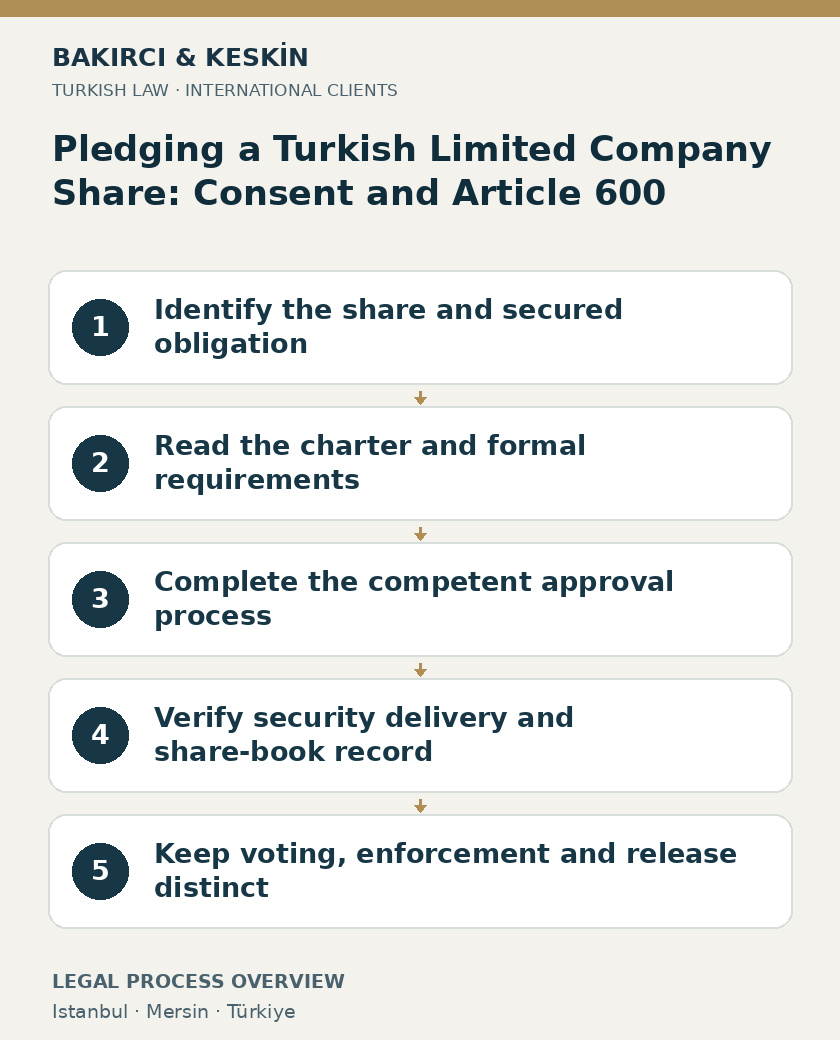
A share pledge is not a transfer of company ownership
A Turkish limited company share can be offered as security for a loan or another defined obligation. Turkish Commercial Code Article 600 governs the relevant share-right categories, including pledge and usufruct, while Article 595 addresses transfers. A pledge is intended to secure performance of the debt; it does not by itself make the lender the registered shareholder or transfer the company’s management to the creditor. Any transaction documents should distinguish the secured claim from the corporate interest used as collateral.
A foreign bank or investor should identify the company, registration details, the precise capital share and the holder offering it. The shareholder, borrower, company and lender may be four different legal persons. The fact that a group company receives funds does not automatically authorize another company or individual to pledge its shares. Establish capacity and representation before discussing whether the company needs to approve the security.
The pledge description should identify the obligation secured, the collateral share, amount or determinable scope and the legal conditions governing creation and enforcement. A vague clause that all assets stand as security may not establish the specific corporate right intended. Likewise, a lender should not treat the possession of an unverified share certificate as conclusive proof that the underlying Turkish limited company share has been effectively pledged.
Article 600(2): consent depends on the company’s articles
Article 600(2) allows a Turkish limited company’s articles of association to make establishment of a pledge over an ordinary capital share subject to general assembly approval. The statute does not impose this requirement unconditionally in every company, and it is inaccurate to apply the default approval requirement for sale under Article 595(2) as though it automatically governed all pledges. Read the actual registered articles and any valid amendments.
Where the articles require approval, Article 600(2) refers to the rules on transfer and limits refusal to cases where just cause exists. This is materially different from the ordinary share-transfer rule under Article 595(3), which may permit refusal without stating a reason unless the articles provide otherwise. A company should not cite Article 595’s general sale rule while ignoring the stricter Article 600 limit applicable to the pledge approval it has required.
A creditor requesting approval should identify the actual security transaction and present the relevant agreement and shareholder information through the proper corporate procedure. The general assembly’s decision should be recorded in the manner applicable to that company’s books. Managers should not invent an approval already given, and the creditor should not assume a generic manager letter replaces the corporate body’s decision where the articles assign authority to the general assembly.
Proper written instruments and authority must be assessed together
Article 595(1) requires written form and notarized signatures for share transfers and transactions creating an obligation to transfer. Article 600(2) refers to transfer provisions in the situation where the articles require approval of a pledge. The legal form of the particular security transaction must therefore be coordinated with the relevant statutory rules and the company’s articles rather than decided on the basis of a foreign-law template alone.
For overseas lenders, obtain the original Turkish pledge document and any foreign-language parallel contract. Verify powers of attorney, signatory capacity, company identification and the relevant notarization or other legally required formalities. A foreign notarial document may raise apostille, authentication or translation questions when presented in Türkiye. The English wording of the finance agreement should not be assumed to satisfy every Turkish form requirement without examination.
Prepare a closing checklist that separates contract execution, necessary corporate approval, the pledge’s legal establishment, the company records and any subsequent registration or delivery requirement. The order matters because an unsigned or unapproved document cannot be represented as completed security merely because the loan proceeds were transferred. The lender’s bank transfer and the creation of the property right are related commercial events but different legal questions.
The general assembly has a defined role when approval is required
Where the registered articles require approval, the application and decision must be handled through the company assembly. Keep proof of the request’s contents and when it was submitted to the company. The applicable transfer-referral rules include Article 595(7), which provides for deemed approval after three months without rejection under the defined circumstances. Whether the referral operates in the particular pledge case should be assessed together with Article 600’s specific text and actual registered provisions.
The company should identify any just cause relied on for refusal. A personal disagreement with the shareholder or an unexplained preference for another lender does not automatically establish a legally adequate reason. Equally, an article should not claim that refusal is impossible in every case. The registered articles, proposed security, legitimate company interests and relevant facts require examination.
A lender needs a reliable record of the assembly decision or the legally relevant lapse of time, rather than a verbal assurance that directors will not object. If a dispute about consent arises, preserve meeting notices, resolutions, application evidence and the pertinent company rules. No party should assume that ignoring a properly submitted application indefinitely produces the same result under every conceivable corporate structure without verifying the statutory and contractual framework.
Company share-book entries and the 2026 electronic record system
The Turkish limited company share book is part of the evidence of capital shares and their holders. The law governing its required content and the company’s actual recording arrangements must be checked when security is granted. Recording a pledge or related change may be an important part of closing the transaction, but a share-book notation should not be treated as a magical replacement for the rules governing legal creation of the pledge, corporate consent and the correct secured obligation.
From 1 January 2026, companies newly registered in the trade registry are required to maintain their share book and general assembly meeting and discussion book through the Electronic Commercial Books System (ETDS), under the Ministry of Trade’s implementing rules. The ministry’s official notice makes that obligation clear. Companies registered before that date may be in different categories, including voluntary ETDS use, so the lender should not assume that every existing company has already migrated.
The lender should request an appropriate excerpt or record and identify who is authorized to maintain the book. A newly incorporated company should not be treated as compliant solely because someone produces an old-style blank physical share ledger. Conversely, electronic book-keeping does not make a defective pledge enforceable. Keep technical recordkeeping, shareholder identity and the legally operative security agreement distinct in the due-diligence checklist.
A share certificate does not resolve all legal questions
Article 593 addresses limited company share rights and the relevant certificates. A limited company may issue certificates with the characteristics provided by that article, but possession of a piece of paper is not the same thing as holding every underlying corporate right. The lender should identify the actual capital share, shareholder and any additional burdens attached to it, rather than rely on an instrument described by a sales agent as a ‘stock certificate’.
A foreign creditor may be accustomed to security over negotiable share instruments under another legal system. Turkish limited companies are not identical to joint-stock corporations for transfer and corporate approval purposes. A form imported from another jurisdiction may describe a delivery of securities without addressing the Turkish corporate transaction. The parties should agree on a security package that matches the actual Turkish limited company structure.
Where the share is jointly held, inherited or subject to another right, obtain the records showing who can validly grant security and whether further approvals are needed. Existing transfer restrictions and pledged rights should be checked carefully. Avoid inferring that the creditor may simply take the entire company if a loan instalment is missed merely because it holds a company-issued document.
Pledge and usufruct have different consequences for voting
Article 600(1) refers the creation of a usufruct over the share to the rules on transfer, and Article 600(3) addresses representation of the share by the usufruct holder. The same paragraph imposes a duty to observe the shareholder’s interests in equity, with compensation consequences if that duty is not respected. A pledge under Article 600(2) serves a different security purpose and must not automatically be equated to a usufruct.
Granting the lender security does not itself give the lender the shareholder’s general assembly vote. Any attempt to provide a separate voting proxy or management arrangement needs its own validity and corporate-law assessment. A clause asserting that the lender ‘becomes owner and votes immediately upon default’ is not a safe substitute for the required security and enforcement process.
The parties should also distinguish distributions and economic rights. The pledge’s scope and any arrangement concerning dividend receivables must be identified in the agreement and applicable property and obligations law. It is inaccurate to assume that every future distribution becomes the creditor’s free income merely because the share is encumbered. A finance agreement should state precisely how money paid on the share is to be handled.
Borrower default does not itself transfer the share to the lender
If the secured debt is not paid, the creditor’s remedies depend on the valid pledge and the applicable enforcement rules. An automatic ownership transfer clause should not be treated as a replacement for legally required realization or transfer procedures. The rights attached to a pledged limited company share and a debtor’s separate contractual obligations need to be assessed independently.
Article 596 deals with acquisition of a limited company share through inheritance, marital property regimes and enforcement, including a special company response mechanism in the cases it describes. Those rules are not identical to the initial establishment of a pledge. A creditor should not assume that approval of the original pledge automatically resolves every corporate question when the share is later acquired through enforcement.
The security documents should address proceeds, priorities, the extent of the secured obligation, release after payment and any legally permissible arrangements for enforcement. Avoid drafting an unconditional statement that the lender will own the company the next day if payment is late. A reliable transaction anticipates default but remains within the actual property and corporate-law framework.
Foreign lender and foreign shareholder practical requirements
A foreign financing transaction may involve overseas execution of the agreement, bilingual documents, translation, apostille or consular authentication and representation in Türkiye. The parties must identify which documents actually need which formalities. A bank’s internal KYC checklist, while commercially important, is not itself the statute that creates the company pledge. Keep those requirements on separate pages in the transaction closing file.
Foreign legal persons should verify that the proposed grantor is the holder of the share and that its representative has the necessary powers to encumber it. A foreign parent cannot assume it owns a Turkish subsidiary shareholder’s assets simply because it controls a group. Inspect company registration records, corporate resolutions and the secured obligation to ensure the correct persons are parties.
Once the loan closes, the lender should retain signed instruments, proofs of approval, relevant book records and evidence that the collateral was validly created. A transaction lawyer should be able to explain what would happen on payment, early release, shareholder restructuring or default. If a security element remains incomplete, the finance records should identify it accurately rather than describe all closing conditions as met.
Other creditors and competing rights must be checked
A lender seeking valuable collateral should inquire about existing share pledges, usufruct or transfer restrictions. The company book and underlying agreements may reveal relevant claims, but the correct legal assessment goes beyond whether a particular administrator remembers a prior encumbrance. Ask the holder and company for reliable documentary disclosure and investigate the legal effect of the available records.
The creditor should identify any other liens, corporate rights or restrictions affecting the economic value and transferability of the share. A company with substantial liabilities, additional-payment duties or disputes may offer materially different collateral value from its nominal registered capital. The statute does not promise that a pledged capital share is worth its nominal amount in a forced realization.
Where competing creditor claims arise, priority and enforcement consequences must be assessed under the relevant property and execution provisions. This article does not invent a universal ranking determined solely by the date of a private email. A closing opinion should distinguish established legal priority from information supplied by the shareholder as a commercial representation.
Release of security after satisfaction of the debt
When the secured obligation is lawfully discharged, the parties should document the consequence for the pledge and make appropriate related records consistent with the actual legal position. A payment receipt from a person unrelated to the creditor is not necessarily adequate evidence that security has been released. The precise creditor, obligor, debt and collateral must be identified.
A pledge can create practical obstacles to a subsequent share sale, refinancing or corporate restructuring. The parties should therefore agree on a lawful process to evidence release or substitute collateral and update relevant company records when appropriate. Do not assume a later sale contract has erased an earlier secured right without examining the required steps.
A foreign shareholder may seek transaction certainty before transferring the company or repaying another loan. Retain the final discharge documents and the resulting share-book or company record. The correct completion test is the legal release of the pledged interest, not merely a message that the lender is commercially satisfied.
An auditable closing file protects both lender and shareholder
The first layer of the file is ownership and corporate capacity: current Turkish trade registry information, actual articles, shareholder information, share rights and any existing restrictions. The second is the secured obligation and pledge terms, with necessary execution formalities. The third is assembly approval where legally required and proof of the completed corporate process. These layers should be distinguishable for a reader unfamiliar with Turkish company law.
The fourth layer is documentary completion: security establishment, ETDS or other share-book records as applicable, any legally necessary registration or deliveries, and a plan for enforcement and release. A matrix naming the responsible person, document and completion date avoids confusing a promise to create security with an effective pledge. Legal reviewers should not fill missing items with invented confirmations.
The final review should test the intended commercial result. Can the lender identify the asset secured? Does the grantor have authority? Is consent needed under Article 600? Have the applicable formal and record requirements been satisfied? Is the enforcement position understood without claiming automatic ownership? These are concrete questions on which an overseas financier can base a decision, without a guarantee that a court would decide an unexamined dispute in its favor.
Frequently asked questions
Does every Turkish limited company share pledge need general assembly consent?
No. Article 600(2) allows the company’s articles to require approval. The registered articles must be examined before determining whether approval is needed.
Can a company reject approval for any reason?
Where Article 600(2) makes pledge approval necessary, refusal is permitted only for just cause under its specific wording.
Is the default Article 595 share-sale approval rule automatically the same as a pledge?
No. Article 600 specifically governs pledge approval and differs from the ordinary sale rules. Its transfer referral must be applied to the actual articles and transaction.
Can a manager alone approve a pledge when the articles require general assembly approval?
A manager’s informal assurance is not necessarily the corporate decision required by the articles and Article 600. Obtain the competent body’s record.
What does Article 595(7) say about delayed approval?
It provides deemed approval after three months without rejection of the relevant application in the transfer context; any referral under Article 600 must be analyzed for the actual pledge.
Does the pledge transfer the shareholder’s voting rights?
Creation of a pledge does not automatically make the creditor the shareholder or holder of its vote. Article 600(3) concerns usufruct, a different right.
Does holding a company-issued share certificate prove the pledge is valid?
No. Verify the identified share and relevant legal creation, company approval and corporate records.
Must a limited company formed in 2026 keep its share book electronically?
The Ministry of Trade requires share books and general assembly books of companies registered from 1 January 2026 to be maintained through ETDS under the applicable rules.
Can the lender automatically become the owner after one missed payment?
A pledge does not by itself establish automatic ownership. The appropriate legally permitted realization and transfer rules must be assessed.
What happens to a share acquired through enforcement?
Article 596 contains special rules for acquisition through enforcement and related company responses; these are separate from initially creating the pledge.
Can a foreign bank be pledge creditor?
The relevant Turkish-law security structure and applicable requirements must be verified; foreign status alone does not settle form, authorization or enforceability.
Which documents are essential before treating the loan as secured?
Obtain the articles, shareholder and company records, properly executed pledge agreement, assembly approval if required, share-book evidence, loan documents and any required closing formalities.
Related English legal guides
- Transferring shares in a Turkish limited company
- Can foreign investors own 100% of a Turkish company?
- Minority shareholder rights in Turkish joint-stock companies
- English contact and representation
Office and contact
Mersin physical office: İhsaniye Mahallesi, 4903. Sokak, Profit İş Merkezi No:23, Floor 3, Office 14, Akdeniz/Mersin. Istanbul meeting venue can be confirmed through the firm’s contact channels. +90 552 224 43 66.
Istanbul Office – Polaris Plaza, Maslak / Sarıyer
Bakırcı & Keskin Hukuk Bürosu
Maslak Ahi Evran Caddesi, Polaris Plaza No:21, Kat:9, 34475 Sarıyer/İstanbul
Our physical offices in Istanbul and Mersin coordinate matters throughout Turkey, subject to jurisdiction and the local steps required for each case. Please specify your preferred office when arranging an in-person appointment.
Open the Istanbul office on Google Maps · Contact and appointments
Contact regarding a legal matter
In your first message, you may briefly state the subject, your country or city, and any relevant notification or recent procedural date. Please do not send identity numbers, medical data, or personal documents. Messaging alone does not constitute legal advice or create a lawyer–client relationship.
Discover more from Bakırcı & Keskin Hukuk Bürosu
Subscribe to get the latest posts sent to your email.