Air-Cargo Arbitration in Turkey: Montreal Convention Articles 33–34 and Written Agreement Requirements
Short answer: Montreal Convention Article 34 permits a written agreement to arbitrate disputes about the carrier’s liability for cargo within the Convention. The claimant retains the choice of a place within the Article 33 jurisdictions, and the tribunal must apply the Convention. Those requirements form part of every qualifying arbitration agreement; inconsistent terms are void. Where Turkish International Arbitration Law No. 4686 applies, its procedural rules must be read together with these treaty requirements, including commencement, interim protection, evidence and the separate route for challenging an award.
Have a general question about this article? Ask anonymously
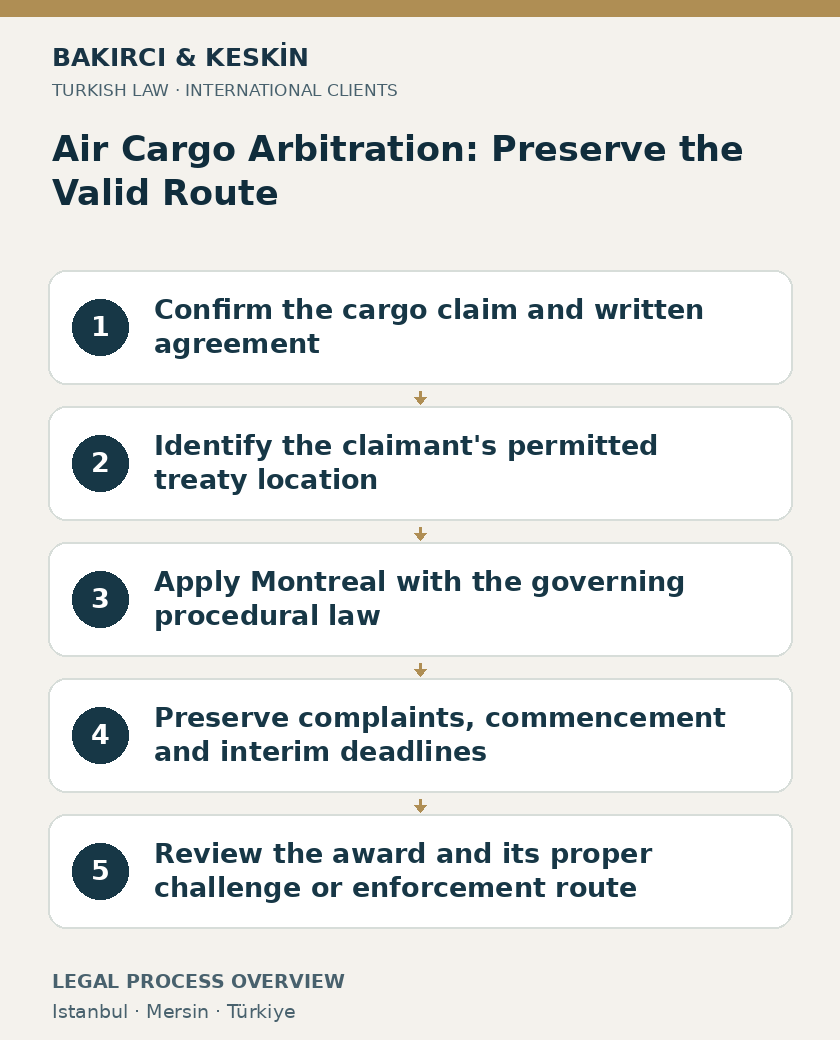
Quick summary
| Legal issue | Air Cargo Arbitration in Turkey: Montreal Article 34 and Turkish Procedure |
|---|---|
| Short answer | Montreal Convention Article 34 permits a written agreement to arbitrate disputes about the carrier's liability for cargo within the Convention. The claimant retains the choice of a place within the Article 33 jurisdictions, and the tribunal must apply the Convention. Those requirements form part of every qualifying arbitration agreement; inconsistent terms are void. Where Turkish International Arbitration Law No. 4686 applies, its procedural rules must be read together with these treaty requirements, including commencement, interim protection, evidence and the separate route for challenging an award. |
| Key legislation | Law No. Montreal Convention1999 — Articles 1, 18, 19, 22, 24, 31, 33, 34, 35, 39–46, 49; Law No. ICAO2024 Article24 review — Articles 22(3), 24; Law No. 4686 International Arbitration Law — Articles 1, 2, 3, 4, 5, 6, 8, 9, 10, 12, 15, Additional1 |
1. Article 34 concerns cargo carrier liability under the Convention
An air cargo contract containing an arbitration clause requires more than a general review of its institution or fee provisions. First establish whether the carriage is within Article 1 of the Montreal Convention and whether the dispute concerns the carrier’s liability under that instrument. Article 34 expressly addresses cargo carriage and supplies conditions specific to that dispute.
Identify the actual undertaking and claimant. A carriage claim for lost, damaged or delayed goods is not automatically the same dispute as an independent storage, customs-brokerage or sale-contract claim. The arbitration agreement’s scope must be compared with the obligation in dispute. A single logistics file can contain several contracts without one clause governing all of them.
Establish the legal parties and any contracting-and-actual-carrier relationship. The fact that an airline performed a flight does not by itself prove it accepted every clause in a forwarder’s separate agreement. Preserve the booking contract, incorporated terms and the documents connecting the relevant entities before deciding which party is bound to the proposed arbitration.
2. Establish the written agreement and its actual terms
Article 34(1) requires the arbitration agreement to be in writing. Collect the complete clause and the contract or exchange through which it was agreed. Do not rely only on a customer-service message saying that disputes go to arbitration. Identify the parties, the disputes submitted, any institutional rules and the version of the conditions that governed the shipment.
Where Law No. 4686 Article 4 applies, the written-form provisions include a signed document, the relevant exchange of communications or electronic record, and the other specified statutory routes. Incorporation by reference is addressed where a document containing the clause is referred to for inclusion in the principal contract. Preserve the actual incorporation evidence.
Article 4 also separates the arbitration agreement from an objection that the principal contract is invalid or the dispute had not yet arisen. That rule does not eliminate the need to establish a valid arbitration agreement. Analyse the clause’s own formation, applicable law and scope, while retaining Montreal’s mandatory requirements for the cargo dispute.
3. The claimant’s choice is confined to the treaty’s permitted jurisdictions
Article 34(2) requires the arbitration to take place, at the claimant’s option, within one of the jurisdictions referred to in Article 33. For cargo, Article 33(1) identifies the carrier’s domicile, principal place of business, the establishment through which the contract was made and the destination, within a State Party. Establish the relevant connection from the contract and corporate records.
The location of an arbitral institution’s headquarters does not itself establish one of those connections. Nor does the cargo owner’s residence automatically create the additional passenger forum, which concerns death or injury. Compare the place specified in the clause with the actual Article 33 options instead of assuming that a familiar institution validates every chosen location.
Article 34(4) makes the location requirement part of every qualifying agreement and renders inconsistent terms void. Review a term that purports to remove the claimant’s treaty choice or requires a place outside the permitted connections against that rule. A clause’s remaining procedural machinery and the effective location still require a coherent legal assessment.
4. The tribunal must apply the Convention
Article 34(3) directs the arbitrator or tribunal to apply the Convention. Paragraph 4 incorporates that obligation into each qualifying clause and invalidates inconsistent terms. A national governing-law provision or institutional rule cannot be treated as permission to discard Montreal’s applicable liability, complaint, limitation or compensation rules.
Article 49 separately invalidates contractual provisions and pre-damage special agreements purporting to infringe Convention rules through choice of law or alteration of jurisdiction. The clause review should therefore distinguish valid procedural arrangements from an attempted reduction of mandatory protection. State which rule governs each disputed issue rather than treating the agreement as an indivisible label.
The cargo limit must also be current. Article 22(3)’s ordinary figure became 26 SDR per kilogram on 28 December 2024 under the ICAO revision. An old clause or original treaty printout does not justify using the former figure for a shipment governed by the revised limit.
5. Establish the scope of Turkish International Arbitration Law separately
Law No. 4686 Article 1 applies to disputes containing a foreign element where the place of arbitration is Turkey or the law’s provisions are selected by the parties or tribunal. Article 2 specifies foreign-element connections, including parties established in different states and a contractual relationship involving movement of goods or capital between countries.
Article 1 expressly preserves treaties to which Türkiye is a party. The national law’s procedural operation must therefore be coordinated with Montreal Article 34. Its general rules on choosing an arbitral place should not be used to remove the claimant’s treaty protection. Explain both the national-law connection and the applicable treaty constraint in the procedural position.
Some national provisions also operate where the arbitral place is outside Turkey: Article 1 expressly extends Articles 5 and 6 to that situation. The presence of Turkish assets or a request for Turkish court assistance should not be mistaken for proof that every provision of Law No. 4686 governs the entire foreign arbitration.
6. Choose procedure and language within the applicable mandatory rules
Article 8 permits the parties to determine procedure or refer to national, international or institutional rules, subject to the law’s mandatory provisions. In the absence of an agreement, the tribunal proceeds under the statute. It also requires equal rights and an opportunity for both sides to present their claims and defences.
Article 10(C) permits Turkish or an official language of a state recognised by Türkiye. The parties determine the language, or the tribunal does so where they have not agreed. The tribunal can require translations of relied-upon documents. A foreign-language business contract does not by itself settle the language and translation arrangements for every procedural step.
Article 8 allows representation in the arbitration by foreign natural or legal persons, but expressly excludes related court applications from that provision. Separate arbitration representation from authority to act before Turkish courts. The practical file should identify who handles the arbitration, court assistance, translations and reporting without assuming that one authorisation resolves every distinct role.
7. Identify the legally effective commencement step
Article 10(A) contains default commencement rules unless the parties agree otherwise. Where appointment is sought from the court or an agreed appointing person or body, the relevant application is the starting event specified by the statute. Where the parties appoint arbitrators, it identifies the claimant’s appointment and notification requesting the other party’s appointment.
Where the agreement already names the arbitrator or tribunal members, the statutory event is the respondent’s receipt of the request to resolve the dispute by arbitration. These alternatives should not be collapsed into a universal rule that any demand email starts the case. Examine the agreement, chosen rules and actual method of appointment.
Preserve the filed request, payment where procedurally required, delivery evidence and institutional correspondence. Counsel must assess the effective commencement under the governing framework while protecting the Convention’s action period. A preliminary inquiry to an institution or a discussion of arbitrator names should not be assumed to have the same legal effect as commencing the proceedings.
8. The arbitration clause does not remove cargo complaint requirements
Montreal Article 31 requires a written cargo-damage complaint promptly after discovery and no later than fourteen days after receipt. A delay complaint is due no later than twenty-one days after the cargo is placed at the entitled person’s disposal. Paragraph 4 bars an action without a timely complaint, except for carrier fraud. Preserve the complaint independently of arbitration preparation.
Article 35 separately extinguishes the damages right unless an action is brought within two years from arrival, the date the aircraft should have arrived or the date carriage stopped, as applicable. Its calculation provision refers to the law of the court seized. Obtain a specific assessment of the effective procedural route and dates; do not treat clause negotiations or ordinary correspondence as automatic preservation.
Keep a deadline schedule separating the complaint, the damages action, appointment steps and any interim-measure obligation. Those periods perform different functions. An accurate schedule should identify the source, triggering event, evidence of that event and responsible representative for each step, rather than use a single date marked claim deadline.
9. Interim protection can require court assistance and its own follow-up
Law No. 4686 Article 6 states that seeking an interim injunction or attachment from a court before or during arbitration, and the court granting it, is not inconsistent with the arbitration agreement. A request still requires the applicable legal grounds and supporting evidence. An arbitration clause alone does not establish entitlement to freeze assets.
Unless otherwise agreed, a tribunal can grant the stated interim measures during arbitration on request and can require security. Article 6 limits its authority: it cannot issue measures requiring compulsory enforcement bodies or other official authorities to execute them, or measures binding third parties. Court assistance and a tribunal’s procedural direction therefore have different functions.
Under Article 10(A), a party obtaining an interim injunction or attachment from a court must commence arbitration within thirty days; otherwise the measure lapses automatically. Preserve the order and calculate that follow-up separately from the Montreal period. The statute’s court-allocation rules also require attention to Article 3 and Additional Article 1, including the dispute’s subject matter.
10. Organise evidence around the treaty issues the tribunal must decide
Article 12 permits the tribunal to appoint experts, require relevant information for their work and arrange an inspection. It also addresses parties questioning experts and presenting their own expert evidence in the stated circumstances. A cargo report should explain the actual technical issue, such as condition, custody or valuation, rather than offer a general conclusion without supporting records.
The same article addresses submission of evidence within the tribunal’s period and judicial assistance in collecting it. Identify the record sought, its holder and its relevance. A request for assistance should not assume unrestricted access to another business’s records. The carriage documents, complaints, movement records and loss schedule should be organised before an evidential dispute arises.
11. The arbitration’s duration is different from the time to bring the claim
Article 10(B) sets a default one-year period for an award on the merits unless the parties agree otherwise. For a sole arbitrator it runs from selection; for a tribunal it runs from the first meeting minutes. This is a procedural duration rule and should not be confused with Montreal Article 35’s two-year period for bringing the damages action.
The statute allows extension by agreement or, without agreement, through the specified court process. Record the operative duration and any extension. A party should not assume that lengthy expert work or settlement discussions extend the arbitration automatically. The procedural timetable must remain consistent with the actual agreement and applicable statutory requirements.
12. An award governed by Law No. 4686 has a defined challenge route
Where Law No. 4686 governs the relevant award, Article 15 provides an annulment action on specified grounds. It assigns the action to the regional court of appeal territorially connected to the competent first-instance court under Article 3. Additional Article 1 requires the underlying dispute’s subject matter to be considered in the civil or commercial court allocation.
The statutory annulment period is thirty days from notification of the award or the applicable correction, interpretation or completion decision. The grounds concern defined matters such as the agreement, tribunal, procedure, scope, equality, arbitrability and public policy. Do not treat this route as an unrestricted rehearing of the cargo dispute’s merits.
13. A foreign award requires a separate Turkish enforcement assessment
A completed foreign award and a Turkish arbitration agreement are different instruments at different stages. The foreign arbitral award enforcement guide addresses the award, agreement, document requirements and refusal grounds. The fact that a tribunal applied Montreal does not itself prove that an award is immediately executable against Turkish assets.
Retain the complete award, corrections, notification record, agreement and information about any challenge or suspension. Identify the exact award debtor and outstanding balance after payments. Do not substitute the arbitration institution’s covering letter for the operative award or assume that every company involved in the shipment is an award debtor.
14. Give counsel the clause, shipment and procedural history together
The initial file should include the carriage agreement, complete arbitration clause, incorporated rules, carrier identities, route, complaint, loss records and every procedural communication. Identify any court measure and its date. A chronology connecting these materials allows the treaty and national procedural requirements to be assessed without treating the arbitration clause in isolation.
The guide to representation from abroad addresses authority for Turkish legal work. Agree who handles arbitration, Turkish court applications and reporting. The objective is a valid forum, a supported cargo claim and preserved deadlines, with any eventual award and enforcement steps addressed under their own applicable rules.
Frequently asked questions
Can a Montreal air cargo dispute be arbitrated?
Article 34 permits a written agreement for disputes concerning the carrier’s cargo liability under the Convention, subject to its mandatory location and applicable-law requirements.
Can the clause select any country?
Article 34(2) preserves the claimant’s choice within the Article 33 jurisdictions. The institution’s headquarters or a convenient hearing location does not automatically establish a qualifying connection.
Can the tribunal apply a contract instead of Montreal?
It must apply the Convention under Article 34(3). Paragraph 4 incorporates that obligation into qualifying clauses and invalidates inconsistent terms. Valid contractual and procedural provisions must operate within that framework.
When does Turkish Law No. 4686 apply?
Article 1 addresses foreign-element disputes with a Turkish arbitral place or a selection of its provisions by the parties or tribunal. It preserves treaties and separately extends Articles 5 and 6 to arbitration located outside Turkey.
Can the proceedings use a foreign language?
Article 10(C) permits Turkish or an official language of a state recognised by Türkiye. The agreement or tribunal determines the procedural language, and required document translations must be addressed.
Does a demand email always commence arbitration?
No. Article 10(A)’s default rules differ according to the appointment arrangement, and the parties can agree otherwise. Examine the effective commencement step under the agreement and applicable rules.
Can I seek a Turkish court attachment despite the clause?
Article 6 states that seeking and obtaining the specified court protection is not inconsistent with arbitration. The grounds, evidence, competent court and any follow-up requirement remain separate questions.
What follows a court-granted interim measure?
Article 10(A) requires commencement of arbitration within thirty days after obtaining the relevant court measure; otherwise it lapses automatically. Preserve the order and assess the exact procedural dates.
Does the one-year arbitration duration replace the two-year Montreal period?
No. Article 10(B)’s default award period and Montreal Article 35’s action period serve different purposes and have different starting events. Both need separate attention where applicable.
Is a foreign cargo award immediately enforceable in Turkey?
Its Turkish recognition and enforcement position requires a separate assessment of the applicable framework, award, agreement, documents and objections. Identifying Turkish assets does not by itself complete that process.
Official legal sources
- Montreal Convention1999 — Articles 1, 18, 19, 22, 24, 31, 33, 34, 35, 39–46, 49
- ICAO2024 Article24 review — Articles 22(3), 24
- 4686 International Arbitration Law — Articles 1, 2, 3, 4, 5, 6, 8, 9, 10, 12, 15, Additional1
Recorded primary-source check dates: 26 October 2026. The official Turkish legislation controls. A new publication-date check is still required.
Contact information
Do not include confidential documents or identity numbers in an initial message. An enquiry does not establish representation or suspend any legal deadline.
Istanbul and Mersin contact details
Bakırcı & Keskin Law Office is Mersin-based. Turkish matters are handled under the applicable jurisdiction and agreed mandate. The competent court and the scope of representation are assessed for each matter.
Istanbul — Polaris Plaza
Maslak Ahi Evran Caddesi, Polaris Plaza No:21, Floor 9, 34475 Sarıyer/İstanbul, Türkiye.Mersin — Profit İş Merkezi
İhsaniye Mahallesi, 4903. Sokak, Profit İş Merkezi No:23, Floor 3, Office 14, 33070 Akdeniz/Mersin, Türkiye.+90 552 224 43 66 · Contact details in English. An enquiry does not establish representation or suspend a legal deadline.
Istanbul Office – Polaris Plaza, Maslak / Sarıyer
Bakırcı & Keskin Hukuk Bürosu
Maslak Ahi Evran Caddesi, Polaris Plaza No:21, Kat:9, 34475 Sarıyer/İstanbul
Our physical offices in Istanbul and Mersin coordinate matters throughout Turkey, subject to jurisdiction and the local steps required for each case. Please specify your preferred office when arranging an in-person appointment.
Open the Istanbul office on Google Maps · Contact and appointments
Contact regarding a legal matter
In your first message, you may briefly state the subject, your country or city, and any relevant notification or recent procedural date. Please do not send identity numbers, medical data, or personal documents. Messaging alone does not constitute legal advice or create a lawyer–client relationship.
Discover more from Bakırcı & Keskin Hukuk Bürosu
Subscribe to get the latest posts sent to your email.