Return of Criminal Security in Turkey: Acquittal, Non-Prosecution and CPC Articles 113–115
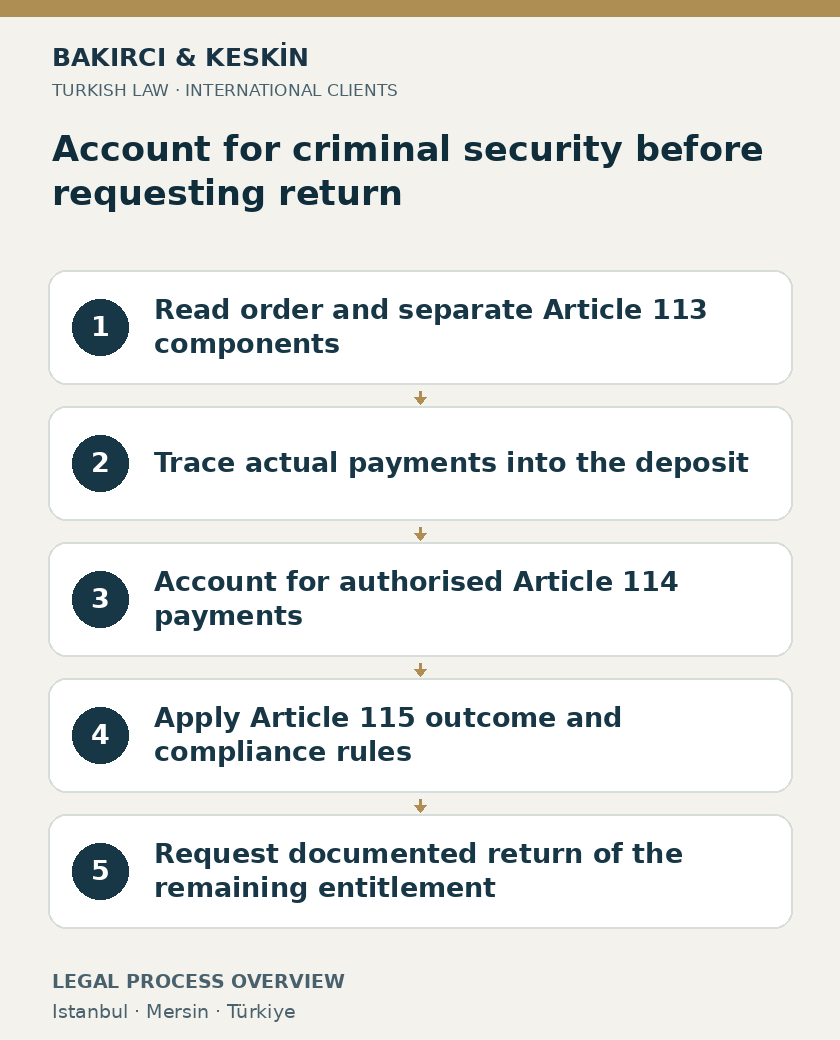
Short answer: Money deposited as security in a Turkish criminal case is not governed by a single automatic-refund rule. Criminal Procedure Code Article 113 separates the purposes covered by the security. Article 114 permits specified advance payments to victims or maintenance creditors. Article 115 regulates return, use after conviction and the relevant forfeiture consequence. After acquittal or non-prosecution, the second component that has not been paid to a victim or maintenance creditor is returned under Article 115(2). The original allocation and payment history must therefore be checked.
Have a general question about this article? Ask anonymously
Quick summary
| Legal issue | Return of Criminal Security in Turkey: Acquittal, Non-Prosecution and Articles 113–115 |
|---|---|
| Short answer | Money deposited as security in a Turkish criminal case is not governed by a single automatic-refund rule. Criminal Procedure Code Article 113 separates the purposes covered by the security. Article 114 permits specified advance payments to victims or maintenance creditors. Article 115 regulates return, use after conviction and the relevant forfeiture consequence. After acquittal or non-prosecution, the second component that has not been paid to a victim or maintenance creditor is returned under Article 115(2). The original allocation and payment history must therefore be checked. |
| Key legislation | Law No. Criminal Procedure Code No.5271 — Articles 109(3)(f),(h),(i), 113, 114, 115 |
Start with the order rather than the English label “bail”
A foreign suspect may describe any payment connected with release as bail. Turkish criminal procedure requires identification of the actual judicial-control measure and security order. Criminal Procedure Code Article 109(3)(f) provides for depositing an amount determined by the judge at the prosecutor’s request, taking account of the suspect’s financial circumstances and specifying payment at once or in instalments. The order and deposit receipt establish what was required and what was actually supplied.
Other paragraphs of Article 109 address securing the victim’s rights and assurances concerning family and maintenance obligations. These measures should not be silently treated as identical to one undifferentiated deposit. Obtain every relevant decision, including later modifications. A bank transfer reference that says court payment does not establish the legal character, beneficiary or allocation of the money.
This article concerns security within criminal procedure. Security for costs in a civil case, an enforcement stay deposit, an administrative guarantee and a payment made privately to a complainant follow different frameworks. A client asking for return should identify the issuing court or judgeship, criminal file number, decision date and payment channel. The correct classification prevents a refund request from being directed to an institution that does not hold the money or apply the relevant rule.
Article 113 requires the covered parts to be shown separately
Article 113 identifies two purposes of security. The first concerns the suspect’s or defendant’s presence for procedural acts, execution of the judgment and fulfilment of other obligations that may be imposed. The second concerns payments in the order listed by the statute. Under Article 113(2), the decision requiring security must show separately the parts that cover those purposes. The allocation is therefore central to the later return account.
Read the operative order for the amount assigned to each part. If the documents available to the client show only a total, obtain the complete decision and any supplementary allocation record. Do not invent a fifty-fifty split or assume that the entire amount secured appearance alone. A repayment calculation cannot be reliable until the original statutory allocation is known.
The separate parts also explain why a favourable criminal outcome may not produce a transfer equal to the original deposit. Money may have been applied through an authorised advance payment, and different provisions govern the different components. The authority’s account should identify these movements. A difference between the deposited total and the amount proposed for return needs an explanation based on the decision and records, not an assumption that the missing amount is a routine administrative deduction.
The appearance component is linked to fulfilment of the specified duties
Article 113(1)(a) concerns presence for all procedural acts, execution of the judgment and other obligations that may be imposed. It should not be reduced to attendance at one hearing. The relevant file can include several summonses and judicial-control directions. Preserve compliance records and any permission changing an obligation so that the return assessment is based on the order actually in force at each stage.
Article 115(1) expressly provides, for a convicted person who has fulfilled all the obligations described in Article 113(1)(a), for return of the component allocated to those obligations in the decision. Conviction therefore should not be described as automatically converting every part of the security into a fine. The appearance component and the payment component have distinct statutory treatment.
Where attendance was excused or a requirement modified, retain the actual judicial decision. A flight cancellation, medical document or foreign employment demand can be relevant to a request, but it is not itself permission to disregard an order. The record should show what was required, what occurred and how the authority dealt with any difficulty. That chronology is more useful than a general assurance that the defendant cooperated throughout.
The second component has a statutory order of use
Article 113(1)(b) lists the payments secured in an order. It first addresses the intervening complainant’s expenses, compensation for damage caused by the offence and restoration, together with maintenance debts where the prosecution concerns their non-payment. Public expenses follow, and monetary fines come afterwards. The sequence matters when an amount is available for several legally established items.
The allocation should not be replaced by an informal agreement among people handling the file. Each proposed payment needs its legal basis and amount, and the authority must account for the statutory sequence. A complainant’s demand is not automatically the amount lawfully payable from the deposit. Nor does describing money as costs establish whether it is the participant’s expense, a public expense or another item outside the stated account.
For the defendant, preserve the decisions and calculations supporting deductions. For a victim, identify the recognised claim and relevant procedure instead of assuming that existence of security guarantees immediate compensation. The security is a source of protection within the statutory framework; it does not dispense with the requirements for establishing the payment to which the recipient is entitled.
Article 114 can authorise payment before the final return calculation
Article 114(1) allows the judge, court or prosecutor, with the suspect’s or defendant’s consent, to order that the parts covering the victim’s rights or maintenance debt be paid to the victim or maintenance creditor if requested. The record must therefore show more than a transfer. It should identify the relevant part of the security, the recipient’s request, the required consent and the authority’s order.
Article 114(2) provides an exception to the consent requirement where a judicial decision has been given in favour of the victim or maintenance creditor because of the events forming the subject of the investigation or prosecution. In that situation, payment can be ordered without the suspect’s or defendant’s consent. The existence and scope of the judicial decision must be verified; the exception should not be extended to every private invoice or demand letter.
An advance payment changes the balance still held as security. Obtain the payment instruction and proof of actual delivery to the recipient. An amount authorised but not yet transferred and an amount already received are different accounting positions. A later return request should identify which occurred. Any separate dispute about recovery from a recipient must be analysed on its own basis rather than treated as though the money remained in the court’s deposit account.
Article 115(2) returns the unused second part after the specified outcomes
Article 115(2) provides that, when non-prosecution or acquittal decisions are given, the second part that has not been paid to the victim or maintenance creditor is returned to the suspect or defendant. The words identifying the unpaid portion are essential. The provision does not promise that an amount already transferred under Article 114 will automatically be refunded from the security account as well.
Provide the actual decision and its procedural status. An oral report that the case is closed, release from detention or a prosecutor’s statement that an investigation is nearly complete is not the same as a non-prosecution or acquittal decision. The authority needs the relevant outcome and the existing security record to determine the statutory consequence. Include any appeal or later decision rather than presenting an incomplete procedural history.
The request should distinguish the second component from the appearance component and explain the remaining balance. Do not substitute a general sentence requesting all bail back for the statutory accounting. Where the authority proposes to retain an amount, ask for the legal basis and decision concerning that amount. An accurate breakdown allows counsel to assess whether the dispute concerns the outcome, prior payment, compliance or a simple accounting error.
After conviction, Article 115 requires allocation and return of the excess
Article 115(3) directs use of the security under Article 113(1)(b) in the event of conviction and return of the excess. This is an allocation rule. It does not say that the whole deposit is automatically confiscated merely because a conviction exists. The account must identify the relevant payments, their statutory order and the amount left after lawful application.
Read the conviction’s operative provisions and any separate decisions establishing amounts payable. Keep principal compensation, participant expenses, public expenses and monetary fines distinguishable. A sentence of imprisonment and a monetary fine are not the same entry, and the mere existence of one does not calculate the other. The security account should correspond to the actual enforceable obligations and the applicable procedural stage.
Where payments were made from another source, record them to prevent duplicate satisfaction of the same item. The account should also identify any earlier Article 114 payment. An excess cannot be calculated reliably by subtracting the original demand from the original deposit without checking what was finally established and already paid. The person seeking return should be able to trace each deduction to a document.
A forfeiture issue needs its own decision and compliance history
Article 115 also contains a Treasury-revenue consequence and an express qualification concerning a valid excuse. If the authority relies on forfeiture, obtain the actual decision and identify the conduct, component and legal basis involved. Do not assume that an unexplained absence from one hearing necessarily resolves the entire security account, or that a later favourable result automatically erases an earlier disputed compliance issue.
Prepare the relevant summonses, service records, attendance minutes, requests for permission and decisions on excuses. The question is the legally required obligation and the authority’s treatment of the actual events. A genuine obstacle should be supported by contemporaneous evidence. It should not be reconstructed with a convenient date or an exaggerated medical statement after the refund dispute arises.
The available challenge depends on the decision and procedural route. Obtain advice promptly when a retention or forfeiture decision is received, preserving the notification record. A request for an account statement does not necessarily preserve a separate objection period. Reports should distinguish a pending challenge from an order reversing the forfeiture and from the later transfer of money.
Money supplied by a relative or employer creates an additional identification issue
The person who funded the deposit may be different from the suspect or defendant named in the security order. Preserve the transfer record, deposit receipt and any agreement explaining the funding. Article 115’s statutory return language should not be replaced with an assumption that the bank account from which money originated must automatically receive every refund. The authority needs the correct recipient and lawful payment instructions.
A private reimbursement arrangement between the defendant and a relative, employer or company is distinct from the criminal security account. Identify it without asking the criminal authority to decide an unrelated contractual dispute merely through a bank-detail change. If a representative is to receive funds, verify the required authority and written client instructions. Payment to an unverified account creates a new problem even after the legal entitlement to return has been established.
Prepare a component-by-component return request
The request should include the original security order, allocation, deposit receipts, modifications, criminal outcome, relevant compliance documents and any Article 114 payment record. Add a reconciliation showing the deposited amount, each statutory component, authorised payments, sums already returned and the balance sought. Identify an unresolved entry expressly instead of presenting a net figure that conceals the disagreement.
Where the deposit was payable in instalments, distinguish the amount ordered from the amount actually paid. A schedule requiring several future transfers is not evidence that the full total reached the deposit account. Match each receipt to the same case and depositor, and identify a payment recorded under an incorrect reference. The request should seek correction of a demonstrated allocation problem without counting an unmade instalment as money available for return.
Foreign-language funding or corporate documents should be translated in the form required for the intended use. Keep currencies and payment dates clear. Do not promise that the refund will arrive abroad in a particular currency, at a historical exchange rate or within a fixed number of banking days without a verified legal and administrative basis. The return decision, payment instruction and completed transfer are separate records to obtain and reconcile.
Return of security does not by itself remove every other restriction
Article 109 permits one or more judicial-control obligations. A money-security decision can therefore coexist with a travel ban or reporting requirement. The guide to travel restrictions for foreign suspects addresses the separate need to obtain and verify the competent authority’s decision. Do not infer permission to leave Turkey solely from a refund, possession of a passport or a change in the deposit balance.
An overseas client can coordinate the documentary review through counsel while ensuring that any personal obligation remains addressed. The power-of-attorney guide explains preparation of authority for Turkish representation. The final report should state what component was returned, what was lawfully applied, what remains disputed and which other measures still require attention. That record completes the security issue without confusing a financial transfer with the entire criminal case’s procedural status.
Frequently asked questions
Is Turkish criminal security the same as a civil security-for-costs deposit?
No. Identify the criminal order and Articles 109,113–115. Other guarantees follow their own legal framework.
Must the security order separate its purposes?
Yes. Article 113(2) requires the covered parts to be shown separately. Do not invent an allocation from a single receipt total.
Does acquittal automatically refund the whole original deposit?
Article 115(2) returns the second part not already paid to a victim or maintenance creditor. The complete allocation and payment history must be checked.
Can money be paid to a victim before the return decision?
Article 114 permits specified advance payments under its conditions, including consent in paragraph one and a judicial-decision exception in paragraph two.
Is the defendant’s consent always required for an advance payment?
No. Article 114(2) permits payment without consent where its specified judicial decision in favour of the victim or maintenance creditor exists.
Does conviction automatically forfeit all security?
No. Article 115 separately addresses the compliant appearance component, use under Article 113(1)(b), and return of the excess.
What order applies to payments from the second component?
Article 113 lists the participant’s expenses and specified damage/restoration or maintenance items, then public expenses, then monetary fines.
What if a relative supplied the deposit?
Preserve the funding and authority records. The private funding relationship and the statutory recipient of return must be assessed separately.
Does receiving the refund cancel a travel ban?
Not by itself. Other judicial-control obligations and the relevant decision removing or modifying them must be checked separately.
Which documents are needed first?
Provide the security order and allocation, deposit receipts, later decisions, criminal outcome, compliance record and any advance-payment or prior-refund documents.
Official legal sources
Recorded primary-source check dates: 26 October 2026. The official Turkish legislation controls. A new publication-date check is still required.
Contact information
Do not include confidential documents or identity numbers in an initial message. An enquiry does not establish representation or suspend any legal deadline.
Istanbul and Mersin contact details
Bakırcı & Keskin Law Office is Mersin-based. Turkish matters are handled under the applicable jurisdiction and agreed mandate. The competent court and the scope of representation are assessed for each matter.
Istanbul — Polaris Plaza
Maslak Ahi Evran Caddesi, Polaris Plaza No:21, Floor 9, 34475 Sarıyer/İstanbul, Türkiye.Mersin — Profit İş Merkezi
İhsaniye Mahallesi, 4903. Sokak, Profit İş Merkezi No:23, Floor 3, Office 14, 33070 Akdeniz/Mersin, Türkiye.+90 552 224 43 66 · Contact details in English. An enquiry does not establish representation or suspend a legal deadline.
Istanbul Office – Polaris Plaza, Maslak / Sarıyer
Bakırcı & Keskin Hukuk Bürosu
Maslak Ahi Evran Caddesi, Polaris Plaza No:21, Kat:9, 34475 Sarıyer/İstanbul
Our physical offices in Istanbul and Mersin coordinate matters throughout Turkey, subject to jurisdiction and the local steps required for each case. Please specify your preferred office when arranging an in-person appointment.
Open the Istanbul office on Google Maps · Contact and appointments
Contact regarding a legal matter
In your first message, you may briefly state the subject, your country or city, and any relevant notification or recent procedural date. Please do not send identity numbers, medical data, or personal documents. Messaging alone does not constitute legal advice or create a lawyer–client relationship.
Discover more from Bakırcı & Keskin Hukuk Bürosu
Subscribe to get the latest posts sent to your email.